
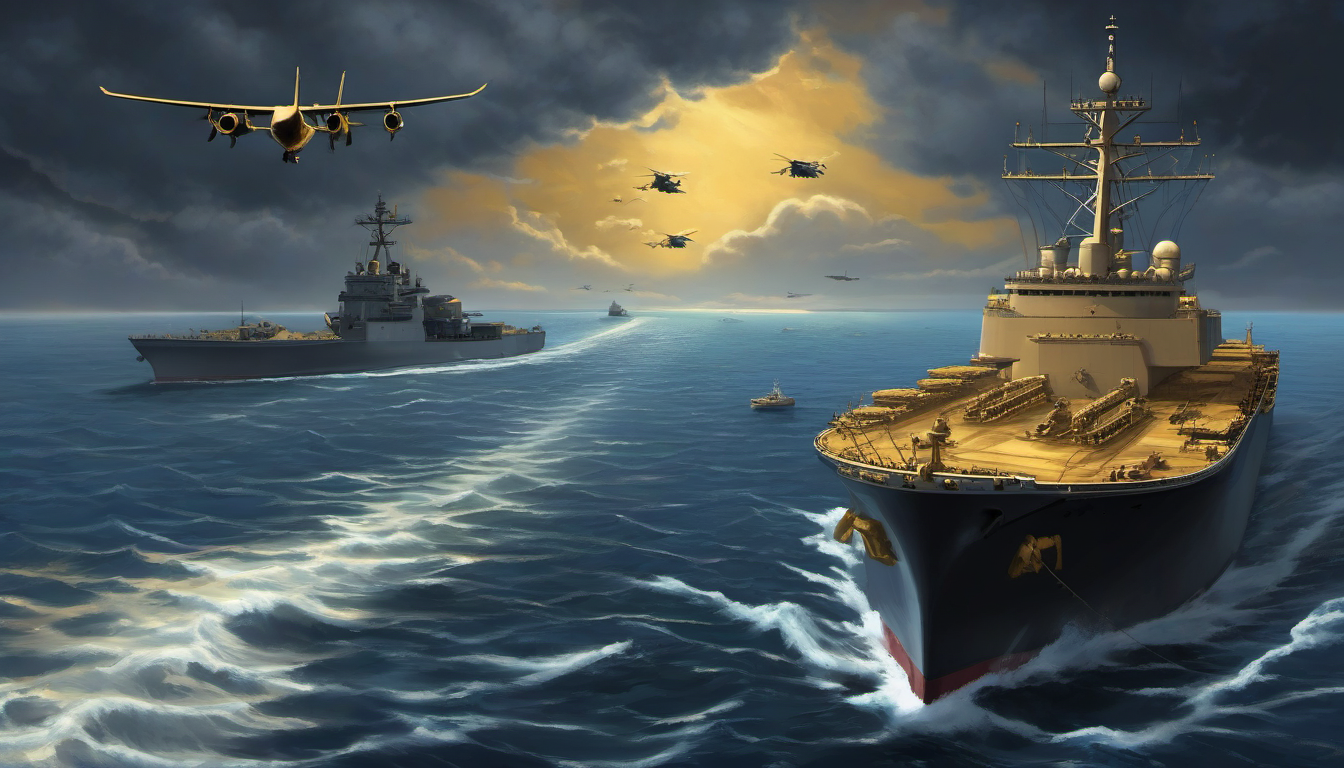
How Washington created a shipping crisis—then seized control of the solution
Executive Summary
- President Trump ordered the U.S. Development Finance Corporation (DFC) to provide political risk insurance for all maritime trade through the Persian Gulf, making the federal government the world's insurer of last resort after private markets fled
- The move, coupled with potential Navy tanker escorts reminiscent of 1987-88's Operation Earnest Will, represents an unprecedented merger of military power and financial infrastructure to control global energy flows
- The moral hazard is staggering: the same government that launched Operation Epic Fury and caused the insurance market collapse is now positioning itself as the only entity capable of keeping trade alive—effectively monetizing a crisis of its own making
Chapter 1: The Insurance Void
On March 5, 2026, the world's major marine insurers—Gard, Skuld, NorthStandard, London P&I Club, and the American Club—will formally cancel war risk cover for the entire Persian Gulf. The decision, announced within 72 hours of Operation Epic Fury's launch, has created an insurance void unprecedented in modern maritime history.
Without war risk insurance, no commercial vessel can legally operate. Banks refuse to finance uninsured cargoes. Port authorities deny entry. The entire apparatus of global trade seizes.
The numbers tell the story. VLCC (Very Large Crude Carrier) freight rates surged 94% in a single day to an all-time record of $423,736 per day. At least 150 vessels—oil tankers, LNG carriers, container ships—dropped anchor in and around the Strait of Hormuz. The number of cargo vessels navigating the strait plummeted from 50+ per day to just seven on Sunday, according to Lloyd's List.
Containerized freight rates from Shanghai to Dubai's Jebel Ali port doubled from $1,800 to $3,700 for a 40-foot container. CMA CGM imposed emergency conflict surcharges of $2,000-$4,000 per container. Maersk suspended all special cargo acceptance for the UAE, Oman, Iraq, Kuwait, Qatar, Jordan, Bahrain, and Saudi Arabia.
Marcus Baker, global head of marine at Marsh, estimated insurance rates could increase 50-100%, from 0.25% to 0.5-1% of insured asset value. For a VLCC carrying $150 million in crude oil, that means insurance costs jumping from $375,000 to $750,000-$1.5 million per transit.
Chapter 2: The DFC Gambit
Into this void stepped Donald Trump with a Truth Social post that may prove to be one of the most consequential financial policy decisions of the decade:
"Effective IMMEDIATELY, I have ordered the United States Development Finance Corporation (DFC) to provide, at a very reasonable price, political risk insurance and guarantees for the Financial Security of ALL Maritime Trade, especially Energy, traveling through the Gulf."
The DFC is an unusual vehicle for this mission. Created in 2019 as the successor to the Overseas Private Investment Corporation (OPIC), the DFC was designed to finance development projects in emerging markets as a counter to China's Belt and Road Initiative. Its total portfolio is approximately $41 billion. Its mandate says nothing about becoming the world's wartime marine insurer.
Yet the implications are enormous. By offering "political risk insurance and guarantees" for all maritime trade, the U.S. government is effectively:
- Replacing Lloyd's of London as the backstop for global shipping insurance
- Subsidizing the energy trade that its own military operations disrupted
- Creating leverage over every nation that depends on Gulf energy—which is to say, most of Asia and much of Europe
- Establishing a financial toll booth on 20% of global oil supply and 20% of seaborne LNG
The "very reasonable price" language is particularly telling. If the DFC underprices the risk—and given the political imperative to keep oil flowing, it almost certainly will—American taxpayers will be underwriting the financial consequences of a war launched without Congressional authorization.
Chapter 3: Operation Earnest Will 2.0
Trump's announcement included a second component: the potential deployment of U.S. Navy escorts for tankers through the Strait of Hormuz. This evokes Operation Earnest Will (1987-88), the last time the U.S. Navy escorted commercial tankers through the Persian Gulf during the Iran-Iraq "Tanker War."
But the comparison reveals more problems than it solves. During Earnest Will, the U.S. Navy escorted Kuwaiti tankers that had been re-flagged under the American flag—a total of 11 vessels. The current crisis involves hundreds of vessels from dozens of flag states, traversing a threat zone that stretches 1,000 nautical miles from Kuwait to Duqm, Oman.
Behind closed doors, U.S. Navy officials have already told tanker executives there is no present availability for an escort mission, Lloyd's List reports. An estimated one-third of the deployed U.S. fleet is already in the Middle East, engaged in strike operations and air defense. The Navy is simultaneously conducting Tomahawk missile strikes and defending carrier battle groups—adding convoy escort duties would strain an already overstretched force.
The Earnest Will precedent also carries a dark warning. In April 1988, the USS Samuel B. Roberts struck an Iranian mine during escort operations, nearly sinking. The U.S. retaliated with Operation Praying Mantis, destroying half of Iran's navy. In July 1988, the USS Vincennes shot down Iran Air Flight 655, killing all 290 civilians aboard—the worst friendly fire incident in modern naval history.
| Comparison | Earnest Will (1987-88) | Current Crisis (2026) |
|---|---|---|
| Vessels to escort | 11 re-flagged tankers | 750+ stranded vessels |
| Threat zone | Northern Gulf | Kuwait to Oman (1,000nm) |
| Threat type | Mines, speedboats | Drones, ballistic missiles, speedboats |
| U.S. naval presence | 1 carrier group | 2 carrier strike groups + surface combatants |
| Concurrent operations | None | Active strike campaign on Iran |
| Duration | 14 months | Unknown |
Chapter 4: The Moral Hazard Machine
The structural contradiction at the heart of this policy is breathtaking. The United States launched Operation Epic Fury without Congressional authorization, destroying Iranian nuclear facilities and killing the Supreme Leader. Iran retaliated across the Gulf, damaging infrastructure in Saudi Arabia, the UAE, Bahrain, Qatar, and Kuwait. Private insurers fled. And now the same government offers to insure the trade it disrupted—at a price it determines.
This creates a self-reinforcing cycle of dependency:
Step 1: The U.S. launches military strikes, creating a war zone
Step 2: Private insurance markets collapse, halting trade
Step 3: The U.S. government becomes the sole insurer, gaining leverage over all parties
Step 4: Countries that want their energy trade to continue must cooperate with U.S. policy
Step 5: The DFC's "reasonable" pricing creates a de facto subsidy that masks the true cost of the war
For China, which imports 50% of its crude oil through the Strait of Hormuz, this creates a particularly uncomfortable dilemma. Beijing is convening the Two Sessions this week to approve its 15th Five-Year Plan. The DFC insurance offer forces China to choose: accept American financial protection for its energy lifeline, or find alternatives that don't exist at scale.
Japan (75% Hormuz-dependent), South Korea (60%), and India (50%) face similar calculations. The DFC effectively becomes a financial leash—nations that comply with U.S. Iran policy get affordable insurance; those that don't face prohibitive costs or no coverage at all.
Chapter 5: Historical Precedents and the Weaponization of Insurance
The use of insurance as a tool of geopolitical power has deep roots:
World War I Convoy System (1917): Britain used the Royal Navy to provide insurance-like protection for merchant vessels, but this was a defensive response to German U-boat warfare—not insurance for trade disrupted by Britain's own military operations.
U.S. War Risk Insurance Act (1914): Congress created a federal marine insurance program when European insurers withdrew from the Atlantic. But again, the U.S. was not the belligerent—it was filling a gap created by others' conflict.
Russia Sanctions and P&I (2022): Western insurers withdrew from Russian-linked vessels, creating a "shadow fleet" of under-insured tankers. The insurance withdrawal was itself the weapon, designed to strangle Russian oil exports.
Houthi Red Sea Crisis (2023-25): War risk premiums surged, but private markets adjusted—they didn't collapse entirely. The U.S. launched Operation Prosperity Guardian but didn't offer government insurance.
What distinguishes the 2026 DFC gambit is that the U.S. is simultaneously the cause of the insurance collapse, the insurer of last resort, and the military guarantor. No historical precedent combines all three roles.
Chapter 6: Scenario Analysis
Scenario A: Controlled Reopening (35%)
The U.S. achieves limited military objectives within 2-3 weeks. DFC insurance backstop and Navy presence allow gradual resumption of shipping. Oil prices settle at $75-85/bbl. The DFC quietly winds down its exposure over 6 months.
Trigger: Iran ceases retaliation, accepts new leadership transition
Historical parallel: 1991 Gulf War—rapid military resolution, quick market normalization
Scenario B: Protracted Standoff (45%)
The conflict extends beyond 4 weeks. DFC exposure balloons to $50-100 billion+ as it underwrites massive trade flows. Navy escorts begin but are stretched thin. Oil prices oscillate $80-100/bbl. The DFC becomes a permanent fixture of Gulf trade—a "Federal Maritime Insurance Corporation" in all but name.
Trigger: Iran maintains asymmetric attacks while avoiding full-scale escalation
Historical parallel: Tanker War (1984-88)—years of low-grade conflict with periodic escalation
Scenario C: Systemic Cascade (20%)
A major incident—tanker sinking, escort vessel damaged, large insurance claim—exposes the DFC's inadequate reserves. Congress balks at appropriating funds to cover losses. The insurance backstop loses credibility, private markets remain absent, and a true global energy crisis unfolds. Oil surges past $120/bbl.
Trigger: DFC claims exceed its statutory limits; Congressional gridlock prevents emergency funding
Historical parallel: AIG bailout (2008)—government insurer of last resort faces catastrophic losses
Chapter 7: Investment Implications
Energy Sector: The DFC backstop is designed to keep oil flowing, which should cap upside in crude prices near-term. But the tail risk of Scenario C means energy hedging costs remain elevated. Long positions in integrated oil majors (Exxon, Chevron) with diversified supply chains; short exposure to pure-play Gulf producers.
Shipping: VLCC owners are the immediate winners—record freight rates with U.S. government insurance backing. Frontline, Euronav, and DHT Holdings benefit most. Container lines face mixed signals: rerouting costs increase, but surcharges offset.
Defense/Aerospace: The Navy escort mission creates demand for additional surface combatants, drones, and mine countermeasures. Huntington Ingalls, General Dynamics, and L3Harris benefit.
Insurance: The DFC's entry as competitor-of-last-resort is bearish for specialty marine insurers near-term (Beazley, Hiscox), but the eventual return to private markets—at much higher premiums—is bullish medium-term.
DFC/Government Bonds: If DFC exposure grows rapidly, it represents a contingent fiscal liability that could pressure Treasury yields, especially given the already-expanded deficit.
Conclusion
The DFC maritime insurance order is more than an emergency measure—it is a structural assertion of American financial hegemony over global energy trade. By making the U.S. government the indispensable insurer of the world's most critical shipping lane, Trump has created a new form of power projection that combines military force with financial infrastructure.
The danger is that this power is exercised without accountability. The DFC operates with minimal Congressional oversight. Its insurance commitments create fiscal exposure that could dwarf the direct costs of the military campaign. And the moral hazard—starting a war, then profiting from insuring against its consequences—sets a precedent that future administrations may find irresistible.
As Adrian Beciri of DUCAT Maritime warned, the ripple effects extend far beyond the Gulf: "We were trying to hire a dry bulk vessel to carry rice food supplies to West Africa… We actually lost the ship. Someone had paid 50% more to carry coal from Indonesia to India."
The United States has become not just the world's policeman, but its underwriter. The question is who pays the premium when the policy comes due.
Leave a Reply