
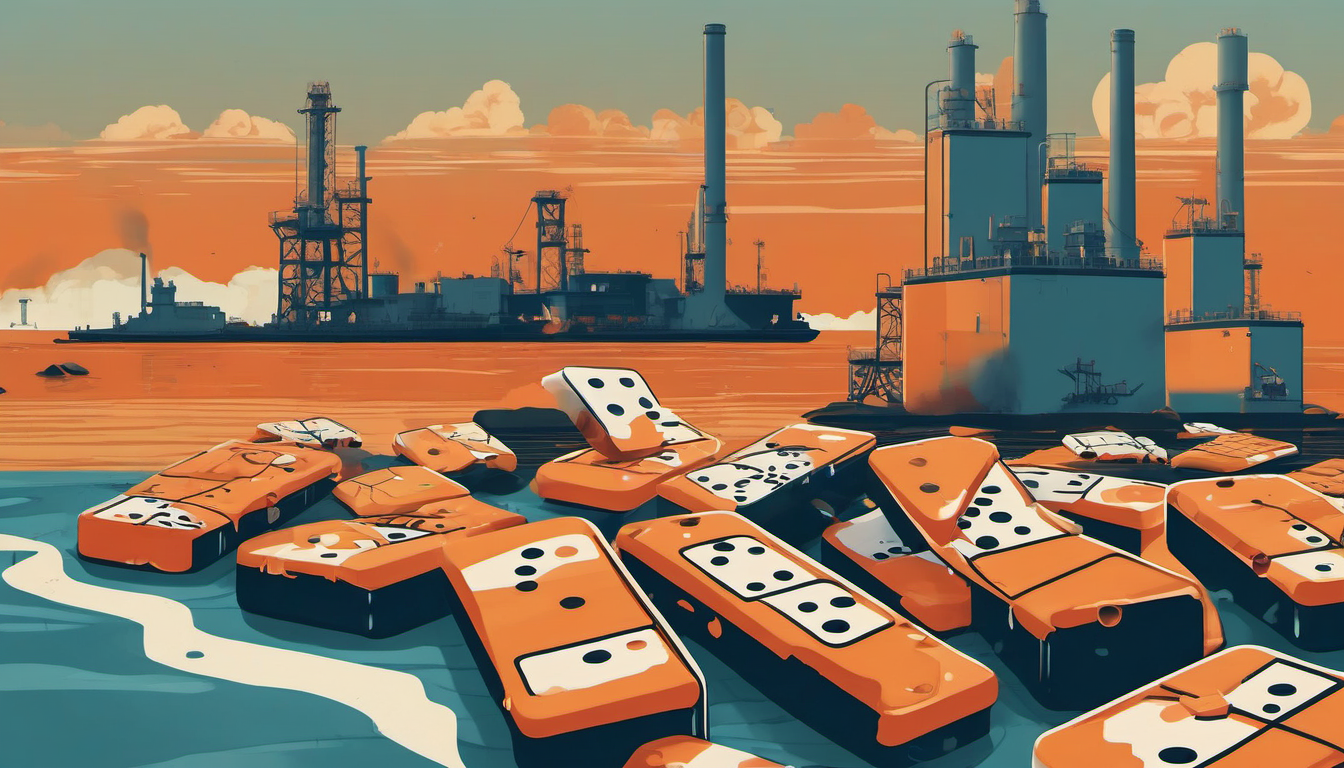
While the world watches oil prices, a far more consequential disruption is unfolding in the chemical building blocks of modern civilization
Executive Summary
- The Hormuz crisis threatens not just crude oil but 35% of global petrochemical feedstock exports — ethylene, propylene, methanol, and ammonia — that feed into virtually every manufactured product on Earth.
- With vessel traffic through the Strait down 70% and Maersk, Hapag-Lloyd, CMA CGM, MSC, and COSCO all suspending transit, the just-in-time manufacturing model is breaking down in real time.
- The cascade will hit consumers within 4–8 weeks: automotive production halts, pharmaceutical shortages, fertilizer price spikes threatening the spring planting season, and plastic component scarcity across electronics and consumer goods.
Chapter 1: The Hidden Pipeline — What Actually Flows Through Hormuz
The global conversation about the Strait of Hormuz fixates on crude oil — 20 million barrels per day, roughly one-fifth of global supply. This framing, while accurate, is dangerously incomplete. The Strait is the exit valve for an entire industrial ecosystem that extends far beyond the barrel.
Qatar alone exports 80 million tonnes of LNG annually through the Strait, accounting for 22% of global supply. Saudi Arabia's SABIC and the UAE's Borouge operate some of the world's largest petrochemical complexes, producing ethylene, polyethylene, polypropylene, and methanol at volumes that feed manufacturing supply chains across Asia, Europe, and the Americas. Iran itself, before the strikes, was the world's fourth-largest methanol producer at 7 million tonnes per year.
These aren't abstract commodities. Ethylene becomes the plastic in medical devices, food packaging, and automotive interiors. Propylene becomes the polypropylene in surgical masks, baby diapers, and car bumpers. Methanol feeds into formaldehyde, which becomes the adhesive binding plywood, insulation, and furniture. Ammonia becomes the nitrogen fertilizer that grows 50% of the world's food supply.
The Gulf petrochemical complex shipped approximately $180 billion worth of chemical products through Hormuz in 2025, according to the Gulf Petrochemicals and Chemicals Association (GPCA). When vessel traffic dropped 70% within hours of Operation Epic Fury, it wasn't just oil tankers that stopped. Chemical tankers, LNG carriers, and bulk carriers loaded with urea, ammonia, and polymer pellets also ground to a halt.
"Everyone is watching Brent crude," said Daniel Harrison, Senior Automotive Analyst at Ultima Media. "They should be watching polymer feedstock prices. That's where the real pain will be felt."
Chapter 2: The Just-in-Time Collapse
Modern manufacturing was built on a beautiful but fragile assumption: that goods would flow reliably, cheaply, and on schedule. The just-in-time (JIT) inventory system, pioneered by Toyota in the 1970s and adopted globally, minimizes warehouse costs by receiving materials exactly when needed. It works brilliantly — until it doesn't.
The Hormuz crisis represents the most severe stress test of JIT logistics since the pandemic. But unlike COVID-19, which disrupted production capacity, the current crisis disrupts the physical movement of goods with a geographic precision that makes workarounds extraordinarily difficult.
The Rerouting Penalty
Ships diverted around the Cape of Good Hope add 10–15 days to Europe-bound voyages and 7–12 days to Asia-bound routes. This isn't merely a delay — it removes effective capacity from the global shipping system. Every container ship spending an extra two weeks at sea is a container ship not available for its next scheduled voyage.
Hapag-Lloyd has imposed a $1,500 per container war risk surcharge. Marsh, the insurance broker, predicts marine insurance premiums could rise 50–100% within days. These costs cascade: the shipping company charges the importer, the importer charges the manufacturer, the manufacturer charges the retailer, and the retailer charges the consumer.
"When transit times stretch by weeks, the just-in-time model breaks down," explained Mahmoud Abuwasel, managing partner at Wasel & Wasel, in an interview with NBC News. "Raw materials arrive late. Components don't show up on schedule. Manufacturers feel it first, and consumers feel it soon after."
The Timeline to Empty Shelves
Industry analysts project the following cascade:
| Timeframe | Impact |
|---|---|
| Week 1–2 (now) | Shipping rerouting, insurance repricing, spot market panic |
| Week 3–4 | Petrochemical feedstock shortages hit Asian manufacturers |
| Week 4–6 | Automotive and electronics production lines start idling |
| Week 6–8 | Consumer-facing shortages emerge: auto parts, medical supplies, plastics |
| Week 8–12 | Fertilizer shortages affect spring planting; food price inflation begins |
| Month 4–6 | Crop yield reductions in South Asia, Latin America; food security crisis |
This timeline assumes the Strait remains effectively closed. Even a partial reopening would slow the cascade but not prevent it — the insurance and routing disruptions have already locked in weeks of delays.
Chapter 3: The Automotive Reckoning
The modern vehicle contains 150–200 kilograms of plastic components. Dashboards, door panels, bumpers, wiring harnesses, seals, and fluid systems are almost entirely petrochemical in origin. The polymer feedstocks that produce these — ethylene, propylene, polypropylene — are derived from naphtha and natural gas liquids, both priced against crude benchmarks, both transported through routes now under fire.
Market analysts estimate petrochemical feedstock cost increases of 15–25% in a sustained disruption scenario, forcing production adjustments across plastics, adhesives, and specialty chemicals. For a manufacturer producing several hundred thousand vehicles annually, even a moderate feedstock cost increase translates into tens of millions of dollars in additional costs per quarter.
But cost is only half the problem. Availability is the other.
Steel foundries and aluminum smelters — whose output feeds every stamping line on the planet — are among the most energy-intensive industrial facilities in existence. When natural gas prices spike (LNG from Qatar is 100% Hormuz-dependent), the cascading effect on metal production timelines is measured in days, not weeks.
"At a time when the automotive industry is struggling with a seeming permacrisis — including the Great $60 Billion EV Reset — the US-Iran war will have severe supply chain impacts: higher energy costs, increased logistics costs, lower sales and production volumes, lower margins, and inflationary effects feeding into higher interest rates and borrowing costs," Harrison warned.
Japan is particularly exposed. Toyota, Honda, Nissan, and their tier-one suppliers depend on Gulf energy for 75% of Japan's oil and nearly all of its LNG. The Japanese auto industry, already reeling from the China-Japan diplomatic crisis and rare earth restrictions, now faces a triple squeeze: energy costs, material availability, and shipping delays.
Chapter 4: The Fertilizer Time Bomb
Of all the petrochemical cascades triggered by the Hormuz crisis, the most consequential may be the one that arrives last: fertilizer.
The Gulf region produces approximately 15 million tonnes of nitrogen fertilizer annually, primarily as urea and ammonia. These products transit through Hormuz to reach the world's major agricultural regions — India, Southeast Asia, Brazil, and sub-Saharan Africa. The Haber-Bosch process that produces synthetic ammonia requires natural gas as its primary feedstock, and Qatar's LNG — the cheapest source of natural gas for many Asian fertilizer producers — is entirely Hormuz-dependent.
The timing could not be worse. The Northern Hemisphere spring planting season is weeks away. American farmers, already facing corn-to-fertilizer price ratios at historic worsts according to RFD News, now confront the prospect of fertilizer prices spiking further. In India, where 60% of the population depends on agriculture, the kharif (summer) planting season beginning in June requires nitrogen fertilizer applications starting in April-May.
The 2022 Russian fertilizer disruption offers a grim precedent. When Western sanctions and Russian export restrictions temporarily constrained global fertilizer supply, prices doubled, contributing to food price inflation that triggered social unrest from Sri Lanka to Egypt. The current disruption is potentially more severe: while Russia eventually resumed exports through alternative channels, the Hormuz closure has no easy workaround. There are no overland routes for Qatari LNG or Saudi urea.
"Everyone's watching oil prices," the analysis platform Albis noted. "The real Hormuz crisis is fertilizer."
Chapter 5: Scenario Analysis
Scenario A: Quick Resolution (20%)
The Strait reopens within 2 weeks through diplomatic channels or Iranian restraint
Rationale: The 20% probability reflects the unprecedented scale of escalation — Khamenei's death, multi-country retaliatory strikes, and IRGC's explicit closure declaration make rapid de-escalation unlikely. However, China's dependence on Gulf energy and the upcoming Trump-Xi summit could produce external pressure.
Trigger: Ceasefire mediated by China, Oman, or Turkey; IRGC succession leadership opts for strategic restraint.
Impact: Oil returns to $70–75; petrochemical disruption limited to 2–4 weeks; JIT systems absorb the shock with minimal consumer impact. Shipping surcharges persist for 1–2 months.
Historical precedent: The 2025 12-day Iran-Israel exchange resolved relatively quickly with limited Hormuz disruption.
Scenario B: Prolonged Disruption, 1–3 Months (50%)
Intermittent passage, elevated risk, insurance-driven economic blockade
Rationale: This is the most likely scenario. Even without a physical naval blockade, the combination of war risk insurance cancellations, shipping company suspensions, and IRGC threats creates an economic blockade that is nearly as effective as a military one. The Strait technically remains open but commercially unusable for most operators.
Trigger: Iran's new leadership maintains hostile posture but avoids full-scale naval confrontation; coalition operations continue targeting military sites; negotiations begin but move slowly.
Impact: Brent crude $85–100; petrochemical feedstocks up 25–40%; automotive production cuts of 10–15% globally; fertilizer prices double; pharmaceutical supply chains under severe strain; consumer goods inflation of 3–5% in importing nations. Spring planting partially disrupted.
Historical precedent: The 1984–88 Tanker War saw prolonged disruption with intermittent passage. The 2023–24 Red Sea/Houthi crisis demonstrated how insurance-driven rerouting can persist for over a year even without a full blockade.
Scenario C: Full Closure and Escalation (30%)
Military confrontation in the Strait; physical blockade; regional war expansion
Rationale: Iran's retaliatory strikes against Gulf states, the IRGC's explicit "no passage" declaration, and Hezbollah's renewed attacks from Lebanon suggest the conflict is widening, not narrowing. If coalition forces attempt to forcibly reopen the Strait, direct naval engagement becomes likely.
Trigger: IRGC mine-laying or anti-ship missile attacks on commercial vessels; coalition forces engage IRGC naval assets; conflict spreads to include Iraq, Lebanon, or Yemen.
Impact: Brent crude $100–150; petrochemical supply chains collapse; automotive production halts in Japan, South Korea, and parts of Europe within 4 weeks; fertilizer crisis triggers food emergency in South Asia and Africa by Q3 2026; global recession probability exceeds 70%. LNG-dependent nations face energy rationing.
Historical precedent: The 1973 oil embargo, which quadrupled prices and triggered a global recession, involved a much smaller share of global energy trade than a Hormuz closure would today.
Chapter 6: Investment Implications
Winners
- Petrochemical producers outside the Gulf: Dow Chemical, LyondellBasell, INEOS — companies with North American shale-gas feedstock advantage
- Alternative fertilizer sources: CF Industries, Yara International, Nutrien — non-Gulf nitrogen producers
- Shipping companies (short-term): Longer routes mean higher utilization and freight rates, benefiting container and tanker operators
- Cape of Good Hope logistics: South African ports, Namibian logistics infrastructure
- Energy storage and renewables: The crisis accelerates energy diversification arguments
Losers
- Gulf petrochemical companies: SABIC, Borouge, Qatar Energy — production intact but export routes severed
- Japanese and Korean manufacturers: Toyota, Hyundai, Samsung — extreme energy and feedstock dependence on Gulf
- Airlines: Extended rerouting, higher fuel costs, reduced Gulf hub capacity
- Agricultural-dependent emerging markets: India, Egypt, Bangladesh, Pakistan — food price inflation + energy costs
- JIT-dependent consumer electronics: Apple, Samsung — component shortages within 6–8 weeks if disruption persists
Key Indicators to Watch
- Qatar LNG spot prices — most sensitive early indicator of chemical feedstock disruption
- Rotterdam polymer benchmark prices — signals manufacturing cost pressure
- Lloyd's List war risk premium quotes — determines whether commercial shipping resumes regardless of military situation
- USDA fertilizer price index — early warning for food security cascade
- Japanese industrial production data — canary in the coal mine for Gulf-energy-dependent manufacturing
Conclusion
The Hormuz crisis is not primarily an oil story. It is a story about the material foundations of modern industrial civilization — the polymers, fertilizers, solvents, and chemicals that are so ubiquitous they have become invisible. Oil can be replaced, at least partially, by strategic reserves and alternative sources. Petrochemical supply chains have no equivalent buffer.
The world built its manufacturing infrastructure on the assumption that the Strait of Hormuz would always be open. That assumption has now been destroyed. Whether the physical passage reopens in weeks or months, the insurance and risk models that underpin global trade through the Gulf have been permanently repriced. The petrochemical domino has begun to fall, and the cascade — from polymer pellets to car bumpers to baby bottles to crop yields — will be felt in every household on Earth.
Sources: NBC News, Automotive Manufacturing Solutions, Albis News, GPCA, RFD News, Rapidan Energy Group, Marsh Insurance, Bloomberg Intelligence, Rystad Energy
Leave a Reply