
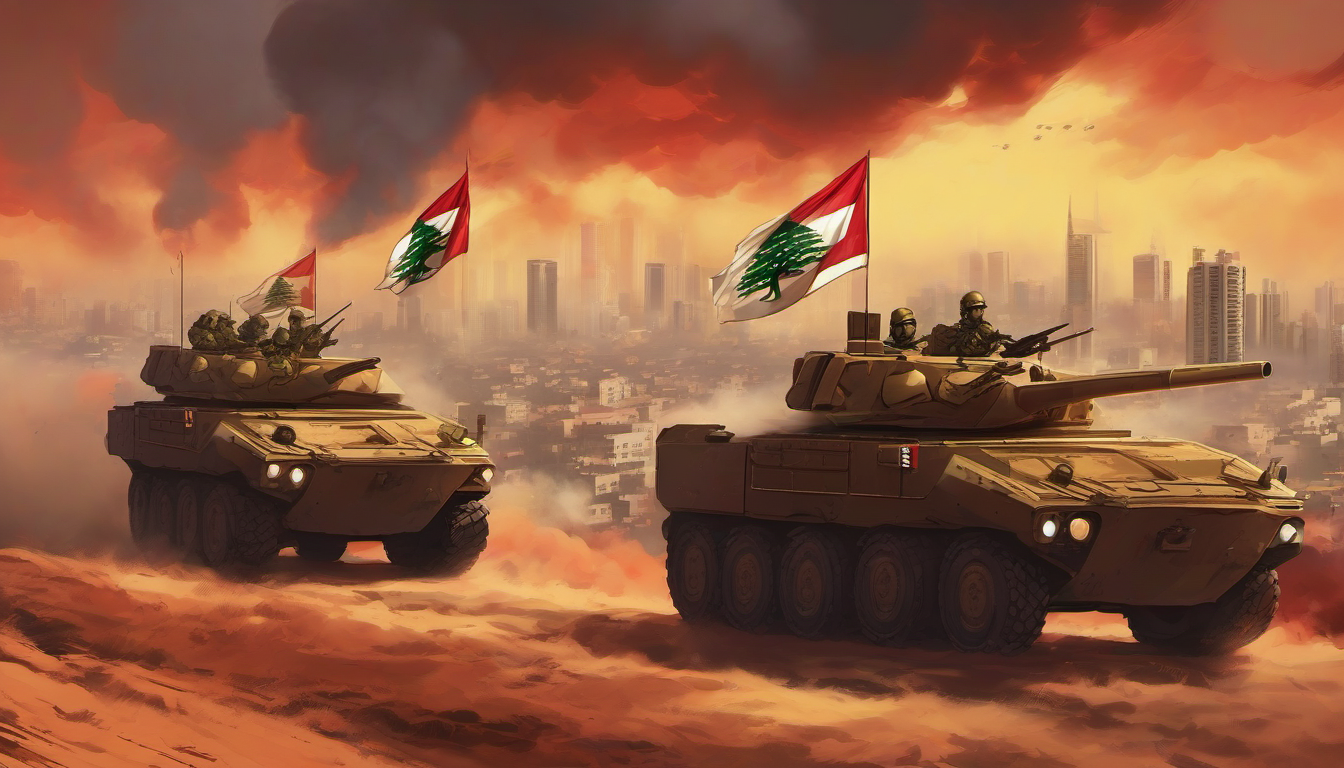
A government's unprecedented ban on the armed group's military activities marks the most consequential assertion of Lebanese sovereignty in decades — but can Beirut enforce it?
Executive Summary
- Lebanese Prime Minister Nawaf Salam declared a total ban on Hezbollah's military and security operations on March 2, ordering the army to enforce state control over weapons north of the Litani River — the most direct challenge to the group's armed status in Lebanon's modern history.
- The ban came hours after Hezbollah fired rockets and drones at Israel in retaliation for the killing of Iran's Supreme Leader Ali Khamenei, breaking the November 2024 ceasefire and provoking Israeli strikes that killed 52 people in Beirut's southern suburbs and southern Lebanon.
- The move exposes the fundamental contradiction at the heart of the Lebanese state: a government that has technically never sanctioned Hezbollah's parallel military apparatus is now, under immense pressure, attempting to assert monopoly over the use of force — at a moment when its patron Iran is in existential crisis.
Chapter 1: The Decision That Changed Everything
On the afternoon of Monday, March 2, 2026, Lebanese Prime Minister Nawaf Salam stood at a podium in the presidential palace in Baabda and uttered words no Lebanese head of government had ever spoken with such finality: "We announce a ban on Hezbollah's military activities and restrict its role to the political sphere."
The statement, delivered after an emergency Cabinet session chaired by President Joseph Aoun, went further than any previous Lebanese government action against the armed group. Salam declared all Hezbollah military activities "illegal," ordered security forces to "prevent any attacks originating from Lebanese territory," and instructed the Lebanese Armed Forces (LAF) to implement the weapons-restriction plan north of the Litani River "decisively."
The immediate trigger was clear. Hours earlier, Hezbollah had launched a barrage of rockets and drones at a military missile defense facility near Haifa, claiming it acted "in defense of Lebanon and its people" and in retaliation for the US-Israeli killing of Ayatollah Ali Khamenei. Israel's response was devastating: airstrikes on Beirut's Dahiyeh southern suburbs and across southern Lebanon killed at least 52 people and wounded 154 more. The Israeli military announced it had killed Hussein Makled, described as the head of Hezbollah's intelligence headquarters.
Salam called the Hezbollah attack "an irresponsible and suspicious act that jeopardizes Lebanon's security and safety and provides Israel with pretexts to continue its aggression." The subtext was unmistakable: Hezbollah had unilaterally dragged Lebanon into a war the government neither authorized nor desired.
Chapter 2: The State Within a State — A 40-Year History
To understand the magnitude of Salam's announcement, one must grasp the unique architecture of Hezbollah's power within the Lebanese state.
Since its founding in 1982 during the Israeli occupation of southern Lebanon, Hezbollah has operated as what political scientists call a "state within a state." It maintains its own military forces — estimated at 20,000-50,000 fighters before the 2024 war — its own intelligence apparatus, its own social services network, and its own foreign policy, aligned with Iran rather than Beirut.
This parallel sovereignty was formalized, paradoxically, through the Lebanese political system itself. Under the 1989 Taif Agreement that ended Lebanon's civil war, all militias were supposed to disband. Hezbollah alone was exempt, classified not as a militia but as a "resistance" movement against Israeli occupation. Even after Israel withdrew from southern Lebanon in 2000, Hezbollah retained its weapons under the justification of defending against future Israeli aggression and liberating the disputed Shebaa Farms.
UN Security Council Resolution 1559 (2004) called for the disarmament of all Lebanese militias. Resolution 1701 (2006), which ended the July War between Israel and Hezbollah, demanded that no armed groups operate south of the Litani River. Neither resolution was enforced. No Lebanese government dared to try.
The reasons were both political and practical. Hezbollah's parliamentary bloc — the Loyalty to the Resistance Bloc — held significant seats in the legislature and wielded effective veto power in coalition governments. The group's military capability dwarfed the Lebanese Armed Forces. Any attempt to disarm it risked a repeat of the brief but traumatic events of May 2008, when Hezbollah fighters seized parts of Beirut in a show of force after the government attempted to shut down the group's private telecommunications network.
| Year | Event | Lebanese State Response |
|---|---|---|
| 1989 | Taif Agreement: all militias to disband | Hezbollah exempted as "resistance" |
| 2000 | Israel withdraws from south Lebanon | Hezbollah retains weapons |
| 2004 | UNSCR 1559 calls for militia disarmament | Not enforced |
| 2006 | UNSCR 1701 after July War | Partially implemented south of Litani |
| 2008 | Government challenges Hezbollah telecom network | Hezbollah seizes West Beirut in hours |
| 2024 | Israel-Hezbollah war kills 4,000+ in Lebanon | Ceasefire, 5-stage disarmament plan |
| 2026 | Salam bans all Hezbollah military activity | Enforcement uncertain |
Chapter 3: Why Now? The Iran Factor
The timing of Salam's decision is inseparable from the catastrophic blow that has befallen Hezbollah's patron. The killing of Ayatollah Khamenei — confirmed on March 1 — has plunged Iran into a succession crisis and dramatically weakened the network of proxy forces that Tehran spent decades building across the Middle East.
Hezbollah was already in a significantly degraded state. The 2024 war with Israel killed most of the group's senior military and political leadership, including Secretary-General Hassan Nasrallah. Its military infrastructure south of the Litani was largely destroyed. Under the November 2024 ceasefire, Lebanon's government had agreed to a five-stage disarmament plan.
By January 2026, the first phase — covering the area between the Litani and the southern border — was completed. In February, Salam said the military would need at least four months for the second phase, extending from the Litani to the Awali River, about 40 km south of Beirut. Hezbollah maintained that the ceasefire's disarmament provisions applied only south of the Litani, refusing to surrender weapons north of it.
The killing of Khamenei fundamentally altered the calculus. Iran's ability to fund, supply, and coordinate with Hezbollah — estimated at $700 million to $1 billion annually before the 2024 war — is now in question. The overland supply route through Syria, already disrupted by the fall of Assad in late 2024, has been functionally severed. The Iranian Revolutionary Guard Corps, Hezbollah's primary patron within Iran's military establishment, is itself reeling from leadership losses.
Salam and Aoun appear to have calculated that this is a once-in-a-generation window: Hezbollah is militarily weakened, politically isolated, and cut off from its lifeline. If the Lebanese state does not assert sovereignty now, it may never get another chance.
Chapter 4: Hezbollah's Response — Defiance Without Options
Hezbollah's response to the ban was revealing in both its tone and its substance. Mohammad Raad, head of the group's parliamentary bloc, issued a statement that combined rhetorical defiance with an implicit acknowledgment of weakness.
"We understand the Lebanese government's impotence in the face of the brutal Zionist enemy," Raad said — a formulation that simultaneously dismissed the government's authority while avoiding a direct threat of force. "We see no justification for the government to take such aggressive measures against the Lebanese who reject the occupation."
The choice of words was striking. In 2008, when the government challenged Hezbollah far less aggressively, the group's response was armed seizure of the capital. In 2026, the response was a press release.
This rhetorical downshift reflects Hezbollah's dramatically reduced capacity. Multiple factors converge:
- Leadership decimation: Most senior military commanders killed in 2024; intelligence chief Makled killed hours before the ban.
- Iranian patronage crisis: With Khamenei dead and Iran under sustained bombardment, financial and logistical support has collapsed.
- Military degradation: Rocket and drone stocks significantly depleted by 2024 war and ongoing Israeli strikes.
- Popular fatigue: The 2024 war displaced over a million Lebanese; the 2026 strikes have triggered another wave of displacement.
- Political isolation: The Sunni, Christian, and Druze political blocs have rallied behind the government's assertion of sovereignty.
Yet "weakened" is not "finished." Hezbollah retains significant weapons caches north of the Litani, an intelligence network, and deep roots in Lebanon's Shia community. The question is not whether Hezbollah can defy the ban — it almost certainly can in the short term — but whether it can sustain defiance as the regional order that underwrote its power collapses.
Chapter 5: Scenario Analysis
Scenario A: Managed Disarmament (35%)
Premise: Hezbollah, recognizing the irreversible loss of Iranian support, negotiates a structured transition to a purely political party.
Triggers: Prolonged Iranian crisis confirming the end of financial/military support; international guarantees (possibly including a multinational peacekeeping force); Lebanese political deal preserving Shia community representation.
Historical precedent: The IRA's decommissioning of weapons (2001-2005) under the Good Friday Agreement. The FARC's transition to a political party in Colombia (2016-2017). Both took years and required extensive international mediation.
Challenges: Hezbollah's identity is inseparable from armed resistance. Total disarmament would face resistance from hardline elements. The absence of a credible Israeli commitment to end incursions into Lebanese territory undermines the security rationale.
Scenario B: Frozen Defiance (45%)
Premise: Hezbollah neither fully complies nor openly challenges the government, creating a prolonged standoff. Weapons remain hidden but unused. The ban exists on paper but is not enforced against residual capabilities.
Triggers: Lebanese army reluctance to confront Hezbollah militarily; international community accepts partial compliance; Hezbollah leadership calculates that patience and preserving political role is the optimal survival strategy.
Historical precedent: The post-Taif period (1990-2005), where Hezbollah's anomalous armed status was tolerated. The Northern Ireland "peace walls" era, where armed groups technically disarmed but retained influence.
Challenges: Israel may not accept ambiguity. The US and Gulf states may condition reconstruction aid on verifiable disarmament. Frozen conflicts tend to reignite — Lebanon has seen this pattern repeatedly.
Scenario C: Confrontation and Fragmentation (20%)
Premise: Hardline Hezbollah elements reject the ban and clash with the Lebanese army. The group fractures between pragmatists accepting political transition and militants refusing disarmament.
Triggers: Israeli provocations (continued airstrikes, settlement of Shebaa Farms); hardline IRGC successor faction in Iran attempts to re-establish proxy network; LAF overreach triggers armed resistance.
Historical precedent: The PLO's fragmentation in Lebanon (1982-1988). Libya's militia fragmentation after Gaddafi's fall (2011-present). Iraq's PMF splintering after Soleimani's assassination (2020).
Challenges: Could reignite sectarian conflict. Would destabilize Lebanon at its most vulnerable economic moment. Risk of ISIS or other extremist groups exploiting the security vacuum.
Chapter 6: Investment Implications and Regional Impact
Defense and Reconstruction
- Lebanon's reconstruction needs will be significant. International donors — particularly Gulf states — are likely to condition aid on progress toward Hezbollah disarmament, creating a linkage between political reform and economic recovery.
- Defense sector beneficiaries include companies supplying the LAF's expansion: the US provides approximately $120 million annually in military aid to the Lebanese army.
Energy and Infrastructure
- Lebanon's offshore gas exploration (Block 9, operated by TotalEnergies) could accelerate if Hezbollah's maritime claims are no longer backed by military force. The Qana field, near disputed waters with Israel, becomes a potential cooperation point rather than a flashpoint.
- Port and infrastructure reconstruction could attract Gulf and European investment if political stability improves.
Regional Precedent
- If Lebanon successfully transitions Hezbollah from an armed group to a political party, it would be the most significant example of a state reasserting sovereignty over a non-state armed actor in the Middle East since Iraq's integration of certain PMF units.
- Conversely, failure would reinforce the "state within a state" model that has plagued Iraq, Libya, Yemen, and Syria.
Risk Factors
- Israel's continued violations of Lebanese sovereignty (near-daily since the 2024 ceasefire) undermine the government's narrative that disarming Hezbollah will bring security.
- The Lebanese economy remains in crisis: GDP contracted 58% between 2019 and 2023, the currency has lost 98% of its value, and the banking sector remains frozen. Economic desperation could either accelerate pragmatic compromise or fuel radicalization.
Conclusion
Prime Minister Salam's ban on Hezbollah's military activities is less a policy decision than a declaration of existential intent. For the first time, the Lebanese state has formally claimed what the constitution has always theoretically guaranteed: monopoly over the legitimate use of force.
Whether this remains a paper declaration or becomes reality depends on variables largely outside Lebanon's control — the outcome of the Iran war, Israel's strategic calculus, and the willingness of the international community to invest in Lebanon's sovereignty rather than merely demanding it.
The most likely outcome is the messiest one: a prolonged, ambiguous transition where Hezbollah's military capability diminishes not through dramatic disarmament but through the slow erosion of the conditions that sustained it. Iran's financial pipeline is severed. The overland supply route through Syria is closed. The 2024 war destroyed much of the group's hardware. The killing of Khamenei has shattered the theological authority that legitimized the "axis of resistance."
What emerges will not be the Lebanon of 2005, when a million people marched demanding Syrian withdrawal and briefly believed in a sovereign, unified state. It will be something more complicated, more fragile, and more consequential: a country trying to rebuild sovereignty from the ruins of someone else's war.
Sources: Al Jazeera, Reuters, Daily Sabah, Middle East Eye, UNSCR 1559/1701, Lebanon National News Agency
Leave a Reply