
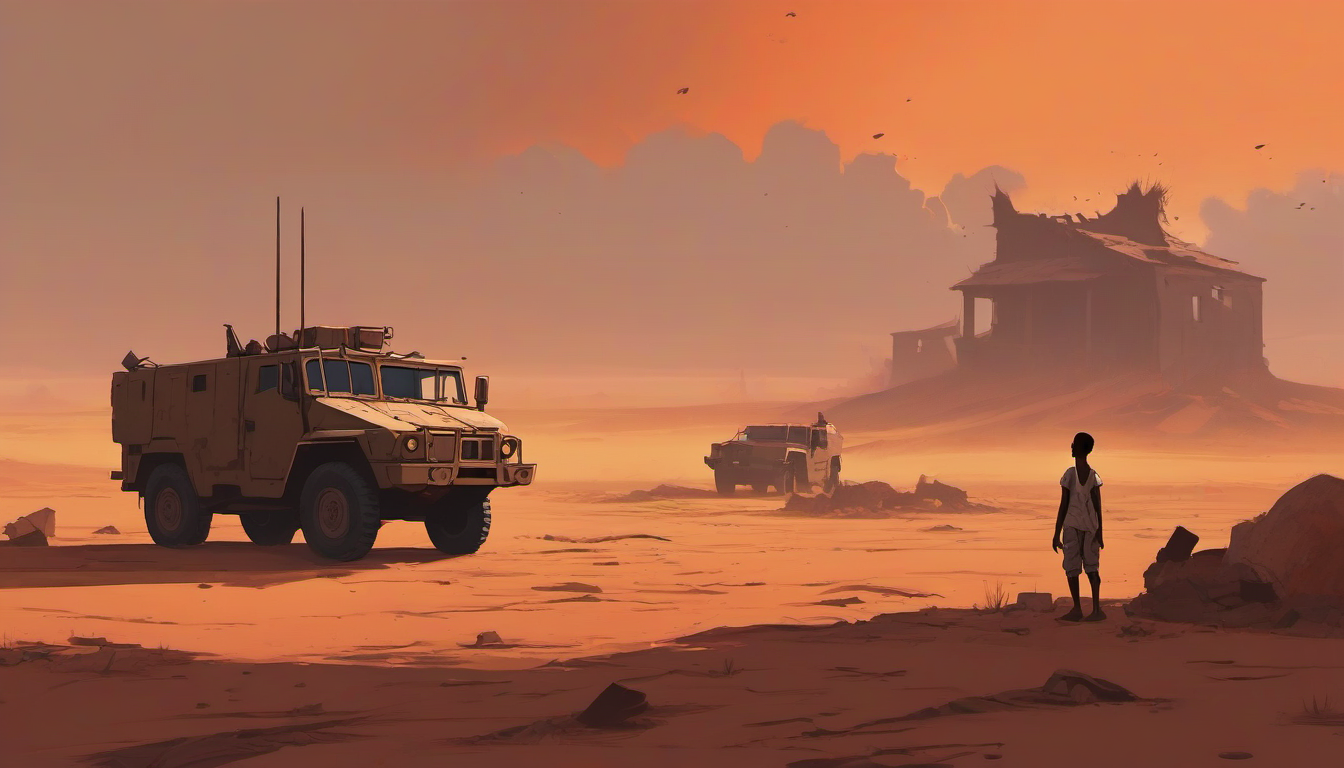
As global attention fixates on Iran, Africa's most fragile state teeters on the brink of a second civil war — and the world isn't watching
Executive Summary
- The Ruweng massacre of 169 people on March 2 — including a county commissioner — is the deadliest single attack since South Sudan's 2013-2018 civil war, and a clear signal that the 2018 peace agreement has functionally collapsed.
- President Kiir's arrest of First Vice President Machar, purges of financial officials, and Ugandan military intervention have systematically dismantled every pillar of the power-sharing framework, triggering what the UN calls "escalating atrocity risks."
- With the economy having contracted 24% in 2025 due to Sudan war-related pipeline disruptions, Kiir is running out of petrodollars to buy the loyalty of rival generals — creating a combustible mix of political fracture and economic desperation that mirrors the conditions preceding the 2013 civil war.
Chapter 1: The Ruweng Massacre — Anatomy of a Warning
On Sunday, March 2, 2026, dozens of armed youths from Mayom County in Unity state crossed into Ruweng Administrative Area's Abiemnom County at 4:30 a.m., while residents were still sleeping. Over the next three to four hours, they executed what Ruweng's information minister called "a policy of extermination."
The toll: 169 dead — 90 civilians including women, children, and the elderly, plus 79 government soldiers. The county commissioner and executive director were among the killed. Fifty more were wounded. By Monday, all 169 bodies had been buried in a mass grave — the sheer volume of casualties making individual burials impossible.
The attackers were linked to the Sudan People's Liberation Army in Opposition (SPLA-IO), the armed wing of detained Vice President Riek Machar's political faction, though the SPLA-IO denied involvement. Over 1,000 civilians fled to the UNMISS peacekeeping base for protection.
This was not an isolated incident. A similar attack in Abiemnom last year killed 42 civilians. In Jonglei state, 26 Doctors Without Borders (MSF) staff members are currently missing after weeks of escalating violence. MSF has suspended operations in Lankien and Pieri after a government air strike hit its facility on February 3.
The pattern is unmistakable: South Sudan is sliding back into organized, large-scale ethnic violence — the same dynamic that killed an estimated 400,000 people between 2013 and 2018.
Chapter 2: The Dismantling of Peace
The 2018 Revitalized Agreement on the Resolution of the Conflict in South Sudan (R-ARCSS) was always fragile. It brought together President Salva Kiir, an ethnic Dinka, and his nemesis Riek Machar, an ethnic Nuer, in a power-sharing arrangement designed to prevent the recurrence of the civil war that had devastated the country since 2013.
Over the past year, Kiir has systematically gutted every safeguard in that agreement.
The Machar Arrest (September 2025): After Nuer White Army fighters overran a military garrison in Nasir — an act Kiir blamed on Machar — the president suspended his vice president and charged him with murder, treason, and crimes against humanity. Machar remains under house arrest, on trial in proceedings the opposition considers illegitimate. His allies have been arrested or purged from government.
The Official Purges (February-March 2026): In the past week alone, authorities arrested former Finance Minister Bak Barnaba Chol at the Ugandan border, former Finance Minister Marial Dongrin Ater, a former central bank governor, a former undersecretary for petroleum, and an intelligence general. The government claims these are anti-corruption measures targeting "irregularities within the monetary system." Analysts read them differently.
Daniel Akech of the International Crisis Group described the arrests as a narrowing of Kiir's "big tent" coalition — the network of patronage and political inclusion he has relied on for years to hold together a fractured state. When the tent shrinks, those left outside have every incentive to pick up arms.
Ugandan Military Intervention: Uganda, a guarantor of the 2018 peace agreement, has deployed forces that have "materially strengthened" government military capacity. Joint Ugandan-South Sudanese aerial bombardments have targeted civilian areas, "predominantly affecting Nuer communities in opposition-affiliated areas," according to the UN Commission on Human Rights in South Sudan (CHRSS). A peace guarantor has become a co-belligerent.
The CHRSS's February 27 report concluded bluntly: South Sudan faces "a return to full-scale war."
Chapter 3: The Oil Curse — An Economy in Freefall
South Sudan is one of the most oil-dependent economies on Earth. Petroleum revenues have historically accounted for over 90% of government income. The country's entire crude production — which peaked at around 350,000 barrels per day before the civil war and had recovered to only 60,000-90,000 bpd — flows through pipelines that traverse war-torn Sudan.
Since Sudan's civil war erupted in April 2023, those pipelines have become recurring casualties. Ruptures have at times taken more than 60% of South Sudan's production offline. The World Bank estimates that South Sudan's economy shrank by 24% in 2025 — a contraction comparable to war-devastated economies.
This matters because South Sudan's political system runs on oil money. The 2024 International Crisis Group analysis was prescient: the disruption of oil production would lead to wider political violence as Kiir runs out of petrodollars "to keep South Sudan's rivalrous generals and warlords on his side."
That prediction is now playing out in real time. The arrest of financial and petroleum officials suggests the regime is scrambling to control what remains of its fiscal resources — a classic sign of a patronage state in crisis.
Key economic data:
| Indicator | Value |
|---|---|
| GDP contraction (2025) | -24% |
| Oil production (current) | ~60,000-90,000 bpd |
| Oil production (pre-war peak) | ~350,000 bpd |
| Oil revenue share of budget | >90% |
| Displaced since Dec 2025 | 280,000+ |
| Killed in 2025 violence | Thousands (UN est.) |
| Population | ~12.4 million |
China's CNPC and Sinopec, together with India's ONGC Videsh, operate more than 80% of South Sudan's oil output. Their investments — totaling billions of dollars — are increasingly at risk. CNPC had been asked to rehabilitate idle oil blocks (1, 2, 3, 4, and 7), but governance breakdown and security deterioration make any production recovery unlikely.
Chapter 4: The Attention Deficit — Why the World Isn't Watching
The Ruweng massacre occurred on the same day the world was consumed by Day 3 of Operation Epic Fury — the US-Israeli military campaign against Iran. Eight countries' airspace was closed. Oil prices were surging. The Hormuz Strait was under effective blockade. South Sudan's 169 dead barely registered in global news cycles.
This attention deficit is structural, not coincidental. South Sudan has been the world's forgotten crisis for years. The country ranks near the bottom of virtually every global development index. It has no strategic value to the great powers beyond its oil — which is currently flowing at a trickle. UNMISS, with approximately 17,000 personnel, is one of the UN's largest peacekeeping missions, but its mandate is set for renewal in March, and the political appetite for costly African peacekeeping is waning.
The convergence of global crises creates what analysts call "attention arbitrage" — smaller conflicts escalate precisely because the international community's bandwidth is consumed elsewhere. Sudan's civil war followed the same pattern, escalating catastrophically while global attention was on Ukraine in 2023.
For South Sudan, the timing is particularly dangerous. The CHRSS report calling for "urgent preventive action" — including sanctions and enforcement of the UN arms embargo — arrived at exactly the moment when no major power has the diplomatic capacity to act on it.
Chapter 5: Scenario Analysis
Scenario A: Managed Containment (20%)
Premise: Regional and international pressure forces a negotiated de-escalation. Machar is released or placed in exile. A reformed power-sharing arrangement emerges.
Trigger conditions:
- The African Union, IGAD, or the Troika (US, UK, Norway) mobilizes sustained diplomatic pressure
- Kiir calculates that the military costs of full-scale war outweigh the political costs of compromise
- Oil revenues partially recover, giving Kiir resources to expand the patronage tent
Historical precedent: The 2018 R-ARCSS itself was reached after intense regional pressure, though it took five years of war and 400,000 dead to get there.
Why only 20%: Every international actor that could exert pressure is distracted — the US by Iran, the UK by post-Brexit security commitments, the AU by Horn of Africa conflicts. Uganda's direct military involvement makes it a spoiler rather than a mediator. The conditions for sustained diplomatic engagement simply don't exist.
Scenario B: Slow-Burn Fragmentation (50%)
Premise: Violence escalates gradually without tipping into full-scale civil war. Multiple armed groups control different territories. The state continues to exist formally but governs little beyond Juba.
Trigger conditions:
- Machar's trial proceeds, keeping opposition mobilized but leaderless
- Oil revenues remain too low for Kiir to fund comprehensive military operations
- UNMISS maintains a minimal protection presence
- No external shock (like the Sudan war spilling over) pushes the situation past the tipping point
Historical precedent: Somalia's trajectory from the 1990s onward — a recognized state that controls limited territory while armed factions and clan militias hold the rest. Also resembles the Democratic Republic of Congo's eastern provinces, where state authority has been nominal for decades.
Why 50%: This is the path of least resistance. Neither side has the resources for total war. Kiir can't pay his generals; Machar's forces lack coordination without their leader. The result is a grinding, low-intensity conflict that the world can ignore.
Scenario C: Return to Full-Scale Civil War (30%)
Premise: A triggering event — the assassination of Machar, a major military defection, or spillover from Sudan — ignites coordinated, nationwide fighting between Dinka and Nuer forces.
Trigger conditions:
- Machar dies in custody (illness, assassination) — galvanizing Nuer resistance
- A senior general defects with troops and heavy weapons
- Sudan war combatants (SAF or RSF) cross into South Sudan in force
- Oil pipelines are permanently destroyed, eliminating Kiir's last fiscal lifeline
Historical precedent: The 2013 civil war began with a similar dynamic — Kiir's purge of Machar triggered Nuer military defections that quickly escalated into full ethnic warfare. The 2013-2018 war killed 400,000 in a country of 12 million.
Why 30%: The Ruweng massacre, the MSF facility bombing, the mass arrests, and the Ugandan bombardments are escalation indicators consistent with pre-war conditions. The 2013 trigger — Kiir dismissing Machar — has already occurred in more extreme form (arrest and prosecution). What's restraining the situation is the opposition's organizational weakness following Machar's detention and the economic exhaustion of all parties.
Chapter 6: Investment & Strategic Implications
Energy: South Sudan's oil production is effectively stranded. CNPC and ONGC Videsh investments face further deterioration. In the context of the Hormuz crisis, every barrel matters — but South Sudan's 60,000-90,000 bpd contribution is negligible against a 20 million bpd chokepoint. The greater risk is to Sudan-transiting pipelines, which could face sabotage from any direction.
Humanitarian & Aid Sector: With USAID having been dismantled over the past year and global attention on Iran, South Sudan faces a humanitarian funding cliff. MSF's suspension of operations in Jonglei is a harbinger. WFP and other agencies dependent on voluntary contributions will struggle.
Regional Contagion: South Sudan borders six countries — Sudan, Ethiopia, Kenya, Uganda, the DRC, and the Central African Republic. Four of these are already experiencing armed conflicts. A South Sudanese civil war would generate refugee flows into already-strained neighbors, compound the Horn of Africa's multiple crises, and potentially draw Uganda deeper into a military quagmire.
Peacekeeping: UNMISS's March mandate renewal will be a test of whether the UN Security Council can muster attention for Africa while consumed by the Iran crisis. A weakened or withdrawn UNMISS would remove the last institutional check on mass atrocities.
Conclusion
South Sudan is dying in plain sight. The world's youngest nation — born in 2011 with immense international goodwill — has consumed every peace dividend, squandered its oil wealth, and is now systematically demolishing the political framework that ended its last civil war.
The Ruweng massacre is not an aberration. It is a data point on a trajectory that the UN, the International Crisis Group, and every serious analyst has been charting for months. The 2018 peace agreement has been "systematically dismantled," in the UN's own words. The patronage state that held the country together is bankrupt. Armed groups are mobilizing. Civilians are fleeing. Aid workers are being bombed and going missing.
And the world, consumed by the fires burning in the Persian Gulf, has no bandwidth left for the slow-motion catastrophe unfolding in East Africa.
The 400,000 who died in South Sudan's last civil war did so largely in silence. If the pattern holds, the next round of killing will be even quieter.
Sources: Al Jazeera, BBC, Reuters, AP News, UN Commission on Human Rights in South Sudan (CHRSS), UNMISS, MSF, International Crisis Group, World Bank
Leave a Reply