
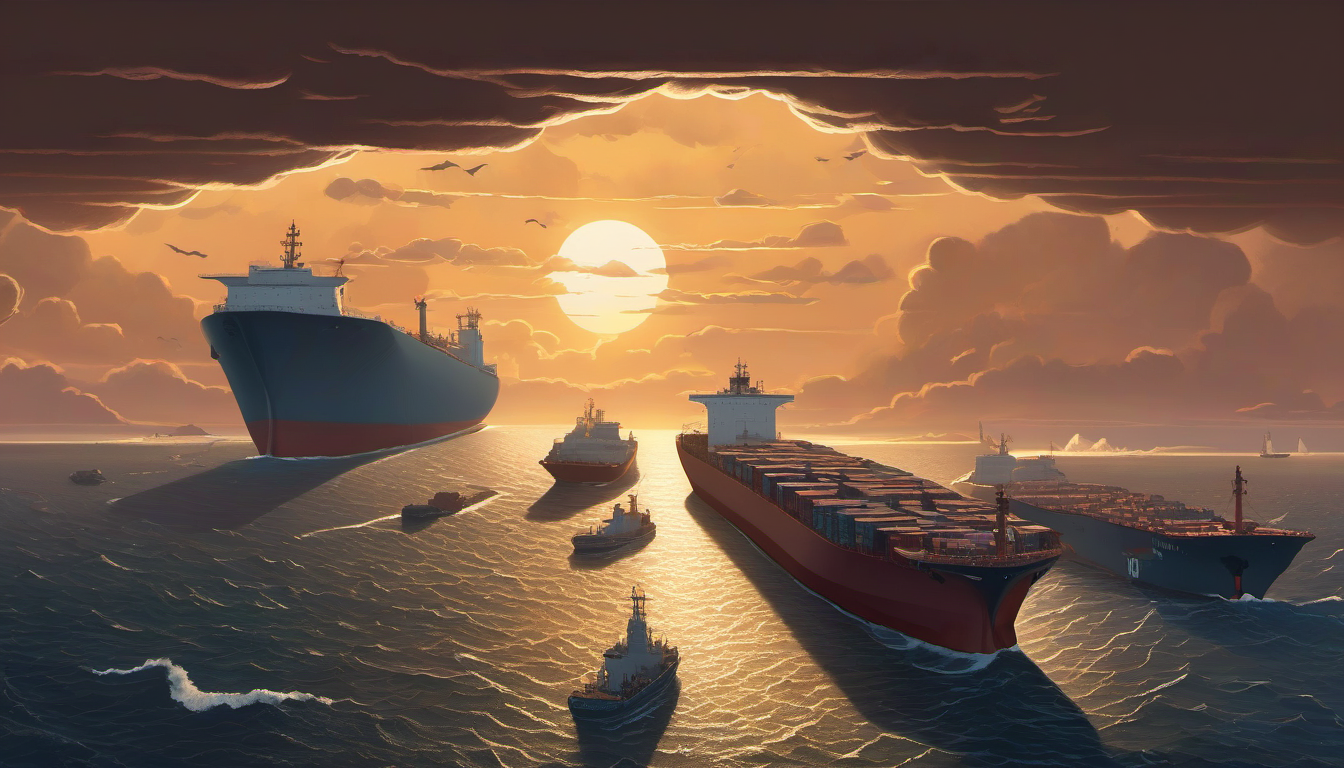
For the first time in modern history, three of the five critical maritime chokepoints are compromised at once — and the last open route cannot handle the load
Executive Summary
- Maersk, MSC, and Hapag-Lloyd have simultaneously suspended transits through both the Strait of Hormuz AND the Suez Canal/Bab el-Mandeb, an unprecedented dual chokepoint shutdown forcing all east-west trade around the Cape of Good Hope
- Over 750 vessels carrying crude, LNG, and containerized cargo are anchored in open waters as DP World's Jebel Ali port — the world's 9th largest — and ports across Bahrain and Oman have shut down
- The Cape of Good Hope, already strained by 18 months of Red Sea diversions, now faces an additional surge of Persian Gulf oil and LNG traffic — a volume the route was never designed to absorb, adding 3-6 weeks transit time and threatening a $2-3 trillion annualized trade disruption
Chapter 1: The Anatomy of a Maritime Cardiac Arrest
On March 1, 2026, Maersk — the world's second-largest container shipping line — issued a statement that will likely mark a turning point in the history of global trade. The Danish shipping giant announced it was suspending all vessel crossings through the Strait of Hormuz "until further notice" while simultaneously pausing future trans-Suez sailings through the Bab el-Mandeb Strait. Both routes — ME11 (Middle East-India to Mediterranean) and MECL (Middle East-India to East Coast US) — would be rerouted around the Cape of Good Hope.
Hours later, MSC, the world's largest container line by capacity, went further: it ordered all vessels in the Persian Gulf to seek safe shelter and suspended all bookings for worldwide cargo to the Middle East entirely. Hapag-Lloyd, the fifth-largest global carrier, followed with identical Hormuz suspensions.
This was not merely an operational adjustment. It was the simultaneous shutdown of two of the world's three critical east-west maritime corridors, executed by the three carriers that collectively control over 45% of global container shipping capacity.
The immediate trigger was Operation Epic Fury — the US-Israeli military campaign against Iran that killed Supreme Leader Khamenei on February 28. Iran's Revolutionary Guards responded by declaring the Strait of Hormuz a "war zone," effectively prohibiting all vessel transits. A tanker registered in Palau was attacked off the coast of Oman on March 1, injuring four crew members. The International Maritime Organization urged all vessels to avoid the region.
But the maritime crisis extends far beyond Iran. The Houthi threat in the Red Sea — which had forced carriers into Cape diversions since late 2023 — has not only persisted but intensified. With Iran's direct encouragement following the strikes, Houthi militants resumed attacks on commercial shipping in solidarity. This closed the second major chokepoint.
The result: for the first time in recorded maritime history, both the Strait of Hormuz (through which 20% of global oil and 25% of LNG passes) and the Suez Canal/Bab el-Mandeb corridor (through which 12-15% of global trade flows) are simultaneously inoperable for commercial shipping. The Panama Canal, while technically functional, remains constrained by drought-related transit restrictions that have persisted since 2023, limiting daily passages to 24 versus the normal 36-40.
Three of the world's five critical maritime chokepoints are compromised. Only the Cape of Good Hope and the Strait of Malacca remain fully open — and the Cape is about to face a volume it was never engineered to handle.
Chapter 2: The Cape of Good Hope — A Bottleneck Designed for Another Era
The Cape of Good Hope route around southern Africa has served as maritime commerce's fallback since the Suez Canal opened in 1869. When the Canal closed for eight years during and after the 1967 Arab-Israeli War, the Cape became the primary east-west route, spurring the development of supertankers (VLCCs) whose scale made the longer journey economical.
But today's maritime logistics operate on fundamentally different assumptions. The global shipping industry has spent decades optimizing for a three-corridor system: Suez for Europe-Asia trade, Hormuz for Middle Eastern energy exports, and Panama for Atlantic-Pacific containerized cargo. Supply chains, port schedules, insurance models, and just-in-time inventory systems all depend on predictable transit times through these corridors.
The math of the diversion is staggering:
| Route | Normal Transit | Via Cape | Added Time | Added Cost per Vessel |
|---|---|---|---|---|
| Persian Gulf → Rotterdam (via Suez) | 18-20 days | 35-40 days | +15-20 days | $500K-$1M |
| Persian Gulf → Singapore (via Hormuz) | 7-8 days | 22-25 days | +15-17 days | $400K-$800K |
| Persian Gulf → Yokohama (via Hormuz) | 15-17 days | 30-35 days | +15-18 days | $600K-$1.2M |
| Jeddah → Rotterdam (via Suez) | 11 days | 24-26 days | +13-15 days | $350K-$700K |
Before the Hormuz crisis, the Red Sea diversions had already pushed 2,000+ additional vessel transits per month around the Cape. That volume strained port capacity at Cape Town and Algoa Bay, stretched fuel bunkering supplies, and created insurance bottlenecks in the waters around South Africa — where vessel traffic density increased by approximately 60% through 2025.
Now, add the Persian Gulf traffic. Approximately 21 million barrels of oil per day transit the Strait of Hormuz. That equates to roughly 25-30 VLCCs per day in normal conditions. The LNG trade adds another 15-20 carrier transits daily. Together with the containerized and dry bulk traffic already diverted from the Red Sea, the Cape route faces a potential volume increase of 80-120% above its pre-crisis baseline.
South Africa's ports — particularly Cape Town, Durban, and Richards Bay — were already operating near capacity. Port congestion, tug availability, bunkering infrastructure, and pilot services all face acute stress. The South African Maritime Safety Authority has not issued formal capacity warnings, but industry observers note that anchorage areas off the Cape are already crowded and that weather windows (the Cape is notorious for rough seas) will create periodic traffic jams lasting days.
Chapter 3: Beyond Oil — The Hidden Supply Chains at Risk
Headlines focus on crude oil prices — IG weekend markets showed US crude jumping 11% to $74/barrel, with Barclays projecting $80 and RBC warning of $100+ in a sustained disruption. But the Hormuz shutdown threatens far more than energy markets.
Fertilizers and food security. The Persian Gulf nations — Saudi Arabia, Qatar, Oman, and Iran — collectively export approximately 25-35% of the world's traded ammonia and urea, the building blocks of nitrogen fertilizer. As Forbes reported on March 1, the Hormuz closure threatens to "choke off global nitrogen fertilizer exports" precisely as the Northern Hemisphere approaches spring planting season. A prolonged disruption could trigger a fertilizer price spike comparable to 2022's post-Russian-invasion surge, threatening crop yields across South Asia, Africa, and Latin America.
LNG and European energy security. Qatar alone supplies approximately 20% of global LNG, all of which transits Hormuz. Europe, which spent 2022-2025 replacing Russian pipeline gas with LNG imports, faces a potential supply crunch. TTF (Dutch gas) benchmarks could surge above €90/MWh — triple current levels — if the closure persists beyond two weeks.
Petrochemicals and manufacturing. The Gulf states produce approximately 15% of global polyethylene and polypropylene — plastics that serve as inputs for everything from food packaging to automotive components. Disruption here cascades into manufacturing supply chains worldwide.
Containerized consumer goods. DP World's Jebel Ali port in Dubai, the largest in the Middle East and 9th globally, has suspended operations. This port serves as a transshipment hub for goods moving between Asia, Africa, and Europe. Its closure disrupts supply chains extending far beyond the Gulf region.
Chapter 4: Historical Precedent — and Why This Time Is Different
The closest historical parallels offer limited comfort:
The 1956 Suez Crisis closed the canal for five months. But Hormuz remained open, the Red Sea was unaffected, and global trade volumes were a fraction of today's. The closure accelerated the development of supertankers but caused manageable economic disruption.
The 1967-1975 Suez closure lasted eight years. Again, Hormuz remained open. The world adapted through larger vessels and the Cape route, but over years rather than weeks. Global supply chains were far less integrated and less reliant on just-in-time delivery.
The Iran-Iraq Tanker War (1984-1988) saw approximately 546 attacks on commercial shipping in the Persian Gulf, but neither Hormuz nor Suez was fully closed. Shipping continued with elevated insurance costs and convoy escorts.
The 2023-2025 Houthi Red Sea crisis forced Cape diversions for container shipping, adding $2-4 billion in annual shipping costs. But Hormuz remained open, and oil flows were unaffected.
What makes March 2026 unprecedented is the simultaneity. Never before have Hormuz and Suez been simultaneously inoperable while a third chokepoint (Panama) operates at reduced capacity. The global economy has no playbook for this scenario.
The 1973 OPEC oil embargo, often cited as a worst-case energy disruption, removed approximately 4.4 million barrels per day from the market — roughly 7% of global supply at the time. The Hormuz closure alone threatens to strand 17-21 million barrels per day (approximately 20% of current global supply), with only partial mitigation possible through pipeline alternatives (East-West Pipeline, IPSA, and Abu Dhabi's Habshan-Fujairah pipeline can collectively bypass approximately 6.5-7.5 million bpd).
Chapter 5: Scenario Analysis
Scenario A: Swift Resolution (25%)
Premise: Military operations conclude within 2-3 weeks; Iran's successor regime or IRGC remnants negotiate de-escalation; Hormuz reopens with international naval escort.
Basis: Trump stated the operation could take "four weeks or less." Historical precedent of the June 2025 12-day war suggests Washington has limited appetite for prolonged Middle Eastern engagement. OPEC+ has already signaled flexibility with the 206,000 bpd April increase (vs. expected 137,000).
Market impact: Oil spikes to $80-85, then retreats to $70-75. Shipping costs elevate 20-30% for 2-3 months. Limited long-term supply chain restructuring.
Scenario B: Prolonged Disruption — 2-6 Months (45%)
Premise: Iran's decapitated but unconquered military sustains asymmetric resistance. IRGC naval forces continue mine-laying and small boat attacks. Hormuz remains a war zone; Suez marginally reopens under naval escort but at reduced capacity.
Basis: Iran's IRGC naval forces possess thousands of mines, fast attack craft, and anti-ship missiles (including the newly acquired Chinese CM-302). The 1984-88 Tanker War lasted four years. Iran's population of 90 million and rugged terrain make occupation impossible. Trump's own words — "there will likely be more [casualties]" — suggest preparation for an extended campaign.
Trigger: Continued IRGC resistance + failure to establish stable successor government.
Market impact: Oil sustained above $85-100. Container shipping rates triple. Global inflation adds 1.5-2.5 percentage points. Cape route congestion creates 3-6 week delays. South Asian and African nations face fertilizer-induced food crisis. European gas prices surge, potentially reigniting industrial recession.
Scenario C: Escalation and Fragmentation (30%)
Premise: The conflict draws in additional actors — Hezbollah remnants, Iraqi militias, Pakistan-Afghanistan war spillover, or Chinese intervention to protect energy interests. Multiple simultaneous conflicts render the entire Arabian Sea a high-risk zone, extending disruption to the Strait of Malacca approaches.
Basis: Iran has already struck targets in six Gulf states (Saudi Arabia, UAE, Bahrain, Qatar, Kuwait, and Oman). Pakistan is simultaneously at open war with Afghanistan. China imports 13.4% of its seaborne crude from Iran. Kataib Hezbollah has threatened attacks on US bases. The precedent of conflict metastasis is well-established (WWI's cascading alliances, Syria's regional spillover).
Trigger: Major attack on a non-belligerent nation's infrastructure or Chinese naval intervention.
Market impact: Oil above $100-120. Global recession. Shipping insurance market collapse. Strategic petroleum reserve drawdowns accelerate. Permanent restructuring of global supply chains away from Middle Eastern chokepoints.
Chapter 6: Investment Implications
Energy sector: Crude producers with non-Hormuz export routes benefit disproportionately. US shale (Permian Basin), Brazil (pre-salt deepwater), Guyana, Canada (TMX pipeline now operational), and West African producers gain market share. Saudi Aramco shares rose 2.5% even as the Saudi equity market fell 2.5% on March 1.
Shipping: Tanker rates will surge. Cape-sized bulk carrier demand increases. However, container shipping faces margin pressure — higher fuel costs and longer voyages compress profitability unless rate increases are passed through. Maersk and Hapag-Lloyd face elevated costs; MSC's booking suspension suggests near-term revenue loss.
Fertilizer and agriculture: CF Industries, Yara, Nutrien, and OCI gain from price spikes on ammonia/urea shortages. Agricultural commodity futures (wheat, corn, rice) face upward pressure from fertilizer cost pass-through, particularly affecting emerging markets.
Defense and security: Naval mine countermeasure capabilities, convoy escort demand, and maritime surveillance technologies see sustained demand. ITA (iShares US Aerospace & Defense ETF) already up 14% in 2026.
Safe havens: Gold at $5,400 and rising. Silver following. US Treasuries benefit from flight to safety despite fiscal concerns. Japanese yen strengthens as carry trade unwinds.
Avoid: Gulf-dependent logistics (DP World, Emirates logistics subsidiaries), Gulf real estate developers, airlines with Gulf hub exposure, petrochemical companies dependent on Gulf feedstock, and any entity with concentrated Hormuz transit risk.
Conclusion
The Triple Strait Crisis of March 2026 represents something genuinely new in the history of global commerce: the simultaneous failure of the maritime infrastructure on which 60%+ of east-west trade depends. The Cape of Good Hope — the world's fallback route since the age of sail — now bears a burden it was never designed to carry.
The optimistic case is swift: military operations wind down, Hormuz reopens under escort, and the crisis becomes a painful but temporary disruption. The pessimistic case echoes the structural shifts that followed 1973: a permanent repricing of maritime risk, acceleration of pipeline and overland alternatives, and a fundamental restructuring of supply chains away from Middle Eastern chokepoints.
What is certain is that Monday, March 2, 2026, will test whether global financial markets have correctly priced the most comprehensive maritime trade disruption since World War II.
Related Reading
- The Strait of Hormuz and the Global Food Risk — Forbes
- Oil price expected to surge after Iran strikes — The Guardian
- Maersk Suspends Hormuz and Suez Transits — Maersk
Leave a Reply