
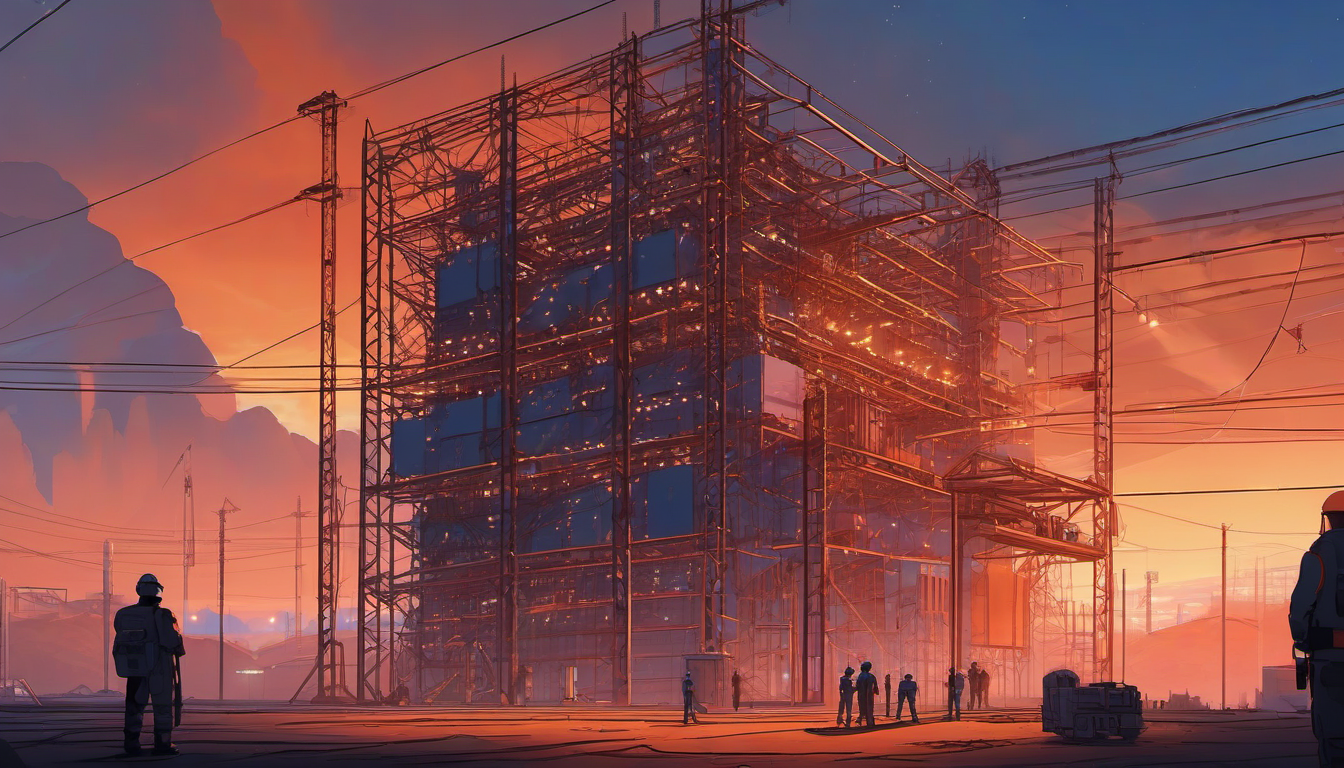
The technology destroying white-collar jobs can't find enough blue-collar workers to build itself
Executive Summary
- The AI data center boom is stalling: 11 GW of planned 2026 capacity remains unbuilt with no signs of construction, and 26 projects were cancelled in just two months — up from one in October 2025.
- A triple bottleneck — labor shortages (349,000 new construction workers needed in 2026 alone), grid interconnection delays (up to 12 years in some regions), and a proliferating wave of community moratoriums — threatens to derail what has been the primary engine of U.S. economic growth.
- The central irony: AI is simultaneously eliminating hundreds of thousands of white-collar jobs (Block just cut 40% of staff, Nvidia's gaming division abandoned consumer GPUs) while being unable to recruit the electricians, welders, and HVAC technicians it needs to build the physical infrastructure upon which the entire $7 trillion investment thesis depends.
Chapter 1: The Stalled Machine
McKinsey estimates cumulative global data center investment could reach $6.7 trillion by 2030. The four largest spenders — Amazon, Google, Meta, and Microsoft — have committed $650 billion in capital expenditure over the next year alone. Meta's Hyperion project in Louisiana is designed to be four times the size of Central Park. These are not incremental expansions. They are the largest peacetime construction projects in human history.
And yet, the machine is stalling.
According to MacroEdge, an investment research firm tracking the data center pipeline, 26 planned data center projects were cancelled or indefinitely delayed in December 2025 and January 2026. That figure was one — just one — in October. Sightline Climate reports that up to 11 gigawatts of planned 2026 capacity "remains in the announced stage with no signs of construction." For context, 11 GW is roughly the electricity consumption of the entire state of New Jersey.
The cancellation wave has not gone unnoticed on Wall Street. MacroEdge's chief economist Don Johnson warned that the Trump administration "is going to be scrambling to find its next growth engine as the datacenter machine winds down as a tailwind." Data center construction has powered an estimated 0.3-0.5 percentage points of U.S. GDP growth over the last 18 months. If that engine sputters, the consequences for an already fragile economy — GDP growth slowed to 1.4% in Q4 — could be severe.
Chapter 2: The Labor Paradox
The most acute bottleneck is paradoxically the most analog: human beings with wrenches, conduit benders, and hard hats.
A single large data center requires up to 1,500 workers during peak construction, each facility 40-50% larger than a Walmart Supercenter. The Associated Builders and Contractors estimates the U.S. construction industry needs 349,000 net new workers in 2026 alone to meet demand. The International Brotherhood of Electrical Workers (IBEW) has described the situation as "life-or-death."
The math is brutal. Nearly 30% of union electricians are between 50 and 70. Approximately 20,000 retire each year — 200,000 over the next decade. More than 300,000 new electricians are projected to be needed over the same period just to meet AI-driven demand. The pipeline of apprentices, while growing, cannot scale at the pace Big Tech demands.
Here lies the central paradox of the AI economy. The same week Fortune profiled Gen Z electricians being recruited into $71,000-a-year apprenticeships to wire data centers, Block (formerly Square) announced it was laying off 40% of its workforce — 4,000 people — because AI had made their jobs redundant. CEO Jack Dorsey declared that "most companies are late" to the automation wave. Goldman Sachs estimates AI is eliminating 5,000 to 10,000 net jobs per month.
The AI economy is performing an extraordinary inversion of the labor market: destroying demand for the cognitive workers who designed the digital world while creating desperate, unfillable demand for the manual workers who must physically build it. White-collar unemployment rises. Blue-collar wages soar. The economy bifurcates not along the old lines of education versus non-education, but along the axis of physical versus digital labor.
Marsden Hanna, Google's head of energy and sustainability, captured the infrastructure side of the crisis at a recent utility conference: "We have utilities in many markets telling us four or five, sometimes 10 years to interconnect." One utility told Google it would take 12 years just to study the interconnection timeline.
Chapter 3: The NIMBY Rebellion
If labor shortages are the supply-side constraint, community opposition has become the demand-side veto.
Across the United States, a grassroots rebellion against data center construction is proliferating with startling speed. The movement spans the political spectrum. In liberal Vermont, Senator Bernie Sanders has proposed a nationwide moratorium on new data center construction. In conservative Florida, Governor Ron DeSantis announced an AI "bill of rights" giving local communities the right to limit new facilities. In swing-state Arizona, Governor Katie Hobbs reversed her support for data center tax incentives.
The legislative response is hardening. New York State has introduced what its sponsors call "the strongest" anti-data center bill in the country: a three-year moratorium on all new data center permits statewide while regulators study environmental and economic impacts. New Orleans passed a one-year construction ban. Madison, Wisconsin, enacted a similar pause. In Georgia, a bipartisan wave of bills targets the industry. At least 19 Michigan towns have paused data center approvals.
The concerns are concrete and local. Data centers consume prodigious quantities of water for cooling — a single facility can use as much as a small city. They strain power grids already struggling to meet existing demand. They generate noise, truck traffic, and visual blight. And they deliver remarkably few permanent jobs relative to their footprint. A data center employing 50 full-time staff can consume the electricity of 50,000 homes.
The political economy is toxic. The benefits — cloud computing power, AI model training — are diffuse and abstract. The costs — strained grids, depleted aquifers, construction disruption — are concentrated and tangible. This is the classic formula for NIMBY politics, and it is proving devastatingly effective.
Chapter 4: The Grid That Can't Keep Up
Even where communities welcome data centers and workers can be found, the electricity grid itself has become a binding constraint.
Regional grid operators can take up to five years merely to review how a new power source — a gas plant, solar installation, or nuclear reactor — would affect the grid. This process was already backlogged before the AI boom. The clean energy transition had multiplied the number of interconnection requests, since solar installations require roughly five projects to generate the same power as one gas plant. The sudden surge in data center demand has piled onto an already overwhelmed queue.
Douglas Jester, managing partner at 5 Lakes Energy, describes the situation bluntly: "The interconnection process is really getting bogged down, and it has been a problem even before datacenters."
The numbers tell the story. U.S. data center power consumption is projected to reach 9-17% of total electricity generation by 2030, according to EPRI. Virginia alone already accounts for 57% of U.S. data center capacity. Twelve states have introduced regulatory bills targeting data center energy use. The tension between AI's insatiable appetite and grid capacity is not a future problem — it is a present crisis.
Big Tech's response — building their own power plants, signing nuclear power purchase agreements, even exploring microreactors — acknowledges the scale of the problem but introduces new timelines. A nuclear small modular reactor takes 7-10 years to deploy. A natural gas plant takes 3-5 years. AI models are being trained on infrastructure that may not exist for a decade.
Chapter 5: Scenario Analysis
Scenario A: Managed Deceleration (45%)
Data center construction slows but continues. Big Tech reduces its most ambitious targets by 20-30%, extends timelines, and concentrates investment in states with favorable regulatory environments (Texas, Virginia, parts of the Southeast). AI model development shifts emphasis from raw scale to efficiency — echoing the DeepSeek pivot. GDP impact: 0.2-0.3pp drag in 2026-2027.
Historical precedent: The fiber-optic bubble of 1998-2001 saw massive overbuilding followed by a demand-supply recalibration. Capacity utilization eventually caught up, but the companies that overbuilt went bankrupt while the infrastructure they left behind powered the next decade's internet growth.
Trigger conditions: Continued moratorium proliferation, 2-3 more quarters of project cancellations, investor pressure on capex returns.
Scenario B: Infrastructure Breakthrough (25%)
Federal intervention — whether through executive action on permitting reform, energy emergency declarations, or defense production act invocations — clears regulatory bottlenecks. The Stargate project's national security framing provides political cover. Gen Z trade recruitment accelerates. Grid interconnection timelines compress from 10 years to 3-5 years.
Historical precedent: The Interstate Highway System (1956) and the wartime industrial mobilization of 1941-1945 demonstrate that federal urgency can radically compress infrastructure timelines. But both required political consensus that does not currently exist.
Trigger conditions: DHS shutdown resolution, bipartisan infrastructure deal, DOE emergency grid interconnection authorities.
Scenario C: The AI Winter Catalyst (30%)
Project cancellations accelerate, creating a negative feedback loop: reduced infrastructure → constrained AI capacity → disappointing returns → further investment pullback. The physical paradox becomes the trigger for a broader AI valuation correction. SaaSpocalypse credit contagion spreads to data center REITs and infrastructure debt.
Historical precedent: The nuclear power construction wave of the 1970s-1980s, where cost overruns, regulatory delays, and community opposition transformed a technology promising unlimited cheap energy into stranded assets and cancelled projects.
Trigger conditions: Major data center developer bankruptcy or project write-down, energy price spike from Hormuz crisis, moratorium reaching a major data center hub state.
Chapter 6: Investment Implications
Winners in all scenarios:
- Electrical equipment manufacturers (Eaton, Schneider Electric, Vertiv) — demand exceeds supply regardless of pace
- Skilled trades training and staffing companies — structural labor shortage persists
- Grid infrastructure (transformers, switchgear, high-voltage cables) — multi-year backlogs
- Energy utilities with available capacity — pricing power increases
Losers in deceleration/winter scenarios:
- Data center REITs with heavy development pipelines (Equinix, Digital Realty)
- Construction-phase dependent firms without operational revenue
- AI infrastructure lenders — $400B+ in leveraged loans at risk
- Communities that granted tax incentives for facilities that may never be built
The paradox trade:
The most contrarian position may be long physical labor, short digital labor. Companies that employ electricians, welders, and heavy equipment operators are experiencing pricing power not seen since the post-WWII construction boom. Companies that employ knowledge workers face structural demand destruction from the very technology they're racing to build.
| Metric | Data Point |
|---|---|
| Planned 2026 capacity stalled | 11 GW |
| Project cancellations (Dec-Jan) | 26 (up from 1 in Oct) |
| New construction workers needed (2026) | 349,000 |
| Electricians retiring per year | 20,000 |
| New electricians needed (decade) | 300,000+ |
| Grid interconnection wait | Up to 12 years |
| Big Tech 2026 capex | $650 billion |
| States with data center moratoriums/bills | 12+ |
| Data center share of U.S. electricity (2030) | 9-17% |
Conclusion
The AI revolution is discovering what every revolution eventually learns: the future must be built with present-day hands, on present-day grids, in present-day communities. The $7 trillion bet on artificial intelligence was always, at its core, a bet on concrete, copper wire, and cooling towers. Silicon Valley's vision of an infinitely scalable digital future has collided with the stubbornly finite physical world — a world where electricians retire faster than they can be trained, where power grids take a decade to expand, and where citizens have the democratic right to say no.
The physical paradox is not merely an obstacle to be overcome. It is a signal about the nature of AI's economic transformation. A technology that promises to make everything virtual and weightless turns out to require more physical infrastructure than any technology in history. A technology that eliminates the need for human cognitive labor has never been more dependent on human manual labor. A technology that promises efficiency is generating the most spectacular misallocation of capital since the railroad age.
The question is not whether AI will transform the economy. It will. The question is whether the physical world — with its stubborn, irreducible constraints of workers, watts, and water — will permit AI to transform it at the pace its investors demand.
Sources: Fortune, The Guardian, TechCrunch, MacroEdge, Sightline Climate, McKinsey, IBEW, Associated Builders and Contractors, EPRI, 5 Lakes Energy
Leave a Reply