
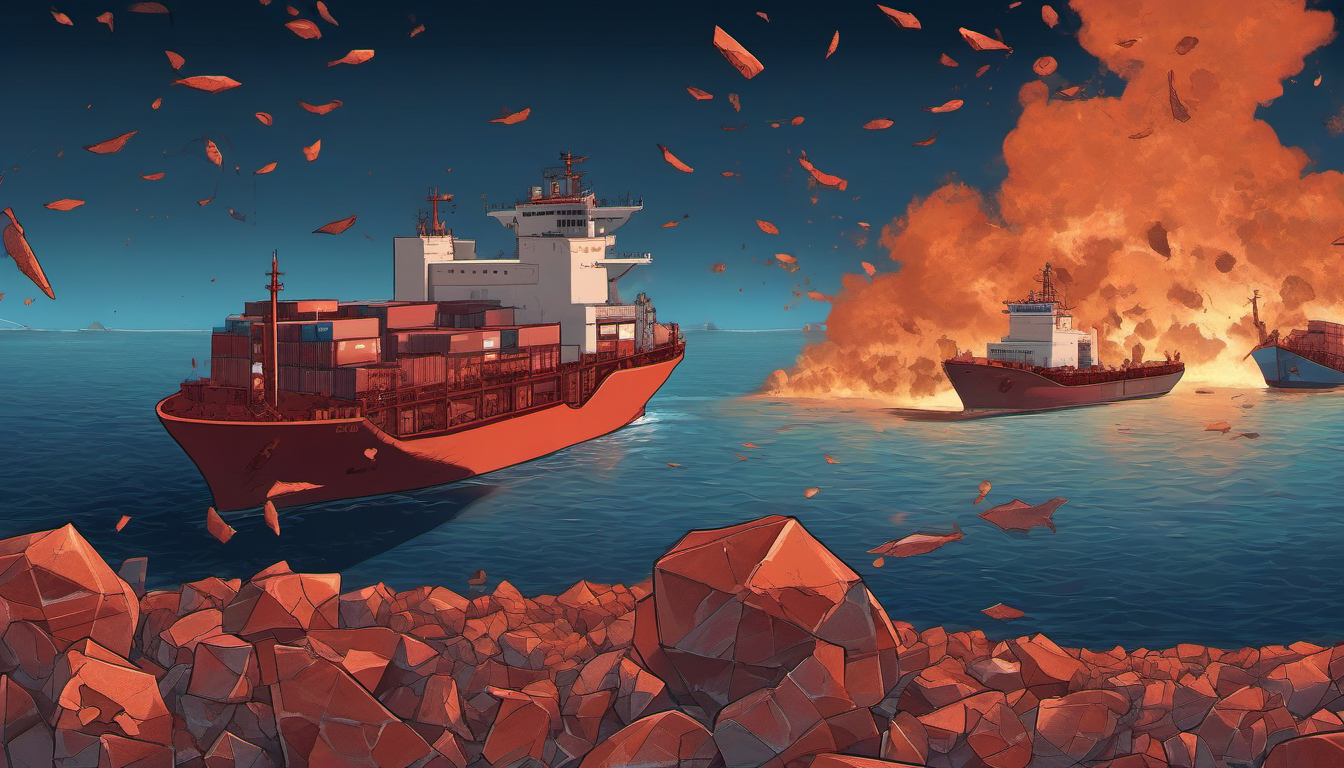
When underwriters cancel policies faster than admirals can lay mines, the financial infrastructure of global trade becomes the true chokepoint
Executive Summary
- Marine war-risk insurers began canceling policies for Persian Gulf vessels within hours of the US-Israel strikes on Iran — before any mine was laid or any ship physically blocked
- The insurance cancellation mechanism creates a de facto economic blockade more effective than any naval operation: without coverage, ships cannot transit, cargo cannot be financed, and letters of credit become void
- War-risk premiums are surging 50%+ from already-doubled levels, with some underwriters refusing to quote at any price — threatening $500 billion in annual Persian Gulf trade
- This represents a structural shift in how wars create economic damage: the financial infrastructure of trade is now more fragile than the physical infrastructure
Chapter 1: The Saturday Cancellation
At approximately 04:30 UTC on Saturday, February 28, 2026, the first American cruise missiles struck Tehran. By 09:00 UTC — before most London-based insurance executives had finished their morning coffee — cancellation notices were already being sent to shipowners with vessels insured for Persian Gulf transit.
The timing was extraordinary. In the Lloyd's of London market, where roughly 60% of global marine war-risk policies originate, the standard operating procedure during geopolitical escalation follows a familiar rhythm: monitor, assess, adjust pricing. What happened on Saturday was different. Underwriters skipped assessment entirely and moved directly to cancellation.
"Cancellation notices are part of a standard process during heightened geopolitical risk," industry sources told RegTechTimes. But the speed and scope were anything but standard. Within 12 hours of the first strikes, every major war-risk syndicate at Lloyd's had issued 7-day cancellation notices for vessels trading through the Persian Gulf and the Strait of Hormuz — a waterway through which 20% of global petroleum liquids consumption, worth approximately $500 billion in annual trade, transits daily.
The mechanism is simple but devastating. Marine war-risk insurance is a separate policy from standard hull and cargo coverage. It covers damage or loss from acts of war, terrorism, or military conflict. Without it, a vessel worth $100-300 million is effectively uninsurable in a conflict zone. And without insurance, the entire chain of maritime commerce — from letters of credit to cargo financing to port entry requirements — breaks down.
Prior to the latest escalation, war-risk premiums for ships moving through the Gulf sat at around 0.25% of hull value. After the June 2025 strikes on Iran's nuclear facilities, those premiums had already doubled to approximately 0.5%, with panic-peak quotes touching 1%. For a Q-Flex LNG carrier valued north of $200 million, Forbes reported, that translated to $0.10-0.15 per million BTU in structural cost.
Now, brokers indicate premiums could increase by 50% or more — pushing voyage costs for a $100 million vessel from $250,000 to $375,000 or beyond. But the price is almost beside the point. The real question is whether underwriters will quote at all.
Chapter 2: The Anatomy of a Financial Blockade
To understand why insurance cancellation functions as a blockade, one must follow the chain of dependencies that undergirds every commercial voyage.
Link 1: The Insurance Requirement. Port state control authorities in virtually every major trading nation require vessels to carry valid war-risk insurance before entering or departing ports. Without it, a vessel is legally stranded.
Link 2: The Financing Chain. Banks that finance cargo — through letters of credit, trade finance facilities, or commodity financing — require proof of insurance as a condition of lending. When war-risk coverage disappears, the financing evaporates simultaneously. An oil trader cannot purchase 2 million barrels of Saudi crude if the bank financing the transaction has no assurance the cargo will survive transit.
Link 3: The P&I Club Connection. Protection and Indemnity clubs — the mutual insurers that cover third-party liabilities — typically include war exclusion clauses that activate when a region is designated a war zone. The International Group of P&I Clubs, which covers approximately 90% of global ocean-going tonnage, can effectively veto transit through a conflict zone by withdrawing coverage.
Link 4: The Reinsurance Cascade. Behind every primary insurer sits a reinsurer, and behind them, a retrocessionaire. The reinsurance market concentrates catastrophic war risk among a handful of global players — Munich Re, Swiss Re, Berkshire Hathaway, and a few others. When these entities adjust their risk appetite, the effect cascades through every policy written at Lloyd's and beyond.
This four-link chain means that insurance cancellation achieves what a naval blockade attempts through force: the cessation of commercial traffic. And it does so faster, more comprehensively, and without the legal complications of maritime law governing physical blockades.
By Saturday evening, at least three vessels had reportedly altered course rather than proceed through the Strait of Hormuz. Maritime advisory firm EOS Risk reported that some vessels received radio communications warning that the strait was "closed." While no official closure was confirmed, the practical effect was identical: ships stopped moving.
Chapter 3: Historical Precedents — The Insurance Wars
The weaponization of marine insurance is not new. But its scale and speed have never been tested at the level now unfolding.
The Tanker War (1984-1988). During the Iran-Iraq "Tanker War," both sides attacked commercial shipping in the Persian Gulf, damaging or sinking over 400 vessels. War-risk premiums surged from negligible levels to 5-7.5% of hull value — a cost that was economically prohibitive for most shipowners. Lloyd's estimated total losses at $2 billion (approximately $5.5 billion in 2026 dollars). Kuwait chartered tankers under the US flag specifically to access US naval escorts, creating the "reflagging" precedent.
| Conflict | War-Risk Premium (% of Hull) | Duration | Vessels Affected |
|---|---|---|---|
| Tanker War 1984-88 | 5-7.5% | 4 years | 400+ attacked |
| Gulf War 1990-91 | 2-3% (initial surge) | 7 months | ~200 rerouted |
| Houthi Red Sea 2024-26 | 0.5-1.0% | Ongoing | 1,000+ rerouted |
| Epic Fury 2026 | 0.5%→? (cancellations) | Day 2 | 750+ stranded |
The Red Sea Crisis (2024-2026). Houthi attacks on commercial shipping forced war-risk premiums to 0.5-1.0% for Red Sea transit, prompting most major container lines to reroute around the Cape of Good Hope. The additional 10-14 days of voyage time and $1 million+ in extra fuel costs per transit effectively created a commercial blockade of the Suez Canal — without the canal itself being blocked. At peak, roughly 90% of container traffic diverted.
The Russian Insurance Squeeze (2022-2026). Western sanctions on Russian oil included restrictions on insurance services for vessels carrying Russian crude above the $60 price cap. Russia responded by building a "shadow fleet" of aging tankers operating with opaque insurance from non-Western providers. This demonstrated both the power of insurance as an economic weapon and its limitations — motivated actors will find workarounds, albeit at higher cost and risk.
The February 2026 situation differs from all precedents in one critical respect: the conflict involves the world's dominant insurance market (London/Lloyd's), the world's most important energy chokepoint (Hormuz), and simultaneous strikes on the capitals that host the region's largest commercial ports (Dubai, Abu Dhabi, Doha, Bahrain, Kuwait). There is no "safe" side of the Gulf to insure from.
Chapter 4: The Cascade Effects
The insurance cancellation triggers a series of economic cascades that extend far beyond shipping costs.
Energy Markets. Barclays analysts projected Brent crude could hit $100 per barrel when markets open Monday — a 37% spike from Friday's $72.87 close. Goldman Sachs' worst-case scenario, modeled before the strikes, saw Brent peaking at $110 if Iran closed Hormuz for a prolonged period. But these models assumed physical closure. The insurance-driven economic blockade may produce similar price effects even if no mine is laid.
LNG Markets. Qatar supplies approximately 20% of global LNG. All of it transits Hormuz. Japan, which has shifted 30% of its LNG portfolio to US sources, is better positioned than it was a year ago. But South Korea, Taiwan, and much of South and Southeast Asia remain critically dependent on Qatari volumes. LNG spot prices, already elevated, face the prospect of an asymmetric shock.
Asian Economies. India imports nearly half its crude through the Persian Gulf. Japan sources 75%, South Korea 60%, China 50%. The insurance disruption adds a layer of cost and uncertainty on top of any physical supply disruption. Central banks across Asia face the prospect of simultaneous currency depreciation (from higher energy import bills) and inflationary pressure — a toxic combination for economies already navigating the US tariff regime.
Trade Finance. The global trade finance gap — estimated by the Asian Development Bank at $2.5 trillion annually — will widen sharply if Gulf-related letters of credit become uninsurable. Small and medium enterprises in import-dependent economies, which already struggle to access trade finance, face potential exclusion from energy markets entirely.
Chapter 5: Scenario Analysis
Scenario A: Rapid De-escalation and Insurance Restoration (20%)
Premise: A ceasefire or significant de-escalation within 7-14 days allows underwriters to restore coverage at elevated but manageable premiums (1-2% of hull value).
Basis for probability: This scenario requires both the US/Israel and Iran to agree on a cessation of hostilities — unlikely given the regime-change language from Washington and Iran's vow of "no red lines." Historical precedent: the June 2025 nuclear facility strikes saw insurance normalize within 3-4 weeks, but the scale of February's strikes is categorically different.
Market impact: Brent stabilizes at $85-95. Gulf shipping resumes with significant war-risk surcharges passed to consumers. Asian energy costs rise 15-25%.
Scenario B: Prolonged Conflict with Partial Insurance Function (45%)
Premise: Fighting continues for weeks to months, but the Strait of Hormuz remains technically open with elevated risk. Underwriters offer coverage at extreme premiums (3-5% of hull value), effectively creating a "risk tax" on Gulf energy.
Historical parallel: The Tanker War (1984-88) saw continuous attacks on shipping for four years while trade continued at premium costs. During that period, war-risk premiums of 5-7.5% were absorbed by the global economy, though with significant inflationary consequences.
Trigger conditions: Iran does not physically close Hormuz but continues asymmetric harassment. US naval escorts enable some commercial traffic. Insurance remains available but expensive.
Market impact: Brent fluctuates between $90-120. Global inflation rises 1.5-2.5 percentage points. Central banks face impossible choices between rate hikes (to fight inflation) and rate cuts (to support growth). Energy import-dependent nations — India, Japan, South Korea — face current account deterioration.
Scenario C: Insurance Market Closure and De Facto Blockade (35%)
Premise: Sustained conflict and/or a major incident (vessel sinking, port attack) causes the insurance market to effectively close for Gulf transit. P&I clubs withdraw coverage. Trade finance freezes.
Historical parallel: No direct parallel exists. The closest analog is the complete cessation of container traffic through the Red Sea in early 2024, but the economic magnitude of Gulf closure would be 10-20x greater.
Trigger conditions: A major commercial vessel is sunk or severely damaged in the Strait. Iranian mines are confirmed in shipping lanes. Multiple Gulf ports sustain significant damage.
Market impact: Brent spikes above $130. Global recession probability rises above 70%. Asian economies face energy rationing. Gold breaks $6,000. The Federal Reserve faces the most acute policy dilemma since the 1970s oil embargo.
Chapter 6: Investment Implications
Energy: The structural repricing of Gulf transit risk benefits energy producers outside the conflict zone — US shale, Brazilian pre-salt, Guyana, and to a lesser extent, West African producers. Pipeline-connected supplies (US-to-Europe LNG, Russia-to-China crude) gain a structural premium over seaborne cargoes transiting chokepoints.
Insurance/Reinsurance: War-risk premium surges generate windfall profits for underwriters willing to bear the risk — but catastrophic losses for those caught with existing exposure. Munich Re, Swiss Re, and Beazley face asymmetric risk profiles.
Shipping: Tanker rates for non-Gulf routes will surge as global supply chains reroute. Suezmax and VLCC operators with vessels positioned outside the conflict zone benefit. Containership operators face route disruption cascading from Houthi Red Sea attacks combining with Gulf risks.
Defense: The iShares US Aerospace & Defense ETF is already up 14% in 2026. Continued military operations support further upside for major defense contractors.
Safe Havens: Gold, already above $5,000, faces a fresh catalyst. US Treasuries may see a safety bid despite fiscal concerns. The Japanese yen and Swiss franc traditionally benefit from risk-off flows, though yen strength would compound Japan's energy import pain.
Avoid: Airlines (fuel cost exposure), Asian utilities (LNG cost pass-through), emerging market sovereign debt (energy-driven current account stress), and any company with significant Gulf logistics exposure.
Conclusion
The most effective blockade in history may not involve a single mine, torpedo, or naval vessel. It is being executed by insurance underwriters in London, Tokyo, and Zurich — professionals who measure risk in basis points rather than kilotons.
The cancellation of marine war-risk policies for the Persian Gulf represents a structural innovation in economic warfare, one that exploits the dependencies embedded in the financial infrastructure of global trade. When a vessel cannot obtain insurance, it cannot obtain financing, it cannot enter ports, and it cannot carry cargo. The entire chain of commercial activity dependent on that vessel — from the wellhead in Saudi Arabia to the refinery in Yokohama — freezes.
This is the invisible blockade: a weapon that requires no navy to deploy, no international law to justify, and no military risk to maintain. It is, in the language of insurance markets, a "force majeure" — an event so extraordinary that normal rules cease to apply. But unlike natural disasters, this force majeure is entirely man-made, and its consequences will be measured not in days but in the structural repricing of every assumption that undergirds $500 billion in annual trade.
The question for Monday's market opening is not whether oil prices will spike. It is whether the financial architecture that makes 20% of global energy trade possible can survive the weekend.
Sources: Forbes, RegTechTimes, Business Insider, Barclays Research, Goldman Sachs, Deutsche Bank, EIA, Lloyd's of London market reports
Leave a Reply