
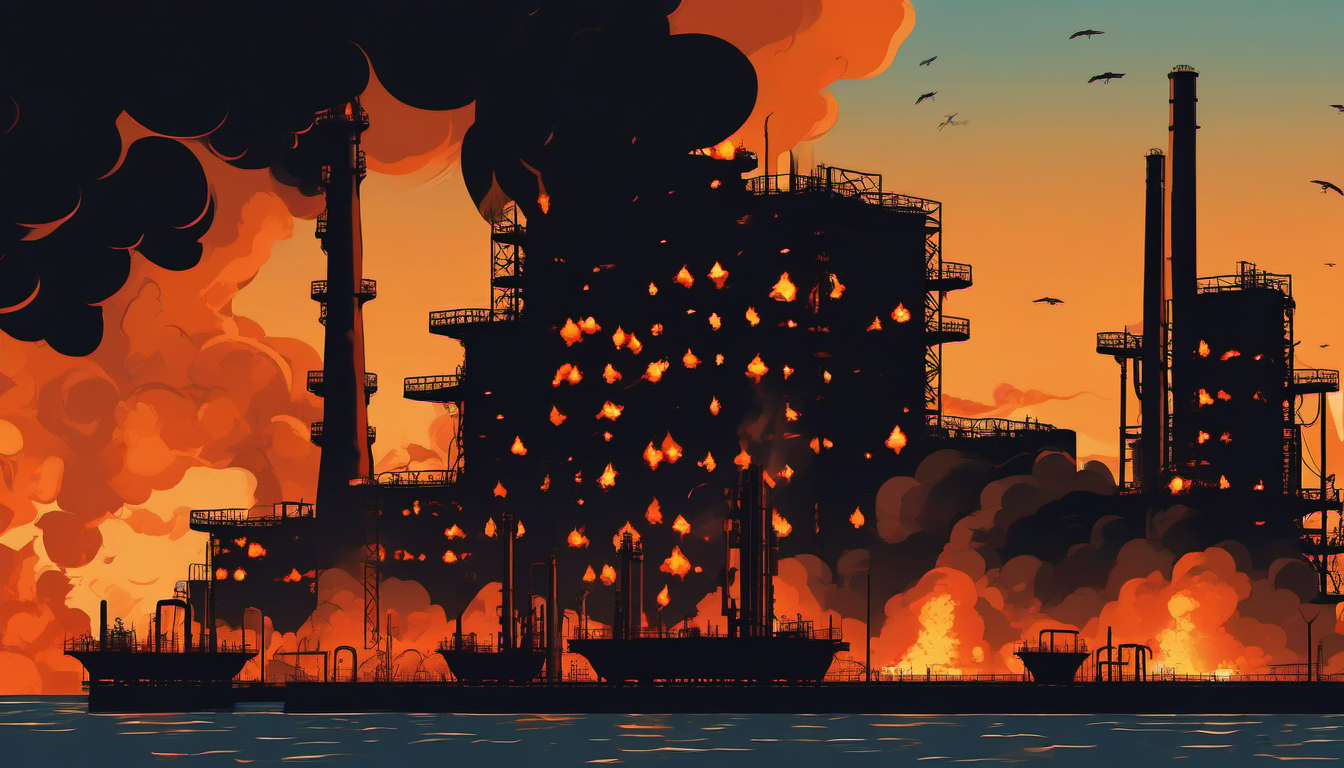
Iran's Shahed strike on Ras Tanura exposes the trillion-dollar fragility at the heart of global energy
Executive Summary
- Iran's drone strike on Saudi Aramco's Ras Tanura refinery—the world's largest oil export hub at 550,000 barrels per day—represents the most significant direct attack on Gulf oil infrastructure since the 2019 Abqaiq-Khurais assault, this time by a state actor in open warfare rather than through proxies.
- The strike lays bare a structural asymmetry that decades of military spending have failed to resolve: a $50,000 Shahed-136 drone can shut down facilities worth tens of billions of dollars, and no air defense system currently deployed can guarantee protection against saturation attacks.
- With Brent crude surging 13% to $82 on Monday, the Ras Tanura hit compounds the Strait of Hormuz closure to create a dual supply shock—physical destruction of refining capacity plus logistical blockade of export routes—that OPEC+ spare capacity cannot offset.
Chapter 1: Ras Tanura — The Crown Jewel Falls
On Monday, March 2, 2026, Iranian Shahed-136 drones struck Saudi Aramco's Ras Tanura refinery complex on the Persian Gulf coast. The facility—one of the world's largest integrated refining-and-export terminals—immediately halted operations. Aramco confirmed a fire at the site and the temporary shutdown of all loadings.
Ras Tanura is not just another refinery. With 550,000 barrels per day of refining capacity and an adjacent export terminal that handles roughly 6.5 million bpd of crude shipments, it is the single most important node in the global oil supply chain. At peak operation, approximately 7% of global seaborne crude passes through Ras Tanura. Its shutdown removes not only refining capacity but the physical infrastructure through which Saudi Arabia's spare production capacity reaches world markets.
The attack occurred on the third day of Operation Epic Fury, the US-Israeli military campaign that killed Supreme Leader Khamenei and triggered Iranian retaliatory strikes across six Gulf states. Tehran's decision to hit Ras Tanura—rather than purely military targets—signals a deliberate strategy: if Iran's oil infrastructure is destroyed, it will ensure the attacker's allies suffer proportionate economic damage.
Chapter 2: The Abqaiq Precedent — Lessons Unlearned
The ghost haunting Monday's strike is September 14, 2019. On that day, a swarm of 18 drones and 7 cruise missiles struck Saudi Aramco's Abqaiq processing facility and Khurais oil field. The attack—attributed to Iranian-backed Houthi forces, though widely believed to have been launched from Iranian territory—temporarily knocked out 5.7 million bpd of Saudi production, roughly 5% of global supply.
The 2019 attack exposed three uncomfortable truths that remain unresolved seven years later:
1. Air defense systems cannot stop saturation drone attacks. Saudi Arabia had deployed Patriot PAC-3 batteries around its oil facilities. None intercepted the Abqaiq attackers. The drones flew low, exploiting radar blind spots, and approached from the north—a direction the defense architecture was not optimized to cover. In 2026, despite billions spent on additional air defense procurement, the fundamental physics remain the same: low-flying, slow-moving drones present a detection challenge that expensive missile systems designed for ballistic threats are poorly suited to address.
2. The cost asymmetry is devastating. The 2019 Abqaiq attack cost an estimated $2 million in drones and missiles. It caused an immediate $12 billion spike in oil market capitalization losses in a single day. The Ras Tanura strike likely cost Iran less than $500,000 in Shahed-136 units. The refinery's replacement value exceeds $10 billion. The facility processes and exports energy worth roughly $400 million per day at current prices. This is the most lopsided cost-exchange ratio in modern warfare outside of cyber operations.
3. Concentration is the vulnerability. Saudi Arabia's oil infrastructure is extraordinarily concentrated. Five mega-facilities—Abqaiq, Ras Tanura, Yanbu, Jubail, and Ras al-Khair—handle the vast majority of the kingdom's production, processing, and export. This concentration was designed for economic efficiency. It is a catastrophic vulnerability in an era of cheap precision-guided munitions.
| Factor | Abqaiq 2019 | Ras Tanura 2026 |
|---|---|---|
| Attacker | Proxy (Houthis/Iran) | State actor (Iran directly) |
| Weapons | 18 drones + 7 cruise missiles | Shahed-136 drones (number TBC) |
| Capacity offline | 5.7M bpd processing | 550K bpd refining + ~6.5M bpd export terminal |
| Oil price impact | +15% intraday, reversed in 2 weeks | +13% Day 1, ongoing escalation |
| Recovery time | 2 weeks partial, 2 months full | Unknown—amid active warfare |
| Air defense result | Complete failure | Partial interception, facility still hit |
| Geopolitical context | Proxy conflict, limited escalation | Full-scale state-on-state war |
The critical difference: In 2019, Saudi Arabia restored production within weeks because the conflict was contained. In 2026, Ras Tanura was struck during an active multi-front war with no ceasefire in sight. Repair crews cannot operate under ongoing military threat. Replacement components cannot transit through a blockaded Strait of Hormuz.
Chapter 3: The Dual Supply Shock
The Ras Tanura strike does not exist in isolation. It compounds three simultaneous disruptions that together constitute the worst energy supply crisis since the 1973 Arab oil embargo:
1. Strait of Hormuz effective closure. Since Saturday, IRGC naval forces have declared the strait a "war zone." Marine tracking data shows 750+ vessels at anchor on either side, unable to transit. The International Maritime Organization has urged ships to avoid the area. Maersk suspended all strait and Suez canal transits. War risk insurance has been cancelled for Gulf waters, creating an economic blockade even in areas where military activity is minimal.
2. Physical infrastructure destruction. Beyond Ras Tanura, Iranian missiles struck targets across Bahrain (US Fifth Fleet), Qatar, UAE (including Dubai's Burj al-Arab and airport), and Kuwait. DP World suspended operations at Jebel Ali, the region's largest port. Multiple Gulf airports closed. The physical infrastructure of Gulf commerce—not just oil—is under attack.
3. OPEC+ spare capacity is trapped. OPEC+ agreed on Sunday to increase output by 206,000 bpd for April. But as Wood Mackenzie analysts noted, "additional volumes and ultimately most of OPEC's spare capacity are inaccessible while the waterway remains closed." Saudi Arabia holds approximately 3 million bpd of spare capacity—the world's only meaningful buffer—but cannot export it through a blockaded strait. The Ras Tanura shutdown further reduces the capacity that could flow even if the strait reopens.
The net effect: global oil markets face the removal of approximately 15-20 million bpd of seaborne supply (strait closure) plus the destruction of 550,000 bpd of refining capacity (Ras Tanura), with no near-term mechanism to compensate. The US Strategic Petroleum Reserve, drawn down to approximately 350 million barrels, provides roughly 23 days of coverage at full release rates—assuming domestic logistics can deliver.
Chapter 4: Scenario Analysis
Scenario A: Rapid De-escalation (15%)
Trigger: Trump-Iran back-channel produces ceasefire within 7-10 days. Strait reopens within 2 weeks. Ras Tanura partially operational within 4-6 weeks.
Oil impact: Brent spikes to $90-100, settles at $75-80 within a month.
Rationale: Trump has stated Iran "wants to talk," but Tehran's refusal (Larijani's denial of resuming negotiations) and the killing of Khamenei make rapid diplomacy extremely unlikely. Iran's new leadership—a 3-person transitional committee—lacks the authority to make concessions. Historical precedent (1988 Iran-Iraq War ceasefire) required months of negotiation even after military stalemate.
Scenario B: Protracted Conflict, Managed Escalation (50%)
Trigger: Military operations continue 3-6 weeks as Trump suggested. Strait remains effectively closed for 2-4 weeks, then partially reopens under military escort. Ras Tanura offline 2-3 months.
Oil impact: Brent sustains $85-100 range for Q2 2026. Gasoline prices in US and Europe rise 30-50%.
Rationale: This mirrors Trump's stated timeline ("four weeks or less"). The 1984-88 Tanker War precedent shows that shipping can partially resume under military escort, albeit at vastly higher insurance costs. Barclays' $100/barrel forecast and UBS's $120 worst-case scenario both assume this duration range. Key variable: whether Iran launches follow-up strikes on Saudi infrastructure.
Scenario C: Uncontrolled Escalation (35%)
Trigger: Iran sustains attacks on Gulf oil infrastructure across multiple nations. Hezbollah fully enters the conflict (already showing signs). Strait of Hormuz closed for 4+ weeks. Multiple refineries targeted.
Oil impact: Brent exceeds $120, potentially $150+. Global recession triggered by energy shock.
Rationale: Iran has already struck targets in 7 countries in 72 hours—a pace that suggests willingness to expand rather than contain. The Ras Tanura strike specifically demonstrates intent to weaponize oil infrastructure. If Yanbu (Red Sea coast) or Jubail are also struck, Saudi Arabia loses its bypass options. The 1973 precedent: a 25% supply reduction caused a 300% price increase. Today's removal of 20% of seaborne supply could produce a proportionate shock.
Chapter 5: Investment Implications
Energy sector: The Ras Tanura strike validates the structural bull case for energy equities. Shell and BP rose ~6% on Monday; Saudi Aramco +2.5% on Riyadh's exchange. Companies with non-Gulf production—US shale producers (Pioneer, ConocoPhillips, EOG), Brazilian pre-salt (Petrobras), Guyana (Exxon)—enjoy both higher prices and zero conflict exposure. Dangote Refinery in Nigeria emerges as a strategic swing supplier.
Defense and air defense: The drone asymmetry problem creates urgent demand for counter-UAS systems. Companies with operational solutions—RTX (Coyote), Northrop Grumman (FAAD C2), Rafael (Iron Dome/Iron Beam)—benefit from both Gulf and European procurement. The failed air defense at Ras Tanura will accelerate already massive spending.
Shipping and insurance: War risk insurance premiums have risen 50%+ for Gulf waters. Lloyd's of London has effectively suspended new coverage for Hormuz transit. Tanker companies with non-Gulf exposure benefit (Frontline, Euronav); those dependent on Gulf routes face existential disruption. Container shipping rates for Asia-Europe will spike as Suez-Hormuz alternative routes are both compromised.
Refining margins: Global refining capacity was already tight before Ras Tanura. Removing 550,000 bpd of capacity—plus potential follow-up strikes on other facilities—will widen crack spreads dramatically. Valero, Marathon Petroleum, Phillips 66, and Indian refiners (Reliance Jamnagar) stand to benefit.
Gold and safe havens: Gold hit $5,408/oz on Monday, up 2.5%. The combination of war, oil shock, and central bank paralysis (Fed's impossible position between war inflation and AI deflation) supports continued precious metals strength.
Conclusion
The ghost of Abqaiq has returned, and it is no longer a ghost. The 2019 attack was a warning shot fired through proxies that the world chose to forget within weeks as Saudi production recovered. The 2026 Ras Tanura strike is a direct state attack during active warfare, with no prospect of rapid recovery.
The fundamental lesson is architectural: the global energy system was built for efficiency, with massive concentrated facilities connected by a single maritime chokepoint. That architecture assumed a geopolitical environment in which state-on-state attacks on energy infrastructure were unthinkable. That assumption died on March 2, 2026.
The investment implication extends beyond the current crisis. Even when this war ends, the demonstrated vulnerability of concentrated oil infrastructure to cheap drone warfare will permanently reprice the risk premium on Gulf energy. The era of $60-70 oil as a baseline may be over—not because supply is scarce, but because the infrastructure that delivers it can no longer be taken for granted.
Leave a Reply