
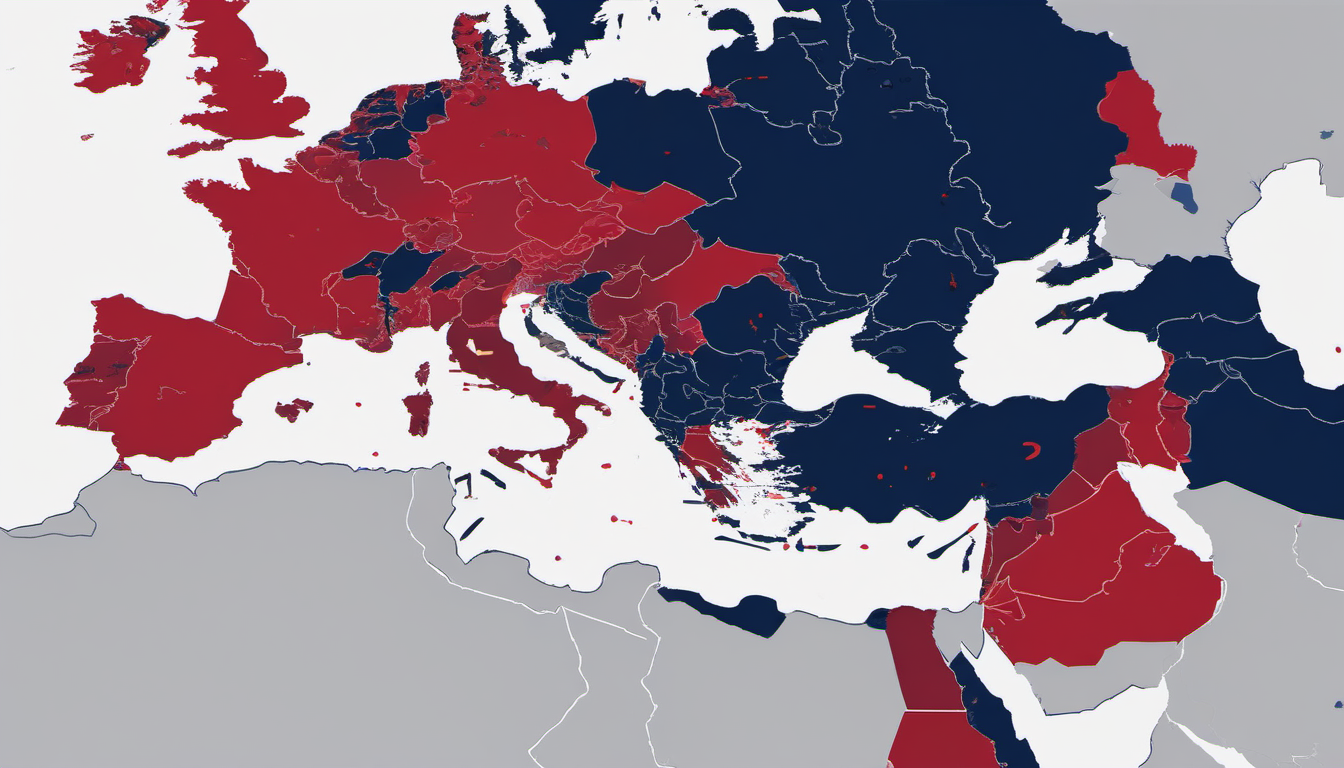
From bilateral strikes to regional conflagration — the anatomy of a war that refuses to stay contained
Executive Summary
- What began as a US-Israeli surgical strike on Iran has metastasized into a multi-front conflict involving at least seven countries in just 72 hours, with Hezbollah opening a northern front, Iraqi militias attacking Baghdad airport, and a suspected drone hitting a British base in Cyprus
- The killing of Khamenei — intended to decapitate Iran's command structure — has instead activated the very proxy network it was meant to paralyze, creating simultaneous escalation vectors that exceed any single military's capacity to manage
- The conflict's rapid geographic spread follows a pattern historians call "alliance chain-ganging" — the same mechanism that turned a regional assassination in 1914 into a world war — and raises the question of whether the Middle East has crossed a point of no return
Chapter 1: The 72-Hour Timeline of Escalation
The speed at which Operation Epic Fury expanded from a bilateral US-Israeli operation against Iran to a multi-theater conflict has stunned military analysts and diplomats alike.
Saturday, February 28 (Day 1): US B-2 stealth bombers and Israeli F-35s launched coordinated strikes on Iran's ballistic missile facilities, air defenses, and military leadership targets in Tehran. Supreme Leader Khamenei was killed, along with former President Ahmadinejad and — according to Trump — 48 senior leaders "in one shot." The operation appeared precisely calibrated to destroy Iran's retaliatory capability before it could be used.
Sunday, March 1 (Day 2): Iran's surviving military command launched its "scorched earth" retaliation. Hundreds of missiles and drones struck six Gulf states — the UAE, Bahrain, Qatar, Kuwait, Saudi Arabia, and Oman — killing at least five civilians and injuring over 100. Three US service members died in Kuwait, the first American combat fatalities. A girls' elementary school in Minab, southern Iran, was struck, killing 148 children and staff in what Iranian media called the war's worst mass casualty event. The E3 — Britain, France, and Germany — offered "defensive" military support to the US.
Monday, March 2 (Day 3): Hezbollah launched missiles and drones at Israel from Lebanon — the first attack since the November 2024 ceasefire — triggering massive IDF strikes on Beirut's Dahiyeh suburb under "Operation Roaring Lion." An Iraqi Shia militia, Saraya Awliya al-Dam, claimed a drone attack on Baghdad airport targeting US troops. A suspected drone struck RAF Akrotiri, the British base in Cyprus, with no casualties. Eight countries' airspace remained closed. Brent crude surged 13% to $82.
In 72 hours, the conflict had spread from Iran to Lebanon, Iraq, the Gulf states, and Cyprus — five distinct theaters, each with its own escalation logic.
Chapter 2: The Proxy Paradox — Why Decapitation Activated the Network
The strategic logic behind killing Khamenei rested on a theory that eliminating Iran's supreme decision-maker would paralyze its proxy network. The "axis of resistance" — Hezbollah, Iraqi militias, the Houthis, Hamas remnants — depended on Tehran's command and resource flow. Cut the head, the theory went, and the body dies.
The opposite happened.
Hezbollah's decision to enter the war illustrates why. The group's statement explicitly cited two motivations: retaliation for Khamenei's killing and "repeated Israeli aggressions" — referring to the near-daily IDF strikes in Lebanon that continued long after the November 2024 ceasefire. In other words, Hezbollah had its own reasons to fight, independent of Iranian direction.
This reflects a fundamental misunderstanding of how proxy networks operate in 2026. After decades of development, Iran's proxies have evolved from obedient satellites into semi-autonomous actors with local grievances, independent funding streams, and domestic political constituencies. Hezbollah is a Lebanese political party with parliamentary seats. Iraqi militias control government ministries. The Houthis run a de facto state.
Killing the patron doesn't disable the network — it removes the one actor who might have restrained it.
The historical parallel is instructive. When Austria-Hungary issued its ultimatum to Serbia in July 1914, it expected Russia would back down without its key ally. Instead, the removal of diplomatic constraint activated alliance commitments rather than disabling them. Political scientist Glenn Snyder called this "chain-ganging" — when alliance partners drag each other into conflicts they might otherwise avoid.
Chapter 3: Five Theaters, Five Escalation Logics
Each front in this expanding war operates under its own strategic dynamics, making unified management nearly impossible.
Theater 1: Iran Proper
US-Israeli strikes continue targeting missile sites, naval bases, and military infrastructure. Trump claims the operation could last "four weeks or less." But Iran's surviving military has dispersed into hardened underground facilities built precisely for this scenario. The 3-person transitional leadership committee faces a succession crisis that could produce either negotiation or further radicalization.
Theater 2: The Gulf States
Iran's retaliatory strikes on Bahrain, Kuwait, Qatar, and the UAE shattered the region's carefully maintained neutrality. Dubai's Burj Al Arab and airport were hit. The Gulf Cooperation Council reserved "the right to respond" — a diplomatic escalation that could transform these countries from bystanders into belligerents. UAE and Dubai stock markets closed for two days.
Theater 3: Lebanon
Hezbollah's entry marks the collapse of the 15-month-old ceasefire. The IDF's "Operation Roaring Lion" — a name suggesting preparation for a multi-front scenario — indicates Israel expected this development. But Lebanon's civilian population, which never recovered from the 2024 war, faces renewed devastation. Lebanese President Joseph Aoun cautioned against being "drawn into regional conflict," but that ship has sailed.
Theater 4: Iraq
The Saraya Awliya al-Dam drone attack on Baghdad airport targeting US troops opens the most dangerous vector for American escalation. Unlike Gulf state strikes (which Iran can plausibly direct), Iraqi militia attacks come from groups with ambiguous ties to Iran's surviving command structure. Any US retaliation risks destabilizing the Iraqi government and reopening the 2019-2020 cycle of tit-for-tat strikes.
Theater 5: The Eastern Mediterranean
The suspected drone strike on RAF Akrotiri in Cyprus brings the war to NATO territory for the first time. While the UK Ministry of Defence reported no casualties and the attack may have been a stray or warning shot, it crosses a qualitative threshold. Britain had just agreed to allow US "defensive" strikes from its bases — making them legitimate military targets under international law.
Chapter 4: The Minab Massacre and the War's Moral Calculus
The strike on a girls' elementary school in Minab, which killed 148 children and staff, represents a potential inflection point. While neither the US nor Israel has claimed responsibility for the specific strike, the sheer scale of civilian casualties — the worst single-incident death toll of the war — creates several cascading effects.
First, it hardens Iranian public opinion. Reports from Tehran indicate that far from rising up against the regime as Trump urged, most Iranians are sheltering in place while Basij paramilitaries control the streets. The Minab massacre transforms any potential popular uprising into rallying around the flag.
Second, it complicates the E3's defensive posture. Britain, France, and Germany offered to help stop Iranian attacks — but how do European democracies justify assisting an operation that killed 148 schoolchildren? Already, protests are gathering outside US embassies in London and Paris.
Third, it provides propaganda ammunition that will outlast the war itself. The image of a destroyed school will define this conflict in the Global South for a generation, much as the Abu Ghraib photographs defined Iraq.
The 1991 Amiriyah shelter bombing in Baghdad, which killed 408 civilians, offers a precedent. It didn't stop the Gulf War, but it permanently damaged American credibility in the region and shaped two decades of anti-American sentiment.
Chapter 5: Scenario Analysis — Where This Goes from Here
Scenario A: Contained Escalation (25%)
Premise: The war remains limited to current theaters. Hezbollah conducts symbolic strikes but avoids full-scale war. Iraqi militias are deterred. Gulf states accept compensation rather than retaliate.
Trigger conditions: Iran's transitional leadership signals willingness to negotiate (Trump claims they already want to talk). Hezbollah calculates that full war would destroy Lebanon. Gulf states prioritize economic stability.
Historical precedent: The 2019 Saudi Aramco attack — massive provocation that didn't trigger regional war because all parties chose restraint.
Why only 25%: The Minab massacre, Khamenei's killing, and Gulf civilian casualties create domestic pressures for retaliation that rational calculation may not overcome.
Scenario B: Expanding Regional War (50%)
Premise: The conflict continues spreading. Hezbollah escalates beyond symbolic strikes. Gulf states conduct limited military operations against Iranian assets. The Houthis reopen the Red Sea front. Multiple simultaneous theaters overwhelm US force projection.
Trigger conditions: Another mass casualty event in Iran or the Gulf. Israeli ground operations in Lebanon. Iraqi government collapse. Houthi anti-ship attacks resume.
Historical precedent: The 1973 Yom Kippur War, which began as an Egyptian-Syrian-Israeli conflict but drew in superpower confrontation, oil embargoes, and global economic disruption.
Why 50%: The alliance chain-ganging dynamic is already active. Each new front creates new grievances and new actors with incentives to escalate.
Scenario C: Great Power Confrontation (25%)
Premise: China or Russia intervene — not militarily, but through actions that create direct confrontation with the US. China cuts off remaining economic cooperation. Russia provides military intelligence to Iran. The conflict becomes a proxy for great power competition.
Trigger conditions: Chinese nationals killed in Gulf strikes. Russian military advisors killed in Iran. UNSC deadlock leads to unilateral actions. Hormuz closure causes energy crisis that forces Chinese intervention.
Historical precedent: The Korean War, where a regional conflict escalated to great power confrontation within months.
Why 25%: China's NPC "Two Sessions" opens March 4-5 — Beijing is preparing its 15th Five-Year Plan amid this chaos. Xi faces a decision between strategic patience and demonstrating alliance credibility. Russia, already stretched by Ukraine, has limited bandwidth.
Chapter 6: Investment Implications
Energy: Brent at $82 with 13% single-day surge. Hormuz closure threatens 20% of global supply. Goldman Sachs' pre-war $6,300 gold target now looks conservative. Energy equities (Exxon, Chevron, Saudi Aramco) benefit from price spike but face demand destruction risk if crisis persists beyond weeks.
Defense: The HALO trade (Heavy Assets, Low Obsolescence) accelerates. European defense stocks (Rheinmetall, BAE Systems, Leonardo) benefit from E3 military activation. Israel's defense sector faces dual demand — domestic operations plus export inquiries from newly anxious Gulf states.
Aviation & Insurance: Eight countries' airspace closures strand hundreds of thousands. Emirates, Qatar Airways, Etihad face existential disruption. War risk insurance premiums have jumped 50%, creating a financial blockade even where physical access is possible. Lloyd's of London is the critical chokepoint.
Safe Havens: Gold, Swiss franc, Japanese yen, and US Treasuries benefit from risk-off flows. But the traditional safe-haven framework is strained — US Treasuries face selling pressure from countries angry about American military action.
| Asset | Pre-War Level | Current | Change | Outlook |
|---|---|---|---|---|
| Brent Crude | $72.50 | $82.00 | +13.1% | $90-120 if Hormuz persists |
| Gold | $5,050 | $5,200+ | +3% | $5,500-6,000 |
| S&P 500 Futures | 5,850 | 5,720 | -2.2% | Volatility spike |
| Nikkei | 42,500 | 41,850 | -1.5% | Asia energy vulnerability |
| DXY | 94.2 | 93.8 | -0.4% | Mixed — safe haven vs. war cost |
Conclusion
The most dangerous aspect of the current situation is not any single front — it is the interaction between them. Each escalation in one theater creates pressure for escalation in others, producing a feedback loop that no single actor controls.
Trump's claim that the operation could end in "four weeks or less" reflects the same optimism that preceded every modern American military engagement. Iraq was supposed to last weeks. Afghanistan was supposed to be limited. Libya was supposed to be over after Gaddafi fell.
The difference this time is the speed of contagion. It took weeks for the Iraq War to produce regional instability. Epic Fury produced five theaters in 72 hours. In a world of instant communication, autonomous proxy networks, and interconnected energy infrastructure, the old assumption that wars can be geographically contained may be the most dangerous illusion of all.
Sources: AP News, The Guardian, NPR, Times of Israel, Indian Express, Business Today India, CBSNEWS live updates
Leave a Reply