
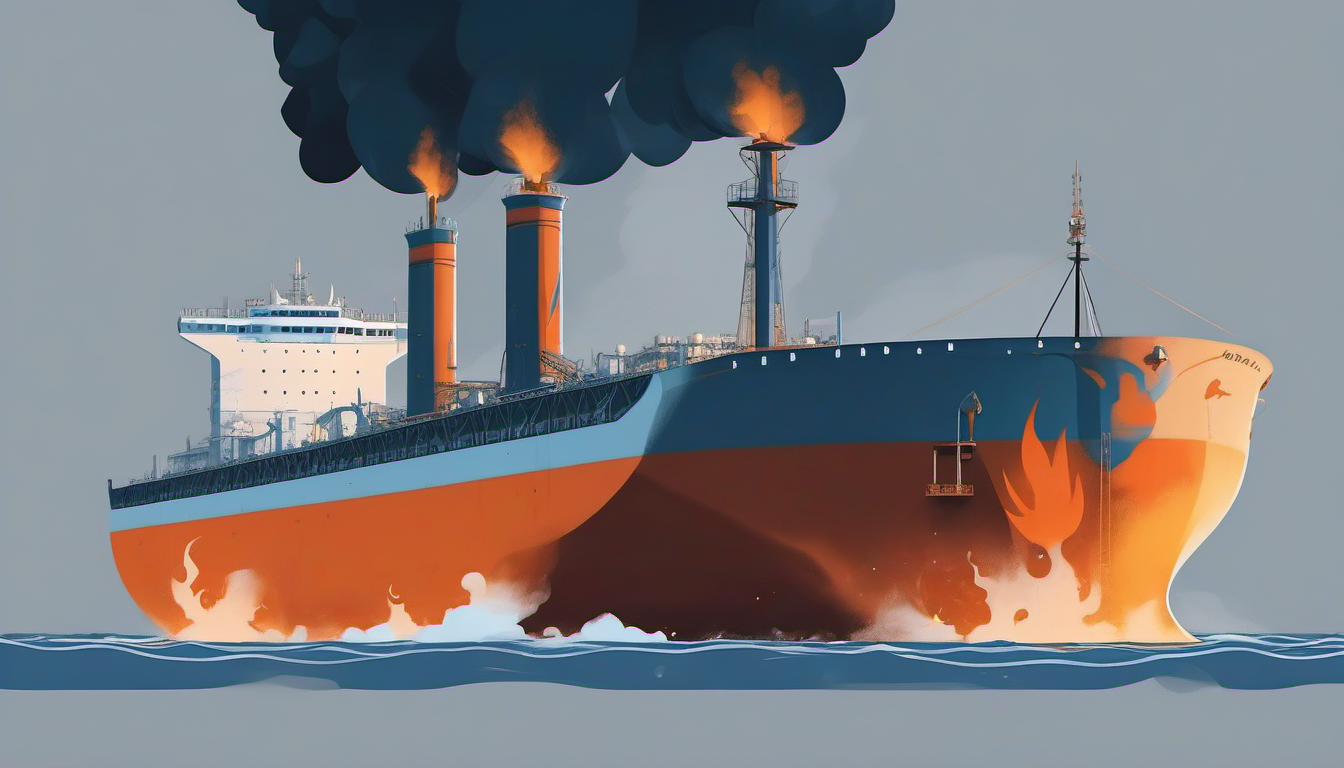
The Hormuz blockade doesn't just threaten oil — it has trapped the world's largest LNG exporter behind a naval chokepoint, creating an energy crisis that could outlast the war itself
Executive Summary
- Qatar, the world's largest LNG exporter, is completely landlocked by the Hormuz blockade — unlike oil producers with pipeline alternatives, Qatar has zero bypass options for its 106 million tonnes per year of LNG exports
- 14+ LNG tankers have already U-turned, slowed, or stopped near the Strait; a Nigerian vessel bound for Qatar aborted its Europe-bound trip entirely
- Europe, which replaced Russian pipeline gas with Qatari LNG, now faces a potential second energy crisis in four years — with gas storage at just 35%, the lowest in five years
- Japan and South Korea, which receive 100% of their LNG through Hormuz, face the most acute vulnerability among developed economies
Chapter 1: The Invisible Chokepoint
When Iran's Revolutionary Guards broadcast their VHF warning on February 28 — "no ship is allowed to pass the Strait of Hormuz" — the world's attention fixed on oil. Brent crude surging toward $80, OPEC+ emergency meetings, strategic petroleum reserves being tapped. But the more consequential disruption may be one that receives far less attention: liquefied natural gas.
Approximately 20% of global LNG trade passes through the Strait of Hormuz. Unlike oil, which has pipeline alternatives — Saudi Arabia's East-West pipeline can bypass the strait with 5 million barrels per day of capacity, and the UAE's Habshan-Fujairah pipeline offers another 1.5 million — Qatar's LNG has no alternative route whatsoever.
Qatar sits at the tip of a peninsula jutting into the Persian Gulf. Its massive Ras Laffan Industrial City, home to the world's largest LNG export terminal, loads tankers that must transit the Strait of Hormuz to reach any customer anywhere in the world. There is no pipeline to the Indian Ocean. There is no overland route. There is no bypass.
This geographic reality transforms the Hormuz crisis from an oil supply disruption — serious but manageable through reserves and alternatives — into something far more structural: the complete severing of the world's single largest LNG supply source from global markets.
Chapter 2: Qatar's Gas Empire
To understand the scale of what's at stake, consider Qatar's position in global energy markets. Despite being smaller than Connecticut, Qatar produces approximately 106 million tonnes of LNG annually — roughly 22% of global supply. The country was in the process of expanding capacity to 142 million tonnes per year through its North Field expansion project, a $30 billion investment that was supposed to cement its dominance through 2030.
| Metric | Qatar | Global Context |
|---|---|---|
| LNG production | 106 Mt/year | 22% of world supply |
| Planned capacity (2027) | 142 Mt/year | Would be 26% |
| Revenue (2025) | ~$85 billion | Largest per-capita income |
| Key customers | Japan, South Korea, China, UK, Italy | 5 continents |
| Alternative export routes | Zero | Only via Hormuz |
Qatar's North Field is the world's single largest non-associated natural gas field, shared with Iran's South Pars field. The irony is brutal: the war targeting Iran is disrupting the export of gas from a field that Iran itself partially owns.
Chapter 3: Europe's Second Energy Crisis
Europe's vulnerability is particularly acute because it is self-inflicted — in the best possible sense. After Russia invaded Ukraine in 2022, European nations undertook a historic pivot away from Russian pipeline gas. Russian gas, which once supplied 40% of European demand, has been largely replaced by LNG imports, primarily from the United States, Qatar, and increasingly from new producers like Mozambique and Senegal.
But this diversification created a new concentration risk. EU gas storage stood at just 35% entering March 2026 — the lowest level in five years — after a cold winter depleted reserves. The EU had planned to refill storage through spring and summer LNG purchases. Qatar was expected to supply approximately 15-18% of Europe's LNG imports in 2026, with long-term contracts already signed by major utilities in Germany, Italy, the Netherlands, and the UK.
The UK's situation is especially precarious. Britain closed its Rough storage facility in 2017 and now holds only about 4-5 days of gas reserves at peak winter demand. Prime Minister Starmer's decision to allow UK bases for strikes on Iran — the very strikes causing the Hormuz blockade — has created a policy contradiction that energy analysts have been quick to note.
"Europe spent four years and hundreds of billions of euros to escape dependence on one supplier through one chokepoint," said a Kpler analyst. "It has now found itself dependent on a different supplier through a different chokepoint."
European Gas Vulnerability Table
| Country | Qatar LNG share | Storage level | Days of reserve |
|---|---|---|---|
| UK | ~12% of imports | 4-5 days | Critical |
| Italy | ~15% of imports | ~38% | Moderate |
| Germany | ~8% of imports | ~32% | Low |
| France | ~6% of imports | ~40% | Moderate |
| Netherlands | ~10% of imports | ~28% | Low |
Chapter 4: Asia's Frozen Pipeline
If Europe's situation is concerning, Asia's is existential. Japan imports roughly 75% of its energy through the Strait of Hormuz — and virtually 100% of its Qatari LNG. South Korea is in a similar position. These are not emerging economies that can absorb energy shocks; they are advanced industrial economies whose manufacturing sectors depend on reliable gas supplies.
Japan's JERA — the world's largest LNG buyer — has long-term contracts with QatarEnergy for approximately 7 million tonnes per year. These contracts typically specify delivery on a "delivered ex-ship" basis, meaning Qatar bears the shipping risk. But no contract can deliver gas through a closed waterway.
The timing compounds the crisis. Japan's fiscal year ends March 31, and utilities typically build inventory in February-March for the shoulder season. With 14+ LNG tankers already diverted, spot LNG prices in Asia are expected to surge when markets open Monday, potentially testing the records set during the 2022 European energy crisis.
South Korea faces an additional vulnerability: its nuclear fleet has been operating at reduced capacity after safety inspections, increasing reliance on gas-fired generation. The country's gas reserves cover approximately 14 days of consumption — barely enough to weather a two-week disruption.
China, the world's largest LNG importer, is somewhat better positioned. It has diversified its pipeline gas supply through the Power of Siberia pipeline from Russia and expanded domestic production. But China still imports approximately 40% of its LNG through or near the Hormuz chokepoint, and its strategic gas reserves remain modest relative to consumption.
Chapter 5: The LNG Tanker Bottleneck
The physical logistics of LNG make the Hormuz crisis qualitatively different from an oil disruption. Oil can be stored relatively easily in tanks, caverns, and even floating storage. It can be rerouted through pipelines. It can survive weeks on the water without degradation.
LNG is different. It must be maintained at -162°C (-260°F) throughout transportation. LNG carriers are specialized vessels — there are approximately 700 in the global fleet — and they cannot simply divert to alternative loading terminals because those terminals don't exist in Qatar's case.
The 14 tankers that Kpler identified as having slowed, U-turned, or stopped near the Strait represent approximately 1 million tonnes of LNG — roughly one week of Qatar's exports. If the blockade persists beyond a few days, the consequences cascade:
- Day 1-3: Tankers in the Gulf queue or anchor. Spot prices surge 30-50%.
- Week 1-2: Qatar reduces liquefaction as storage fills. European and Asian utilities scramble for US Gulf Coast cargoes.
- Week 2-4: US LNG premium explodes as every buyer competes for the same molecules. TTF (European benchmark) potentially tests €50-60/MWh.
- Month 1+: Demand destruction begins. Industrial users curtailed. Power sector switches to coal where possible. Fertilizer plants shut down.
The fertilizer dimension deserves special attention. Qatar is also a major exporter of urea and ammonia — nitrogen-based fertilizers critical for global agriculture. With northern hemisphere spring planting beginning in March-April, a prolonged Hormuz closure could disrupt fertilizer supply chains precisely when they're most needed, echoing the 2022 price spike that followed Russia's invasion of Ukraine.
Chapter 6: Scenario Analysis
Scenario A: Rapid Reopening (35%)
Premise: The Hormuz "blockade" is more theatrical than functional. Iran lacks the naval capacity to sustain a full closure against two US carrier strike groups. Within 5-7 days, a combination of US naval escort operations and diplomatic pressure (possibly through Oman, which has remained neutral) restores transit.
Basis: Iran's economy itself depends on Hormuz — its own oil exports and food imports transit the strait. A prolonged closure would devastate Iran's own economy, creating a strong incentive to de-escalate. Historical precedent: during the 1984-88 Tanker War, Iran never fully closed Hormuz despite years of conflict.
Market impact: LNG spot prices spike 40-60% then normalize within 2-3 weeks. European storage refill delayed but manageable. TTF peaks at €40-45/MWh.
Scenario B: Contested Waterway (45%)
Premise: Iran doesn't fully blockade Hormuz but creates a "contested waterway" through mine-laying, drone attacks on tankers, and sporadic IRGC naval harassment. Insurance costs make transit prohibitively expensive for commercial vessels. Military escorts enable some traffic but at reduced volume.
Basis: This mirrors the 2024-25 Houthi Red Sea campaign model — not a formal closure but an effective one through risk pricing. Iran has 6,000+ naval mines, fast attack craft, and anti-ship missiles that can threaten commercial shipping without requiring a decisive naval confrontation with the US.
Trigger conditions: Iran's leadership calculates that prolonged economic disruption to the West is the most effective retaliation, without crossing the threshold of a full naval confrontation they would lose.
Market impact: LNG prices sustained 80-120% above pre-crisis levels for months. TTF reaches €55-65/MWh. European utilities activate emergency conservation measures. Asian buyers pay record premiums. Qatar's revenue falls 40-60% despite higher global prices. Insurance premiums for Hormuz transit reach 1-2% of vessel value.
Scenario C: Prolonged Closure (20%)
Premise: The conflict escalates to the point where Hormuz becomes a genuine war zone — sustained mine-laying, Iranian submarine activity, and potential attacks on desalination plants and LNG terminals in Gulf states. Qatar's Ras Laffan terminal itself could become a target.
Basis: Iran's missile attacks on Jebel Ali (confirmed by satellite imagery of the fire at the Dubai port berth) demonstrate willingness to strike Gulf infrastructure. If the war evolves into regime change operations, Iran's leadership has no reason to restrain escalation.
Market impact: Global energy crisis comparable to 1973. LNG effectively unavailable from the Gulf for months. TTF surges past €100/MWh. European industrial recession. Asian manufacturing disruption. Global GDP impact estimated at 1.5-2.5% by Oxford Economics.
Chapter 7: Investment Implications
The Hormuz LNG crisis creates clear winners and losers across the energy landscape:
Winners:
- US LNG exporters (Cheniere Energy, Venture Global, Sempra): As the only major LNG source unaffected by the crisis, US Gulf Coast terminals become the world's swing supplier. Cheniere's stock is expected to gap up 15-20% Monday.
- European pipeline gas: Norway's Equinor benefits from increased pipeline gas demand. Algeria's Sonatrach gains leverage.
- LNG shipping: Flex LNG, Cool Company, GasLog — tanker day rates will explode for vessels outside the Gulf.
- Coal producers: Peabody Energy, Whitehaven Coal — as gas prices surge, thermal coal becomes the emergency backup.
- Nuclear: Uranium miners and reactor operators benefit from the reminder that nuclear provides baseload power independent of fossil fuel chokepoints.
Losers:
- European utilities: Enel, E.ON, RWE, EDF — margin squeeze between wholesale cost and regulated retail prices.
- Asian gas importers: JERA, KOGAS, CPC (Taiwan) — contracted volumes may not arrive.
- Qatar's sovereign wealth fund: QIA may face liquidity pressure as gas revenue drops while defense spending rises.
- Gas-intensive industries: Chemicals (BASF, Yara), glass, ceramics, steel — margin destruction from input cost surge.
- Airlines: Aviation fuel prices rise alongside crude, compounding the Gulf airspace closure impact.
Conclusion
The world built a global LNG market on the assumption that Hormuz would always remain open. That assumption has now been tested. Qatar's 106 million tonnes of annual LNG capacity — representing one-fifth of global supply — sits behind a chokepoint that a regional power has declared closed.
The deeper lesson is about infrastructure geography. The energy transition was supposed to reduce dependence on Middle Eastern chokepoints by shifting to renewables. Instead, the intermediate step — replacing Russian pipeline gas with Qatari LNG — has created a new form of the same vulnerability. Europe traded one geopolitical hostage situation for another.
For investors, the immediate question is duration. A 48-hour disruption is a trading event. A two-week disruption is a market event. A month-long disruption is an economic event. And a permanent shift in Hormuz risk pricing is a structural event that would accelerate both the energy transition and the re-evaluation of LNG's role as a "bridge fuel" — a bridge, it turns out, that crosses a very dangerous strait.
Sources: AP News, Wired, Guardian, Reuters/Kpler, S&P Global Commodity Insights, Oxford Economics
Leave a Reply