
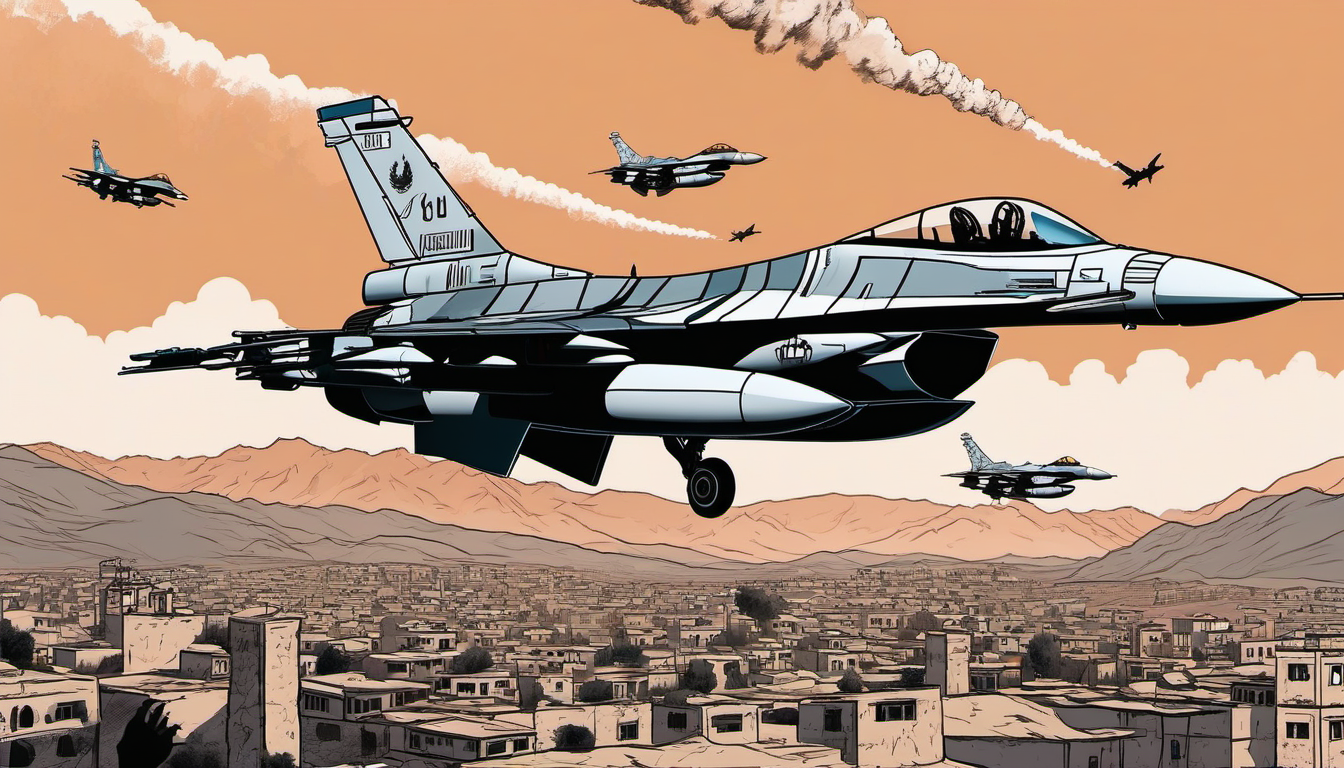
As Iran burns, Pakistan and Afghanistan escalate into full-scale aerial combat over a nuclear-armed region's most dangerous frontier
Executive Summary
- Pakistan attempted to bomb Bagram Air Base—the former US military installation—while Taliban forces deployed anti-aircraft systems over Kabul for the first time, marking an unprecedented escalation from border skirmishes to air-to-air combat over a sovereign capital.
- The conflict has entered its fourth day with Pakistan holding 32 km² of Afghan territory, claiming 415 Taliban kills across 46 strike locations, while Afghanistan claims 80 Pakistani soldiers killed and 27 military posts captured—all while the world's diplomatic bandwidth is consumed by the Iran war.
- This is now the most significant conventional military conflict between two states in South Asia since the 2025 India-Pakistan Sindoor crisis, with nuclear-armed Pakistan conducting sustained aerial operations against a neighbor that defeated the world's most powerful military over 20 years of insurgency.
Chapter 1: The Battle Over Kabul
In the pre-dawn darkness of March 1, 2026, residents of Kabul were jolted awake by explosions and sustained gunfire. This was not the familiar sound of Taliban-era factional fighting or distant border clashes. Pakistani F-16s and JF-17 Thunder jets had penetrated Afghan airspace and were flying combat sorties over the capital itself.
Taliban spokesperson Zabihullah Mujahid issued a statement that would have been unthinkable just a week earlier: "Air defense attacks were carried out in Kabul against Pakistani aircraft. Kabul residents should not be concerned."
The targets included Bagram Air Base—the sprawling former US military installation 60 kilometers north of Kabul that served as the nerve center of America's 20-year war in Afghanistan. Pakistani jets attempted to strike the facility, now repurposed by the Taliban as a military hub, but were met by anti-aircraft fire and what Afghanistan described as "missile defense systems."
This represented a qualitative leap in the conflict. Border skirmishes between Pakistani and Afghan forces have occurred intermittently for years. But sustained aerial combat over a sovereign nation's capital, with anti-aircraft defenses engaging foreign military jets, crosses a threshold that the international community has largely failed to acknowledge—because the world's attention is fixed squarely on Iran.
Pakistan's information minister, Attaullah Tarar, confirmed that 46 locations across Afghanistan had been struck since Operation Ghazab Lil Haq ("Wrath for the Truth") commenced. The operation's scope extends far beyond counter-terrorism: it is a conventional military campaign against a state, conducted by a nuclear-armed power with no UN mandate, no coalition partners, and no meaningful international oversight.
Chapter 2: The Anatomy of Escalation
The current crisis did not erupt overnight. It is the culmination of months of accelerating tensions rooted in the Tehreek-e-Taliban Pakistan (TTP) insurgency.
Pakistan experienced its most violent year in nearly a decade in 2025, with deaths surging 75% to 3,413 and violent incidents rising 29%, according to the Pakistan Institute for Conflict and Security Studies. Islamabad has long accused the Afghan Taliban of harboring TTP militants—a charge Kabul categorically denies.
Timeline of Escalation:
| Date | Event |
|---|---|
| Oct 2025 | Pakistan-Afghanistan border war; brief ceasefire |
| Feb 21, 2026 | Pakistani airstrikes in Nangarhar and Paktika provinces; UN reports 13 Afghan civilians killed |
| Feb 26 | Afghanistan launches "retaliatory operations" along the frontier |
| Feb 27 | Pakistan declares "open war"; bombs Kabul, Kandahar, Paktia |
| Feb 28 | Pakistan rejects all dialogue: "no talks, no negotiation" |
| Mar 1 | Pakistani jets attempt to bomb Bagram; Taliban deploys anti-aircraft over Kabul; Pakistan holds 32 km² of Afghan territory |
The speed of escalation is striking. In less than a week, the conflict progressed from cross-border strikes against alleged militant hideouts to a declared "open war" with air combat over the Afghan capital. Pakistan's Defense Minister Khawaja Muhammad Asif used the phrase without qualification. Pakistan PM Shehbaz Sharif canceled a planned trip to Russia (March 3-5) citing the "regional and internal situation."
On the Afghan side, Interior Minister Sirajuddin Haqqani—the former Haqqani Network leader, now one of the Taliban government's most powerful figures—issued a calculated warning: the conflict would be "very costly," and Afghanistan had deployed "only front-line forces" so far, with its military yet to be fully mobilized. This is not bluster from a ragtag militia. The Taliban command an estimated 80,000-100,000 battle-hardened fighters who spent two decades defeating the world's most advanced military.
Chapter 3: The Bagram Dimension
The attempted strike on Bagram Air Base carries symbolic and strategic weight that extends beyond the Pakistan-Afghanistan conflict.
Bagram was the beating heart of America's Afghan war. At its peak, the sprawling 30-square-mile facility housed 40,000 troops, served as the primary detention site for high-value prisoners, and operated the most advanced military hospital in Central Asia. Its abandonment during the chaotic August 2021 withdrawal became a symbol of American retreat.
In 2025, President Trump publicly expressed interest in reoccupying Bagram, framing it as a potential staging ground for counter-terrorism operations and a strategic asset in the broader Central Asian competition with China and Russia. The idea was shelved, but the fact that Pakistani jets are now attempting to bomb the facility creates an awkward dynamic: a US treaty ally is striking an installation that the US president has explicitly expressed interest in reclaiming.
The Taliban, for their part, have invested significantly in converting Bagram into a functional military base. Satellite imagery in recent months has shown new construction, runway maintenance, and the parking of former Afghan Air Force aircraft that the Taliban captured in 2021. By defending Bagram against Pakistani airstrikes, the Taliban are protecting what they consider sovereign military infrastructure—using some of the very air defense systems left behind by the US and NATO.
Chapter 4: The Attention Arbitrage
Perhaps the most consequential dimension of the Pakistan-Afghanistan war is its timing. The conflict is escalating in the shadow of Operation Epic Fury—the US-Israeli strikes on Iran that killed Supreme Leader Khamenei and triggered retaliatory missile attacks across the Gulf.
This creates what strategic analysts call "attention arbitrage": Pakistan's freedom to escalate military operations while the world's diplomatic bandwidth is entirely consumed elsewhere.
Consider the contrast:
- Iran: Two US carrier strike groups deployed, E3 nations threatening military action, UN Security Council emergency sessions, 24/7 global media coverage, oil markets in crisis
- Afghanistan: A nuclear-armed state bombing a sovereign capital, holding foreign territory, and declaring "open war"—met with generic calls for restraint
Afghanistan itself acknowledged this dynamic. Foreign ministry spokesman Abdul Qahar Balkhi expressed "deep regret" over the Iran strikes, noting that "recent political and security developments in the region have created unprecedented tensions that will have long-term negative effects on the entire region."
The diplomatic infrastructure that might otherwise constrain Pakistan is either distracted or compromised:
- Iran, which shares a 900 km border with Afghanistan and had offered to mediate, is now itself under massive military assault
- Saudi Arabia and Qatar have called for restraint but are consumed by the Gulf crisis
- China, Pakistan's closest ally, is focused on the Hormuz disruption and its Two Sessions political meetings
- The United States explicitly said it "supports Pakistan's right to defend itself"
- Russia, another potential mediator, saw Pakistan's PM cancel a planned visit
Al Jazeera's reporting captured the essence of the problem: the conflict risks being "left to continue without urgent international attention."
Chapter 5: The Military Mismatch—and Why It Doesn't Matter
On paper, the military balance overwhelmingly favors Pakistan. With the world's sixth-largest military, nuclear weapons, a modern air force featuring F-16s and JF-17s, advanced missile systems, and a $10+ billion annual defense budget, Pakistan's conventional superiority over the Taliban is absolute.
But the history of this region suggests conventional superiority is a poor predictor of outcomes.
Historical Precedents:
| Conflict | Superior Force | Outcome |
|---|---|---|
| Soviet-Afghan War (1979-89) | Soviet Union | Withdrawal after 10 years |
| US-Afghan War (2001-21) | United States/NATO | Taliban victory after 20 years |
| India-Pakistan Kargil War (1999) | India | Pakistan withdrawal under diplomatic pressure |
The Taliban have already adapted, deploying drones against Pakistani military camps—the same asymmetric tool that reshaped the Ukraine conflict. These are cheap, effective, and difficult to counter with conventional air defenses designed for state-on-state warfare.
Moreover, Haqqani's warning that only "front-line forces" are engaged is strategically significant. The Taliban's deep bench includes thousands of fighters experienced in IED warfare, ambush tactics, and mountain combat across the exact terrain where this war is being fought. A protracted conflict along the 2,600 km border would bleed Pakistan's conventional forces in exactly the way the US experienced over two decades.
Pakistan's 32 km² territorial hold in the Zhob sector is also double-edged. Holding Afghan territory requires sustained logistics, force protection, and political will—all of which degrade over time, especially if the Taliban shifts to its preferred mode of asymmetric warfare.
Chapter 6: Scenario Analysis
Scenario A: Coerced De-Escalation (30%)
Thesis: International pressure, combined with Pakistan's own resource constraints and the Iran crisis, forces both sides back to negotiations within 2-3 weeks.
Triggers:
- China intervenes directly, leveraging CPEC influence over Pakistan
- TTP launches a major attack inside Pakistan, forcing Islamabad to redirect resources
- Gulf states, once the Iran crisis stabilizes, invest diplomatic capital
Historical precedent: The October 2025 border war ended with a ceasefire after approximately two weeks, suggesting a pattern of short-intensity escalation followed by cooling. However, the "open war" declaration makes walking back harder.
Why 30%: The attention arbitrage effect works against de-escalation. Without external diplomatic pressure, neither side has incentive to stop. Pakistan believes air superiority gives it leverage. The Taliban believe time and terrain favor them.
Scenario B: Protracted Low-Intensity Conflict (45%)
Thesis: The conflict settles into a pattern of periodic air strikes, border clashes, and retaliatory drone attacks without formal resolution—a "forever border war."
Triggers:
- Pakistan withdraws from occupied territory but continues air strikes
- Taliban shifts to asymmetric warfare: IEDs, ambushes, drone strikes on Pakistani military installations
- Both sides declare informal ceasefires that neither fully honors
Historical precedent: The India-Pakistan Line of Control dynamic, where periodic violations and retaliatory strikes continue for years without formal war or peace. Also comparable to the Israel-Lebanon dynamic pre-2006.
Why 45%: This is the path of least political cost for both sides. Pakistan can claim it struck terrorism; the Taliban can claim they defended sovereignty. Neither achieves decisive victory, but neither suffers the domestic political consequences of capitulation.
Scenario C: Full-Scale War and Regional Contagion (25%)
Thesis: Escalation spirals beyond control—Pakistan targets Taliban leadership in Kabul, Afghanistan deploys its full military, and the conflict draws in regional powers or triggers a refugee crisis.
Triggers:
- Pakistani strike kills senior Taliban leadership (e.g., Haqqani)
- Taliban successfully downs a Pakistani military aircraft
- Refugee flows destabilize Pakistan's Balochistan or Khyber Pakhtunkhwa provinces
- TTP exploits the conflict to launch major urban attacks in Pakistan
Historical precedent: The 1971 Bangladesh Liberation War, where Pakistan's military campaign against East Pakistan spiraled into a full-scale war involving India. The refugee dimension was critical—10 million refugees flowing into India triggered intervention.
Why 25%: Both sides have escalatory tools they haven't used. Pakistan hasn't targeted Taliban leadership. The Taliban haven't fully deployed. The 2,600 km border offers countless points of friction. The simultaneous Iran crisis means there is no great power willing to impose restraint.
Chapter 7: Investment Implications
Defense and Security:
- Pakistan's defense spending will increase regardless of outcome. Pakistan Ordnance Factories, Pakistan Aeronautical Complex benefit.
- Turkish drones (Bayraktar) continue proving their worth in asymmetric warfare. Turkish defense exports to the region may expand.
- Counter-drone systems are the critical gap—companies like Rafael (Israel), Rheinmetall, and L3Harris are positioned.
Energy and Infrastructure:
- CPEC ($62 billion Chinese investment) faces direct risk. The Zhob sector fighting is near key CPEC corridors. Chinese infrastructure investments in Pakistan face force majeure scenarios.
- Natural gas pipelines (TAPI—Turkmenistan-Afghanistan-Pakistan-India) are effectively dead as long as the conflict persists.
Agriculture and Commodities:
- Afghanistan's saffron industry ($80M annually) faces disruption.
- Pakistan's wheat imports may increase if border agriculture is disrupted, adding to global food price pressures already elevated by the Hormuz crisis.
Regional Stability Premium:
- South Asian risk premiums should increase. Pakistan's sovereign bonds and rupee face pressure.
- Indian defense stocks (HAL, BEL, Bharat Dynamics) benefit from the broader narrative of South Asian instability driving military spending.
Conclusion
The air war over Kabul represents a dangerous escalation that the international community cannot afford to ignore, even as Iran dominates the headlines. A nuclear-armed state is conducting sustained air combat operations over a neighboring capital, holding foreign territory, and explicitly declaring "open war"—while the world watches elsewhere.
The historical record in this region is unambiguous: conventional military superiority does not guarantee strategic victory against determined adversaries fighting on their own terrain. Pakistan's air campaign may degrade Taliban infrastructure in the short term, but it cannot resolve the underlying TTP problem that Islamabad claims justifies the operation.
The greatest risk is not the conflict itself, but the absence of diplomatic bandwidth to contain it. With Iran consuming the world's attention, Qatar and Saudi Arabia managing their own crises, China focused on domestic politics, and the US explicitly backing Pakistan's "right to defend itself," there is no external brake on escalation.
Afghanistan's Interior Minister Haqqani said his country had not yet fully deployed its military. Pakistan's defense minister used the words "open war." Between these two statements lies a gap that could swallow the region.
Sources: Al Jazeera, NBC News, Reuters, The Hindu, Pakistan Institute for Conflict and Security Studies
Leave a Reply