
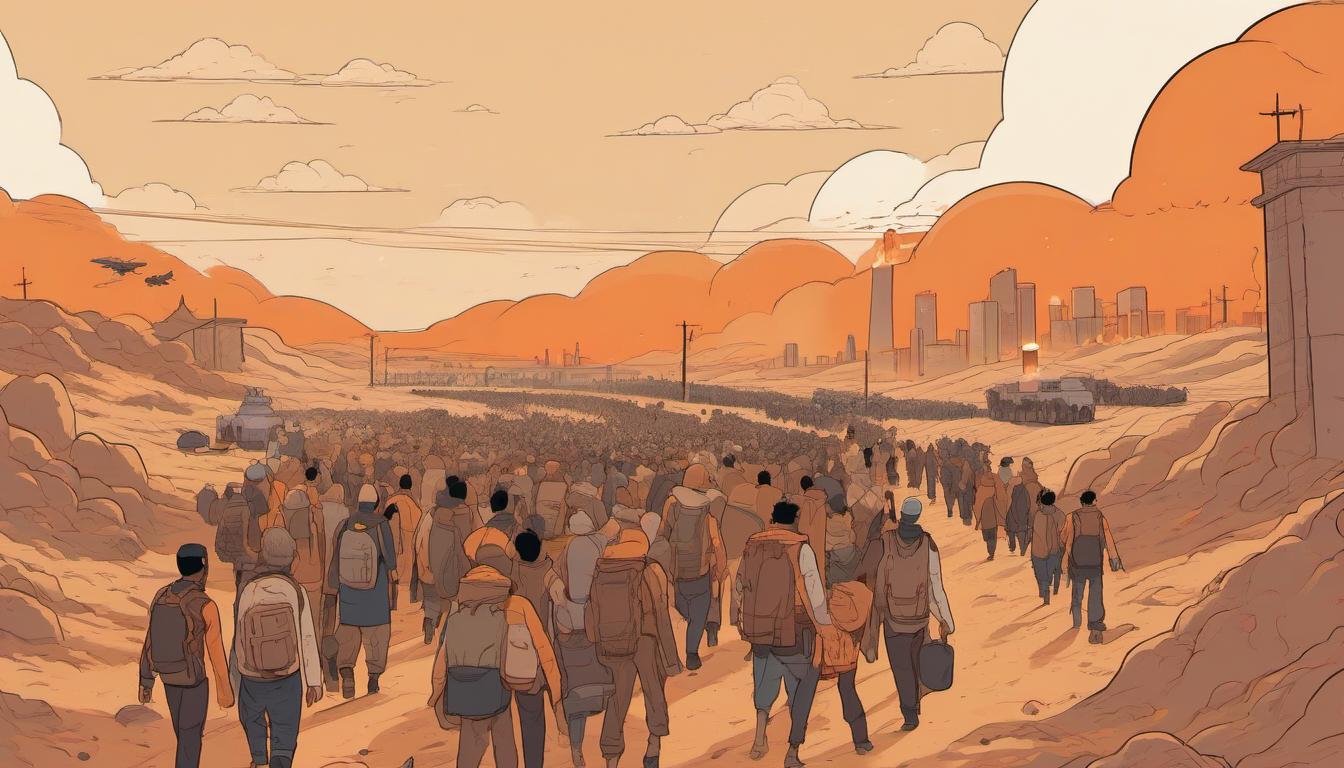
Operation Epic Fury could trigger the largest displacement crisis of the 21st century — and nobody is prepared
Executive Summary
- The US-Israeli strikes on Iran risk displacing 9–22 million people from a nation of 90 million, dwarfing the Syrian refugee crisis that destabilized Europe in 2015
- Turkey, already hosting 3.5 million Syrian refugees amid its own democratic crisis, faces the prospect of becoming the primary pressure valve for Iranian displacement — threatening to overwhelm its economy and fracture NATO's southern flank
- The Gulf states, themselves under Iranian missile fire, confront a paradox: their 8 million Iranian-origin workers are simultaneously economic lifeblood and potential security liabilities, while their desalination and energy infrastructure lies exposed
Chapter 1: The Scale of What's Coming
When the United States invaded Iraq in 2003, one in six Iraqis — roughly 4.7 million people — were eventually displaced. Syria's civil war, which began in 2011, forced 6.7 million to flee the country and displaced another 6.9 million internally. Libya's post-Gaddafi collapse scattered approximately 1 million.
Iran's population is 90 million — larger than Iraq, Syria, and Libya combined.
The arithmetic is brutal. If just 10% of Iran's population is displaced, the resulting 9 million refugees would rival the entire Syrian displacement. If the figure reaches 25% — a plausible scenario given the breadth of US-Israeli strikes targeting military, nuclear, and political infrastructure across Tehran, Ilam, and Hormozgan provinces — it would add 22.5 million people to the global refugee population, increasing UNHCR's total caseload by roughly 75%.
This is not speculative alarmism. Every major Middle Eastern military intervention since 2003 has generated displacement at scale. The pattern is consistent: aerial campaigns destroy civilian infrastructure, economic collapse follows, and populations move. Iran's internal crisis — the 2025-26 protests that killed an estimated 30,000-36,000 people, the IRGC crackdown, the economic collapse — means the displacement infrastructure is already primed. Millions of Iranians were already contemplating exit before the first cruise missile hit Tehran on February 28.
The critical difference from previous crises: Iran's population is urbanized (76%), educated, and middle-class. Tehran alone holds 9 million people. The destruction of government ministries, military installations, and critical infrastructure in a city of that density creates immediate displacement pressure that rural conflicts like Syria's took years to generate.
Chapter 2: Turkey — The Pressure Valve That's Already Cracking
Turkey shares a 534-kilometer border with Iran, and the two countries maintain deep economic ties — $10 billion in annual bilateral trade, shared energy pipelines, and centuries of cultural exchange. Turkey is the natural first destination for Iranian refugees, just as it absorbed the bulk of Syrian displacement.
But Turkey in 2026 is not Turkey in 2015.
The refugee arithmetic: Turkey already hosts approximately 3.2 million registered Syrian refugees (down from a peak of 3.6 million), along with hundreds of thousands of Afghans, Iraqis, and others. Anti-refugee sentiment has become one of the most potent political forces in the country. Erdogan's AKP lost significant support in 2023-2024 municipal elections partly on the refugee backlash. The opposition CHP's Ekrem Imamoğlu, currently imprisoned, built his political brand partly on promises to manage refugee flows.
The democratic crisis overlay: Erdogan has intensified authoritarian consolidation — jailing Imamoğlu, deploying military in civilian areas, manipulating judicial appointments. Adding millions of Iranian refugees to this volatile mix could trigger either:
- A humanitarian response that bankrupts the already-strained Turkish treasury (inflation remains above 30%)
- A hardline border closure that creates a humanitarian catastrophe in Iran's western provinces
- Political exploitation of the refugee issue that further erodes democratic norms
The Kurdish dimension: Turkey's greatest fear isn't Iranian refugees per se — it's what happens to Iran's Kurdish population (approximately 10 million) in a regime collapse scenario. As Gönül Tol of the Middle East Institute warned: "Turkey fears chaos on the borders, more refugees into Turkey, and the PKK-linked groups getting more active." The PKK's armed insurgency against the Turkish state, which lasted from 1984 to 2025, left deep scars. An empowered Iranian Kurdish movement could reignite separatist dynamics across southeast Turkey.
Historical precedent: During the Iran-Iraq War (1980-88), Turkey absorbed several hundred thousand Iranian refugees. But that conflict, devastating as it was, did not involve strikes on Tehran or threaten regime collapse. The scale differential between then and now could be 10-20x.
Chapter 3: The Gulf Paradox — Workers, Weapons, and Vulnerability
The Gulf Cooperation Council (GCC) states face a unique dilemma. They host an estimated 8 million Iranian-origin or Iranian-connected workers and residents, primarily in the UAE (400,000+ Iranian nationals), Bahrain (significant Shia population with Iranian cultural ties), Qatar, Kuwait, and Oman. These communities are embedded in Gulf economies — running businesses, staffing hospitals, working in construction.
Iran's retaliatory strikes on February 28 — hitting the US 5th Fleet headquarters in Bahrain, Al Udeid Air Base in Qatar, and targets in the UAE (one confirmed death in Abu Dhabi) and Kuwait — have transformed these communities from economic assets into potential security concerns.
The infrastructure vulnerability: Pierre Razoux of the Mediterranean Foundation for Strategic Studies warned that "the Iranians have enough basic, intermediate-range missiles to hit vital infrastructure, desalination plants, hydrocarbon hubs, power stations." The Gulf states' economic model — which depends on desalinated water (100% of drinking water in Qatar, 90%+ in UAE and Bahrain), uninterrupted energy exports, and functioning aviation hubs — is existentially exposed.
The liquidity crisis: Cinzia Bianco of the European Council on Foreign Relations warned that a Hormuz blockade could trigger "a liquidity crisis" for GCC governments that are spending heavily on megaprojects (Saudi Vision 2030, Neom, Qatar 2030). Saudi Arabia already faces a $74 billion fiscal deficit in 2026. A prolonged disruption to oil revenues — even partial — could force emergency drawdowns from sovereign wealth funds that are the backbone of Gulf economic planning.
The worker exodus: Historically, Gulf conflicts trigger massive foreign worker departures. During the 1990-91 Gulf War, approximately 5 million foreign workers fled the region. The UAE alone houses 9 million expatriates (88% of its population). Even a partial exodus would cripple service sectors, construction, healthcare, and logistics.
Chapter 4: Europe's Fortress Under Siege
The European Union has spent the better part of a decade building what critics call "Fortress Europe" — externalized border controls, deals with Turkey and North Africa to contain migration, the Frontex expansion, and increasingly restrictive asylum policies. This architecture was stress-tested by the 2015 Syrian crisis and barely survived politically.
An Iranian displacement crisis would hit Europe at its most vulnerable moment.
The Mediterranean death toll: Even before the Iran war, 2026 was already the deadliest start to a year for Mediterranean migration since the IOM began tracking in 2014 — 606 confirmed deaths in just two months. The factors driving this — collapsed states in Libya and Tunisia, USAID withdrawal from Africa, climate-driven displacement — now compound with potential Iranian flows.
The political tinderbox: Europe's far-right parties have made migration their central issue. The AfD leads German polls at 25-27%. France's Le Pen faction remains potent. Italy's Meloni government built its mandate on anti-migration rhetoric. A new mass displacement event from Iran — whose refugees would be largely Muslim, Persian-speaking, and visible — could supercharge the populist backlash that's already reshaping European politics.
The rearmament paradox: EU governments just committed to €150 billion in SAFE defense bonds, NATO members are pushing toward 5% GDP defense spending, and European budgets are stretched between rearmament and economic competitiveness. Adding a refugee crisis to this fiscal equation creates an impossible trilemma: defense, economic reform, and humanitarian response, but budget for only two.
The 2015 analogy and its limits: In 2015, approximately 1.3 million asylum seekers arrived in Europe, primarily from Syria, Afghanistan, and Iraq. The political fallout — Brexit, the AfD's rise, Orbán's fence, the fracturing of EU solidarity — reshaped European politics for a decade. An Iranian refugee wave could be 3-5x larger. Europe's absorption capacity has not grown; if anything, the political tolerance for migration has shrunk dramatically.
Chapter 5: The Smaller Neighbors — Azerbaijan, Armenia, Pakistan
Azerbaijan (population 10 million): Shares a 765-km border with Iran and hosts a significant Azerbaijani-speaking minority connection (roughly 15-20 million ethnic Azerbaijanis live in northern Iran — more than in Azerbaijan itself). A regime collapse could trigger ethnic mobilization on both sides of the border, potentially destabilizing Azerbaijan. As Baku-based analyst Nikita Smagin warned, for smaller nations, an influx could "threaten the stability of the whole country easily."
Armenia (population 2.8 million): Shares a 44-km border with Iran and has historically relied on Iran as a counterbalance to Turkey and Azerbaijan. An Iranian collapse would remove Armenia's last strategic ally in the region, while potentially directing refugee flows into a country that has already absorbed 100,000+ from Nagorno-Karabakh.
Pakistan (population 230 million): Shares a 959-km border with Iran's Sistan-Baluchestan province — one of Iran's poorest and most restive regions. Pakistan is simultaneously fighting what its defense minister called "open war" with Afghanistan. The prospect of managing two active border conflicts simultaneously — Iranian refugees from the west, Taliban hostilities from the northwest — could overwhelm Pakistan's military and humanitarian capacity. Former diplomat Maleeha Lodhi warned that "Pakistan in particular would be seriously affected if there is a spillover across its border."
Chapter 6: Scenario Analysis
Scenario A: Short Campaign, Regime Survives (30%)
Trigger: US-Israeli strikes remain limited to military and nuclear targets; IRGC maintains internal control; ceasefire within 2-4 weeks.
Displacement: 1-3 million internally displaced, 200,000-500,000 cross-border refugees, primarily to Turkey and Iraq.
Historical precedent: Israel's 12-day war against Iran in June 2025 generated limited displacement because the regime's internal security apparatus remained intact.
Investment implication: Oil premium fades within weeks; Gulf assets recover; refugee-related fiscal pressure minimal.
Scenario B: Extended Campaign, Regime Fractures (45%)
Trigger: Strikes expand to IRGC economic assets, regime leadership targeted (Netanyahu explicitly stated the goal of removing an "existential threat"), internal protests reignite, regional proxy conflicts escalate.
Displacement: 5-10 million displaced over 6-18 months, with 2-4 million crossing borders — primarily Turkey (1-2M), Iraq (500K-1M), Pakistan (300-500K), Gulf states (worker exodus 1-2M).
Historical precedent: Iraq 2003-2008 pattern — initial military victory followed by state collapse and prolonged displacement.
Investment implication: Sustained oil premium $15-25/barrel; Turkish lira under severe pressure; European defense stocks benefit but humanitarian costs offset fiscal plans; Gulf SWF drawdowns accelerate.
Scenario C: Regime Collapse, Regional Contagion (25%)
Trigger: IRGC fragments, ethnic separatist movements activate (Kurdish, Baluch, Azerbaijani), power vacuum attracts proxy competition, Trump's explicit call for Iranians to "take over" their government succeeds in toppling the regime but produces no successor state.
Displacement: 15-22 million over 2-5 years, rivaling the combined displacement of Syria, Iraq, and Afghanistan.
Historical precedent: Libya post-2011 — NATO-backed regime change followed by state fragmentation, ongoing civil conflict, and permanent displacement.
Investment implication: Structural oil supply disruption ($20-40 premium for years); European political crisis as migration overwhelms existing frameworks; Turkey faces fiscal emergency; massive infrastructure/reconstruction demand (potential $200-500B over a decade, but who pays?).
Chapter 7: Investment Implications
Immediate (1-4 weeks):
- Long oil, gold, defense; short airlines, tourism, Gulf real estate
- Turkish lira hedge positions critical
- European defense stocks (Rheinmetall, BAE, Leonardo) benefit from dual driver: rearmament + border security spending
Medium-term (3-12 months):
- Refugee camp infrastructure: prefab housing, water treatment, mobile health — companies like Excelerate Energy (LNG), Watts Water Technologies, and Turkish construction firms
- Remittance platforms: Iranian diaspora (estimated 4-6 million already abroad) will drive massive remittance flows — potential beneficiaries include Western Union, Wise, and regional fintech
- European political risk: migration backlash could accelerate EU institutional reform (qualified majority voting) or fracture it entirely
Long-term (1-5 years):
- Iran reconstruction: if/when stability returns, $200-500 billion opportunity — cement, steel, telecom, energy
- Demographic impact: Iran's median age is 32; a mass exodus of working-age population could permanently alter the country's economic trajectory
- Regional labor markets: Gulf states may need to rapidly restructure away from Iranian-connected labor, creating opportunities for South/Southeast Asian labor recruitment firms
| Crisis | Population | Displaced | % | Duration |
|---|---|---|---|---|
| Iraq 2003 | 26M | 4.7M | 18% | 5+ years |
| Syria 2011 | 22M | 13.6M | 62% | 10+ years |
| Libya 2011 | 6.4M | 1M | 16% | Ongoing |
| Iran 2026 | 90M | 5-22M | 6-25% | TBD |
Conclusion
Operation Epic Fury may achieve its stated military objectives — degrading Iran's nuclear program and military infrastructure. But the humanitarian aftermath is the variable that markets, governments, and alliances are not pricing in. A nation of 90 million people, already in economic freefall and political upheaval, is now under sustained aerial bombardment from the world's two most capable air forces.
The displacement equation is not a matter of "if" but "how many." Turkey, the Gulf states, Pakistan, and Europe are all unprepared for the answer. The 2015 Syrian refugee crisis reshaped European politics for a generation. The Iranian exodus — if it materializes at scale — could reshape the global order.
The most dangerous gap is not in military planning but in humanitarian planning. As Sinan Ülgen of Carnegie Europe warned: "The cross-border shocks are likely to be an order of greater magnitude, given the size, population, heterogeneity of the country." Nobody is ready.
Sources: Al Jazeera, CNBC, GB News, Turkish Minute/AFP, UNHCR, IOM, Carnegie Europe, Middle East Institute, ECFR, Mediterranean Foundation for Strategic Studies
Leave a Reply