
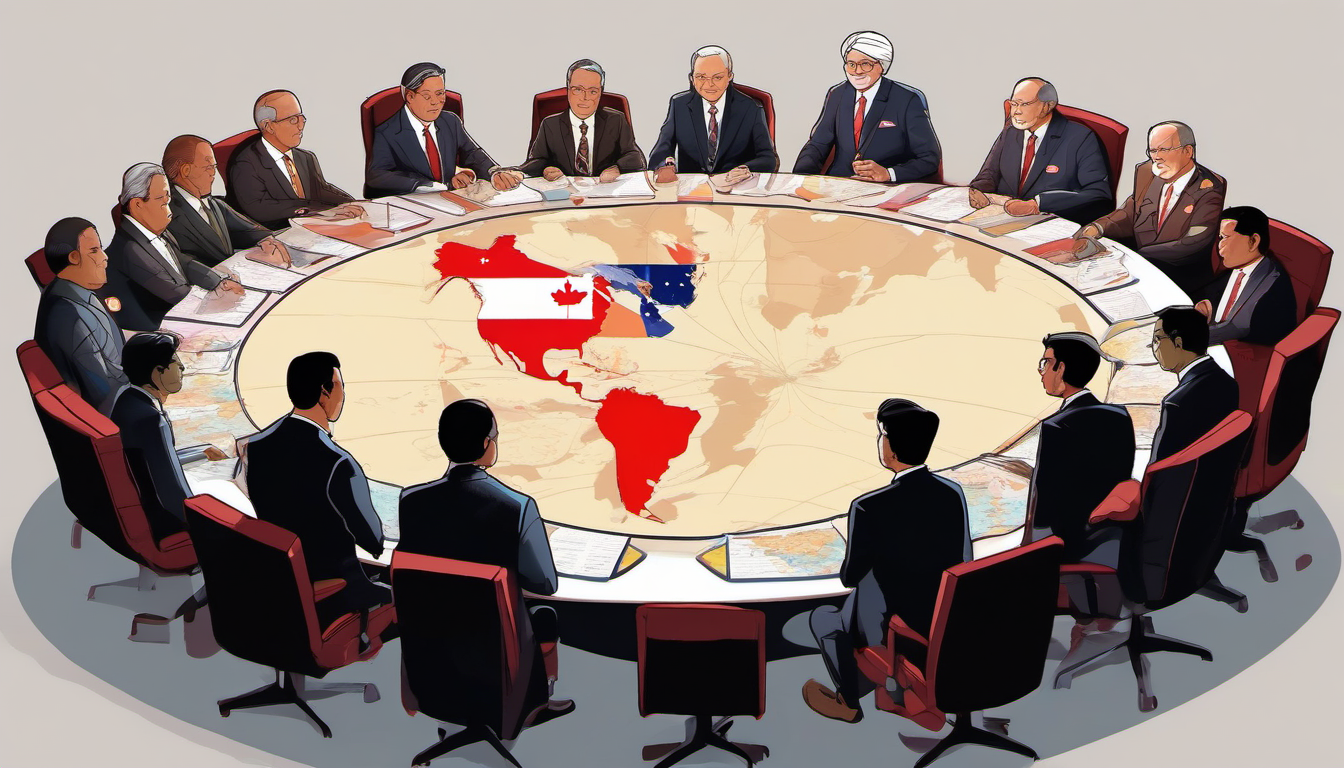
A former central banker's audacious bid to build a coalition of medium-sized democracies against great-power coercion
Executive Summary
- Canadian Prime Minister Mark Carney has embarked on a landmark 10-day tour of India, Australia, and Japan — the first concrete manifestation of his "middle power doctrine" articulated at Davos in January 2026, which explicitly challenged "American hegemony."
- The trip represents more than Canadian trade diversification. It signals the emergence of a structural realignment where medium-sized democracies — collectively representing over 2 billion people and $15 trillion in GDP — seek to build autonomous economic corridors outside the gravitational pull of both Washington and Beijing.
- The timing is deliberate: with the SCOTUS IEEPA ruling invalidating much of Trump's tariff architecture, the Iran conflict consuming U.S. strategic bandwidth, and the "tribute economy" model alienating traditional allies, a window has opened for middle powers to assert collective agency in reshaping the global trading system.
Chapter 1: The Davos Declaration
On January 22, 2026, Mark Carney stepped to the podium at the World Economic Forum and delivered what would become the most consequential speech by a Canadian prime minister since Pierre Trudeau's "Third Option" address in 1972. In clear, undiplomatic language, Carney urged middle powers to band together against "American hegemony" and the efforts of great powers to "coerce and subjugate smaller countries."
The speech was remarkable not just for its content but for its source. Carney — a former Governor of both the Bank of Canada and the Bank of England, the only person to have led two G7 central banks — brought the credibility of a technocrat who had navigated the 2008 financial crisis from positions of institutional power. He was not a populist firebrand; he was the establishment itself, declaring that the establishment's rules no longer applied.
The intellectual framework was precise. Carney identified three converging pressures that made middle-power coordination both necessary and possible:
-
The weaponization of economic interdependence. The United States under Trump had transformed trade policy into a coercive instrument — using tariffs, sanctions, and the dollar system to extract concessions from allies and adversaries alike. The "tribute economy" model, where countries like India, Japan, and Taiwan signed bilateral deals exchanging market access for political alignment, had created a hierarchy that medium-sized nations found increasingly intolerable.
-
The fragmentation of the multilateral order. With the WTO's MFN principle effectively dead, the SCOTUS IEEPA ruling creating legal chaos, and bilateral deals replacing multilateral frameworks, middle powers faced a choice: submit to great-power bilateralism or build alternative architectures.
-
The Indo-Pacific as the new center of gravity. By 2026, the combined GDP of India, Japan, Australia, South Korea, and Canada exceeded $18 trillion — larger than the European Union. These countries shared democratic governance, advanced technology sectors, and abundant natural resources. What they lacked was a coordinating mechanism.
The Asia Pacific Foundation's vice-president Vina Nadjibulla captured the impact: "In Asia, Canada is having a moment. Prime Minister Carney's speech really was quite an important development in how Asia sees Canada."
Chapter 2: The 10-Day Odyssey
Carney departed Ottawa on February 27, 2026 for what his aides privately called the "middle power road show" — a meticulously planned 10-day tour touching three continents and four strategic relationships.
India: The Reset (February 27 – March 2)
The India leg was the most symbolically loaded. Canada-India relations had been in deep freeze since September 2023, when Justin Trudeau publicly accused Indian intelligence of orchestrating the assassination of Sikh activist Hardeep Singh Nijjar on Canadian soil. Both countries expelled senior diplomats. High commissioners were recalled. Trade negotiations, which had stuttered since 2010, collapsed entirely.
Carney's approach represented a clean break. He deliberately avoided visiting Punjab — the state most associated with the Khalistan separatist movement — signaling that Ottawa would not let diaspora politics dictate bilateral relations. India's High Commissioner Dinesh Patnaik described the shift: "We both decided that this is too important a relationship to let go."
The substantive agenda was ambitious:
| Area | Details | Estimated Value |
|---|---|---|
| Uranium supply | Cameco 10-year reactor supply | $2.8 billion |
| Free trade agreement | Comprehensive deal in 12 months | $51 billion annual target |
| AI & quantum computing | Trilateral tech partnership (India-Canada-Australia) | TBD |
| Pension investment | Canadian funds already deployed | $73 billion |
| Nuclear energy | Support for India's 100GW nuclear plan | Multi-decade |
The $51 billion annual trade target by 2030 would represent more than a doubling of current two-way commerce — an extraordinarily ambitious goal that, if achieved, would fundamentally alter Canada's economic geography.
Australia: The Five Eyes Pivot (March 3–5)
In Canberra, Carney will address Parliament — a privilege reserved for leaders of countries with the deepest strategic ties. The Australia leg focuses on defense and intelligence cooperation within the Five Eyes framework, but with a critical new dimension: building bilateral military links that do not depend on U.S. strategic coordination.
Canada and Australia signed an over-the-horizon radar sharing agreement in 2025. The 2026 discussions will reportedly cover joint submarine surveillance in the Pacific, critical minerals supply chain coordination, and potential joint procurement of maritime patrol capabilities.
Japan: The Critical Minerals Connection (March 6–8)
The Tokyo stop with Prime Minister Sanae Takaichi centers on cars, energy, and critical minerals — three sectors where Japan and Canada have deeply complementary needs. Japan possesses the world's most advanced battery and semiconductor manufacturing capabilities but lacks raw materials. Canada holds among the world's largest reserves of nickel, cobalt, lithium, and uranium, but lacks the processing infrastructure to capture downstream value.
Chapter 3: The Historical Precedent — Canada's Third Option
Carney's doctrine has a direct ancestor. In 1972, Prime Minister Pierre Trudeau's foreign policy review identified three options for Canada: maintain the status quo of U.S. dependence, pursue deeper continental integration, or seek a "Third Option" — systematic diversification of Canada's economic and political relationships beyond North America.
The Third Option was ultimately a failure. Despite signing a Framework Agreement with the European Community in 1976, Canada's trade remained overwhelmingly U.S.-centric. By the 1980s, the logic of geographic proximity and the Canada-U.S. Free Trade Agreement pulled Ottawa back into Washington's orbit. Today, 75% of Canadian exports still flow to the United States.
| Metric | 1972 (Third Option) | 2026 (Carney Doctrine) |
|---|---|---|
| US share of exports | ~68% | ~75% |
| Trade diversification target | EC Framework Agreement | India-Australia-Japan trilateral |
| Strategic context | Détente, Kissinger realpolitik | Trump tariffs, tribute economy |
| Global trade system | GATT-based multilateralism | Post-MFN bilateral fragmentation |
| Canadian PM background | Intellectual politician | Former G7 central banker |
| Key pressure | Vietnam War, Nixon Shock | IEEPA ruling, tariff chaos |
The critical question: why might the Carney Doctrine succeed where the Third Option failed?
Three structural differences favor the 2026 attempt. First, digital technology has collapsed the friction of distance — supply chains, capital flows, and knowledge work no longer require geographic proximity. Second, the U.S. itself has actively degraded the multilateral institutions that once made American dependence tolerable for middle powers. Third, the Indo-Pacific economies of 2026 are vastly larger and more sophisticated than the European Community of 1972.
Chapter 4: The Middle Power Universe
Carney's coalition is not emerging in isolation. Across the globe, medium-sized democracies are pursuing similar strategies of hedged diversification.
South Korea under President Lee Jae-myung has articulated a four-principle doctrine of strategic autonomy, pursuing critical minerals agreements with Brazil while maintaining the U.S. alliance but seeking greater independence in defense and foreign policy.
The European Union has launched its SAFE defense bond program and begun discussing "two-speed" integration models that would allow subgroups of members to move faster on defense, trade, and technology cooperation.
India itself has concluded or is negotiating three simultaneous mega-deals — with the EU, the U.S., and the GCC — while maintaining strategic autonomy through balanced relationships with Russia, China, and the West.
Brazil under Lula has led a South-South coalition focused on critical minerals, challenging traditional North-South supply chains.
What Carney proposes is to connect these disparate movements into something more deliberate: not a formal alliance (which would provoke great-power backlash) but a coordinated network of bilateral and trilateral partnerships that, in aggregate, creates an alternative center of economic gravity.
The concept echoes what international relations scholars call "minilateralism" — small-group cooperation that avoids the consensus paralysis of large multilateral bodies while building sufficient scale to matter.
Chapter 5: Scenario Analysis
Scenario A: The Middle Power Moment (35%)
Thesis: Carney's tour catalyzes a genuine coordination mechanism. India-Canada FTA concluded by November 2026. Trilateral tech partnership with Australia yields concrete AI governance standards. Japan-Canada critical minerals processing partnership breaks Chinese monopoly in specific materials.
Why 35%: Historical precedent shows that middle-power coalitions tend to form during periods of great-power distraction. The United States is simultaneously engaged in the Iran conflict, managing post-IEEPA tariff chaos, approaching contentious midterm elections, and navigating the DHS shutdown. This strategic bandwidth deficit creates space for autonomous middle-power action. The 2025 G20 trilateral launch between India, Canada, and Australia provides an institutional foundation.
Trigger conditions: India-Canada FTA framework agreed by July 2026; Japan commits to joint critical minerals processing facility; Australia-Canada defense cooperation agreement signed.
Historical parallel: The ASEAN formation in 1967 occurred precisely when the United States was consumed by Vietnam and China by the Cultural Revolution.
Scenario B: Symbolic Diplomacy, Limited Substance (45%)
Thesis: Carney's tour generates positive atmospherics and bilateral goodwill but fails to produce binding economic architecture. The FTA negotiations stall over agricultural access and intellectual property. Critical minerals cooperation remains at the MOU stage. Each bilateral relationship improves independently without achieving the networked coordination Carney envisions.
Why 45%: The Third Option precedent weighs heavily. Canada's economic geography — 75% export dependence on the U.S. — cannot be rewired within a single electoral cycle. India's trade negotiating posture remains protectionist on agriculture and services. Japan under Takaichi is focused on its own $550 billion U.S. investment commitment. Australia's AUKUS submarine program ties it to Washington. Individual bilateral improvements are likely; systemic coordination is harder.
Trigger conditions: FTA talks extend beyond 12-month target; no concrete trilateral institutional mechanism established by end of 2026.
Scenario C: Great-Power Backlash (20%)
Thesis: Washington interprets Carney's explicit challenge to "American hegemony" as hostile and retaliates through trade or diplomatic pressure. China, seeing a potential anti-Beijing alignment, pressures India to distance itself from the coalition. The middle-power initiative becomes a victim of the very great-power dynamics it sought to transcend.
Why 20%: The Trump administration has shown low tolerance for allied defiance. Canada is uniquely vulnerable — sharing the world's longest undefended border with the United States and dependent on it for energy transit, defense, and financial system access. However, the U.S. is currently overextended across multiple crises, reducing the likelihood of immediate retaliation against a NATO ally.
Trigger conditions: U.S. imposes additional tariffs specifically targeting Canadian exports; China conditions bilateral cooperation with India on distancing from the Carney framework.
Chapter 6: Investment Implications
The Carney Doctrine, if even partially successful, has significant implications for asset allocation and sector positioning.
Critical Minerals: Canada's positioning as a reliable democratic supplier to Indo-Pacific manufacturing hubs could benefit Cameco (uranium), Teck Resources (copper, zinc), and First Quantum Minerals (nickel). Japan's Sumitomo and Mitsubishi, and Australia's BHP and Rio Tinto, are natural partners.
Defense: Canadian defense procurement — the $500 billion "Buy Canadian" strategy — intersects with the middle-power doctrine. CAE, General Dynamics Land Systems Canada, and shipbuilding consortia could benefit from joint procurement with Australia and Japan.
Financial Services: Canadian pension funds ($73 billion already deployed in India) would likely increase allocations. CPP Investments, CDPQ, and OTPP are the most likely beneficiaries. India's financial market liberalization creates opportunities for Canadian fintech and insurance firms.
AI & Technology: The India-Canada-Australia trilateral on emerging technologies, launched at the G20, could create a "third pole" in AI governance between the U.S. and China. This benefits companies positioned in AI safety and governance, potentially including Canada's emerging AI ecosystem around the Vector Institute and Mila.
Currency: A successful diversification would structurally reduce the Canadian dollar's correlation with U.S. economic cycles, potentially creating a more independently tradeable currency.
Conclusion
Mark Carney's 10-day odyssey through India, Australia, and Japan is the most ambitious Canadian foreign policy initiative in half a century. It arrives at a moment of extraordinary flux: the American-led multilateral order is fracturing, great powers are consumed by their own crises, and medium-sized democracies face an existential question about whether to submit to bilateral coercion or build collective alternatives.
The Carney Doctrine's intellectual elegance is not in question. A network of middle powers — democratically governed, resource-rich, technologically advanced, and strategically positioned across the Indo-Pacific — makes compelling theoretical sense. Canada, with its unique dual identity as a G7 member and a resource superpower, is perhaps the only country positioned to broker such a coalition.
But the history of middle-power coalitions is one of aspiration outrunning execution. Geography, economic gravity, and great-power pressure have consistently pulled medium-sized nations back into the orbits of larger ones. Whether Carney — the technocrat who became a politician, the central banker who became a geopolitical architect — can overcome these structural forces will be one of the defining questions of 2026.
The stakes extend far beyond Canada. If the middle-power doctrine succeeds, it offers a template for a multipolar world that is neither American-dominated nor Sino-centric — a genuine "third way" in international relations. If it fails, it confirms that in an age of great-power rivalry, medium-sized democracies have no choice but to choose sides.
Leave a Reply