
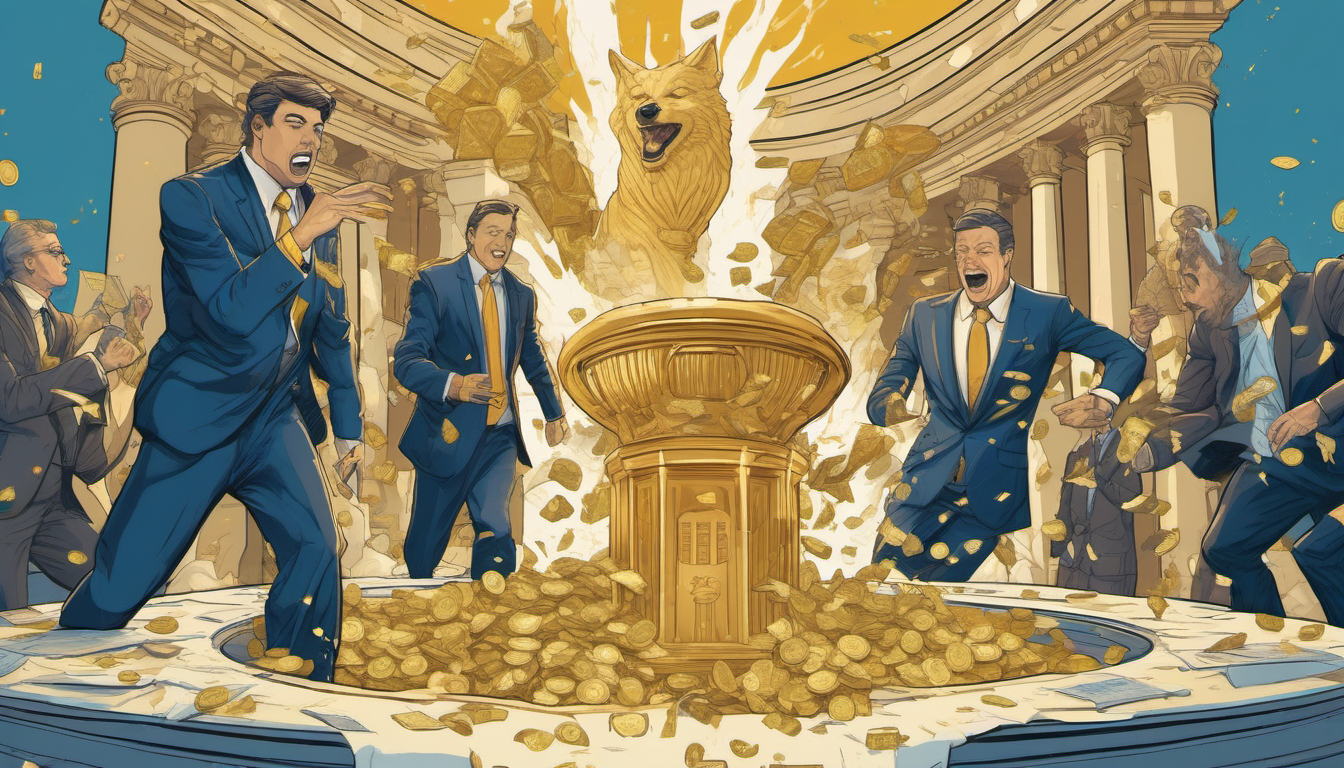
How law firms, hedge funds, and AI companies are turning Trump's legal defeat into the biggest claims windfall in American history
Executive Summary
- The Supreme Court's February 20 IEEPA ruling has triggered an estimated $133.5–$175 billion refund scramble, spawning an entirely new financial ecosystem of trade lawyers, hedge fund claims-buyers, and AI-powered filing platforms.
- A two-tier system is emerging: large corporations with legal firepower are filing aggressively, while small importers face being shut out or forced to sell claims at steep discounts to hedge funds.
- The DOJ is actively trying to slow the refund process, Trump has floated the constitutionally dubious idea of a Supreme Court rehearing, and the administration has financial incentives to obstruct—tariff revenues have become a critical fiscal lifeline.
Chapter 1: The Floodgates Open
On the morning of February 20, 2026, two hours before the Supreme Court officially published its 6–3 ruling in Learning Resources v. Trump, Joseph Spraragen's phone was already ringing. The veteran New York trade attorney at Grunfeld, Desiderio, Lebowitz, Silverman & Klestadt (GDLSK) had spent months filing hundreds of protests for clients including Prada and Dolce & Gabbana. But that Friday changed everything.
The ruling—declaring Trump's use of the International Emergency Economic Powers Act (IEEPA) to impose sweeping tariffs unconstitutional—didn't just invalidate the legal basis for "liberation day" duties. It created an immediate entitlement: every dollar collected under those tariffs, dating back to April 2025, was potentially owed back.
Within days, more than 1,800 companies filed refund lawsuits in the U.S. Court of International Trade. FedEx launched a class action. L'Oréal, Dyson, Bausch + Lomb, Costco, Hasbro, J. Crew, Xerox, and Jaguar Land Rover all filed individual claims. "It's unprecedented," Spraragen told reporters—and in 30 years of trade law, he had never seen demand for customs lawyers at this intensity.
The total refund liability is staggering. Major U.S. media outlets estimate between $133.5 billion and $175 billion in potential claims. For context, this exceeds the entire annual budget of the Department of Homeland Security. It dwarfs the $12.2 billion paid out in the 2008 Troubled Asset Relief Program's first tranche. It would be, if fully disbursed, the largest government-to-private-sector transfer in American history outside of pandemic relief.
Chapter 2: The Legal Gold Rush
The tariff refund wave has electrified a corner of the legal profession that rarely makes headlines. Trade and customs law—typically the domain of arcane harmonized tariff schedule classifications and origin-of-goods disputes—has become the hottest practice area in America.
The fee structure tells the story. Law firms are advertising "flat fees" of $10,000–$15,000 per case just to get filings into court. For a firm handling hundreds of clients, that alone generates millions. Quinn Emanuel Urquhart & Sullivan, a 1,300-lawyer global firm, launched a dedicated "Tariff Refund Task Force" within hours of the ruling. Smaller specialized firms like GDLSK and Neville Peterson, with decades of customs expertise, are suddenly turning away business.
But the flat fees are just the beginning. If the Trump administration—as many expect—makes the refund process deliberately difficult, billable hours will pile up. Nicole Bivens Collinson, head of international trade at Sandler Travis and Rosenberg, estimates the legal fees across the industry could reach "many millions" from flat fees alone, with exponentially more from contested proceedings.
The complexity is the product. Even before the ruling, Trump's tariff regime had created a compliance nightmare. Different rates applied based on where specific components of a product were manufactured. A handbag with a Chinese zipper, Italian leather, and Vietnamese stitching faced a labyrinthine classification problem. Getting it wrong was customs fraud. Getting it right required a lawyer.
Jennifer Hillman, a Georgetown University law professor and former general counsel for the U.S. Trade Representative, put it bluntly: "To me, the only winners from this trade war that Trump has launched have been the lawyers."
| Metric | Scale |
|---|---|
| Estimated total refund liability | $133.5–$175 billion |
| Companies with filed lawsuits | 1,800+ (as of Feb 28) |
| Typical flat fee per filing | $10,000–$15,000 |
| Major class actions filed | FedEx, L'Oréal, Dyson, Costco |
| Court handling claims | U.S. Court of International Trade |
Chapter 3: The Hedge Fund Claims Market
Perhaps the most striking development is the emergence of a secondary market for tariff refund claims—a financial innovation that effectively securitizes government liabilities.
The mechanism is straightforward but powerful: a hedge fund approaches an importer with a large outstanding tariff claim. Rather than wait months or years for the government to process a refund, the importer sells the right to that future payment at a discount. The hedge fund pays cash upfront, assumes the risk and delay, and pockets the difference when the government eventually pays.
The case of Kids2, an Atlanta-based toymaker that imports 95% of its products from China, illustrates the dynamic. The company sold its $15 million tariff claim to a Boston hedge fund for $2 million in immediate cash—a discount of roughly 87%. Before the Supreme Court ruling resolved the legal merits, such steep discounts reflected genuine uncertainty. Now that the legal basis is established, the discounts are narrowing, but the market is exploding in volume.
Richard O'Neill, a partner at Neville Peterson, confirmed that hedge funds have been approaching his firm seeking introductions to clients with large claims. "There are hedge funds out there who are looking to scoop these up. And they've been looking to scoop up these claims since before Friday," he said. "And I'm sure their rates are changing considerably now that we have the merits resolved."
Investment banks are playing matchmaker. Bloomberg reported that Jefferies, Oppenheimer, and Seaport Global Securities are among the firms brokering deals between investors and importers. A new asset class has effectively been born: "tariff refund receivables."
Historical parallels are instructive. The closest precedent is the litigation financing industry that emerged around mass tort cases—asbestos, tobacco, opioids—where hedge funds purchased plaintiffs' claims at discounts. The tariff refund market differs in one critical respect: the underlying liability is not contested. The Supreme Court has already ruled. The only questions are timing and administrative execution, making the risk profile far more attractive for financial buyers.
Chapter 4: The AI Claims Factory
Inevitably, artificial intelligence has entered the tariff refund business. Multiple startups and established legal tech firms are racing to automate the claims process, offering to analyze import records, calculate refund amounts, generate filings, and track case progress—all at a fraction of what human lawyers charge.
The pitch is compelling: a midsize importer with thousands of individual shipment entries over the past year faces a monumental paperwork challenge. Each entry must be reviewed, the tariff classification verified, the IEEPA-specific surcharges identified, and a claim filed. For a company with 10,000 shipments, that's 10,000 potential filings. At $10,000–$15,000 per lawyer-filed case, the legal costs alone could approach or exceed the refund amount for smaller importers.
AI platforms promise to compress this work to hours rather than weeks, at costs measured in hundreds rather than thousands of dollars per claim. The technology leverages the same large language models that have disrupted legal research, contract review, and compliance—now applied to the highly structured domain of customs documentation.
The irony is thick: AI systems, many built by the same companies whose broader economic disruption is reshaping labor markets, are now being deployed to extract value from a legal ruling about presidential overreach. The SaaSpocalypse meets the tariff refund bonanza.
Chapter 5: The Administration's Obstruction
The Trump administration has powerful incentives to slow the refund process. Tariff revenues have become a significant fiscal resource, generating an estimated $80–$100 billion annually that the government has already spent or committed. Returning $175 billion would blow a hole in federal finances at a moment when the IEEPA ruling has already eliminated future revenue from the invalidated tariffs.
The Department of Justice moved quickly to slow the legal machinery. On February 27, the DOJ filed motions in the Court of International Trade requesting additional time to respond to the flood of lawsuits, arguing that the sheer volume of cases requires orderly processing. Critics see a deliberate delay strategy.
Trump himself has publicly mused about obstacles. On Truth Social, he posted: "The recent Supreme Court ruling on tariffs could allow hundreds of billions of dollars to be returned to countries and companies that exploited America for years. Is a Rehearing or Readjudication possible on this case?"
The answer, legally, is almost certainly no. Supreme Court Rule 44 requires a rehearing petition to come from a justice who joined the majority, within 25 days, with five of nine justices voting in favor. Since six justices ruled against the administration, the math is impossible absent a justice reversing their own position.
But the rhetorical framing matters. By characterizing refund recipients as entities that "exploited America," Trump is laying political groundwork for administrative foot-dragging. Bivens Collinson warned: "I can see a scenario wherein this administration would try to make the refund process as difficult as it can because of the reliance that it has now on those tariffs."
The result is a bureaucratic standoff: valid legal claims on one side, a government with financial and political reasons to delay on the other, and an entire industry profiting from the friction in between.
Chapter 6: The Two-Tier System
The tariff refund bonanza is creating a stark divide between large and small importers.
The haves: Multinational corporations with in-house legal teams, dedicated customs brokers, and the financial resources to hire top trade law firms. These companies filed claims within days of the ruling. Many had preemptively challenged tariffs throughout 2025, positioning themselves for immediate recovery. FedEx's class action, if successful, could benefit thousands of businesses that shipped through its network.
The have-nots: Small and midsize importers—the neighborhood retailers ordering goods from overseas, the Etsy sellers sourcing components from China, the family-owned manufacturers importing specialized inputs. These businesses often lack the legal sophistication to know they're entitled to refunds, the administrative capacity to file claims, and the financial cushion to wait for resolution.
Hillman noted that most importers should be able to retroactively change their tariff classification through normal customs procedures, without litigation. But that requires understanding the system, which many small businesses do not. And the window for administrative correction has limits.
The hedge fund claims market exacerbates the inequality. A small business selling a $50,000 claim at an 87% discount—like Kids2's proportional deal—would receive just $6,500. Better than nothing, but a fraction of what they're owed. Large corporations, with the patience and resources to litigate, will recover close to 100 cents on the dollar.
Chapter 7: Scenario Analysis
Scenario A: Orderly Administrative Refund (20%)
Premise: The administration, under political and legal pressure, establishes a streamlined refund process. Customs and Border Protection creates automated mechanisms to recalculate duties and issue credits.
Trigger conditions: Bipartisan Congressional pressure, Court of International Trade mandating expedited processing, political calculation that fighting refunds damages Republican midterm prospects.
Historical precedent: After the 2018 steel tariff exemption process, CBP developed (imperfect) mechanisms for tariff adjustments. In 2020, certain Section 301 tariff exclusions were processed relatively quickly.
Timeline: 6–12 months for most claims.
Market impact: Neutral to mildly positive. Fiscal impact manageable if spread over multiple quarters. Legal fee windfall modest.
Scenario B: Protracted Legal Battle (50%)
Premise: The DOJ fights each case individually, demands extensive documentation, appeals procedural rulings. Trump's "five years in courts" prediction becomes self-fulfilling.
Trigger conditions: Administration prioritizes fiscal revenues, DOJ staffing is redirected to delay tactics, Court of International Trade overwhelmed by volume (currently has 9 judges for 1,800+ cases).
Historical precedent: The Byrd Amendment (Continued Dumping and Subsidy Offset Act of 2000) created refund entitlements that took years to fully disburse, with WTO challenges and Congressional changes extending the process. Post-9/11 customs penalty refund cases averaged 3–5 years.
Timeline: 2–5 years for full resolution.
Market impact: Legal and financial intermediary industry thrives. Hedge fund claims market expands dramatically. Small business recovery rate drops to 30–50 cents on the dollar through secondary sales. Fiscal uncertainty persists.
Scenario C: Congressional Intervention (30%)
Premise: Congress, seeking to reassert trade authority post-IEEPA ruling, passes legislation creating a formal refund mechanism—potentially tied to the Section 122 tariff reauthorization debate.
Trigger conditions: Midterm election pressure, bipartisan recognition that $175B in unresolved claims creates economic drag, desire to use refund framework as leverage in broader trade legislation.
Historical precedent: The Trade Facilitation and Trade Enforcement Act of 2015 included mechanisms for resolving disputed customs assessments. The Miscellaneous Tariff Bill process provides a model for systematic tariff adjustment.
Timeline: 12–18 months for legislation, 6–12 months for implementation.
Market impact: Most constructive outcome. Creates legal certainty, reduces intermediary profits, improves small business recovery rates. Fiscal impact front-loaded but politically managed.
Chapter 8: Investment Implications
Direct beneficiaries:
- Law firms (private): Specialized trade law practices will see record revenues. Publicly listed legal services companies with customs/trade divisions benefit.
- Litigation finance: Burford Capital (BUR), the largest publicly listed litigation funder, has exposure to trade claims. The company's asset-light model is ideally suited to funding tariff refund cases.
- Financial intermediaries: Jefferies Financial Group (JEF), which is actively brokering refund claim transactions, stands to earn advisory fees.
Indirect beneficiaries:
- Importers with large refund claims: Retail and consumer goods companies that bore the heaviest tariff burden—Costco (COST), Hasbro (HAS), footwear and apparel importers—could book significant one-time gains when refunds materialize.
- Legal tech/AI: Companies offering AI-powered compliance and claims processing. The market is nascent but growing.
Risks:
- Fiscal impact: $175B in refunds would widen the federal deficit, potentially pushing Treasury yields higher if markets reprice government debt sustainability.
- Political uncertainty: Trump's rhetoric about rehearing, combined with administrative delays, creates timeline uncertainty that depresses the present value of refund claims.
- Precedent risk: The claims-buying market could attract regulatory scrutiny if seen as exploitative of small businesses.
Conclusion
The tariff refund industrial complex is an unintended monument to policy chaos. A president who promised to use tariffs as leverage against trading partners has instead created a $175 billion transfer payment from the U.S. Treasury to the private sector—routed through an extractive pipeline of lawyers, hedge funds, and AI platforms.
The deepest irony is distributional. American consumers bore the cost of tariffs through higher prices. The refunds will flow primarily to corporations and their legal representatives. The small importers who were most damaged by tariff complexity will recover the least, selling their claims at steep discounts to financial speculators or simply never filing at all.
In the end, Trump's trade war created no winners except the intermediaries who profited from its chaos—and its unwinding.
Leave a Reply