
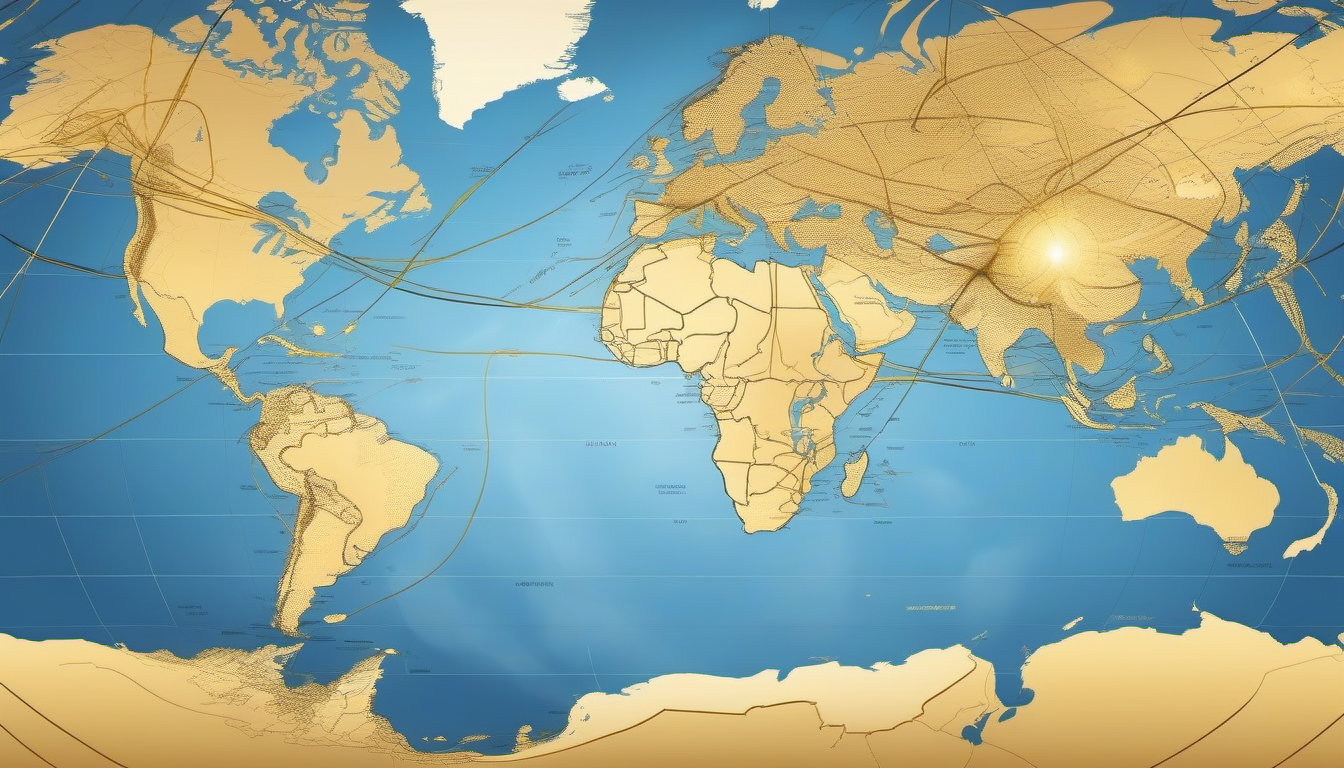
A Citi GPS analysis of 710 corporations reveals the permanent winners and losers of the tariff era — and the $7.75 trillion AI supercycle accelerating the transformation
Executive Summary
- Global trade has undergone a fundamental structural rewiring: US tariffs rose from 2.4% to 16.8%, yet supply chain pressures remained near pre-pandemic levels — companies adapted faster than policymakers anticipated
- Latin America emerged as the surprise winner with an 82% surge in exports to South Asia & ASEAN, the single largest increase in any trade corridor globally
- The Middle East is positioning itself as the new crossroads of global commerce, with shipments from North and East Asia up 52% — a seismic pivot few predicted
- A $7.75 trillion AI infrastructure supercycle is now reshaping trade finance itself, with 36% of large corporates using AI tools for trade operations — an 18% year-over-year increase
Chapter 1: The Great Adaptation — Why Supply Chains Didn't Break
When the Trump administration raised US tariffs from 2.4% to approximately 16.8% — a sevenfold increase — economists predicted supply chain chaos. The predictions proved half-right. Trade flows did transform radically. But chaos? The data tells a different story.
Citi's proprietary Global Supply Chain Pressure Index, built on payment flows from over $5 trillion processed daily through its services business, reveals something counterintuitive: supply chain pressures remained subdued and near pre-pandemic levels throughout the tariff escalation. The global trading system absorbed a shock that would have paralyzed it a decade ago.
How? Through what Citi calls the "triple adaptation strategy": strategic inventory management, supplier diversification, and accelerated nearshoring. Companies didn't wait for governments to negotiate exemptions or courts to rule on constitutional challenges. They rewired their supply chains in real time.
The SCOTUS IEEPA ruling on February 20, which struck down country-specific tariffs as unconstitutional, added another layer of complexity. Trump's immediate invocation of Section 122 — imposing a 15% universal tariff with a 150-day countdown — created yet another set of calculations. But by this point, companies had already built the infrastructure for a multi-polar trade world. The legal uncertainty merely accelerated what was already underway.
Citi's survey of 710 large corporations confirms the scale: 65% are actively diversifying supply chains away from one or more countries. This isn't a temporary adjustment. It's a permanent restructuring of global commerce.
Chapter 2: Latin America's Quiet Revolution
The most dramatic shift in the Citi GPS data isn't where most analysts were looking. While attention focused on the US-China decoupling and the "friendshoring" narrative, Latin America was quietly becoming the biggest winner of the trade war.
Latin American exports to South Asia and ASEAN surged 82% between 2019 and 2024 — the single largest increase in any trade corridor globally. This dwarfs the 44% increase in shipments from North and East Asia to South Asia and ASEAN, and the 50% rise in US imports from the same region.
What's driving this? Three structural forces:
The connector economy. Latin America has positioned itself as a bridge between Asian manufacturing and North American consumption. Brazilian soybeans flow to India. Chilean copper feeds Southeast Asian electronics. Mexican auto parts supply both US and Asian assembly lines. The region isn't just a "nearshoring" destination — it's becoming a genuine hub in multipolar trade networks.
China+1 beneficiary. As companies diversified away from Chinese suppliers, they didn't just move to Vietnam and India. They built redundant supply chains through Latin America, creating a "China+2" or "China+3" model where the region provides both raw materials and intermediate goods.
The tariff arbitrage. With US tariffs on Chinese goods remaining elevated even after the SCOTUS ruling (Section 301 tariffs survive the IEEPA decision), routing through Latin American processing adds value and changes origin rules. This isn't simple transshipment — it's genuine manufacturing transformation.
US imports tell the same story: shipments from Latin America grew 43%, outpacing the 32% growth from North and East Asia. The region's share of US imports has permanently expanded.
| Trade Corridor | Growth 2019-2024 |
|---|---|
| Latin America → South Asia & ASEAN | +82% |
| US → South Asia & ASEAN imports | +50% |
| North/East Asia → South Asia & ASEAN | +44% |
| US → Latin America imports | +43% |
| North/East Asia → Middle East & Africa | +52% |
| US → North/East Asia imports | +32% |
Source: Citi GPS Supply Chain Financing Report, February 2026
Chapter 3: The Middle East as New Crossroads
Perhaps the most underappreciated shift in the Citi data is the Middle East's emergence as a strategic trade hub. Shipments from North and East Asia to the Middle East and Africa increased by 52% between 2019 and 2024. Trade flows from the Middle East and Africa to Europe rose by 27%.
China's exports to the Middle East and Africa grew by 61% — the fastest expansion of any Chinese trade corridor.
This isn't just about oil. Saudi Arabia has leveraged its energy base to make fertilizers its third-largest export growth category, diversifying beyond hydrocarbons. The UAE's position as a logistics hub has deepened. And the region is benefiting from a structural shift in global supply chains that requires intermediate processing zones between Asian manufacturing and European/African consumption.
The geopolitical implications are profound. As trade flows increasingly route through the Middle East, the region's leverage in global affairs grows commensurately. The Abraham Accords, Saudi Vision 2030, and the UAE's logistics investments are not isolated diplomatic moves — they're infrastructure plays for a permanent role in the new trade architecture.
Only 6% of suppliers in the Middle East view rising input costs as their most important challenge, compared to 64% globally. This cost advantage, combined with geographic positioning between Asia, Europe, and Africa, makes the region a natural fulcrum for reconfigured supply chains.
Chapter 4: The $7.75 Trillion AI Trade Supercycle
The Citi report identifies a force reshaping trade flows that most geopolitical analysts overlook: the AI infrastructure buildout. Citi Research estimates $7.75 trillion in global AI-related capital expenditure by 2030 — a once-in-a-generation investment cycle that is already transforming trade finance and supply chain structures.
This supercycle creates its own trade patterns. Data center components — from copper wiring to cooling systems to specialized chips — flow along different routes than consumer goods. The AI buildout requires:
- Copper from Chile and the DRC flowing to semiconductor foundries in Taiwan and packaging facilities in Malaysia
- DRAM from South Korea shipped to server assemblers in the US and Southeast Asia
- Rare earth magnets from China (still 90%+ of global processing) embedded in every server rack
- Natural gas and nuclear fuel powering the facilities that house it all
The AI capex supercycle is creating entirely new trade corridors. Dell's record $113.5 billion annual revenue, with AI server revenue hitting $9 billion quarterly and a $43 billion backlog, illustrates how this demand flows through the real economy. Every server sold requires components from dozens of countries.
Trade finance is adapting in parallel. AI adoption in trade finance itself accelerated dramatically, with 36% of large corporates now using AI tools — an 18% increase from the previous year. Blockchain-based conditional trade payments are moving from pilot to production. The infrastructure for trade is being rebuilt simultaneously with the infrastructure it finances.
Chapter 5: The Working Capital Trap
The Citi GPS report reveals a less visible cost of the tariff era: 6.3% of corporate working capital is now tied up in funding tariff costs. For a Fortune 500 company, this can mean billions of dollars frozen in customs duties, tariff bonds, and compliance infrastructure.
This "tariff tax on liquidity" has three consequences:
Investment crowding out. Capital locked in tariff compliance can't fund R&D, expansion, or hiring. The Tax Foundation estimates tariffs impose an effective $1,300 annual cost per American household, but the corporate working capital drag may be more economically significant.
Financial engineering proliferation. Companies are deploying increasingly sophisticated tools — inventory finance, structured receivables programs, dynamic discounting — to release trapped liquidity. The trade finance industry is booming precisely because tariffs created artificial capital inefficiency.
Advantage to scale. Large corporations can absorb 6.3% working capital drag. Small and medium enterprises cannot. The tariff era is accelerating corporate consolidation, as smaller firms either merge with larger competitors or exit markets entirely.
64% of companies cite increasing input costs as their primary concern — a number that has barely changed since tariffs first escalated. The adaptation is real, but the cost is permanent.
Chapter 6: Scenario Analysis — Where Trade Flows Next
Scenario A: Managed Fragmentation (45%)
The current trajectory continues. Global trade grows but along increasingly regionalized corridors. Latin America, South/Southeast Asia, and the Middle East consolidate as intermediary hubs. US-China direct trade declines further but total global trade volume increases as supply chains lengthen. The SCOTUS IEEPA ruling's Section 122 temporary tariffs become permanent through congressional action.
Historical precedent: The post-Bretton Woods era (1971-1985) saw similar trade restructuring after the Nixon shock, with new intermediary economies (South Korea, Taiwan, Singapore) emerging as trade grew along new corridors. Trade volume increased even as the old bilateral patterns broke down.
Trigger conditions: Congressional compromise on tariff authority; bilateral trade agreements replacing IEEPA framework; continued AI capex growth.
Investment implications: Emerging market infrastructure, logistics companies, trade finance providers benefit. Currency diversification accelerates. Gold maintains $5,000+ as central banks hedge.
Scenario B: Accelerated Decoupling (30%)
The tariff war escalates beyond trade to full technology and financial separation. China's entity list expansion, the Pax Silica technology bloc, and retaliatory rare earth restrictions create parallel economic systems. Trade growth slows as duplication costs mount. The Section 122 sunset leads to even more aggressive bilateral confrontations.
Historical precedent: The Cold War economic partition (1947-1991) created two separate trading systems. GDP growth slowed in the first decade but resumed as each bloc developed internal efficiencies. The current situation differs because economic interdependence is far deeper.
Trigger conditions: Failed April Trump-Xi summit; expanded semiconductor export controls; China counter-sanctions on US financial institutions; PNTR revocation.
Investment implications: Defense and dual-supply-chain plays benefit. Nearshoring infrastructure in Mexico, Vietnam, India accelerates. Higher inflation as duplicate supply chains mature.
Scenario C: Grand Bargain (25%)
A comprehensive trade reset emerges from the converging pressures: SCOTUS ruling, midterm elections, corporate lobbying. Congress reasserts trade authority and negotiates multilateral frameworks. WTO reform proceeds at the March MC14 in Yaoundé. Tariffs decline but don't disappear — they become more targeted and predictable.
Historical precedent: The Uruguay Round (1986-1994) followed a period of escalating trade tensions and unilateral actions. It took 8 years but produced the WTO and a framework that held for 30 years. Current pressures are more intense but so is the institutional infrastructure.
Trigger conditions: Republican midterm losses in tariff-affected districts; IEEPA Section 122 sunset without replacement; corporate campaign contributions shift.
Investment implications: Global equities rally on reduced uncertainty. Emerging markets outperform. Dollar stabilizes. Trade finance volumes surge as barriers predictably decline.
Chapter 7: Investment Implications
Clear winners of the trade rewiring:
- Emerging market infrastructure: Ports, logistics, and warehousing in Vietnam, India, Mexico, Saudi Arabia, and Brazil
- Trade finance: Banks and fintechs enabling the more complex, multi-corridor trade networks
- Copper and industrial metals: The physical backbone of both AI infrastructure and diversified supply chains
- Emerging market currencies: As trade flows diversify, so does currency demand
Structural risks to monitor:
- Working capital deterioration: Companies unable to finance tariff costs face margin compression
- Concentration risk shifting, not disappearing: Dependence is moving from China to a handful of alternatives, creating new single points of failure
- AI capex sustainability: The $7.75 trillion estimate assumes continued ROI evidence — the Solow Paradox 2.0 remains unresolved
- Political risk premium: Trade policy is now a judicial and electoral variable, not just an executive one
Conclusion
The Citi GPS data reveals something that neither trade optimists nor pessimists predicted: the global trading system is more resilient and more different than anyone expected. Companies adapted faster than governments. New trade corridors formed before old ones closed. The AI supercycle is creating demand patterns that didn't exist five years ago.
But resilience is not the same as efficiency. The 6.3% working capital drag, the lengthened supply chains, the compliance costs, and the political uncertainty all represent a permanent tax on global growth. The trade war didn't break the system — it made it more expensive to run.
The real question isn't whether trade will survive. It already has. The question is who pays the adaptation costs — and the Citi data suggests the answer is everyone, unevenly. Large corporations with diversified supply chains thrive. Small businesses absorb disproportionate costs. Consumers pay higher prices. And the countries that positioned themselves as intermediary hubs — Latin America, Southeast Asia, the Middle East — captured value that used to flow directly between the US and China.
The new map of trade is drawn. Understanding it is no longer optional.
Sources: Citi GPS "Supply Chain Financing – Durable Global Trade in the Age of AI" (February 2026), Dell Technologies FY2026 Earnings, Tax Foundation tariff analysis, Citi proprietary Global Supply Chain Pressure Index
Leave a Reply