
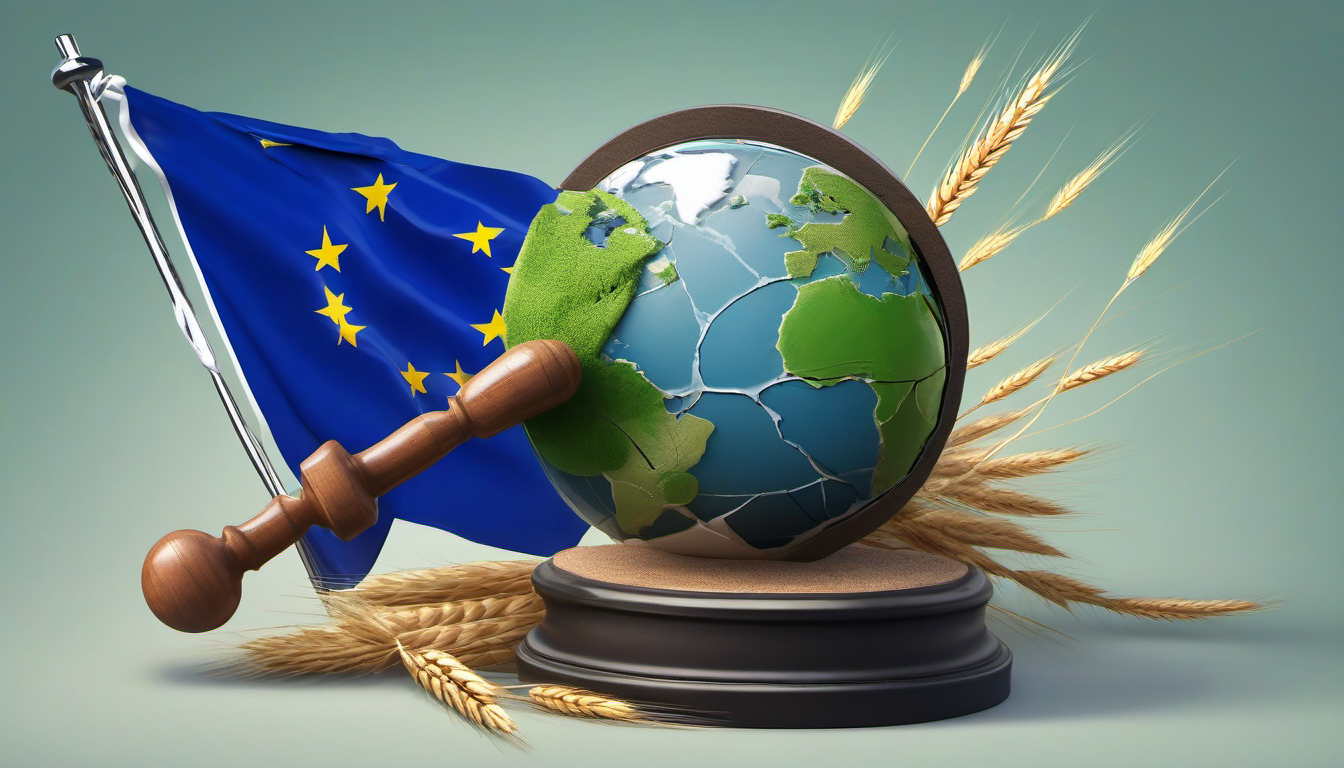
How the EU Commission bypassed its own Parliament to force through the world's largest trade deal — and why it matters for every economy on Earth
Executive Summary
- European Commission President Ursula von der Leyen announced provisional application of the EU-Mercosur free trade agreement on February 27, 2026, bypassing a European Parliament judicial review that had frozen ratification.
- The deal, negotiated over 25 years, creates a free-trade zone spanning 700+ million people and eliminates 93% of tariffs between the EU and Brazil, Argentina, Paraguay, and Uruguay — arriving precisely as the global rules-based trading order fractures under the weight of SCOTUS IEEPA rulings and Trump's tariff regime.
- France's Emmanuel Macron called it a "bad surprise" and an affront to democratic oversight; Germany hailed it as "historic." The split reveals a deeper crisis in EU governance that will define Europe's economic future.
Chapter 1: The Quarter-Century Deal
The EU-Mercosur agreement holds a dubious distinction: it is the longest-negotiated trade deal in modern history. Talks began in 1999, when the euro was months old and the World Trade Organization still appeared capable of managing global commerce. An agreement-in-principle was reached in June 2019, then stalled for years over deforestation concerns in the Amazon, agricultural subsidies, and French election cycles.
The deal's scope is substantial. Combined, the EU and Mercosur represent roughly 25% of global GDP. For EU exporters, the agreement eliminates tariffs on industrial goods — cars, machinery, chemicals, pharmaceuticals — that currently face duties of up to 35% in Brazil. For Mercosur agricultural exporters, the EU would open quotas on sensitive products: 99,000 tonnes of beef annually at a preferential 7.5% tariff, plus expanded access for poultry, sugar, ethanol, and rice.
The European Commission projects the deal would save EU companies approximately €4.5 billion annually in tariff duties. The USITC estimates it eliminates duties on about 95% of tariff lines for EU exports. A 2023 impact assessment projected a €10.9 billion GDP increase for the EU (0.1%) and €7.4 billion for Mercosur (0.3%) by 2032.
These are modest numbers in absolute terms. But the deal's significance has always been strategic rather than purely economic — and in 2026, that strategic calculus has been transformed beyond recognition.
Chapter 2: The Democratic Bypass
Von der Leyen's decision to provisionally apply the deal without parliamentary ratification is unprecedented in its political audacity. Here is the sequence:
In January 2026, the European Parliament secured a majority to refer the deal to the Court of Justice of the European Union (CJEU), effectively freezing the ratification process. The legal question centered on whether the Commission had properly split the agreement into EU-only and mixed competence components — a procedural matter with enormous political implications.
The CJEU could take up to two years to rule. But von der Leyen found a legal mechanism to circumvent the wait: once one or more Mercosur countries completed domestic ratification, the Commission could trigger provisional application under existing treaty authority. Argentina and Uruguay both ratified in early 2026, providing the legal basis.
On February 27, von der Leyen pulled the trigger. "This is one of the most consequential trade agreements of the first half of this century," she declared. The deal would begin taking effect on "the first day of the second month following the date on which the EU and Uruguay exchange notes verbales."
French MEP Manon Aubry of The Left group was blunt: "The largest free trade agreement in history is therefore being implemented WITHOUT the vote of national parliaments, the European Parliament, or the opinion of the Court of Justice of the EU. This is serious!"
Jordan Bardella, chair of the far-right Patriots group, called it "a power grab against our farmers and an overwhelming majority of French people committed to their food sovereignty."
The move exposes a structural tension in EU governance that has intensified throughout 2026: the Commission's growing willingness to act unilaterally when consensus proves elusive, from the SAFE defense bonds to the Buy European industrial policy to now Mercosur.
Chapter 3: France vs. Germany — The Eternal Divide
The Mercosur split maps almost perfectly onto the Franco-German fault line that has defined European integration for seven decades.
Germany's position is driven by industrial self-interest and strategic vision. The German automotive sector — already reeling from Chinese competition, with VW, Bosch, and ThyssenKrupp all announcing major layoffs — sees Mercosur as a lifeline. Brazil is the world's fourth-largest car market, and current tariffs of 35% make German vehicles prohibitively expensive. German Foreign Minister Johann Wadephul called the deal "historic," noting that "companies and people from both continents can finally benefit from more prosperity and growth."
Germany's calculus extends beyond autos. Friedrich Merz's government, inaugurated in January after the snap election, has made economic revitalization its central mission. With German industrial production down 3% and the economy facing what analysts call "structural deindustrialization," any new export market carries outsize importance. Mercosur also provides a hedge against Trump's tariff regime — if the Section 122 tariffs or renewed Section 301 investigations restrict transatlantic trade, having a functioning Latin American corridor matters more.
France's opposition is equally rational but structurally different. France is the EU's largest agricultural producer, and its farming lobby wields decisive political power. The 99,000-tonne beef quota alone terrifies French cattle farmers, who already face competition from cheaper Irish imports and new environmental regulations that raise production costs. Sugar, poultry, and ethanol quotas compound the threat.
But Macron's objections run deeper than agriculture. His reaction — calling the decision a "bad surprise" that was "disrespectful" toward the Parliament — reflects a genuine concern about the Commission's accumulating executive power. Having championed European sovereignty on defense and technology, Macron finds himself in the paradoxical position of opposing Commission autonomy on trade.
Italian Prime Minister Giorgia Meloni added a third dimension, calling for a European free trade zone with the United States and describing Trump's tariff approach as "a mistake." This positions Italy as seeking transatlantic realignment rather than South American diversification — a reflection of Italy's less export-dependent economy and Meloni's closer alignment with Washington.
Chapter 4: The Timing Paradox
Von der Leyen's gamble must be understood in the context of the global trade system's unprecedented fragmentation.
The SCOTUS IEEPA ruling of February 20 struck down Trump's emergency tariff powers, but the administration immediately invoked Section 122, imposing a 15% global tariff with a 150-day countdown. The bilateral "tribute" deals negotiated with India, Japan, Taiwan, and others now face legal uncertainty, and the WTO's MFN principle is functionally dead.
In this environment, locking in a major trade deal becomes an act of strategic insurance. If the global system fragments into competing blocs — a Pax Silica technology alliance, Chinese zero-tariff zones in Africa, and bilateral tribute economics everywhere else — the EU-Mercosur axis provides an independent trade corridor worth approximately $120 billion annually.
The agricultural irony is that some of France's concerns may actually be mitigated by the very global disorder it fears. Brazilian beef exports to the EU are capped by quota, but Brazilian agricultural producers may find more lucrative markets in China and the Middle East as US-China trade decouples. The 99,000-tonne beef quota represents less than 1.5% of EU consumption — a manageable figure if properly managed.
The geopolitical dimension is perhaps most compelling. As the US-Israel strikes on Iran unfold on February 28, Europe's strategic need for economic diversification has never been clearer. Latin America represents the only major economic bloc not currently entangled in military conflict, sanctioned by major powers, or subject to the US's tariff regime. Mercosur offers Europe something increasingly scarce: a trading partner with no geopolitical strings attached.
Chapter 5: Scenario Analysis
Scenario A: The Von der Leyen Gamble Pays Off (40%)
Rationale: The ECJ rules that provisional application is legal (consistent with past precedent on trade agreements). Over 18-24 months, the deal's impact on European agriculture proves manageable — beef imports stay within quota, safeguard clauses are invoked where needed, and the GDP benefits materialize modestly. The European Parliament, facing a fait accompli and German industrial lobbying, ratifies the deal. French farmers protest but are compensated through CAP adjustments.
Historical precedent: The EU-South Korea FTA (2011) was provisionally applied before full ratification and ultimately proved beneficial, with EU exports increasing 50% over a decade.
Trigger conditions: ECJ ruling in Commission's favor; no major food safety scandal involving Mercosur imports; German economic recovery showing signs of progress.
Scenario B: Legal and Political Backlash (35%)
Rationale: The ECJ rules against the Commission, finding that provisional application requires parliamentary consent for mixed agreements. This creates a constitutional crisis within the EU — the Commission having implemented a deal the court deems illegal. Meanwhile, French farmer protests escalate into a broader anti-Commission movement, empowering National Rally ahead of the 2027 French elections.
Historical precedent: The CETA (Canada-EU) provisional application faced Wallonian resistance in 2016, nearly derailing the process and exposing the fragility of EU trade governance.
Trigger conditions: ECJ expedited ruling against Commission; major food safety incident with Brazilian imports; Macron's domestic political crisis deepening.
Scenario C: The Deal as Strategic Shield (25%)
Rationale: The global trade environment deteriorates further — the Section 122 tariff period expires without replacement legislation, creating a US trade policy vacuum. The EU-Mercosur corridor becomes one of the few stable, rules-based trade relationships in the world. Brazil, under Lula's pragmatic leadership, leverages the deal to position itself as a bridge between the West and the Global South. The deal's strategic value far exceeds its economic metrics.
Trigger conditions: Continued US trade policy chaos; China-EU trade tensions escalating; Mercosur countries maintaining political stability.
Chapter 6: Investment Implications
Winners:
- German automotive (VW, BMW, Mercedes-Benz): Tariff elimination on vehicles and parts opens the Brazilian market
- EU chemical and pharmaceutical exporters: Latin American market access at reduced tariffs
- Brazilian agribusiness (JBS, BRF, Marfrig): Expanded EU market access for beef and poultry
- European machinery makers: Reduced tariffs on capital goods exports
- Latin American ethanol producers: EU biofuel quota access
Losers:
- French and Irish cattle farmers: Direct competition from cheaper Mercosur beef
- European sugar producers: Quota-based competition from Brazilian sugarcane
- Poultry producers (France, Poland, Netherlands): Expanded Mercosur access
- US agricultural exporters: Potential trade diversion as Mercosur gains preferential EU access
Key data comparison:
| Metric | EU-Mercosur | USMCA (pre-SCOTUS) | China-Africa Zero Tariff |
|---|---|---|---|
| Combined GDP | ~$22 trillion | ~$28 trillion | ~$22 trillion |
| Population | 700+ million | 500 million | 1.6+ billion |
| Tariff elimination | 93% of lines | ~95% of lines | 100% (53 nations) |
| Negotiation time | 25 years | 2 years (renegotiation) | 6 months |
| Legal status | Provisional application | Under SCOTUS challenge | In effect May 2026 |
Conclusion
Von der Leyen's Mercosur gamble is, at its core, a bet that action beats paralysis. In a world where the United States has declared its own trade powers unconstitutional, where China is building zero-tariff zones across Africa, and where bilateral tribute economics are replacing multilateral rules, the EU Commission chose to move first and ask permission later.
Whether this strengthens or undermines European democracy depends on outcomes that won't be visible for years. But the decision itself reveals something important: in 2026, the EU's greatest internal threat isn't Franco-German disagreement on policy — it's the growing gap between the speed at which the world changes and the speed at which European institutions can respond.
The Parliament will eventually vote. The court will eventually rule. But by then, the trade flows will already be moving. That, perhaps, is exactly what von der Leyen intended.
Sources: European Commission, Euronews, The Guardian, Reuters, France 24, AP News, USITC, USDA Foreign Agricultural Service
Leave a Reply