
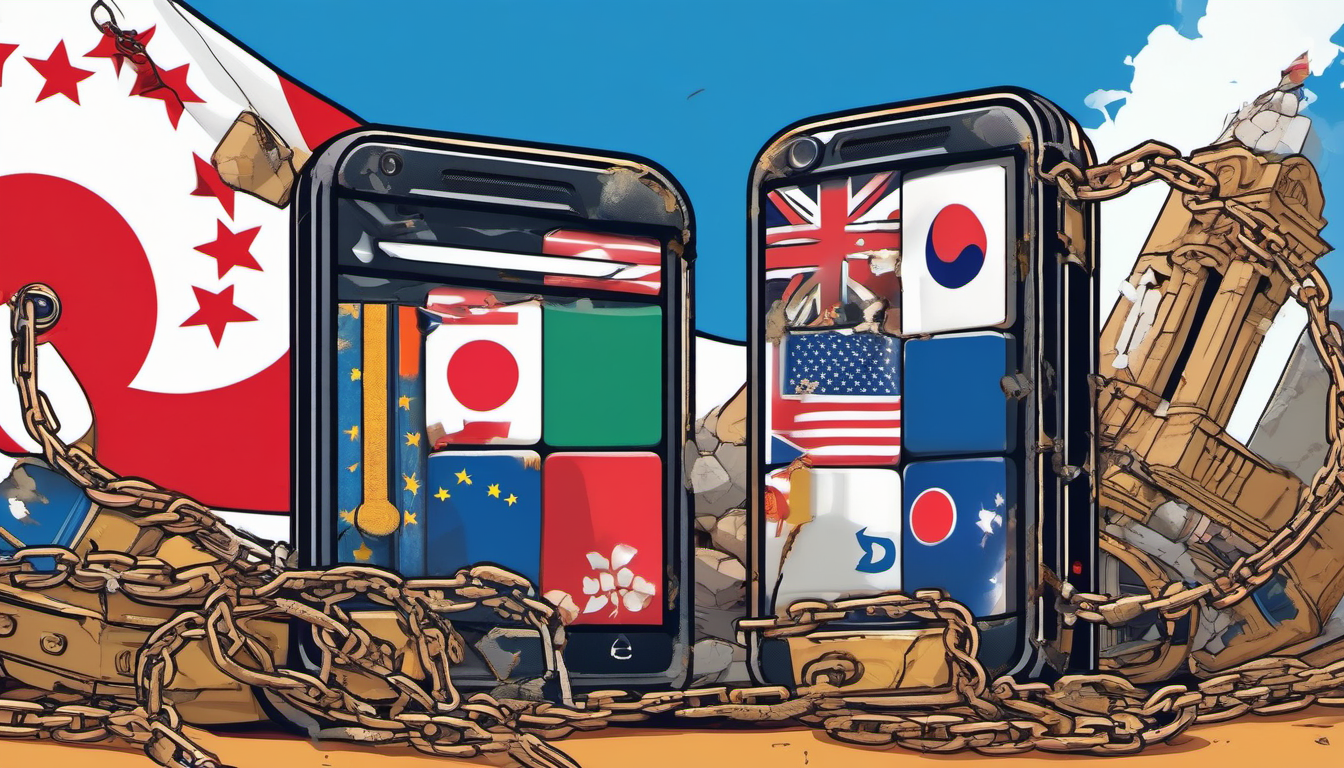
How coordinated antitrust actions across four continents are dismantling the iOS-Android gatekeeping model — and why the AI layer makes it urgent
Executive Summary
- Apple and Google face simultaneous antitrust enforcement across the US, EU, Japan, South Korea, India, and a dozen more jurisdictions — the most coordinated global assault on platform power in history.
- The EU's Digital Markets Act has already forced Apple to allow alternative app stores, while the DOJ pursues structural remedies against Google that could include Chrome divestiture and AdX separation. Combined fines and potential penalties exceed $30 billion.
- The AI dimension transforms this from a competition case into a sovereignty crisis: as Apple Intelligence and Google Gemini become default decision-makers on 6 billion devices, regulators fear a new, virtually unbreakable layer of lock-in is forming before the current one is even addressed.
Chapter 1: The Convergence
For 15 years, the global mobile ecosystem has operated as a duopoly. Apple's iOS and Google's Android collectively control over 99% of the smartphone operating system market worldwide. Together, they govern how 6.4 billion people access the internet, make purchases, and interact with digital services.
Now, regulators on four continents are attacking this structure simultaneously — not in isolated skirmishes, but in what increasingly resembles a coordinated siege.
In the United States, the Department of Justice secured a landmark ruling in August 2024 declaring Google a monopolist in search distribution. The remedies phase is now underway, with prosecutors pushing for structural interventions that could include the forced divestiture of the Chrome browser and the separation of Google's AdX advertising exchange. Separately, the DOJ and 16 state attorneys general have filed suit against Apple, alleging it illegally monopolized the smartphone market through restrictive iPhone practices — the most significant antitrust action against Apple since the e-books case a decade ago.
In Europe, the assault is even further advanced. The European Commission has levied over €8 billion in antitrust fines against Google since 2017, targeting search bias, advertising practices, and Android bundling. Apple was fined €1.8 billion in March 2024 for restricting music streaming competitors, followed by a €500 million penalty for Digital Markets Act violations in early 2026. The DMA itself, fully operational since 2024, represents a new regulatory paradigm: it doesn't require proof of consumer harm but targets structural gatekeeping directly, with penalties of up to 10% of global revenue for non-compliance.
In Asia, the pressure is equally intense. Japan's Fair Trade Commission opened a formal investigation into Apple's App Store practices in 2024 and has signaled it may adopt DMA-style legislation. South Korea has already enacted legislation forcing both companies to permit alternative payment systems — the first country in the world to do so. India's Competition Commission issued an order requiring Google to change how it licenses Android to device manufacturers, a ruling that remains substantially intact despite Google's legal challenges. This week, Japan's JFTC expanded its probe to include Microsoft's cloud licensing practices, signaling that the platform governance model itself is under scrutiny.
Turkey, Brazil, South Africa, Indonesia, and Australia have all initiated or expanded their own investigations into app store fees, default agreements, and self-preferencing. The cumulative picture is unmistakable: this is no longer about individual cases. It is a structural reckoning.
Chapter 2: The Common Architecture of Complaints
Despite different legal traditions and enforcement mechanisms, the global cases converge on remarkably similar allegations. Regulators in Washington, Brussels, Tokyo, New Delhi, and Seoul are all asking variations of three fundamental questions:
1. Should a platform operator also be the rulemaker?
Both Apple and Google set the terms under which competitors must operate on their platforms. Apple's App Store review process can reject, delay, or disadvantage rival apps. Google's Android licensing bundles Search, Chrome, and the Play Store together, creating what the EU termed a "network of self-reinforcing dominance." The structural conflict of interest — referee and player on the same field — is the central complaint across jurisdictions.
2. Should defaults be so difficult to change?
Google pays Apple an estimated $20 billion annually to remain the default search engine on Safari — a deal that the US court found actively reinforces monopoly power. On Android, Google Search, Chrome, and the Play Store come pre-installed on virtually every device, with licensing terms that make removal commercially impractical for manufacturers. Regulators globally see these defaults as mechanisms that foreclose competition regardless of product quality.
3. Should gatekeepers extract 30% from every digital transaction?
Apple's standard 30% commission on App Store purchases — the so-called "Apple tax" — has drawn legal challenges on nearly every continent where Apple operates at scale. Epic Games' lawsuit, South Korea's legislation, the EU's DMA enforcement, and India's investigation all target this fee structure. Google's Play Store imposes a similar commission, though it has made more concessions (reducing fees to 15% for small developers in some markets).
| Jurisdiction | Target | Key Action | Status | Potential Penalty |
|---|---|---|---|---|
| US DOJ | Google (Search) | Monopoly ruling, remedies phase | Chrome divestiture debated | Structural separation |
| US DOJ | Apple (iPhone) | Smartphone monopoly lawsuit | Trial pending 2027 | TBD |
| EU (DMA) | Apple | Alt app stores forced, €500M fine | Compliance disputed | Up to 10% global revenue |
| EU (Antitrust) | €8B+ cumulative fines | Appeals ongoing | Additional fines possible | |
| South Korea | Both | Alternative payments law enacted | Enforced | Fines for non-compliance |
| Japan (JFTC) | Apple | App Store investigation | Active | Potential legislation |
| India (CCI) | Android licensing order | Upheld on appeal | Behavioral remedies | |
| Brazil (CADE) | Both | App store fee investigations | Active | TBD |
The cross-jurisdictional learning is notable. South Korea's payment legislation influenced Japan's approach. The DMA framework has been studied and partially replicated by regulators in Brazil, India, and Turkey. The US DOJ explicitly referenced European enforcement precedents. Regulators are sharing playbooks in real time.
Chapter 3: The AI Acceleration
What transforms this from a routine antitrust cycle into an urgent structural crisis is artificial intelligence.
Both Apple and Google are embedding AI assistants deeply into their operating systems. Apple Intelligence, integrated into iOS 18 and beyond, handles everything from email summarization to photo editing to app suggestions. Google's Gemini does the same on Android, increasingly serving as the default interface between users and the digital world.
The implications for competition are profound. When a user asks Siri to "find a restaurant nearby," Apple's AI determines which apps surface results and in what order. When Gemini suggests a travel itinerary, Google's model decides which booking platform, map service, and review site to recommend. These are not neutral decisions — they are gatekeeping functions embedded in AI models trained on proprietary data from billions of users.
Regulators recognize that if the current duopoly isn't addressed before AI assistants become the primary user interface, a new and potentially unbreakable layer of lock-in will form. The European Commission has explicitly warned that AI integration could extend DMA obligations. Japan's JFTC identified AI-mediated default placement as a key concern in its 2025 annual report.
The paradox is acute: the very AI capabilities that make smartphones more useful also make the platforms harder to leave. Apple Intelligence works best within the Apple ecosystem. Gemini integrates seamlessly with Google Search, Maps, and YouTube but has no incentive to surface competitors. The AI layer threatens to make the 30% commission look quaint — the real tax may become the invisible curation of which businesses users even know exist.
Chapter 4: The Defense and Its Limits
Apple and Google have deployed sophisticated legal arguments across jurisdictions, but the terrain is shifting against them.
Apple's defense centers on security and privacy. The company argues that its closed ecosystem protects users from malware, ensures data privacy, and delivers a premium experience. App Store review, it contends, is a quality control mechanism, not an anticompetitive barrier. This argument has found some traction in US courts, where the consumer welfare standard traditionally focuses on price effects.
But the DMA bypasses this defense entirely — it targets market structure, not consumer harm. And Apple's own compliance behavior has undermined its credibility. When forced to allow alternative app stores in the EU, Apple imposed a "Core Technology Fee" of €0.50 per first annual install even below the 1 million threshold, conditions so onerous that MacPaw's Setapp Mobile — one of the first alternative stores — shut down on February 16, 2026, citing Apple's "still-evolving and complex" terms.
Google's defense emphasizes Android's open-source foundation. Anyone can fork Android, Google argues, and users can change defaults at any time. But regulators have documented that licensing agreements effectively eliminate meaningful choice: manufacturers who want access to the Play Store (essential for commercial viability) must also pre-install Google Search and Chrome, in a bundling arrangement the EU found unlawful in 2018.
The legal environment is shifting structurally. Judge Amit Mehta's ruling against Google in the US signaled willingness to look beyond the consumer welfare standard. India's competition framework now addresses market structure directly. The DMA represents an entirely new regulatory paradigm where gatekeeping itself is the violation.
Chapter 5: Scenario Analysis
Scenario A: Managed Fragmentation (45%)
Outcome: Duopoly persists but with significantly reduced gatekeeping power. Alternative app stores gain 10-15% market share in regulated markets. Commissions decline to 15-20% globally. AI integration faces interoperability requirements.
Rationale:
- Historical precedent: Microsoft's antitrust consent decree (2001) reduced but didn't eliminate its dominance. IBM's case (1982) led to voluntary changes without breakup.
- EU DMA enforcement is already producing incremental opening. South Korea's law is working.
- Apple and Google have enormous resources for compliance strategies that technically satisfy requirements while preserving most advantages.
Trigger conditions: Courts impose behavioral remedies rather than structural separation. Companies comply minimally with DMA-type regulations.
Scenario B: Structural Separation (25%)
Outcome: Google forced to divest Chrome and/or AdX. Apple required to fully open iOS to competing app stores and payment systems. Android unbundled from Google services.
Rationale:
- DOJ is actively pursuing Chrome divestiture. Judge Mehta's ruling was unusually strong.
- EU Commissioner Vestager's successor maintains aggressive posture.
- But structural breakups are historically rare — Standard Oil (1911) and AT&T (1984) are the only major US precedents.
- Companies will appeal for years. Implementation takes 3-5 years minimum.
Trigger conditions: US courts order structural remedies in Google case. EU escalates DMA enforcement to include breakup threats.
Scenario C: AI Lock-In Prevails (30%)
Outcome: Regulatory efforts succeed in opening app stores and reducing commissions, but the AI assistant layer creates new, more powerful gatekeeping that regulators fail to address in time.
Rationale:
- AI integration is advancing faster than regulatory frameworks. Apple Intelligence and Gemini are already default.
- Regulating AI recommendation systems is technically harder than regulating app store commissions.
- Companies can argue AI curation improves user experience, complicating enforcement.
- Geopolitical fragmentation (US vs EU vs China approaches) prevents coordinated AI platform regulation.
Trigger conditions: DMA/DOJ remedies address legacy issues (app stores, defaults) but fail to anticipate AI-mediated gatekeeping. Companies shift value extraction from visible commissions to invisible AI curation.
Chapter 6: Investment Implications
Direct impacts:
- Apple (AAPL): Services revenue ($96B in FY2025) faces structural pressure. App Store commissions account for an estimated 30-40% of Services gross margin. Even a 5-percentage-point reduction in commission rates could trim $4-6B annually. However, Apple's premium hardware margins provide a buffer that competitors lack.
- Alphabet (GOOGL): The $20B+ annual payment to Apple for default search is existentially important. If Chrome is divested, Google loses its second-largest distribution channel. AdX separation would fragment its advertising stack. However, Google's AI capabilities (Gemini, Search Generative Experience) create new competitive advantages that partially offset distribution losses.
Winners from platform opening:
- Epic Games / alternative app stores: Direct beneficiaries of DMA-forced opening, though Apple's compliance strategies limit near-term gains.
- Spotify, Netflix, and other "super-apps": Reduced commissions improve unit economics. Direct billing reduces Apple/Google intermediation.
- Payment processors (Stripe, Adyen): Alternative payment systems on mobile create new addressable market estimated at $50-100B in transaction volume.
- RegTech and compliance platforms: Growing complexity of multi-jurisdictional regulation creates demand for compliance infrastructure.
Structural risks:
- Fragmented regulation increases compliance costs for all app developers, not just Apple and Google.
- If AI lock-in prevails (Scenario C), the companies that initially suffer from antitrust action may emerge stronger through AI moats that are harder to regulate.
- Geopolitical fragmentation could create three distinct mobile ecosystems: US-led, EU-regulated, and China's walled garden — increasing costs for global businesses.
Conclusion
The global assault on the iOS-Android duopoly represents the most significant coordinated antitrust action since the breakup of Standard Oil. Regulators on four continents are attacking the same structural problem through different legal frameworks, creating a regulatory pincer that neither Apple nor Google can fully evade by forum-shopping.
But the deepest irony may be one of timing. By the time courts deliver final rulings and regulators enforce compliance — a process that historically takes 5-10 years — the competitive landscape may have already shifted to a new terrain: AI-mediated interfaces where the real gatekeeping power lies not in app store commissions or default search agreements, but in which businesses an AI assistant decides to recommend.
The regulators are besieging the castle. But the castle's occupants may already be building a new fortress in the sky.
Related Reading
- AI 문지기: 왓츠앱 최후통첩 — EU's earlier Meta antitrust action
- 거대한 클라우드 포위전 — Microsoft cloud antitrust probe
- Technology & AI Hub
Leave a Reply