
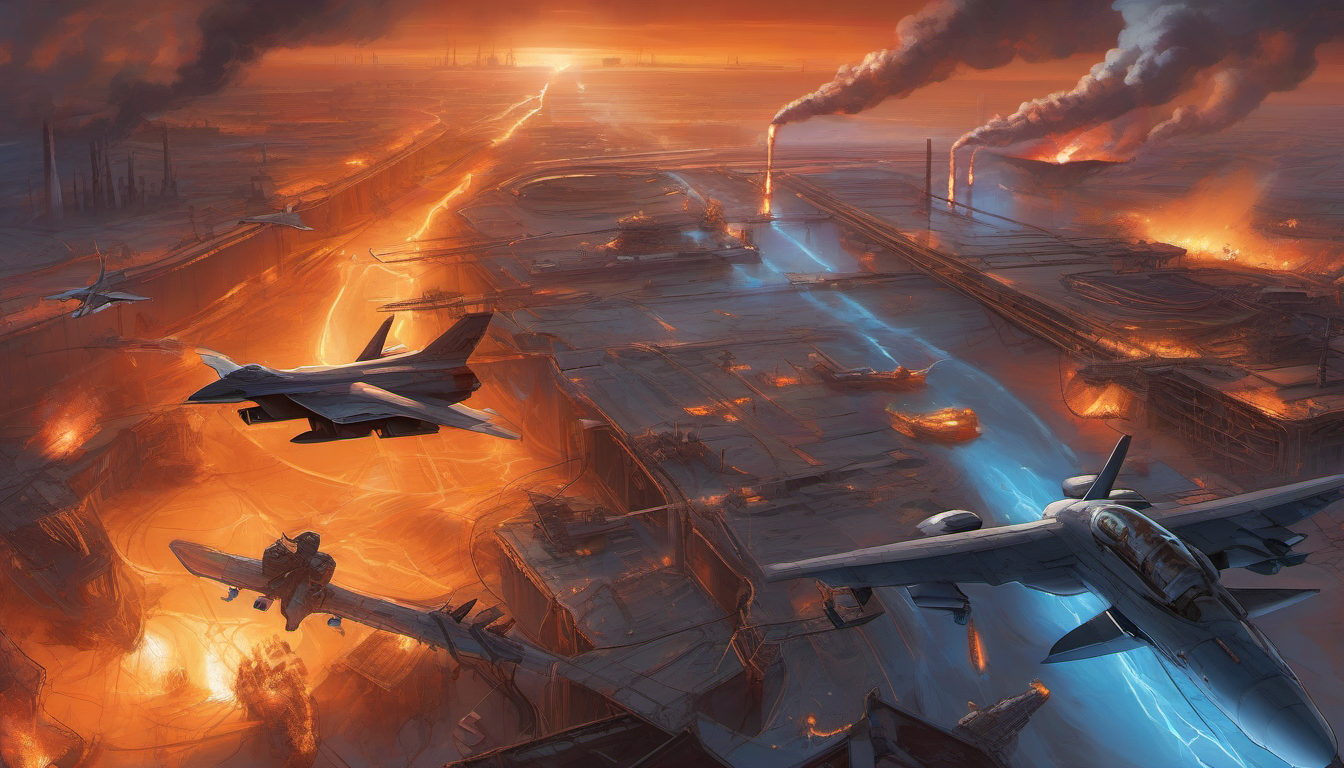
The metal that built the modern world is becoming a strategic weapon — and Western manufacturers are running out of time.
Executive Summary
- Aluminum prices have surged to a four-year high of $3,300/ton on the LME, driven by EU's full phase-out of Russian aluminum (effective February 26, 2026), China's hard 45-million-ton production cap, and the largest global rearmament cycle since the Cold War.
- The "all-in" cost for U.S. manufacturers has reached nearly $5,000/ton when factoring in the 50% import tariff and record Midwest physical premiums — creating a structural cost disadvantage that threatens everything from F-35 production to EV manufacturing.
- Three converging forces — defense-industrial demand, green transition requirements, and trade fragmentation — have created what analysts call a "structural scarcity" regime that could persist through the end of the decade, with profound implications for defense budgets, inflation trajectories, and the geography of industrial power.
Chapter 1: The Perfect Storm — How Aluminum Hit $3,300
On February 26, 2026, the EU's "February Restrictive Measures" took effect, requiring all Russian primary aluminum entering Europe to comply with strict new sanctions protocols. By December 31, 2026, Russian aluminum will be completely banned from EU markets. The London Metal Exchange simultaneously suspended the warranting of Russian aluminum in EU warehouses unless metal owners can provide attestation of compliance.
This is not a minor adjustment. Russia is the world's third-largest aluminum producer at 3.8 million metric tons annually. Rusal, the country's aluminum giant controlled by sanctioned oligarch Oleg Deripaska, had for years remained a significant supplier to European industry even as other Russian commodities faced restrictions. The aluminum exception was always a pragmatic concession — Europe's aerospace, automotive, and construction sectors depended on it. That pragmatism is now over.
The price trajectory tells the story. Benchmark LME aluminum climbed steadily from roughly $2,400/ton in late 2024 to breach $3,100 in January 2026. By late February, it touched $3,300 — levels not seen since the post-pandemic supply crunch of early 2022. But unlike 2022, when the spike was driven by temporary logistics bottlenecks, today's rally is structural.
Three forces converged simultaneously:
China's production ceiling. For decades, China — producing roughly 60% of the world's aluminum (approximately 43 million metric tons) — served as the global market's safety valve. When prices rose, Chinese smelters ramped up production. That mechanism is now broken. Beijing's strict environmental mandates and power-rationing policies have imposed a hard cap at 45 million tons. Chalco (Aluminum Corporation of China) and domestic peers cannot exceed this ceiling regardless of price signals. The world's largest producer has, in effect, exited its role as swing supplier.
The Russian phase-out. Europe imported approximately 275,000 metric tons of Russian aluminum annually under the previous sanctions framework — a threshold designed to prevent market disruption. The new complete ban removes this supply entirely, forcing a costly reshuffling of global trade flows. Middle Eastern and Indian smelters have partially filled the gap, but at higher prices and with longer delivery times.
Defense-industrial demand. The global rearmament cycle — with NATO targeting 5% of GDP, the EU's €150 billion SAFE defense bond, Japan's ¥15 trillion defense budget, and the Pentagon's proposed $1.5 trillion budget — has created unprecedented military demand for high-grade aluminum alloys. Modern fighter jets like the F-35 contain approximately 20 tons of aluminum. A single Virginia-class submarine requires hundreds of tons. The defense sector is now competing directly with commercial aviation and the EV industry for limited supply.
Chapter 2: The Tariff Multiplier — America's $5,000 Problem
For U.S. manufacturers, the global aluminum squeeze is compounded by domestic trade policy. The 50% import tariff on aluminum — expanded from the original Section 232 tariffs and surviving the Supreme Court's IEEPA ruling — has created a two-tier global market.
The LME benchmark of $3,300/ton is only part of the cost. The Midwest physical premium — the additional cost to get aluminum actually delivered to an American factory — has reached record highs in February 2026. When tariffs are added, the "all-in" cost for domestic manufacturers approaches $5,000/ton.
| Cost Component | Price ($/ton) |
|---|---|
| LME Benchmark | $3,300 |
| Midwest Physical Premium | ~$350-400 |
| 50% Import Tariff | ~$1,650 |
| Total All-In Cost | ~$4,950-5,000 |
This creates a stark competitive disadvantage. A European manufacturer operating within the EU — which has no aluminum import tariff from non-Russian sources — pays roughly $3,500-3,700 all-in. A Chinese manufacturer, with access to domestic aluminum at below-global-market prices, pays even less.
The defense implications are particularly acute. Lockheed Martin's F-35 program, already facing cost pressures, must absorb these elevated material costs at a time when the Pentagon is demanding both higher production rates and lower per-unit prices. Boeing's commercial aircraft division, struggling to recover from years of crisis, faces similar headwinds. The irony is unmistakable: tariffs designed to protect American industry are now raising the cost of American rearmament.
Alcoa, the iconic American aluminum producer, has been a primary beneficiary. After years of razor-thin margins, the company reported net income of $1.17 billion for 2025 — a dramatic reversal. Its strategy of restarting curtailed capacity in Spain and Brazil, combined with investment in "ELYSIS" inert-anode green smelting technology, has positioned it as a preferred supplier for Western firms seeking "green" and "conflict-free" aluminum. But Alcoa alone cannot fill the gap left by Russian exclusion and Chinese production caps.
Chapter 3: The Defense-Industrial Bottleneck
Aluminum is not just another commodity in the current geopolitical environment — it is a strategic material at the intersection of three mega-trends: rearmament, electrification, and decarbonization.
Military demand is exploding. The global defense spending surge — approaching $3 trillion annually for the first time — is creating unprecedented demand for aerospace-grade aluminum alloys. The 7000-series alloys used in aircraft fuselages, the 2000-series alloys in structural components, and specialized lithium-aluminum alloys for next-generation platforms are all in tight supply. The EU's SAFE defense bond program, which attracted over €150 billion in subscriptions, will translate directly into orders for armored vehicles, naval vessels, ammunition, and aircraft — all aluminum-intensive.
The EV transition competes for the same metal. A typical electric vehicle contains 30-40% more aluminum than an equivalent internal combustion engine vehicle, due to lightweighting requirements to offset battery mass. With global EV sales still growing — despite BYD's price war and Tesla's brand crisis — the automotive sector absorbs approximately 25% of global aluminum production.
Power grid modernization adds a third claim. Aluminum is the primary conductor material for high-voltage transmission lines. The massive grid buildout required to support AI data centers — an additional 50 GW of demand by 2030 — requires millions of tons of aluminum conductor cable. The U.S. alone needs an estimated $2.5 trillion in grid investment over the next decade.
These three demand sources are converging simultaneously for the first time, and they are largely non-substitutable. You cannot build an F-35 with steel. You cannot lighten an EV with copper. You cannot string power lines with plastic.
Chapter 4: Historical Parallels — When Strategic Metals Reshaped Power
The current aluminum crisis echoes several historical episodes where commodity constraints reshaped strategic outcomes.
World War II aluminum mobilization (1940-1945). The "Aluminum for Defense" campaign saw the U.S. government nationalize the aluminum industry, with Alcoa's production rising from 327,000 tons in 1940 to over 2.3 million tons by 1943. The government built 22 new smelters at public expense. Today's challenge is analogous: military demand is surging, but the industrial base to meet it no longer exists at sufficient scale domestically.
The 2018 Rusal sanctions crisis. When the Trump administration first sanctioned Rusal in April 2018, aluminum prices spiked 35% in days, and the LME briefly suspended deliveries. The sanctions were ultimately relaxed within months after European manufacturers warned of factory shutdowns. The 2026 situation differs fundamentally: the EU has now committed to a complete phase-out, with no reversal mechanism. The 2018 episode was a rehearsal; 2026 is the performance.
China's rare earth embargo (2010). When China restricted rare earth exports to Japan during the Senkaku Islands dispute, the episode catalyzed a decade-long effort to diversify supply chains. The aluminum parallel is clear: Russia's exclusion from Western markets will force a multi-year reconfiguration of global aluminum trade flows, with India, the Middle East, and potentially Africa emerging as alternative supply centers.
| Historical Precedent | Duration | Price Impact | Supply Chain Outcome |
|---|---|---|---|
| WWII Aluminum Mobilization | 1940-1945 | Government-controlled | 22 new smelters built |
| 2018 Rusal Sanctions | April-December 2018 | +35% spike, then reversal | Sanctions relaxed |
| 2010 China Rare Earth | 2010-2015 | +300-400% | Lynas, MP Materials emerged |
| 2026 Russian Aluminum Ban | 2026-ongoing | +38% (12 months) | Structural reshuffling |
Chapter 5: Scenario Analysis
Scenario A: Controlled Tightness (45% probability)
Aluminum prices stabilize in the $3,000-3,500 range as Middle Eastern smelters (UAE, Bahrain, Saudi Arabia) and Indian producers (Hindalco, Vedanta) gradually expand capacity. The defense-industrial base adapts through long-term supply agreements and government stockpiling. Inflation impact is manageable.
Rationale: This mirrors the post-2010 rare earth adjustment. Gulf smelters have access to cheap natural gas — the primary energy input for aluminum production — and have been expanding capacity for years. EGA (Emirates Global Aluminium) and Alba (Aluminium Bahrain) are already running at near-record output. India's National Aluminium Company (NALCO) has announced expansion plans. The historical pattern of commodity supply responding to sustained high prices, typically with a 3-5 year lag, supports this scenario.
Trigger: Gulf smelters announce 2-3 million tons of new capacity commitments; India eases power sector constraints for aluminum producers.
Scenario B: Chronic Scarcity (35% probability)
Prices break above $4,000 as defense demand accelerates faster than new supply comes online. The 3-5 year lag between investment decisions and new smelter capacity creates a prolonged deficit. European manufacturers face competitiveness crisis. U.S. tariffs amplify domestic inflation.
Rationale: New smelter construction requires 4-6 years from investment decision to first metal. The global pipeline of new projects is insufficient to offset Russian exclusion plus defense demand growth. China's production cap removes the traditional price ceiling mechanism. The World War II precedent shows that market forces alone could not mobilize sufficient capacity — government intervention was required.
Trigger: NATO defense procurement orders exceed supply projections; China maintains or tightens production cap; no major new smelter projects announced by mid-2026.
Scenario C: Trade Regime Shock (20% probability)
A geopolitical escalation — such as a wider Middle East conflict disrupting Hormuz shipments, or China restricting aluminum exports as a retaliatory measure — causes a price spike above $5,000. Emergency government action including strategic reserve releases, tariff suspensions, and accelerated permitting for domestic smelters.
Rationale: Nearly 7 million tons of aluminum exports transit the Strait of Hormuz annually. With two U.S. carrier strike groups in the region and Iran-U.S. tensions elevated, any disruption would trigger immediate supply panic. China has precedent for using commodity exports as strategic leverage — the 2010 rare earth embargo and the 2025-26 rare earth export controls against Japan demonstrate willingness.
Trigger: Hormuz disruption; China export restrictions; major smelter outage in Middle East.
Chapter 6: Investment Implications
Winners:
- Primary producers with low-cost energy: Alcoa (AA), EGA (private), Hindalco (HINDALCO.NS), Rio Tinto aluminum division (RIO). Alcoa's 2025 net income of $1.17 billion demonstrates the margin expansion at current prices.
- Defense-industrial primes: Higher material costs will eventually be passed through to defense budgets, supporting revenue growth for Lockheed Martin (LMT), BAE Systems (BA.L), Rheinmetall (RHM.DE).
- Green aluminum technology: ELYSIS (Alcoa-Rio Tinto JV), Aludyne, and companies offering recycled/secondary aluminum at scale. Secondary aluminum requires only 5% of the energy of primary production.
- Gulf state economies: UAE and Bahrain benefit from both aluminum export revenues and downstream industrial diversification.
Losers:
- Aluminum-intensive manufacturers without pricing power: Automotive companies (especially mid-tier), packaging companies, construction materials firms facing margin compression.
- European aerospace without long-term supply contracts: Airbus faces higher input costs than Boeing, despite Boeing's tariff disadvantage, due to proximity of Gulf smelters to Asian supply chains.
- Russian economy: Rusal's exclusion from Western markets eliminates approximately $5-6 billion in annual export revenue, compounding Russia's fiscal crisis (oil revenues already down 65%).
Key metrics to monitor:
- LME aluminum inventory levels (currently at multi-year lows)
- Midwest physical premium (record highs signal domestic tightness)
- Gulf smelter capacity utilization and expansion announcements
- U.S. Section 232 tariff policy changes
- Chinese production data vs. 45 million ton cap
Conclusion
The aluminum market in 2026 represents something more profound than a commodity cycle. It is the physical manifestation of the geopolitical fracturing that has defined this decade. The metal that built the postwar industrial order — from Boeing 707s to Coca-Cola cans — is now being rationed by sanctions, capped by environmental policy, and hoarded by militaries.
The EU's decision to fully phase out Russian aluminum, combined with China's production ceiling and the defense-industrial demand surge, has created a structural deficit that cannot be quickly resolved. Unlike oil — where shale production can respond to prices within months — aluminum smelter capacity requires years of construction and billions in investment. The world is learning, again, that strategic commodities cannot be conjured by market signals alone.
For investors, policymakers, and manufacturers alike, the aluminum war is a preview of the resource constraints that will define the age of great power competition. The nations and companies that secure access to this critical metal will shape the industrial order of the next decade. Those that don't will find themselves priced out of both the defense renaissance and the energy transition.
Eco Stream — Deep geopolitical and economic analysis. Daily.
Leave a Reply