
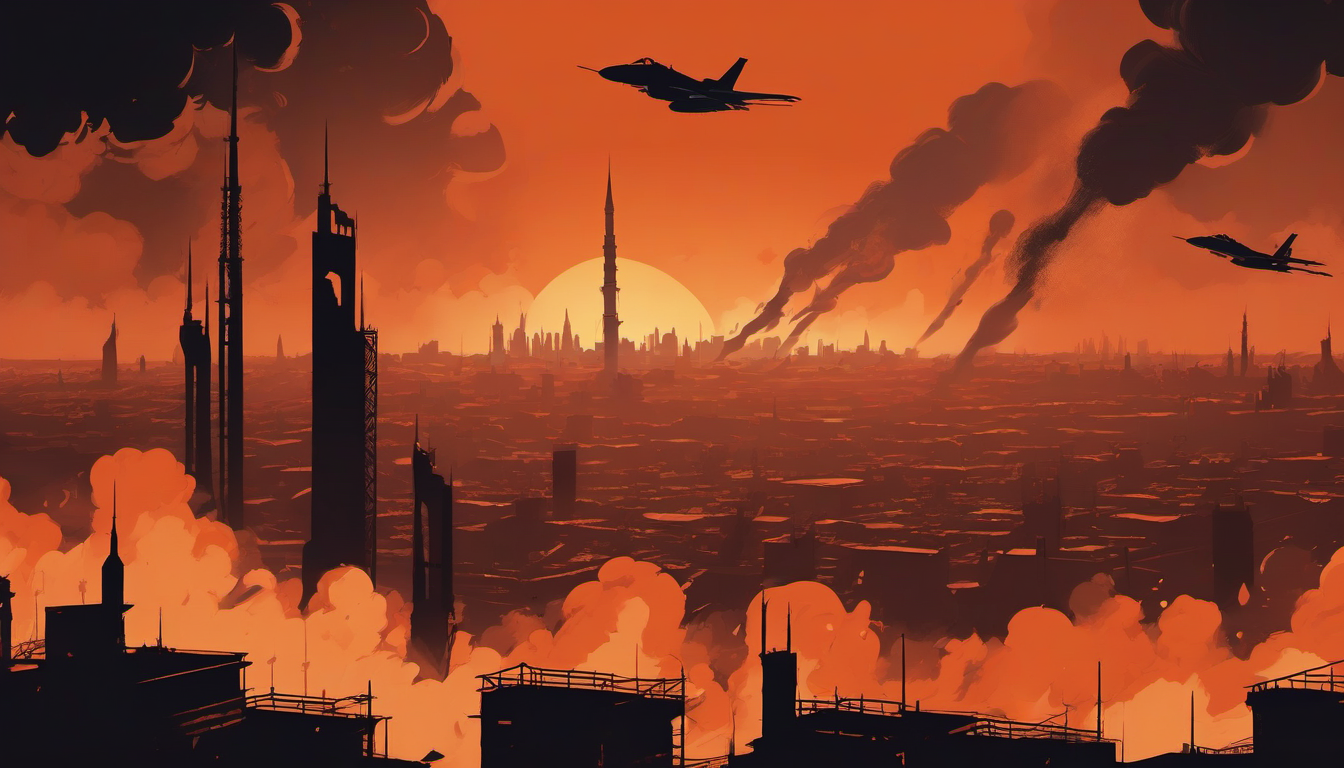
A preemptive attack reshapes the Middle East as diplomacy collapses and Tehran burns
Executive Summary
- The United States and Israel launched a joint preemptive military strike on Iran on February 28, 2026, with multiple explosions reported in central Tehran — the most significant Western military action against Iran since the June 2025 strikes on three nuclear facilities.
- The attack came less than 48 hours after a third round of Geneva nuclear talks ended without breakthrough, with Trump declaring he was "not happy" with Iran's negotiating posture and refusing to rule out regime change.
- Markets face an unprecedented energy shock: Iran sits astride the Strait of Hormuz, through which 20% of global oil transits. With OPEC+ already fractured and global supply-demand in delicate balance, Brent crude is poised for a spike that could ripple through an already fragile global economy.
Chapter 1: The Anatomy of the Strike
At approximately 6:30 AM GMT on Saturday, February 28, 2026, Israel announced what Defense Minister Israel Katz called a strike "to remove threats." Within minutes, witnesses in Tehran reported hearing blasts, and a massive plume of smoke rose from the city's downtown. Iranian state television confirmed the explosions without initially attributing a cause.
Israeli Channel 13, citing a senior security source, reported that the operation was a "joint Israeli-American operation" that had been "worked on for months." The US military initially declined to comment. The New York Times confirmed that "multiple explosions resounded in Tehran."
Simultaneously, air raid sirens wailed across the entirety of Israel. The IDF issued an unprecedented nationwide alert directly to cellular devices, instructing all citizens to remain near protected spaces. Israel shifted to "Essential Activity" status — banning schools, public gatherings, and most workplaces except critical sectors. Israeli airspace was closed.
This was not a surprise to close observers. The pieces had been falling into place for weeks:
- Two carrier strike groups — the USS Ford and USS Lincoln — had been assembled in the region, the largest naval concentration since the June 2025 strikes.
- F-22 Raptors were deployed to Israel's Ovda air base in late February, the first-ever foreign basing of America's most advanced stealth fighter — a 30-year precedent shattered.
- The UK withdrew its embassy staff from Iran on February 27, citing security concerns.
- The US authorized departure of non-essential personnel from Israel and urged citizens to leave "while commercial flights are available."
- Ambassador Mike Huckabee emailed embassy staff at 12:04 AM local time urging them to book flights out "TODAY" to "any place from which you can then continue travel."
Chapter 2: The Diplomatic Collapse
The road to this strike was paved with failed diplomacy. Three rounds of talks between the US and Iran — mediated by Oman in Geneva — produced incremental progress but never bridged the fundamental chasm between the two sides.
The core dispute centered on enriched uranium. Iran possesses approximately 400 kilograms of highly enriched uranium (HEU), enough for multiple nuclear weapons. The IAEA confirmed in its latest report that it had "no knowledge of the whereabouts" of this stockpile and had never been granted access to a newly declared enrichment facility in Isfahan.
Washington demanded that Iran:
- Export its HEU stockpile to the United States
- Permanently end domestic uranium enrichment
- Include its ballistic missile program in negotiations
- Grant full IAEA inspections
Iran was willing to compromise on nuclear issues — agreeing in principle to blend enriched uranium to lower levels and allow IAEA access — but drew firm red lines on two points. First, Tehran insisted on its "right to enrich" as a sovereign nation. Second, it categorically refused to discuss its ballistic missile program, which it considered outside the talks' scope. Iran's parliament had passed a law in July 2025 banning IAEA cooperation until this right was recognized.
Oman's last-ditch effort was extraordinary. Foreign Minister Badr Albusaidi flew directly from Geneva to Washington on February 27, arriving just hours after the third round of talks concluded. He told CBS that a "peace deal is within our reach" and that Iran had agreed to "never, ever have nuclear material that will create a bomb." His mission was to brief Vice President JD Vance — reputedly the administration's strongest voice against military intervention — and convince him that enough progress existed to warrant restraint.
It wasn't enough. Trump told reporters on Friday: "It'd be wonderful if they negotiated in good faith and conscience but they are not getting there so far." Asked about regime change, his response was chilling: "Nobody knows. There might be, and there might not be. Nice if we could do it without but sometimes you have to do it."
Chapter 3: Historical Context — The Escalation Spiral
This strike does not exist in isolation. It is the latest escalation in an increasingly violent cycle between the US-Israel axis and Iran that has defined Middle Eastern geopolitics since 2024.
June 2025: The First Wave
The US launched strikes on three Iranian nuclear facilities — Natanz, Fordow, and Isfahan — causing what intelligence assessments described as "severe damage" to Iran's nuclear program. Iran responded by launching retaliatory missiles at the American Al Udeid Air Base in Qatar, causing minor damage but no casualties. That exchange — known as the "12-Day War" — ended with a fragile ceasefire but no resolution.
January 2026: The Domestic Crisis
Iran experienced its worst internal upheaval since the 1979 revolution. Mass protests, triggered by economic collapse and water shortages, were met with brutal repression. Estimates of 30,000–36,500 deaths emerged. Supreme Leader Khamenei missed the Air Force Day ceremony for the first time in 37 years, reportedly sheltering in underground bunkers. His son Masoud assumed increasing control of state affairs.
February 2026: The Pressure Campaign
The US assembled an overwhelming military presence: two carrier strike groups, F-22s in Israel, 150+ aircraft repositioned from NATO's AWACS base in Konya, Turkey. Iran responded with its own provocations — partially closing the Strait of Hormuz, conducting live-fire exercises, and purchasing CM-302 supersonic anti-ship missiles from China.
The pattern mirrors the Cuban Missile Crisis of 1962 in one critical respect: both sides have been signaling escalation while simultaneously pursuing diplomatic off-ramps. The difference is that in 1962, back-channel communication remained robust. In 2026, the diplomatic architecture has been progressively dismantled.
Chapter 4: Scenario Analysis
Scenario A: Limited Strike, Controlled Escalation (40%)
Premise: The strike targets Iran's nuclear infrastructure — rebuilt since June 2025 — and possibly military command facilities, but avoids population centers and oil infrastructure. Iran retaliates with missile strikes on Israel (intercepted by Iron Dome/Arrow systems) and possibly asymmetric attacks through Hezbollah remnants and Houthi forces. Both sides signal willingness to de-escalate within days.
Historical precedent: The June 2025 exchange followed this pattern. Iran's retaliation on Qatar caused minimal damage, and both sides stepped back. The October 2024 Israeli strike on Iran's air defense systems also remained limited.
Trigger conditions:
- Strike targets are narrowly defined (nuclear/military only)
- Oman or another mediator quickly re-engages
- Iran's retaliatory strike causes minimal casualties in Israel
- Oil markets spike but don't trigger a Hormuz closure
Why 40%: The deployment of F-22s and the "months of planning" suggest this is more extensive than previous strikes. The shift to Essential Activity status in Israel indicates expectations of significant retaliation. But both sides have demonstrated in 2025 that they prefer calibrated exchanges over total war.
Scenario B: Escalation Spiral, Regional Conflagration (35%)
Premise: Iran retaliates with its full conventional arsenal — Khorramshahr-4 ballistic missiles, its underground missile city reserves of 2,000+ missiles, and the newly acquired CM-302 anti-ship missiles against US naval assets. The Strait of Hormuz is fully closed. Hezbollah, Houthis, and Iraqi militias activate simultaneously. Oil spikes above $120/barrel. The US is drawn into a sustained air campaign.
Historical precedent: The 1980-1988 Iran-Iraq War's "Tanker War" phase, where attacks on shipping in the Gulf escalated despite international efforts at containment. The 1990 Gulf War, which began as a limited intervention and expanded rapidly.
Trigger conditions:
- Iranian casualties include senior political/military leadership
- Presidential facility hit (as reported by Channel 12)
- Hormuz closure triggers global energy panic
- Hezbollah launches coordinated attack from Lebanon despite weakened state
Why 35%: The report that "one of the targets is an Iranian presidential facility" suggests this may go beyond nuclear infrastructure. Iran has spent the past 8 months rebuilding its defenses and acquiring anti-ship capabilities specifically for this scenario. The IRGC's institutional survival depends on a robust response.
Scenario C: Diplomatic Rescue, Ceasefire Within 72 Hours (25%)
Premise: The strike is a "shock and awe" demonstration designed to force Iran back to the negotiating table with maximum leverage. Oman's FM Albusaidi — already in Washington — immediately re-engages. China and Russia pressure Iran to accept a modified deal. Rubio's scheduled Monday visit to Israel becomes a victory tour.
Historical precedent: The 1986 US bombing of Libya (Operation El Dorado Canyon) — a limited strike that was followed by diplomatic engagement rather than escalation. Trump's own January 2020 assassination of Qasem Soleimani, which brought the two countries to the brink of war before Iran chose a face-saving missile strike and de-escalation.
Trigger conditions:
- Strike damage is surgical and limited
- Iran signals through back channels a willingness to resume talks
- Oil price spike puts pressure on all parties
- Rubio visit to Israel proceeds as scheduled Monday
Why 25%: The timing — less than 48 hours after talks ended — suggests this was a planned escalation-to-negotiate strategy. Albusaidi's presence in Washington could facilitate rapid re-engagement. However, the scale of the operation (joint US-Israel, months of planning) and the nationwide alert in Israel suggest expectations of significant Iranian response, making a quick diplomatic off-ramp less likely.
Chapter 5: Market Impact and Investment Implications
Energy Markets
The immediate impact is an oil price shock. Iran produces approximately 3.2 million barrels per day and the Strait of Hormuz handles 20% of global oil supply (~21 million bpd). Even a partial disruption would create a supply crisis.
| Scenario | Brent Crude Impact | Duration |
|---|---|---|
| Limited strike, no Hormuz closure | $75→$90-95 | 1-2 weeks |
| Escalation, partial Hormuz disruption | $75→$110-130 | 1-3 months |
| Full regional conflagration | $75→$150+ | Indefinite |
Key comparison: During the June 2025 strikes, Brent rose 15% in two days before settling as the exchange remained limited. The current deployment is significantly larger.
Defense Sector
Defense stocks — already in a supercycle — receive another catalyst. Key beneficiaries: Lockheed Martin (F-22, F-35), Raytheon (Patriot, SM-3), Northrop Grumman (B-2, surveillance), Rafael Advanced Defense (Iron Dome, David's Sling).
Safe Havens
Gold, already at $5,000, likely surges further. The dollar may strengthen short-term on safe-haven flows despite its longer-term weakening trend. US Treasuries rally as risk-off sentiment dominates.
Vulnerable Sectors
Airlines, shipping, tourism, and any company with Middle East supply chain exposure. Insurance and reinsurance companies face another catastrophic event. Emerging market currencies in oil-importing nations (India, Turkey, Japan) under pressure.
The Hormuz Variable
This is the single most important variable for global markets. If Iran fully closes the Strait of Hormuz — which it has partially tested in recent weeks — the resulting supply shock would be the most severe since the 1973 oil embargo. The global economy, already dealing with trade wars, AI disruption, and a US political crisis, has minimal capacity to absorb a simultaneous energy shock.
Conclusion
The US-Israel joint strike on Iran represents the most dangerous escalation in the Middle East since the 2003 Iraq War. It comes at a moment of maximum global fragility: the US political system is convulsing over SCOTUS IEEPA rulings and a DHS shutdown, Europe is scrambling to rearm, China is pursuing economic restructuring, and the global financial system is navigating AI-driven disruption and a sovereign debt crisis.
The next 72 hours will determine whether this becomes a controlled application of force that reshapes the diplomatic equation — or the opening salvo of a broader regional war that could redraw the map of the Middle East and send shockwaves through every financial market on earth.
The stakes are existential, the variables are many, and the margin for error is zero.
Related Reading
- Iran's Missile Gamble — Analysis of Iran's underground missile deterrent
- The Raptor's First Nest — F-22 deployment to Israel
- NATO's Iran Pivot — AWACS surveillance shift
🔗 More coverage: Middle East Hub
Leave a Reply