
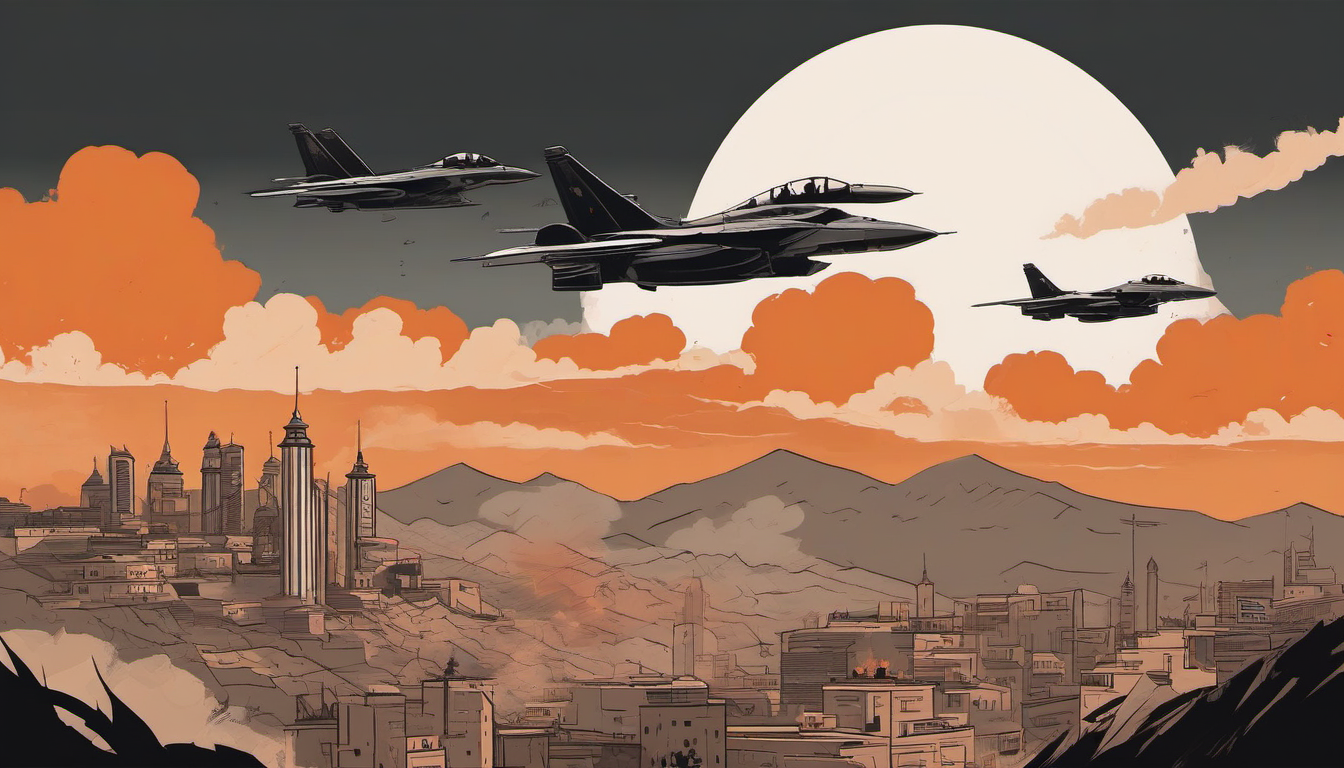
A nuclear-armed state bombs another country's capital — the Durand Line conflict enters uncharted territory
Executive Summary
- Pakistan bombed Kabul, Kandahar, and Paktia on February 27, 2026, marking the first time a nuclear-armed state has struck another country's capital in retaliation for border clashes since India's 2019 Balakot strike against Pakistan itself
- Defense Minister Khawaja Asif declared "open war" against the Afghan Taliban, shattering the Qatar-mediated October 2025 ceasefire and signaling a fundamental shift from counterterrorism operations to interstate conflict
- The escalation creates a dangerous feedback loop: Pakistan's military strikes will likely strengthen TTP recruitment inside Afghanistan while undermining the very diplomatic channels needed to resolve the root causes of violence
Chapter 1: From Border Skirmishes to Capital Bombardment
The trajectory of the past week reads like a textbook escalation ladder. On February 22, Pakistan launched airstrikes into Afghanistan's Nangarhar and Paktika provinces, claiming to target TTP (Tehrik-i-Taliban Pakistan) hideouts and reporting 70 fighters killed. Afghanistan rejected the claims, saying civilians including women and children had died. Four days later, on the night of February 26, the Afghan Taliban launched what they described as "large-scale offensive operations" against Pakistani military positions along the Durand Line — the 2,611-kilometer border that Afghanistan has never formally recognized.
What happened next was without modern precedent. In the early hours of February 27, Pakistani warplanes bombed targets in Kabul, Afghanistan's capital of roughly five million people, along with strikes on Kandahar and Paktia provinces. Residents in Kabul's Dashti Barchi district — a predominantly Hazara neighborhood that has suffered decades of sectarian violence — described their houses shaking violently. "First, we thought it was an earthquake," one resident told the BBC. "Then we heard a loud explosion."
Pakistan's federal information minister Attaullah Tarar claimed the strikes killed 133 Afghan Taliban officials and wounded more than 200. Afghanistan's defense ministry countered that 55 Pakistani soldiers had been killed in the border clashes, with 19 Pakistani army posts destroyed and soldiers "captured alive." Neither claim has been independently verified.
The most explosive statement came from Pakistan's defense minister, Khawaja Asif, who posted on X: "Our patience has now run out. Now it is open war between us."
Chapter 2: The Durand Line — 131 Years of Unresolved Sovereignty
Understanding why two neighbors are bombing each other requires grasping the Durand Line's poisonous legacy. Drawn in 1893 by Sir Mortimer Durand, a British colonial official, the border bisected Pashtun tribal lands between British India and the Emirate of Afghanistan. No Afghan government — monarchy, republic, communist, mujahideen, or Taliban — has ever recognized it as a legitimate international boundary.
This isn't abstract diplomacy. The Durand Line splits families, tribes, and trade routes. An estimated 50 million Pashtuns live on both sides. When Pakistan expelled over 1.7 million Afghan refugees in 2023-2024, many were people whose families had lived in what is now Pakistan for generations. The border fence Pakistan has been constructing since 2017 — now roughly 90% complete — represents, in Taliban eyes, the physical cementing of an illegitimate colonial partition.
The security dynamics are equally tangled. Pakistan accuses the Taliban government of harboring TTP fighters who retreat across the border after carrying out attacks in Pakistan. The TTP emerged in 2007 from Pakistan's tribal districts and shares deep ideological, social, and linguistic ties with the Afghan Taliban, even though the two are organizationally distinct. According to ACLED (Armed Conflict Location & Event Data), 2025 saw more than 1,000 violent incidents involving the TTP across Pakistan — one of the most violent years in over a decade. Trends for early 2026 are tracking at or above that pace.
The Afghan Taliban's dilemma is genuine: cracking down on TTP risks driving its fighters into the arms of ISIS-Khorasan Province (ISKP), the Taliban's primary rival. But refusing to act gives Pakistan the justification it seeks for cross-border strikes.
Chapter 3: The Stakeholders — Who Benefits from Escalation?
Pakistan's Military Establishment: Prime Minister Shehbaz Sharif said Pakistan's forces can "crush" aggressors. For an army that has faced mounting criticism over its inability to contain TTP violence — including a devastating suicide bombing at an Islamabad Shia mosque in February that killed 32 — external military action serves a domestic political function. With former PM Imran Khan imprisoned and PTI supporters claiming political persecution, a rally-around-the-flag dynamic suits the military-civilian hybrid regime.
The Afghan Taliban: The Taliban government has framed every Pakistani strike as unprovoked aggression against civilians, bolstering its nationalist credentials. A Taliban spokesperson told the BBC: "We will retaliate if we are attacked, but we won't start clashes at the moment." This calibrated restraint — claiming 19 Pakistani posts destroyed while leaving room for de-escalation — suggests the Taliban recognizes its conventional military inferiority against a nuclear-armed opponent. Reports of a "battalion of suicide attackers" equipped with explosive vests and car bombs, shared by the Afghan state-run Bakhtar News Agency, add an asymmetric dimension Pakistan fears deeply.
China: Beijing expressed being "deeply concerned" and offered mediation "via its own channels." China's $62 billion China-Pakistan Economic Corridor (CPEC) runs through territories directly affected by TTP violence. Instability along the Durand Line threatens Chinese workers and investments. But China also maintains pragmatic relations with the Taliban government — it was among the first to engage diplomatically after the 2021 takeover. Beijing's preferred outcome is a managed de-escalation that preserves both relationships.
Iran: Tehran offered to mediate, positioning itself as a regional peacemaker even as it faces its own military confrontation with the United States in the Persian Gulf. Iran shares a 921-kilometer border with Afghanistan and has its own concerns about drug trafficking and refugee flows.
India: Conspicuously quiet, but strategically engaged. India has been steadily building ties with the Taliban government — a remarkable reversal from its hostile stance during the Taliban's first period of rule (1996-2001). Pakistan explicitly worries about Indian influence in Afghanistan, and the growing India-Taliban relationship adds another layer of paranoia to Islamabad's calculus.
Chapter 4: Scenario Analysis
Scenario A: Managed De-escalation via External Mediation (35%)
Rationale: The October 2025 Qatar-Turkey mediated ceasefire, despite its collapse, demonstrated that diplomatic infrastructure exists. Saudi Arabia's foreign minister has already met with his Pakistani counterpart to discuss tension reduction. China's offer of mediation carries economic leverage over both parties. Neither side has an interest in prolonged conventional war — the Taliban cannot match Pakistan's air power, and Pakistan cannot occupy Afghan territory without catastrophic consequences.
Trigger Conditions: A face-saving ceasefire within 72-96 hours, followed by renewed Turkish-Qatari mediation. Pakistan would need to halt airstrikes; the Taliban would need to restrain border operations.
Historical Precedent: The October 2025 ceasefire held for roughly four months before collapsing. The 2019 India-Pakistan Balakot crisis de-escalated within days through backchannel diplomacy.
Timeframe: Days to weeks for initial ceasefire; months for any durable agreement.
Scenario B: Protracted Low-Intensity Conflict with Periodic Escalations (45%)
Rationale: This has been the dominant pattern since October 2025 — ceasefire, breakdown, escalation, ceasefire. Neither side possesses the capability or political will for a decisive military outcome. Pakistan can bomb Afghan targets but cannot eliminate TTP sanctuaries without ground operations inside Afghanistan. The Taliban can harass Pakistani border posts but cannot threaten Pakistan's heartland conventionally.
Trigger Conditions: Both sides declare partial victories, reduce kinetic operations without formal agreement, and continue tit-for-tat cycles at lower intensity. Border crossings remain closed, devastating cross-border trade estimated at $2-3 billion annually.
Historical Precedent: The India-Pakistan Line of Control in Kashmir experienced similar cycles of escalation and de-escalation for decades without resolution. The pattern tends to become self-sustaining.
Timeframe: Months to years.
Scenario C: Full-Scale Conventional Conflict (20%)
Rationale: Pakistan's "open war" declaration, combined with strikes on the capital of a sovereign state, represents a dangerous rhetorical escalation that could take on its own momentum. If a Pakistani strike kills significant civilian casualties in Kabul, or if a Taliban asymmetric attack — the "suicide battalion" reportedly assembled — hits a Pakistani urban center, the escalation ladder could collapse entirely.
Trigger Conditions: Mass civilian casualties from Pakistani airstrikes triggering international outcry and Taliban mobilization; or a major terrorist attack in a Pakistani city (Islamabad, Lahore, Karachi) attributed to Afghan-based militants.
Historical Precedent: The 2001 Indian Parliament attack nearly triggered an India-Pakistan war. The 2008 Mumbai attacks produced months of military standoff. Nuclear deterrence has historically prevented full-scale India-Pakistan conflict, but Pakistan-Afghanistan lacks this bilateral nuclear constraint — Pakistan is nuclear-armed; the Taliban is not.
Timeframe: Could emerge within days if casualty thresholds are crossed.
Chapter 5: Investment Implications and Market Impact
Defense Stocks: Pakistani defense firms and broader South Asian defense contractors face heightened demand. Pakistan Ordnance Factories (POF) and Heavy Industries Taxila (HIT) are state-owned, but regional defense procurement — particularly by India, which shares borders with both belligerents — accelerates. India's recent $40 billion Rafale deal and $8.6 billion Israel defense package reflect a neighborhood preparing for protracted instability.
CPEC and Infrastructure: China's investments in Pakistan face elevated risk. The Gwadar port, Karakoram Highway, and energy projects all depend on security in regions proximate to the conflict zone. BLA (Balochistan Liberation Army) activity, already a persistent threat to Chinese workers, could intensify as Pakistan's military attention diverts northward.
Commodities: Afghanistan sits atop an estimated $1-3 trillion in mineral wealth — lithium, copper, rare earths, cobalt — that remains largely unexploitable due to conflict and infrastructure deficits. Prolonged war further delays any resource development. Pakistan's agricultural heartland in Punjab and Sindh is not directly threatened, but refugee flows and border closures disrupt food supply chains to Afghanistan.
Energy: Pakistan's already severe energy crisis (daily load-shedding averaging 8-12 hours in some regions) could worsen if military operations consume additional fuel and power. The conflict adds a risk premium to regional energy markets, though the direct impact on global oil prices is minimal absent an India-Pakistan escalation.
| Factor | Impact |
|---|---|
| Pakistan KSE-100 | -3 to -7% near-term on conflict premium |
| CPEC project timelines | 6-18 month additional delays |
| Afghan mineral development | Indefinitely postponed |
| Regional defense spending | +5-10% acceleration |
| Cross-border trade ($2-3B/yr) | Near-total collapse |
Conclusion
Pakistan bombing Kabul crosses a threshold that border skirmishes did not. When a nuclear-armed state strikes another country's capital and its defense minister declares "open war," the grammar of the conflict changes fundamentally. The Durand Line dispute is no longer a counterterrorism operation dressed in diplomatic language — it is an interstate conflict between a nuclear power and a battle-hardened insurgent-turned-government with nothing left to lose.
The most dangerous dynamic is the asymmetry trap. Pakistan possesses overwhelming conventional superiority — jet fighters, precision munitions, nuclear weapons. But the Taliban's strength has never been conventional. It endured 20 years of American military operations and emerged intact. A "suicide battalion" assembled in Nangarhar suggests the Taliban is prepared to wage the kind of asymmetric urban warfare that no amount of air power can decisively counter.
The international community's response will be critical in the coming 72 hours. But with the United States consumed by Iran nuclear talks, Ukraine peace negotiations, and domestic crises, with China unwilling to choose between Pakistan and Afghanistan, and with the UN calling for dialogue that neither side is inclined to pursue, the most likely outcome is the worst kind: a conflict too dangerous to escalate and too entrenched to resolve.
Related Reading
- The Durand Line Siege — earlier coverage of border conflict dynamics
- Pakistan's Bloody Gamble — February 22 airstrikes analysis
- Asia-Pacific Hub
Leave a Reply