
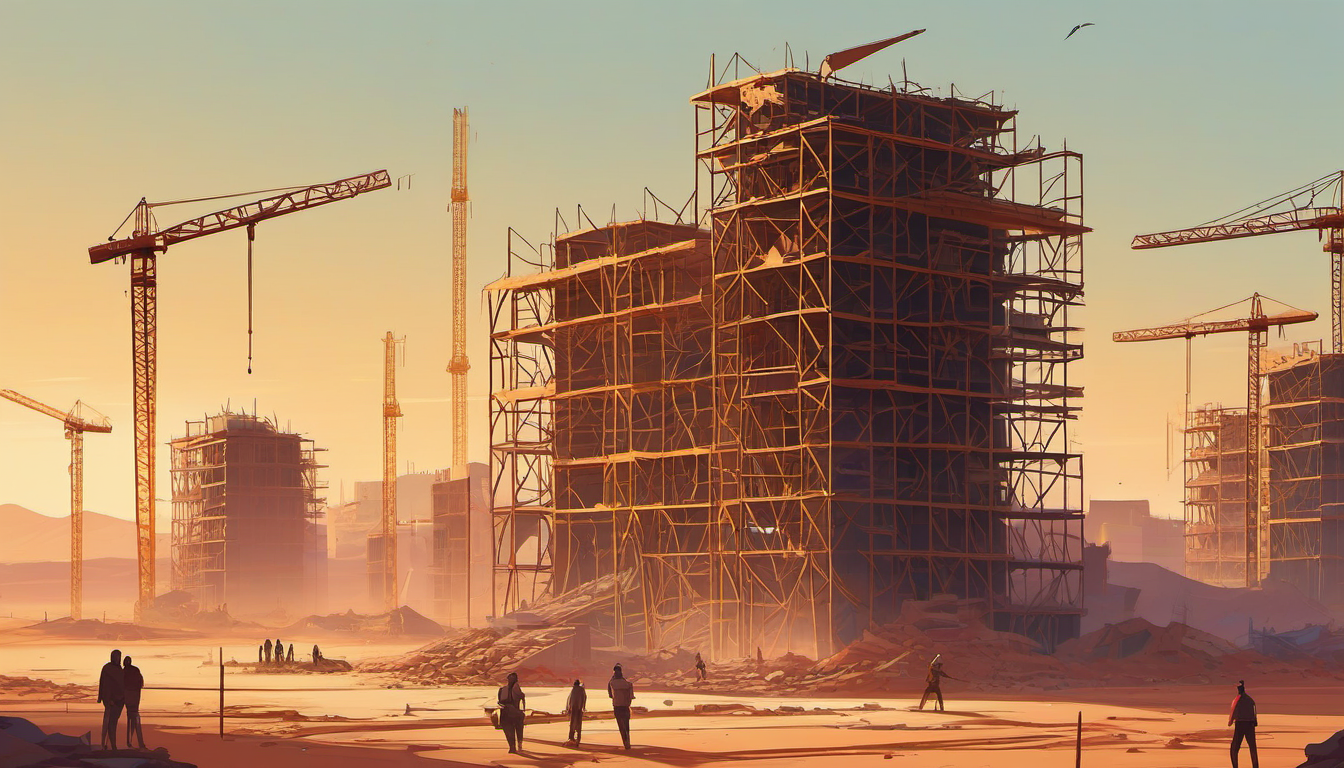
How a UAE-funded housing compound in Israeli-held Gaza is rewriting the rules of post-war reconstruction
Executive Summary
- A 74-acre UAE-funded housing compound dubbed "Emirates City" is being planned near Rafah in southern Gaza — on land under Israeli military control — marking the first physical infrastructure of Trump's post-war Gaza vision
- The project bypasses traditional reconstruction norms by building before withdrawal, effectively normalizing Israeli territorial control while creating facts on the ground that could permanently reshape Gaza's political geography
- With 53% of Gaza under Israeli military control and 2+ million residents confined to a shrinking coastal strip, this compound represents a test case for whether reconstruction can coexist with occupation — or whether it simply subsidizes it
Chapter 1: The Blueprint
In late February 2026, Reuters revealed what diplomats have quietly been calling "Emirates City" — a UAE-funded housing compound planned for construction near Rafah on Gaza's devastated southern edge. The project would cover approximately 74 acres, with prefabricated trailer-style units stacked several stories high, designed to shelter tens of thousands of displaced Palestinians.
The contractor is Gaza-based Masoud & Ali Contracting Co. (MACC), a firm with decades of experience building infrastructure across Gaza and the West Bank for partners including the World Bank and USAID. MACC would partner with two Egyptian firms, paid through a larger Egyptian intermediary that ultimately receives UAE funding.
The compound's location is critical: it sits in an area that Israeli forces depopulated and demolished during the war with Hamas. Israel currently controls 53% of Gaza's territory, having constructed military fortifications across the southern and eastern zones. Gaza's 2+ million residents are largely confined to a remaining coastal strip, most living in makeshift tents or damaged buildings.
The UAE has not formally announced the project. No construction has begun, partly because Israel has not yet approved the plans. Contractors were reportedly scheduled to visit the site earlier in February, though it remains unclear whether the visit occurred.
Chapter 2: Reconstruction Without Withdrawal
What makes Emirates City historically unusual is its fundamental premise: reconstruction proceeding before — and potentially without — an Israeli withdrawal.
Traditional post-conflict reconstruction follows a well-established sequence. In Bosnia after the Dayton Accords (1995), international forces supervised a military withdrawal before major civilian infrastructure projects began. In post-WWII Germany and Japan, reconstruction commenced under occupation but was explicitly tied to a sovereignty transition timeline. Even in Iraq after 2003, the Coalition Provisional Authority established a formal legal framework governing the relationship between occupying power and reconstruction.
Emirates City inverts this logic. The compound would be built on land under active Israeli military control, with no agreed timeline for withdrawal, no formal legal framework governing Palestinian residents' rights, and no clear governance mechanism beyond Trump's Board of Peace — an ad hoc body of international leaders and business figures with no legal standing under international law.
This represents what legal scholars call "developmental occupation" — a concept with troubling historical precedents. When colonial powers built infrastructure in occupied territories — railways in British India, ports in French North Africa — the construction served dual purposes: genuine development and the consolidation of control. The question for Emirates City is whether UAE-funded housing follows the same pattern.
Under the Fourth Geneva Convention (Article 49), an occupying power is prohibited from transferring its own civilian population into occupied territory. Emirates City technically avoids this by housing displaced Palestinians, not Israelis. But critics argue that building permanent infrastructure under military occupation without a withdrawal agreement creates de facto annexation through construction — what Palestinian analysts call "the architecture of permanence."
Chapter 3: The Stakeholders' Calculus
The UAE has emerged as one of Gaza's largest donors since October 2023, providing nearly $3 billion in assistance. At a Board of Peace conference in February, the UAE pledged an additional $1.2 billion for Gaza — though the Emirates City compound was conspicuously absent from formal presentations. The UAE established diplomatic relations with Israel in 2020 under the Abraham Accords and has consistently aligned with Washington's post-war vision. For Abu Dhabi, the compound serves multiple strategic objectives: demonstrating humanitarian commitment, deepening the Abraham Accords partnership, and positioning the UAE as the indispensable broker in Gaza's future.
Israel retains military control over 53% of Gaza and has shown no intention of withdrawing from the southern security corridor. The Netanyahu government views reconstruction as a lever — construction can proceed only with Israeli approval, giving Jerusalem effective veto power over Gaza's physical rebuilding. For Israel's far-right coalition partners, Emirates City could serve as a precedent for internationally funded development under permanent Israeli security control — a model that Finance Minister Bezalel Smotrich has explicitly advocated.
Hamas has not publicly commented on the project but faces a fundamental dilemma. Opposing reconstruction that provides housing for tens of thousands of displaced Gazans would be politically catastrophic. But accepting it means legitimizing Israeli military control over the construction zone and the Board of Peace's governance framework — both of which Hamas has rejected.
Palestinian civilians present the most complex variable. Reham Owda, a Palestinian political analyst, told Reuters that using a local firm rather than foreign workers would be "more acceptable to Gazans" because it creates jobs and respects local culture. But the fundamental question remains: would large numbers of Palestinians agree to live in a compound built under Israeli military occupation, governed by an international body they didn't choose, in an area where their previous homes were demolished by the occupying force?
The Board of Peace oversees Trump's Gaza initiative through a structure that includes international leaders, business figures, and a Palestinian technocratic committee intended to replace Hamas governance. The board has no UN mandate, no formal legal authority, and no Palestinian electoral legitimacy. Emirates City would be its first major physical project — a test of whether top-down reconstruction can generate bottom-up acceptance.
Chapter 4: Historical Precedents and the Permanence Trap
Gaza's history offers a cautionary tale about temporary shelter becoming permanent captivity.
UNRWA camps (1949-present): The eight refugee camps established in Gaza after 1948 were designed as temporary shelter for Palestinian refugees. Seventy-seven years later, they house over 600,000 people in some of the most densely populated square kilometers on earth. What began as emergency accommodation calcified into permanent urban slums, their "temporary" status becoming a political fiction that enabled all parties to avoid addressing the underlying displacement.
Sinai settlements (1967-1982): Israel built civilian settlements in the Sinai Peninsula after the 1967 war, investing heavily in infrastructure. When Egypt demanded their removal as part of the Camp David Accords, Israel dismantled them — but only after 15 years and massive political trauma. The precedent suggests that infrastructure built under occupation develops its own political constituency resistant to withdrawal.
West Bank Area C (1993-present): The Oslo Accords designated Area C (60% of the West Bank) under Israeli military and civil control, with the expectation of gradual transfer to Palestinian authority. Instead, Israeli settlement construction accelerated, creating irreversible "facts on the ground." Today, over 700,000 Israeli settlers live in Area C, making a contiguous Palestinian state geographically impossible by most assessments.
The pattern is consistent: infrastructure built under occupation tends to consolidate control rather than facilitate transition. Each historical case began with assurances of temporariness and ended with permanence.
| Precedent | Initial Promise | Outcome | Timeline |
|---|---|---|---|
| UNRWA camps 1949 | Temporary shelter | Permanent urban slums | 77+ years |
| Sinai settlements 1967 | Security buffer | Dismantled under peace deal | 15 years |
| West Bank settlements 1967 | Security presence | 700,000+ settlers, de facto annexation | 59+ years |
| Emirates City 2026 | Humanitarian housing | ? | Beginning |
Chapter 5: Scenario Analysis
Scenario A: Humanitarian Success (20%)
Premise: Emirates City is built, houses tens of thousands, creates local jobs, and becomes a model for broader reconstruction.
Trigger conditions: Israel approves plans and allows construction materials through checkpoints; Hamas doesn't obstruct recruitment of Palestinian workers; international community provides political cover; residents accept living under Israeli military control in exchange for shelter.
Why 20%: Every element of this scenario requires actors to behave contrary to their demonstrated patterns. Israel has never voluntarily facilitated large-scale Palestinian construction in territory it controls. Hamas has never accepted a governance framework that excludes it. Palestinian civilians have historically resisted cooperation with occupation infrastructure, even at personal cost.
Scenario B: Occupation Infrastructure (45%)
Premise: Emirates City is built but functions as a controlled population management tool — a modern refugee camp under Israeli military authority with Gulf funding.
Trigger conditions: Israel approves limited construction but retains security control over access, movement, and supplies; the compound becomes dependent on Israeli permits for water, electricity, and movement; residents have no political rights or governance voice.
Historical precedent: This mirrors the evolution of UNRWA camps — infrastructure built for humanitarian purposes that became instruments of population control. The West Bank's Area C development pattern, where Israeli authorities control 60% of territory while providing minimal services, offers a direct parallel.
Why 45%: This is the most likely outcome because it aligns with the incentives of the most powerful stakeholders. Israel gets internationally funded population management infrastructure. The UAE gets a visible humanitarian project without challenging Israeli control. The US gets a "win" for the Board of Peace. Only Palestinians bear the cost — living in occupation infrastructure they didn't choose.
Scenario C: Project Failure (35%)
Premise: Emirates City is never built or is abandoned early due to political, security, or legitimacy obstacles.
Trigger conditions: Israel blocks construction approval; Hamas actively sabotages the project; Palestinian workers refuse to participate; international legal challenges (ICJ advisory opinions on occupation construction); broader peace process collapse invalidates the Board of Peace framework.
Historical precedent: Numerous Gaza reconstruction pledges have gone unfulfilled. After the 2014 Gaza war, international donors pledged $5.4 billion at a Cairo conference; less than half was disbursed. After 2021, pledged reconstruction funds were blocked by Israeli restrictions on dual-use materials.
Why 35%: Gaza reconstruction has a consistent track record of failure. The political obstacles are formidable, and the project's lack of legal framework, Palestinian consent, or guaranteed Israeli cooperation makes it inherently fragile.
Chapter 6: Investment Implications
Construction and materials: If Emirates City proceeds, prefabricated housing manufacturers and Egyptian construction firms would benefit. The 74-acre compound with multi-story stacked units suggests significant demand for steel, concrete, and modular building systems. Key suppliers include Egyptian firms like Orascom Construction and prefabricated housing specialists.
Gulf real estate and infrastructure: UAE developers and infrastructure firms positioned in post-conflict reconstruction (Emaar Properties, ADNOC-linked infrastructure entities) could see expanded mandates. The $1.2 billion UAE pledge suggests a pipeline of future projects.
Defense and security: Israeli defense contractors providing perimeter security, surveillance technology, and access control systems for the compound would benefit. Companies like Elbit Systems and Rafael Advanced Defense Systems supply similar technology to existing checkpoint and settlement infrastructure.
Political risk premium: The project adds uncertainty to an already volatile region. Failure or controversy around Emirates City could impact Abraham Accords diplomacy, UAE sovereign risk perception, and broader Gulf investment in Levantine reconstruction.
Insurance and reinsurance: Construction in an active conflict zone with uncertain legal status presents extraordinary risk profiles. Lloyd's syndicates and specialty insurers would likely demand unprecedented premiums, if coverage is available at all.
Conclusion
Emirates City crystallizes the central contradiction of Trump's Gaza vision: reconstruction without resolution. Building housing for displaced Palestinians on land controlled by the military that displaced them, funded by a government that normalized relations with that military, governed by an international board with no democratic mandate — this is not reconstruction in any traditional sense. It is the creation of a new political reality through concrete and steel.
The compound may provide shelter for tens of thousands who desperately need it. That humanitarian imperative is real and urgent. But history teaches that infrastructure built under occupation tends to serve the occupier's interests more than the occupied's aspirations. UNRWA camps were meant to be temporary. West Bank settlements were meant to be security outposts. Each became permanent.
The question is not whether Emirates City will be built. The question is what it will become — humanitarian shelter or the architecture of a new kind of occupation, one funded by Gulf monarchies, blessed by Washington, and built by the very people it confines.
Sources: Reuters exclusive reporting, Ynet News, Daily Sabah, AP News, Board of Peace conference statements, Fourth Geneva Convention, UNRWA historical records
Leave a Reply