
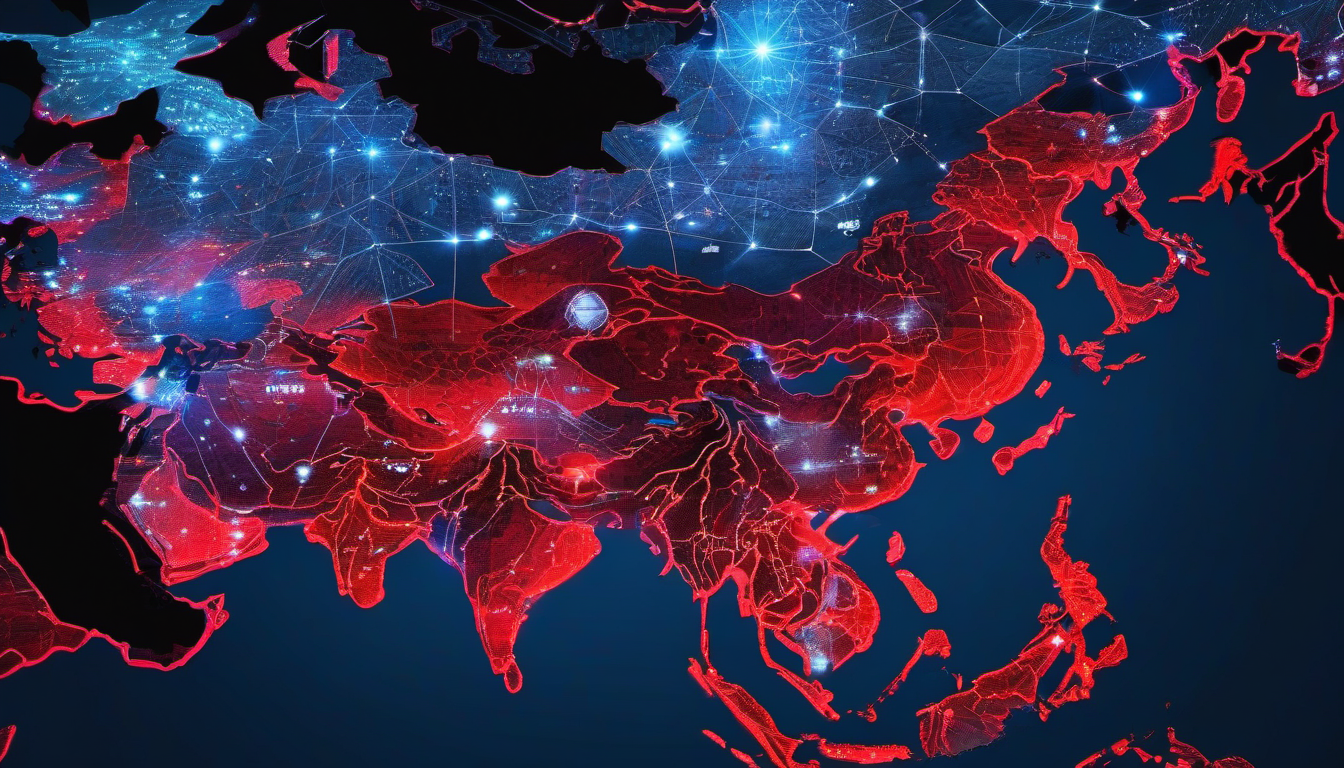
Beijing's Dragonbridge network targets elections from Tokyo to Washington, weaponizing AI and social media to reshape democratic discourse
Executive Summary
- A new FDD/Reuters investigation reveals 327+ coordinated social media accounts linked to China's Dragonbridge/Spamouflage network actively targeting Japan's February election, Trump's fentanyl policy, and democratic processes across the Philippines, Singapore, Vietnam, and Latin America
- Google's Threat Intelligence Group identifies Dragonbridge as the "most prolific" pro-PRC information operations operator as of early 2026, noting a sharp pivot toward Asia-Pacific political interference
- OpenAI disclosed disrupting a mid-October plot by a Chinese law enforcement official to plan a multi-stage information attack against PM Takaichi — revealing the state apparatus behind what Beijing dismisses as "groundless accusations"
Chapter 1: The Takaichi Operation
In the days surrounding Japanese Prime Minister Sanae Takaichi's February 8 election landslide — in which her LDP-JIP coalition secured a constitutional supermajority of 366 seats — at least 35 X (formerly Twitter) accounts and 9 Tumblr channels launched a coordinated assault on her legitimacy. The accounts portrayed Takaichi as a "cult-backed" militarist driving Japan toward war, pushed fabricated corruption allegations, and framed her hawkish China policy as reckless warmongering.
The operation was identified by Maria Riofrio, a researcher at the Foundation for Defense of Democracies' Center on Cyber and Technology Innovation, who traced the accounts to a larger cluster of at least 327 coordinated profiles across multiple platforms. Takaichi's office acknowledged the threat directly: "We consider this to be a national security threat that undermines the very foundations of democracy, including the fairness of elections and freedom of the press."
The timing was surgical. The campaign intensified precisely during the election window when Japanese voters were making decisions. One tweet accusing Takaichi of cult ties received only two likes but was viewed over 1,000 times — a ratio that reveals the algorithmic amplification strategy: low engagement, high visibility, designed to contaminate information feeds rather than spark viral moments.
Japan's Nikkei newspaper independently reported on a separate set of suspected foreign-backed operations targeting the same election, suggesting multiple overlapping campaigns — a hallmark of sophisticated state-sponsored information warfare that creates plausible deniability through operational fragmentation.
Perhaps most alarming was OpenAI's Wednesday disclosure: the company disrupted an attempt by a Chinese law enforcement official in mid-October 2025 to use its tools to plan a multi-stage information attack against Takaichi. This is not a rogue operation by patriotic hackers. This is state apparatus weaponizing AI platforms for political interference.
Chapter 2: The Dragonbridge Empire
The Takaichi operation is merely one tentacle of what has become the world's largest known state-sponsored information warfare network. Dragonbridge — also tracked as Spamouflage, Storm 1376, and Taizi Flood — has been active since at least 2017, but its 2026 incarnation represents a qualitative leap in ambition and sophistication.
Google's Threat Intelligence Group delivered a stark assessment: Dragonbridge is the "most prolific pro-PRC information operations operator" they track as of early 2026, distinguished by its "massive scale and assertive narrative agenda." The network has undergone a strategic pivot from its historical focus on targeting overseas Chinese dissidents and Falun Gong practitioners to directly interfering in democratic processes across allied nations.
The target map has expanded dramatically:
| Target | Method | Narrative |
|---|---|---|
| Japan | Election interference | Takaichi as militarist cult leader |
| United States | Policy manipulation | Trump worsening fentanyl crisis, deflecting blame from China |
| Philippines | Political destabilization | Targeting Marcos Jr. administration |
| Singapore | Leadership undermining | AI-generated videos claiming PM Wong being "sacked" |
| Vietnam | Territorial intimidation | South China Sea activities |
| India | Strategic disruption | Policy narratives |
| Latin America | Geopolitical positioning | Pro-China alignment narratives |
The FDD analysis found that nearly half of the 327 accounts attacked Trump specifically, pushing the narrative that his drug and border policies worsened America's fentanyl crisis — reversing Biden-era gains — while deflecting China's role as a precursor chemical source. One account, "FentanylFreeA," created in December 2025, mimics the DEA's official Fentanyl Free America campaign using identical imagery, attacking both the U.S. and India. Six accounts in a coordinated fentanyl-messaging sequence, despite having fewer than 10 followers each, generated nearly 18,000 views by early February.
Chapter 3: The Singapore Dimension — AI-Powered Escalation
A parallel CNA investigation published February 25 revealed perhaps the most technically advanced element of China's information warfare: hundreds of AI-generated Chinese-language YouTube videos targeting Singapore and Prime Minister Lawrence Wong.
The operation's scale is unprecedented for a country of Singapore's size:
- 300+ videos analyzed over three weeks
- 30+ YouTube channels coordinating uploads
- Millions of views (though bot traffic suspected)
- Mandarin AI-generated voiceovers with traditional Chinese subtitles
- SEO poisoning — aggressive hashtag manipulation to contaminate search results
The content fabricated elaborate conspiracy theories: Wong was about to be "sacked" by predecessor Lee Hsien Loong; Singapore's economy was "collapsing" due to Hainan port competition; the country was an "American puppet." In reality, Singapore handled a record 44.66 million containers in 2025, remaining the world's second-busiest port.
What distinguishes the Singapore operation is its use of generative AI at industrial scale. Videos average 30 minutes, with some approaching an hour — suggesting automated content generation pipelines that can produce propaganda faster than platforms can moderate. When CNA flagged accounts to YouTube, they were terminated within 12 hours. But fresh channels and videos surfaced immediately, demonstrating an infrastructure of rapid regeneration that outpaces content moderation.
This is the future of information warfare: AI-generated content at volumes that overwhelm human and algorithmic defenses, distributed through legitimate platforms that face an asymmetric cost burden in policing it.
Chapter 4: Historical Context — From the 50 Cent Army to Dragonbridge
China's information operations have evolved through three distinct phases:
Phase 1: Internal control (2004–2015). The "50 Cent Army" (五毛党) — estimated at 2 million online commentators paid roughly 0.5 yuan per post — focused on shaping domestic opinion. A 2017 Harvard study estimated they produced 488 million social media posts annually within China's Great Firewall. The objective was regime stability, not foreign interference.
Phase 2: Defensive externalization (2017–2023). Spamouflage emerged, initially targeting overseas dissidents, Uyghur activists, and Hong Kong protesters. Meta removed thousands of accounts in 2019–2023 linked to the network. The U.S. Department of Justice charged members of China's Ministry of Public Security in 2023 for running troll farms on Twitter and Facebook. But the campaigns were largely defensive — protecting narratives about Xinjiang, Tibet, and Hong Kong rather than actively destabilizing foreign politics.
Phase 3: Offensive electoral interference (2024–present). The 2024 Taiwan presidential election marked a turning point. Microsoft's Threat Analysis Center documented Chinese AI-generated deepfake audio targeting candidates. Now, in 2026, the shift to Japan, the Philippines, Singapore, and the U.S. represents Beijing's graduation from defensive propaganda to offensive democratic disruption.
The escalation parallels Russia's evolution from domestic information control to the 2016 U.S. election interference via the Internet Research Agency — but with a critical difference. While Russia's IRA operated with hundreds of employees and a budget of roughly $1.25 million per month, China's Dragonbridge leverages AI automation at orders of magnitude greater scale with potentially lower per-unit costs. Google tracking it as the "most prolific" operator suggests volume that dwarfs anything Russia has achieved.
Chapter 5: Scenario Analysis
Scenario A: Containment Through Platform Action (25%)
Premise: Tech platforms successfully identify and neutralize Dragonbridge at scale.
Evidence against: YouTube terminated flagged accounts within 12 hours in Singapore — but replacements appeared immediately. Meta has removed Chinese networks repeatedly since 2019 without eliminating the threat. The fundamental asymmetry persists: creation is cheap and automated, moderation is expensive and reactive.
Trigger conditions: Major platform (Meta, X, Google) deploys AI-powered detection that identifies coordinated inauthentic behavior before content gains traction. Requires investment in Chinese-language content moderation that platforms have historically underresourced.
Historical precedent: Meta's successful disruption of Russia's IRA in 2018–2020 reduced but never eliminated the threat. Platforms shifted tactics but never achieved containment.
Scenario B: Escalation and Normalization (45%)
Premise: Dragonbridge operations expand to 2028 U.S. presidential election and become a permanent feature of democratic politics globally.
Evidence for:
- Google identifies an "assertive narrative agenda" that is expanding, not contracting
- Philippine officials warn operations "may expand closer to the 2028 elections"
- Chinese law enforcement officials are using AI tools (OpenAI disclosure) for operational planning
- AI content generation costs are falling while quality improves
- Platform moderation budgets are under pressure (Meta reduced trust & safety staff, X under Musk gutted moderation)
Trigger conditions: Already underway. No specific trigger needed — the infrastructure is operational and scaling.
Historical parallel: Russia's information operations became a permanent feature of democratic elections after 2016. Despite sanctions, indictments, and platform action, the capability persisted and adapted. China's operations, with greater resources and AI leverage, will likely prove even more durable.
Scenario C: Geopolitical Blowback (30%)
Premise: Exposed operations trigger diplomatic consequences that raise costs for Beijing.
Evidence for:
- Takaichi's office explicitly called it a "national security threat" requiring "urgent countermeasures"
- Japan is already in a diplomatic crisis with China (economic sanctions, military tensions)
- FDD report provides attribution evidence to U.S. policymakers
- Five Eyes intelligence sharing can amplify exposure
Evidence against:
- China denied involvement ("groundless accusations"), which is standard
- U.S.-China tensions already near peak — marginal diplomatic cost is low
- No existing international framework criminalizes information operations below the threshold of cyberattack
- Trade considerations (April Beijing summit) may mute response
Trigger conditions: A Dragonbridge campaign demonstrably shifts an election outcome, producing a "Sputnik moment" that forces coordinated allied response.
Historical precedent: Russia's 2016 U.S. election interference led to sanctions, indictments, and platform regulation — but these responses took 2–3 years to materialize and never achieved deterrence.
Chapter 6: Investment and Strategic Implications
Cybersecurity and content authentication:
- Companies developing deepfake detection, content provenance, and AI-generated content identification stand to benefit from growing demand. The Coalition for Content Provenance and Authenticity (C2PA) standard becomes strategically critical.
- Platform trust & safety spending will need to reverse its recent decline. Meta, Alphabet, and X face regulatory pressure to invest.
Media and information integrity:
- News organizations and fact-checking operations in Asia-Pacific face increasing demand. Japan's media ecosystem, historically resistant to foreign disinformation, now requires new defenses.
- Government spending on cognitive security and counter-influence operations will grow. Japan's 2026 defense budget already includes cyber and information warfare allocations.
Geopolitical premium:
- Information warfare capabilities add to the "technology stack" that defines great-power competition. Pax Silica's AI export controls may need to extend to AI-powered influence tools.
- Democratic resilience becomes a measurable variable in country risk assessments. Markets may begin pricing "information integrity risk" for nations targeted by sustained campaigns.
Platform governance:
- Regulatory pressure on social media platforms will intensify, particularly in the EU (DSA enforcement), Asia (India's IT Rules, Singapore's FICA), and potentially the U.S.
- The asymmetric cost of moderation vs. generation creates a structural challenge for platform business models that rely on engagement optimization.
Conclusion
China's Dragonbridge network represents the industrialization of information warfare. What began as a defensive propaganda tool has evolved into an offensive capability targeting the electoral processes of U.S. allies across the Indo-Pacific. The 2026 revelations — spanning Japan, Singapore, the Philippines, the U.S., and Latin America simultaneously — demonstrate that this is not experimental. It is operational, scaled, and accelerating.
The critical asymmetry is this: AI has made content generation almost free while content moderation remains expensive and labor-intensive. Dragonbridge can produce hundreds of 30-minute AI-generated videos per week; YouTube struggles to remove them as fast as they appear. This is not a problem that platform moderation can solve alone.
The deeper concern is normalization. If major democracies accept Chinese information operations as background noise — the way they have largely absorbed Russian operations since 2016 — the cumulative erosion of informational integrity becomes a structural feature of democratic politics. The question is not whether China can change election outcomes through social media posts that receive two likes. The question is whether the constant contamination of information environments degrades the capacity for democratic deliberation over time.
Japan's response — explicitly labeling it a "national security threat" — suggests at least some democracies are prepared to treat information warfare with the seriousness it demands. Whether that translates into effective countermeasures remains the defining test of democratic resilience in the AI age.
Sources: Reuters/FDD Center on Cyber and Technology Innovation, CNA Singapore investigation, Google Threat Intelligence Group, OpenAI threat report, Nikkei, Japan PM office statement
Leave a Reply