
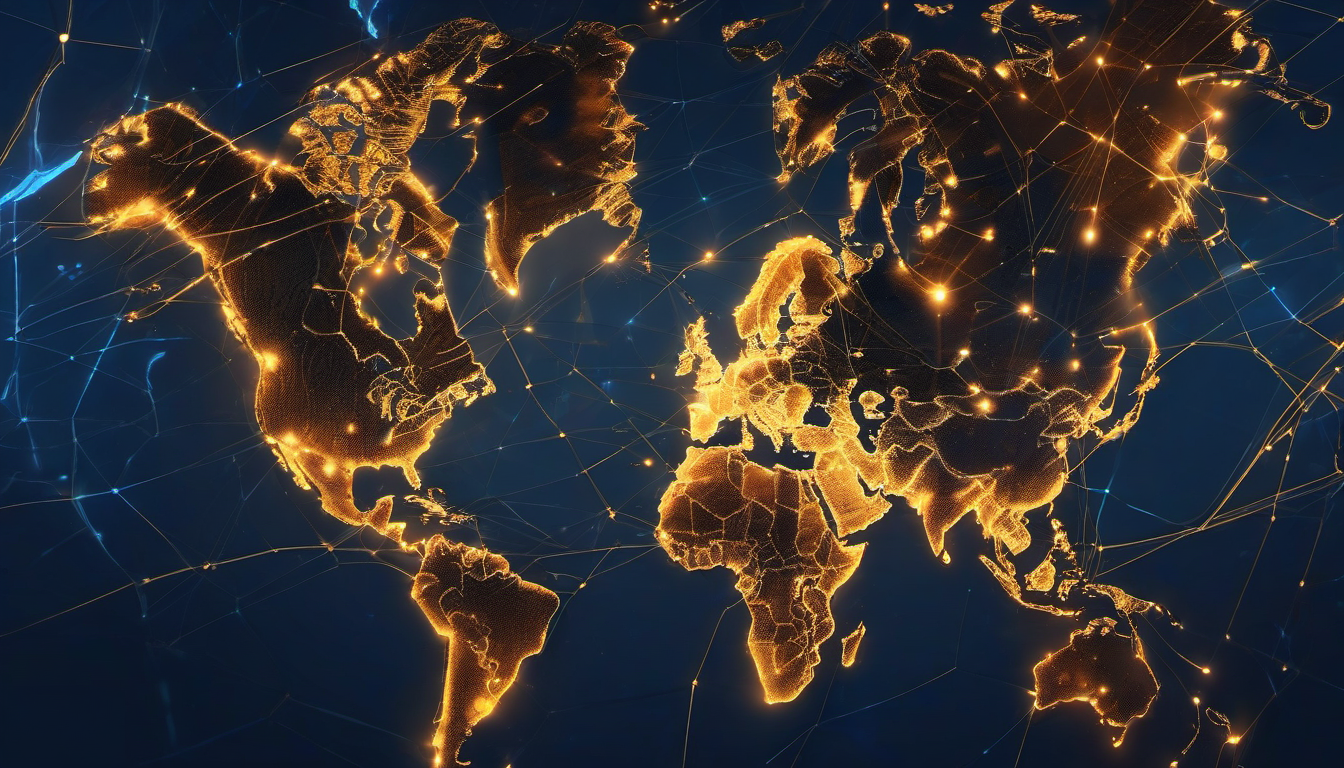
How a leaked State Department cable reveals Washington's plan to weaponize diplomacy for Big Tech's AI ambitions — and why 62 nations are pushing back
Executive Summary
- The Trump administration has ordered U.S. diplomats worldwide to actively lobby against data sovereignty laws, framing data localization as a threat to AI development and civil liberties — a move that transforms American embassies into lobbying arms for Silicon Valley.
- At least 62 countries now have or are drafting data localization requirements, creating a $230 billion compliance cost burden that threatens to fragment the global internet into rival data blocs aligned along geopolitical fault lines.
- The clash exposes a fundamental paradox: the same administration weaponizing IEEPA tariffs to force economic sovereignty is simultaneously demanding that other nations surrender their digital sovereignty to enable American AI dominance.
Chapter 1: The Cable That Lit the Fuse
On February 18, 2026, U.S. Secretary of State Marco Rubio signed an internal diplomatic cable that would soon leak to Reuters, exposing one of the most aggressive technology policy moves of the second Trump administration. Labeled an "action request," the cable directed every U.S. embassy and consulate worldwide to actively oppose foreign data sovereignty legislation — laws that require companies to store and process citizens' data within national borders.
The cable's language was unequivocal. Data sovereignty laws, it argued, would "disrupt global data flows, increase costs and cybersecurity risks, limit AI and cloud services, and expand government control in ways that can undermine civil liberties and enable censorship." Diplomats were instructed to track legislative proposals, counter what Washington deemed "unnecessarily burdensome regulations, such as data localization mandates," and promote the Global Cross-Border Privacy Rules (CBPR) Forum as an alternative framework.
This was no routine policy guidance. It represented the formalization of a doctrine that had been brewing since the first Trump term: data is the new oil, its free flow is a vital American interest, and any nation that dams the river is an adversary of progress.
The timing was deliberate. The cable arrived as the EU was debating its "Digital Omnibus" regulation — a proposed simplification of GDPR data governance requirements for AI training. India had just implemented its 3-hour content deletion rule under the IT Rules 2026. Brazil's data protection authority, ANPD, was finalizing AI-specific data processing guidelines. Indonesia was tightening its Government Regulation No. 71 on electronic systems. The global regulatory tide was rising, and Washington decided to push back with the full weight of American diplomatic infrastructure.
Chapter 2: The Data Sovereignty Tsunami
To understand why Washington felt compelled to act, one must grasp the scale of the global data sovereignty movement. What began with the EU's GDPR in 2018 has become a worldwide phenomenon that fundamentally challenges the architecture of the internet as designed by American engineers and governed by American corporations.
As of February 2026, the regulatory landscape has shifted dramatically:
| Region | Key Regulations | Data Localization Requirement | Status |
|---|---|---|---|
| EU | GDPR + AI Act + DSA | Adequacy decisions for transfers; strict SCCs | Enforced, expanding |
| China | Cybersecurity Law (amended Jan 2026) | Strict: critical data must stay onshore | Enforced |
| India | DPDP Act 2023 + IT Rules 2026 | Government can designate "critical" data categories | Partially enforced |
| Russia | Federal Law No. 242-FZ | Full localization for personal data | Enforced |
| Brazil | LGPD + AI-specific guidelines | Cross-border transfers with adequacy assessment | Finalizing |
| Indonesia | GR 71/2019 (revised 2025) | Strategic electronic systems must localize | Enforced |
| Vietnam | Decree 13/2023 | Data localization for specific categories | Enforced |
| Nigeria | NDPR 2019 + Data Protection Act 2023 | Critical data localization mandate | Enforced |
| Saudi Arabia | PDPL 2023 | Cross-border transfers require authorization | Enforced |
| South Africa | POPIA | Transfer restrictions with adequacy requirements | Enforced |
The numbers tell the story of acceleration. According to the Information Technology and Innovation Foundation (ITIF), the number of countries with some form of data localization requirement grew from 35 in 2017 to 62 in 2025 — a 77% increase in eight years. The compliance costs are staggering: Leviathan Security Group estimated that strict data localization could reduce GDP by 0.7-1.7% in affected economies, while the cost to global cloud services providers of maintaining sovereign infrastructure across dozens of jurisdictions runs into tens of billions annually.
For American AI companies, the stakes are existential. Large language models like those developed by OpenAI, Anthropic, Google, and Meta are trained on vast datasets scraped from global sources. Data localization doesn't just increase costs — it potentially denies these companies access to the diverse, multilingual datasets that make their AI models powerful. A world where Indonesian data stays in Indonesia, Brazilian data in Brazil, and Indian data in India is a world where American AI loses its training advantage.
Chapter 3: The Paradox of Sovereignty
The Rubio cable reveals a striking contradiction at the heart of American economic policy in 2026. The same administration that has wielded tariffs, sanctions, and IEEPA emergency powers to assert American economic sovereignty — forcing trading partners into bilateral "tribute" agreements, imposing Section 232 national security tariffs on everything from steel to semiconductors — is simultaneously demanding that other nations surrender sovereignty over their citizens' most intimate asset: their data.
This paradox is not lost on foreign governments. When GDPR was labeled "unnecessarily burdensome" in the cable, European officials noted the irony of an administration that had just imposed 15% universal tariffs under Section 122 complaining about regulatory burden. The EU's data protection supervisor, in an unofficial response, observed that "the same nation that argues data localization threatens civil liberties has ordered its intelligence agencies to conduct mass surveillance of foreign citizens' communications" — a reference to the post-Snowden revelations that originally catalyzed GDPR's creation.
The Chinese dimension adds further complexity. The cable specifically cited China's data policies as an example of how technology rules can "expand geopolitical influence," noting that Beijing "bundles infrastructure projects with policies that provide access to international data for surveillance and strategic leverage." Yet critics point out that the U.S. itself bundles market access with data flow requirements — the Trans-Pacific Partnership (now CPTPP) included provisions mandating free cross-border data flows, and the USMCA contains similar requirements.
The fundamental question is philosophical: Who owns data? The American position, codified in the Rubio cable, treats data as a commodity that should flow freely across borders, like oil or grain. The European position treats data as an extension of personal identity, subject to individual rights. The Chinese position treats data as a national resource, subject to state control. These three visions are increasingly irreconcilable.
Chapter 4: The AI Arms Race Connection
The urgency behind the Rubio cable becomes clearer when viewed through the lens of the AI arms race. American AI companies are locked in a multi-front competition — against each other, against Chinese rivals like DeepSeek, and against the emerging sovereign AI initiatives of nations from India ($120 billion MANAV vision) to the EU (European AI champions program).
Data is the oxygen of AI development. Consider the scale:
- Training data: GPT-5 was reportedly trained on approximately 45 trillion tokens. Claude 4 consumed roughly 30 trillion. Each new generation requires exponentially more data.
- Fine-tuning data: Localized, domain-specific data — medical records, legal documents, financial transactions — is essential for AI models to perform well in specific markets.
- Inference data: Every query processed by an AI model generates data that improves future performance. If that data must stay local, the global learning loop is broken.
Data localization threatens this ecosystem at every level. If India requires that data generated by its 1.4 billion citizens remain within its borders, American AI companies lose access to one of the world's largest and most diverse datasets. If the EU's AI Act requires that AI training data be auditable and traceable — effectively mandating that companies know exactly which data was used and from where — the cost of compliance could add 20-30% to AI infrastructure spending, according to estimates from Lloydson Research.
The competitive implications are asymmetric. Chinese AI companies like DeepSeek and Baidu operate within a domestic market of 1.4 billion users with minimal data restrictions (for companies aligned with the state). They can train on vast domestic datasets without cross-border compliance costs. Meanwhile, American companies must navigate a patchwork of 62+ national regulations, each with different requirements, penalties, and enforcement mechanisms.
This is why the State Department cable frames data sovereignty as a national security issue rather than a trade dispute. In Washington's view, data localization isn't just inconvenient — it's a strategic weapon that could hand China the advantage in the AI race by forcing American companies to operate with one hand tied behind their backs.
Chapter 5: Scenario Analysis — The Data Sovereignty Endgame
Scenario A: Managed Fragmentation (45%)
Premise: A negotiated compromise emerges, with the CBPR Forum or a similar framework establishing tiered data governance — strict protections for sensitive categories (health, financial, biometric) but free flow for anonymized and commercial data.
Evidence and triggers:
- Historical precedent: The EU-U.S. Data Privacy Framework (successor to Privacy Shield) has survived legal challenges since 2023, suggesting negotiated solutions are possible.
- The EU's "Digital Omnibus" proposal already signals willingness to relax some GDPR requirements for AI training data.
- India's DPDP Act includes provisions for government-designated exemptions, creating space for bilateral data-sharing agreements.
- Economic incentive: McKinsey estimates that unrestricted cross-border data flows add $2.8 trillion annually to global GDP.
Trigger: A successful U.S.-EU data adequacy negotiation that establishes a template for other nations.
Timeline: 12-18 months for framework; 3-5 years for broad adoption.
Scenario B: Digital Bloc Formation (35%)
Premise: The world splits into two or three data blocs — a U.S.-led "free flow" zone, a Chinese "sovereign" zone, and a contested middle.
Evidence:
- The Pax Silica technology alliance already creates a proto-data bloc among allied nations.
- China's 53-nation zero-tariff Africa initiative includes digital infrastructure provisions that effectively extend Chinese data standards to participating nations.
- India's Digital Personal Data Protection Act maintains strategic ambiguity, allowing Delhi to negotiate with both blocs.
- The BRICS digital payment infrastructure (CIPS, digital yuan) creates parallel data channels outside Western systems.
Trigger: A major data breach involving U.S. government access to foreign citizens' data via American cloud providers, or a SCOTUS ruling expanding U.S. government surveillance powers.
Timeline: Already underway; crystallizes within 2-3 years.
Scenario C: Regulatory Escalation and Retaliation (20%)
Premise: The diplomatic offensive backfires, accelerating data sovereignty laws as nations view it as proof that American tech companies cannot be trusted.
Evidence:
- The Snowden revelations in 2013 directly led to GDPR's strengthening and the invalidation of Safe Harbor.
- France's CNIL has already fined American tech companies over €4 billion collectively.
- Brazil's ANPD, emboldened by Lula's resource sovereignty agenda, could impose strict localization as a retaliatory measure against U.S. tariffs.
- The cable's leak itself could serve as proof that U.S. diplomacy is captured by corporate interests.
Trigger: The cable's public disclosure leads to parliamentary hearings in the EU, India, or Brazil, resulting in accelerated localization mandates.
Timeline: 6-12 months for initial legislative responses.
Chapter 6: Investment Implications
The data sovereignty battle creates clear winners and losers across multiple sectors:
Beneficiaries:
- Sovereign cloud providers: European alternatives like OVHcloud, Deutsche Telekom's T-Systems, and India's Yotta Infrastructure stand to gain as governments mandate local data storage. OVHcloud has already seen a 40% increase in government contracts since 2024.
- Data compliance/RegTech: Companies like OneTrust, BigID, and Informatica that help enterprises navigate cross-border data regulations. The global data governance market is projected to reach $8.2 billion by 2028.
- Edge computing: Distributed computing architectures that can process data locally while maintaining AI capabilities. Fastly, Cloudflare, and Akamai benefit from architectures that keep data close to its source.
At risk:
- U.S. hyperscalers: AWS, Azure, and Google Cloud face the highest compliance costs. Each new data localization requirement forces additional sovereign cloud deployments, with estimated costs of $500 million to $2 billion per major market.
- AI model developers: Companies dependent on global data access for training — OpenAI, Anthropic, Meta AI — face potential data deserts if localization accelerates.
- Cross-border SaaS: Salesforce, ServiceNow, and similar companies that process customer data across jurisdictions face mounting compliance overhead.
| Sector | Impact | Timeframe | Key Metric to Watch |
|---|---|---|---|
| Sovereign Cloud | Positive | 1-3 years | Government contract growth |
| U.S. Hyperscalers | Negative | 2-5 years | Sovereign region deployment costs |
| RegTech/Compliance | Positive | Immediate | Revenue growth, deal pipeline |
| AI Model Developers | Negative | 1-3 years | Training data diversity metrics |
| Edge Computing | Positive | 2-4 years | Edge node deployments |
Conclusion
The Rubio cable represents the opening salvo of what may become the defining technology policy battle of the decade. Unlike tariff wars, which involve tangible goods moving across physical borders, the data sovereignty conflict concerns invisible flows of information that power the AI economy worth trillions of dollars.
The irony is that both sides have legitimate concerns. Data localization genuinely does increase costs and reduce AI efficiency. But the unchecked flow of personal data to foreign jurisdictions — and the intelligence agencies that can compel access to it — genuinely does threaten civil liberties and national security.
What makes this conflict particularly dangerous is its self-reinforcing nature. American diplomatic pressure against data sovereignty laws validates the very fears that drive those laws: that the United States views other nations' data as a resource to be extracted, not a right to be protected. Each escalation on one side justifies escalation on the other, pushing the world closer to the digital bloc formation that both sides claim to want to avoid.
The data doctrine, in the end, may prove to be the most consequential policy document of 2026 — not because of what it achieves, but because of the reaction it provokes.
Leave a Reply