
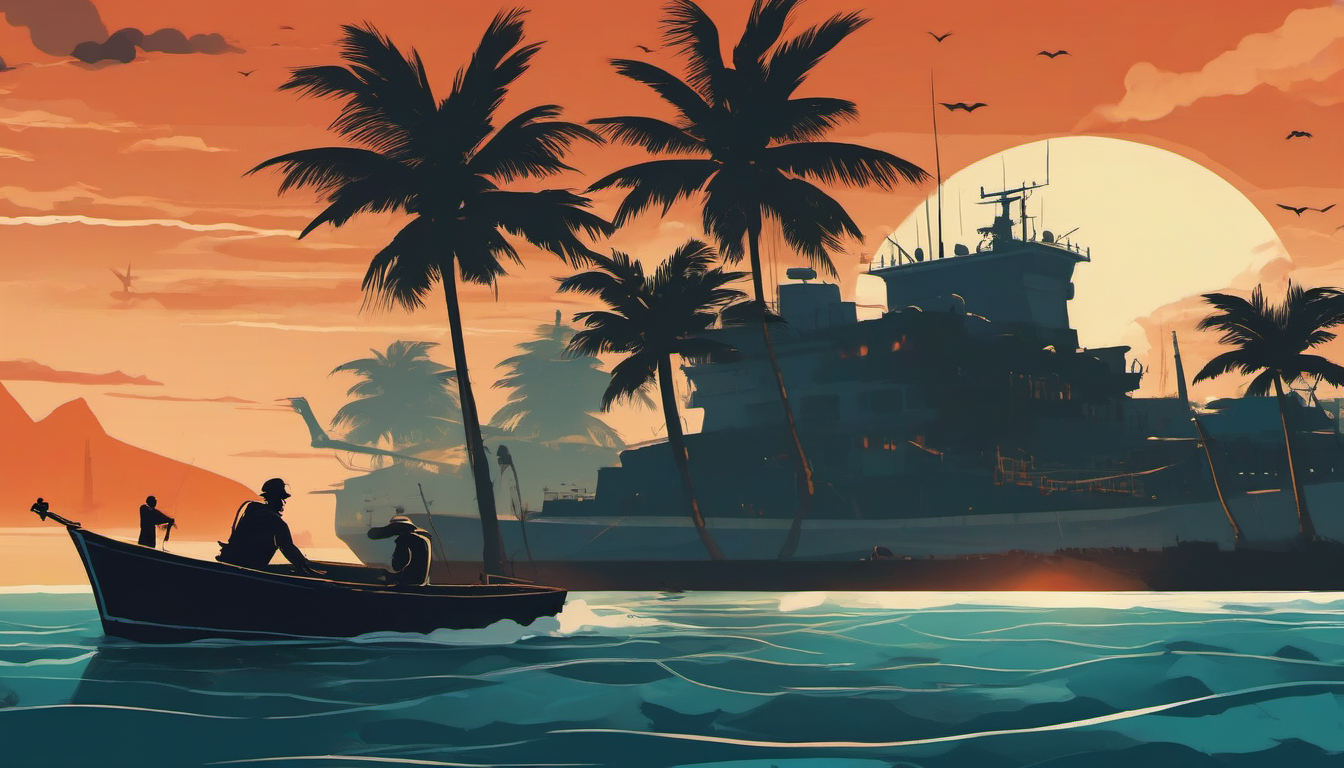
As Rubio meets Caribbean leaders in St Kitts, a deadly shooting off Cuba's coast exposes the fault lines of America's hemispheric reassertion
Executive Summary
- The CARICOM summit in St Kitts has become a flashpoint for Caribbean resistance to Washington's "Donroe Doctrine," with leaders openly criticizing the US oil blockade on Cuba, deadly military strikes that have killed 151+ people, and demands to sever ties with China and Cuban medical missions.
- Hours before Rubio's arrival, Cuban coast guard forces shot dead four passengers on a Florida-registered speedboat—an incident that threatens to become this era's Gulf of Tonkin, escalating an already volatile standoff in waters patrolled by US warships conducting Operation Southern Spear.
- The Caribbean is fracturing along a new axis: Trinidad and Tobago praising US intervention while Jamaica and smaller island nations plead for de-escalation, revealing a CARICOM unable to forge a unified response to the most aggressive US hemispheric policy since the Cold War.
Chapter 1: The Summit in the Shadow of Gunfire
On the morning of February 25, 2026, a Florida-registered speedboat bearing the tag FL7726SH was intercepted by Cuban border patrol near Cayo Falcones, off the central province of Villa Clara. According to Cuba's Interior Ministry, when five border guards approached for identification, the speedboat's crew opened fire, wounding the Cuban commander. In the ensuing exchange, four people aboard the American vessel were killed and six others injured.
The shooting occurred as Secretary of State Marco Rubio—the highest-ranking US official ever to visit the tiny Caribbean nation of St Kitts and Nevis—was flying from President Trump's State of the Union address to join the CARICOM summit. The timing was not lost on Caribbean diplomats. The incident crystallized what had been building for months: the Caribbean basin has become America's most volatile geopolitical theater.
CARICOM, the 15-nation Caribbean Community, was founded in 1973 to promote economic integration and coordinate foreign policy among some of the world's smallest states. Its members collectively account for barely 18 million people and roughly $100 billion in GDP—a fraction of what the US generates in a single week. Yet this gathering of micro-states has become the unlikely stage for a confrontation over the fundamental question of whether Washington's neighbors are sovereign partners or subordinate clients.
Chapter 2: The Donroe Doctrine in Action
When President Trump coined his "Donroe Doctrine" early in his second term—a deliberate play on the 1823 Monroe Doctrine—critics dismissed it as rhetorical bluster. It has proven to be anything but.
The doctrine's implementation has been methodical and comprehensive:
Military dimension: Operation Southern Spear, launched in September 2025, has conducted at least 44 strikes on 45 vessels, killing a confirmed 151 people. The operation targets suspected drug-trafficking boats across the Caribbean and eastern Pacific. Critically, the US has provided no public evidence that the targeted vessels were carrying narcotics. Families of those killed—many of them Caribbean fishermen—have mounted legal challenges. The Inter-American Commission on Human Rights (IACHR) has opened multiple investigations.
Economic coercion: Following the January 3 military raid that arrested Venezuelan president Nicolás Maduro, Washington leveraged its control over Venezuela's oil sector to cut off shipments to Cuba. This has plunged the island into its worst energy crisis since the Special Period of the 1990s, with rolling blackouts affecting millions and the eastern provinces still struggling to recover from Hurricane Melissa's October devastation.
Diplomatic demands: The Trump administration has presented CARICOM nations with a package of requirements that amounts to a loyalty test. Countries have been pressured to: reject Cuban medical missions that have served the region for decades, chill diplomatic and economic relations with China, accept third-country deportees from the US, and consider hosting American military hardware on their territory.
The original Monroe Doctrine of 1823 declared the Western Hemisphere off-limits to European colonialism. Its modern iteration, critics argue, has inverted the principle: rather than protecting hemispheric sovereignty from external powers, it subordinates that sovereignty to American strategic interests.
Chapter 3: CARICOM's Fracture Lines
The summit's opening speeches on February 25 revealed a Caribbean Community split along an axis that mirrors the broader global debate about how small states should navigate great-power competition.
The accommodation camp is led by Trinidad and Tobago's Prime Minister Kamla Persad-Bissessar, whose country provided access to US military forces before the Venezuela operation. "We cannot advocate for others to live under communism and dictatorship," she declared, praising Trump, Rubio, and the US military for "standing firm against narco-trafficking." Trinidad's coastline, visible from Venezuela, gives it both proximity to the threat and dependence on the US security umbrella. Persad-Bissessar credited US intervention with reducing her country's homicide rate by disrupting firearms flows from Venezuela.
The resistance camp is anchored by Jamaica's Prime Minister Andrew Holness, the outgoing CARICOM chair, who framed the Cuba crisis as a regional stability issue. "Humanitarian suffering serves no one," he warned. "A prolonged crisis in Cuba will not remain confined to Cuba. It will affect migration, security and economic stability across the Caribbean basin." His call for "constructive dialogue between Cuba and the United States aimed at de-escalation, reform and stability" was a diplomatic rebuke to Washington's maximum-pressure approach.
The moral witness camp is represented by the summit's host, St Kitts and Nevis Prime Minister Terrance Drew, who studied medicine in Cuba for seven years. His testimony was personal and devastating: "I have friends there. I have people who are like family to me. They reach out to me and tell me of their difficulties. Food has become terribly scarce. Access to water has been challenging. Garbage fills the streets. Houses are without electricity."
This three-way split reflects a structural problem within CARICOM. The organization operates on consensus, meaning any unified response requires agreement among states with radically different threat perceptions and dependencies. Trinidad sees Venezuela and drug trafficking as existential threats; Jamaica and the Eastern Caribbean see US military strikes and economic coercion as the greater danger; and many smaller nations simply lack the diplomatic weight to resist either.
Chapter 4: The Historical Echo Chamber
The current Caribbean crisis invites comparison with three historical precedents, each illuminating different dimensions of the present situation.
The Cuban Missile Crisis (1962): The Caribbean last became a theater of superpower confrontation when Soviet nuclear missiles were discovered in Cuba. That crisis was resolved through backchannel diplomacy and mutual concession—the Soviets withdrew missiles; the US pledged not to invade Cuba. Today, no such diplomatic architecture exists. The Trump administration has rebuffed calls for constructive dialogue, and Cuba's options for external patronage have been severed with Venezuela's collapse.
The Grenada Invasion (1983): When the US invaded Grenada to overthrow a Marxist government, CARICOM nations were deeply divided. Some Eastern Caribbean states supported the intervention; Jamaica and Trinidad opposed it. The invasion succeeded militarily but left deep scars in Caribbean politics. The current situation echoes this division, but at a far larger scale—the question is no longer about one island but about the entire basin.
The Banana Wars (1898–1934): Perhaps the most apt comparison is the period when the US routinely intervened militarily across the Caribbean and Central America to protect corporate interests and enforce political compliance. The "Roosevelt Corollary" to the Monroe Doctrine asserted America's right to exercise "international police power" in the hemisphere. Operation Southern Spear's extrajudicial strikes and the Venezuela operation bear an uncomfortable resemblance to this era.
| Historical Precedent | Duration | US Method | Caribbean Response | Outcome |
|---|---|---|---|---|
| Banana Wars (1898–1934) | 36 years | Military occupation, regime change | Resistance movements, eventual nationalism | US withdrawal, but lasting institutional dependency |
| Cuban Missile Crisis (1962) | 13 days | Naval blockade, backchannel diplomacy | Regional fear, calls for negotiation | Mutual concession, long-term status quo |
| Grenada Invasion (1983) | 4 days | Full military invasion | CARICOM split | Quick victory, slow diplomatic healing |
| Donroe Doctrine (2025–present) | 6+ months | Strikes, blockade, economic coercion | CARICOM fracture, competing camps | Ongoing |
Chapter 5: Scenario Analysis
Scenario A: Managed Accommodation (40%)
Premise: Caribbean nations gradually accept US terms, trading sovereignty for security guarantees and economic concessions.
Trigger conditions: Rubio offers meaningful economic incentives at the summit—perhaps visa liberalization, climate adaptation funding, or preferential trade access. Cuba's government opens limited political space under extreme pressure, giving the US a face-saving justification to ease the blockade.
Evidence supporting this probability: Trinidad's enthusiastic cooperation demonstrates the accommodation model works for states that share US threat perceptions. Historically, Caribbean nations have limited capacity to resist sustained US pressure. The region's climate vulnerability creates leverage—Caribbean states desperately need US disaster relief and climate financing.
Risk: Creates a formal sphere of influence that marginalizes China and Cuba without addressing root causes of Caribbean instability. Migration pressures from a collapsing Cuba could overwhelm the region regardless.
Scenario B: Prolonged Standoff (35%)
Premise: CARICOM remains divided, unable to forge a unified response. The US continues its military campaign and Cuba embargo without significant concessions. The Caribbean becomes a frozen conflict zone.
Trigger conditions: Rubio offers insufficient incentives; the speedboat shooting escalates into a diplomatic incident; domestic US attention shifts to Iran or midterm elections, leaving Caribbean policy on autopilot.
Evidence: The DHS shutdown (now Day 12) and SCOTUS tariff chaos demonstrate the administration's limited bandwidth. The 150-day Section 122 tariff deadline creates a July crisis that may consume all trade negotiating energy. CARICOM's consensus model makes decisive action nearly impossible.
Historical parallel: This mirrors the post-Grenada period (1984–1990), when the Caribbean experienced a "strategic neglect" phase—Washington imposed its will but failed to follow through with development assistance, leaving the region economically stagnant.
Scenario C: Escalation and Blowback (25%)
Premise: The Cuba speedboat incident or a catastrophic civilian casualty event from Operation Southern Spear triggers international condemnation, forcing a crisis.
Trigger conditions: Investigation reveals the speedboat passengers were civilians, not combatants. A US strike kills a boatload of fishermen from a CARICOM member state. Cuba's humanitarian crisis produces mass migration toward Florida, creating a domestic political backlash.
Evidence: The IACHR investigations into Southern Spear are building legal momentum. Cuba's UN coordinator has explicitly linked the oil embargo to Hurricane Melissa recovery failures. The 151 dead from boat strikes—with no evidence of drug trafficking provided—represents an escalating legal and moral liability.
Historical parallel: The 1994 Cuban rafter crisis, when economic collapse produced a mass exodus that overwhelmed US immigration systems and forced the Clinton administration to negotiate.
Chapter 6: Investment Implications
Defense and security: Companies involved in Caribbean maritime surveillance and interdiction technology (L3Harris, Raytheon maritime systems) benefit from sustained operations. However, legal challenges could create regulatory risk.
Energy: Cuba's energy crisis creates opportunity for LNG suppliers if the embargo is eased. Caribbean renewable energy developers face both opportunity (decarbonization mandates) and risk (US pressure to maintain fossil fuel dependency).
Tourism: The Caribbean's $60+ billion tourism industry faces reputational damage from military strikes in popular waters. Cruise lines with Caribbean routes are exposed.
Agricultural commodities: Cuba's agricultural import needs, if the blockade eases, represent a procurement opportunity. Caribbean food security concerns could boost regional agricultural investment.
Remittances: The Trump administration has stopped short of blocking remittances to Cuba—a $3.5 billion annual lifeline. Any change here would have catastrophic humanitarian and economic implications across the region.
Conclusion
The CARICOM summit in St Kitts has laid bare a Caribbean caught between two impossible positions: acquiescence to a US hegemonic project that treats sovereign nations as client states, or resistance that risks economic isolation and military intimidation.
The speedboat shooting off Cuba's coast—whatever the true circumstances—will likely become a defining incident. For the Trump administration, it validates the narrative of Cuban aggression; for Havana, it demonstrates the sovereignty it claims to defend; for Caribbean nations, it illustrates the dangers of a militarized sea in which fishermen and smugglers, coast guards and warships, operate in the same volatile waters.
What makes the current moment historically significant is not any single event but their convergence. The Donroe Doctrine has created a self-reinforcing cycle: US pressure destabilizes Cuba, which threatens Caribbean stability, which justifies further US intervention, which generates more instability. Breaking this cycle would require a diplomatic imagination that neither Washington nor Havana has yet demonstrated.
The Caribbean has survived centuries of great-power competition. Whether it can survive this latest chapter as anything more than an American lake depends on whether its smallest voices can be heard above the sound of gunfire.
Leave a Reply