
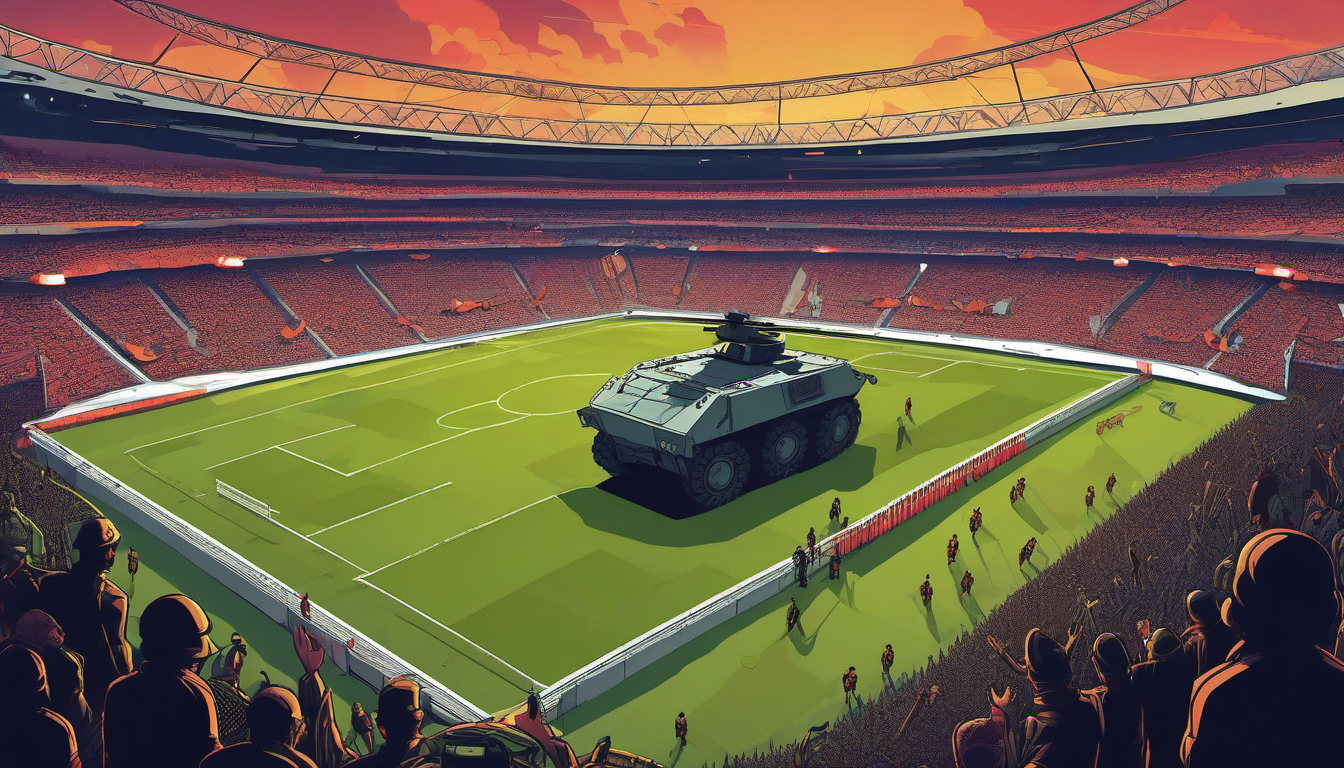
El Mencho's death exposes the fundamental contradiction of hosting a global mega-event in a narco-state — and the $14 billion gamble that FIFA, Mexico, and the global tourism industry cannot afford to lose
Executive Summary
- The killing of CJNG cartel boss "El Mencho" on February 23 triggered Mexico's worst cartel violence in years, with road blockades across 12+ states, 25 National Guard soldiers killed, and Guadalajara — a World Cup host city — effectively shut down, just 112 days before the tournament's June 11 kickoff.
- FIFA says it is "closely monitoring" the situation, but faces an unprecedented dilemma: relocating Mexican matches would destroy the tournament's financial model, while proceeding risks a security catastrophe on the world's biggest stage.
- The crisis exposes a deeper structural problem — Mexico's cartels are embedded in the same economic ecosystem that will host 5 million expected visitors, creating a paradox where criminal organizations simultaneously threaten and depend on the World Cup's success.
Chapter 1: 112 Days and Counting
On the morning of February 23, 2026, Mexican special forces descended on a ranch in Jalisco state. By afternoon, Nemesio Oseguera Cervantes — "El Mencho," leader of the Jalisco New Generation Cartel (CJNG) and the most wanted man in the Western Hemisphere — was dead, shot during a firefight and expired while being airlifted to hospital.
Within hours, his followers responded with a coordinated show of force that stunned even hardened observers of Mexican narco-violence. Nearly 100 major roads were blockaded. Buses and taxis were commandeered and set ablaze — the classic "narcobloqueo" tactic. National Guard bases came under direct assault. At least 25 soldiers and 34 suspected cartel gunmen died in the first 24 hours.
Guadalajara, a city of over 5 million people and the capital of Jalisco, went into lockdown. A code red security protocol froze all civilian activity. Bars and restaurants shuttered. Sports matches were cancelled. The US government advised Americans in Jalisco to shelter indoors. Canada cancelled flights to Puerto Vallarta. Planes turned back mid-flight across the globe.
Just down the road from the burning barricades sits the Estadio Akron — scheduled to host four group-stage matches at the 2026 FIFA World Cup, starting June 14. Mexico City's Azteca Stadium has five matches. Monterrey has four. Together, Mexico's 13 World Cup matches represent approximately one-fifth of the tournament's total games.
The tournament kicks off on June 11 in Mexico City. That is 112 days away.
Chapter 2: The Narco-Economic Paradox
Understanding why Mexico's cartel crisis poses such a unique threat to the World Cup requires understanding a counterintuitive truth: the cartels don't want to destroy the tournament. They want to profit from it.
"In general the cartels have an economic interest in making sure the World Cup is peaceful," explains Javier Eskauriatza, assistant professor of criminal law at the University of Nottingham. "They pay off politicians and local police forces, but they also buy restaurants and own hotels. They are part of the economic system. It is useful for them if Brits, Americans, and others go to Mexico, spend their money and have a good time."
The CJNG alone is estimated to be worth over $10 billion. Its financial tentacles extend far beyond drug trafficking into legitimate businesses — real estate, agriculture, mining, tourism infrastructure. The cartel effectively operates as a parallel economic governance structure across western Mexico, extracting rents from virtually every commercial transaction in its territory.
This creates what might be called the narco-hosting paradox: the same criminal organizations that make Mexico dangerous are also economically invested in the World Cup's success. The problem is not that cartels want to attack the tournament. The problem is that the power vacuum created by El Mencho's death could unleash violence that no one — not the government, not the remaining cartel leadership — can fully control.
The Kingpin Strategy's Recurring Failure
Mexico's history provides a clear template for what happens next. When authorities captured Ovidio Guzmán López — son of "El Chapo" — in 2019, the Sinaloa Cartel responded with such overwhelming force in Culiacán that the government was forced to release him, in an episode known as the "Culicanazo." When authorities finally re-arrested him in 2023, violence again engulfed Sinaloa state.
The Sinaloa Cartel's own internal war, triggered by the arrest of Ismael "El Mayo" Zambada in 2024, has made the city of Culiacán effectively uninhabitable for long stretches. The second-division football club Dorados has not played a true home match since October 2024, having relocated to Baja California.
| Kingpin Event | Year | Aftermath Duration | States Affected |
|---|---|---|---|
| El Chapo Capture (Mazatlán) | 2014 | 3-4 weeks intense violence | 3 |
| Ovidio Guzmán Arrest Attempt | 2019 | Days (government capitulated) | 1 |
| El Mayo Zambada Arrest | 2024 | 18+ months (ongoing civil war) | 4+ |
| El Mencho Killed | 2026 | TBD | 12+ (within 48 hours) |
The pattern is unmistakable: removing a cartel leader creates a succession crisis that generates months or years of elevated violence. El Mencho's death is qualitatively different from previous cases because: (1) the CJNG has a broader geographic footprint than any previous cartel whose leader was neutralized; (2) the response was immediate and national in scope; and (3) it comes with a hard deadline — the World Cup — that constrains the government's options for managing the aftermath.
Chapter 3: FIFA's $14 Billion Dilemma
The 2026 FIFA World Cup is the largest and most expensive in history. Expanded to 48 teams across 16 host cities in three countries, it represents an estimated $14 billion in total economic activity across the US, Mexico, and Canada, according to FIFA and host-country projections.
Mexico's 13 matches are not a peripheral add-on. They are structurally essential to the tournament's identity and finances:
- Mexico City's Azteca Stadium hosts the tournament opener on June 11 — one of the most-watched sporting events on Earth
- Guadalajara is the designated hub for Group G and Group H matches
- Monterrey hosts critical knockout-stage matches
- An estimated 1.2-1.5 million international visitors are expected in Mexico alone
- Mexican sponsorship and broadcast deals represent approximately $2.1 billion of the tournament's revenue
The Relocation Option — And Why It's Nearly Impossible
FIFA has relocated World Cup matches before, but never under comparable circumstances. The logistical, contractual, and political barriers to moving Mexico's matches are formidable:
Contractual obligations: Host city agreements were signed years ago, with billions in infrastructure investment already completed. Stadiums have been renovated, transport links upgraded, and security plans developed specifically for these venues. Breaking these contracts would trigger massive legal liability.
Logistical timeline: With 112 days until kickoff, relocating 13 matches to US venues would require renegotiating broadcast contracts (camera positions, commentary booth allocations), reassigning volunteer and security personnel, rebooking accommodation for tens of thousands of fans, and reprinting millions of tickets. Previous FIFA relocations (like moving the 2022 Club World Cup from Japan due to COVID) had far smaller scope and longer lead times.
Political dimensions: Mexico's co-hosting status was the product of a delicate three-country diplomatic arrangement. President Sheinbaum has explicitly stated there is "no risk" and "all guarantees" are in place. Pulling matches would be interpreted as a national humiliation — and in the current US-Mexico political environment, where Trump has repeatedly called Mexico a "cartel-run" state and Musk has accused Sheinbaum of taking orders from traffickers, relocation would be seen as confirming those narratives.
FIFA's own incentives: FIFA president Gianni Infantino has staked his legacy on the expanded 48-team format and the three-country hosting model. Admitting that one-third of the host nation is too dangerous would be a reputational catastrophe.
Chapter 4: Historical Precedents — Mega-Events in Dangerous States
Mexico's situation is not entirely without precedent. Several previous mega-events have proceeded amid serious security concerns, with mixed results.
Brazil 2014 World Cup
Brazil hosted the tournament amid widespread protests, police strikes, and elevated urban violence. A police strike in Salvador left the city essentially lawless for days before matches. FIFA deployed unprecedented security — 170,000 military and police personnel for 64 matches. No major incidents occurred during games, but the security cost ($900 million) consumed the budget. The tournament was widely judged a success, but at enormous fiscal cost.
South Africa 2010 World Cup
South Africa, one of the world's most violent countries (murder rate: 36 per 100,000), successfully hosted the tournament by creating "fan zones" with militarized perimeters. Forty thousand security personnel were deployed. Crime against tournament visitors was kept minimal, though a Spanish television crew was robbed at gunpoint during a live broadcast.
Russia 2018 World Cup
Russia temporarily suppressed its usual levels of hooliganism and political repression through overwhelming state security presence. The tournament was considered safe, but the authoritarian model of security deployment is not available to Mexico's democratic government.
Sochi 2014 Winter Olympics
Held amid active conflict in nearby Chechnya and Dagestan, Russia deployed 40,000 security personnel for a relatively compact event. Cost overruns made it the most expensive Olympics in history ($51 billion).
| Event | Security Personnel | Security Cost | Incidents |
|---|---|---|---|
| South Africa 2010 | 40,000 | $1.3B | Minimal |
| Brazil 2014 | 170,000 | $0.9B | None during matches |
| Russia 2018 | 100,000+ | est. $2B+ | None reported |
| Mexico 2026 (projected) | 200,000+? | $2-4B? | Unknown |
The key lesson: mega-events in high-risk environments can succeed, but only through massive, expensive security deployments that effectively create a "green zone" around venues. Mexico will need to do this across three cities spread across thousands of kilometers, while simultaneously managing an active cartel succession crisis.
Chapter 5: Scenario Analysis
Scenario A: Controlled Stabilization (40%)
Thesis: CJNG violence peaks within 1-2 weeks, a new leadership structure consolidates, and an informal understanding emerges (as in past cases) that World Cup venues and corridors are off-limits.
Supporting evidence:
- CJNG has strong economic incentives to stabilize — a chaotic World Cup hurts their legitimate business interests
- Mexico's military has already demonstrated capacity with the El Mencho operation itself
- Previous cartel crises (Culiacán 2019, Sinaloa 2024) eventually stabilized, though the timeline varies
- FIFA and Mexico have 3+ months to deploy extraordinary security measures
- Historical precedent (Brazil 2014, South Africa 2010) shows mega-events can succeed in violent contexts
Triggers: CJNG successor quickly consolidates power; government negotiates informal ceasefire (historically common); international security assistance arrives
Investment implications: Tourism stocks recover; Mexican peso stabilizes; Grupo Televisa and broadcast partners maintain value; infrastructure contractors benefit from last-minute security upgrades
Scenario B: Protracted Instability, Modified Tournament (35%)
Thesis: Violence continues at elevated levels for months, forcing FIFA to implement significant modifications — enhanced security perimeters, restricted fan movement, possible rescheduling of Guadalajara matches to Mexico City or Monterrey — but the tournament proceeds in Mexico.
Supporting evidence:
- The Sinaloa civil war (2024-present) has lasted 18+ months, suggesting CJNG succession could follow a similar pattern
- Guadalajara, as CJNG's home base, faces the highest risk of prolonged instability
- FIFA has a precedent of last-minute venue changes (Manaus and Cuiabá modifications in 2014)
- Mexico City and Monterrey, while not immune to cartel violence, are not CJNG heartland
Triggers: CJNG splits into rival factions; violence spreads to Monterrey or Mexico City; a specific high-profile incident (tourist killed, journalist massacre) changes the calculus
Investment implications: Mexican tourism sector takes 15-25% hit; peso weakens; insurance premiums for event coverage spike; US border-region economies benefit from spillover tourism; hotel/airline stocks for US host cities rise
Scenario C: Relocation Crisis (25%)
Thesis: A catastrophic security event — cartel attack near a venue, mass kidnapping of tourists, or military crackdown that destabilizes multiple host cities — forces FIFA to relocate some or all Mexican matches to US venues.
Supporting evidence:
- The unprecedented speed and geographic scope of CJNG's response (12+ states in 48 hours) suggests organizational capacity that could sustain disruption
- Trump administration pressure — Trump has called Mexico "cartel-run" and could leverage relocation as political leverage
- Insurance underwriters for the tournament may demand relocation as a condition of coverage
- 1983 Colombia declinature of the 1986 World Cup (eventually moved to Mexico, ironically) shows precedent for host withdrawal
Triggers: Major incident involving international visitors; CJNG deliberately targets World Cup infrastructure; US government issues formal travel ban for Mexican host cities; FIFA insurance triggers force relocation
Investment implications: Major disruption to Mexican economy (tourism, hospitality, construction); US host city real estate and hospitality spike; FIFA faces $3-5B in contractual liabilities; long-term damage to Mexico's investment reputation; peso under severe pressure
Chapter 6: Investment Implications
Short-Term (0-3 months)
- Mexican peso (MXN): Under pressure. The narco-crisis compounds existing USMCA uncertainty and SCOTUS IEEPA tariff fallout. A move toward 20.5-21.0/USD is plausible (currently ~19.8).
- Mexican tourism stocks (Grupo Posadas, Volaris, VivaAerobus): Immediate downside risk of 10-20%. Guadalajara-exposed assets face steepest decline.
- US hospitality near Mexican border (Marriott, Hilton properties in Texas/Arizona): Potential beneficiaries if tourism diverts northward.
- Global security contractors (G4S, Securitas, Prosegur): Elevated demand for World Cup security augmentation.
- Insurance/reinsurance (Lloyd's syndicates, Munich Re): Event cancellation insurance premiums spiking; potential claims if matches relocated.
Medium-Term (3-12 months)
- FIFA broadcast partners (Fox Sports, Telemundo, Sky Mexico): Revenue at risk if Mexican viewership drops or matches are moved to less accessible US time zones.
- Mexican FDI: Already under pressure from USMCA uncertainty, the "narco-state" narrative damages investor confidence further.
- Defense/security sector: Mexico's military spending likely to increase post-crisis, benefiting domestic and international defense contractors.
Key Monitoring Indicators
- CJNG violence frequency in Jalisco (daily incident count)
- FIFA official statements beyond "monitoring" — any mention of "contingency planning" is a sell signal for Mexican tourism
- US State Department travel advisory changes for Jalisco/Mexico City
- Insurance market pricing for World Cup event cancellation
- Advance hotel booking cancellations in Guadalajara (data from STR/CoStar)
Conclusion
The killing of El Mencho has laid bare a contradiction that Mexico's government, FIFA, and the global sports-entertainment complex have spent years avoiding: you cannot host the world's largest sporting event in a country where criminal organizations exercise de facto governance over significant territory. The narco-hosting paradox — cartels simultaneously threatening and sustaining the economic ecosystem that supports the World Cup — means there are no clean solutions.
The most likely outcome (Scenario A, 40%) is that the crisis stabilizes sufficiently to allow a heavily securitized tournament to proceed. Brazil 2014 and South Africa 2010 demonstrate that mega-events can succeed in violent contexts — but only at enormous cost and with significant risk acceptance. Mexico's challenge is qualitatively harder because the violence is not diffuse street crime but organized, strategic, and capable of national-scale coordination, as the past 48 hours have demonstrated.
For investors, the key variable is not whether the World Cup happens in Mexico — it almost certainly will — but how much it costs to make it happen, and who bears that cost. The answer will ripple through Mexico's fiscal position, its tourism sector, its currency, and its long-term investment reputation for years after the final whistle blows.
Sources: BBC Sport, The Guardian, FIFA Official Statement, Reuters, Associated Press, University of Nottingham Security Analysis, Historical World Cup Security Data
Leave a Reply