
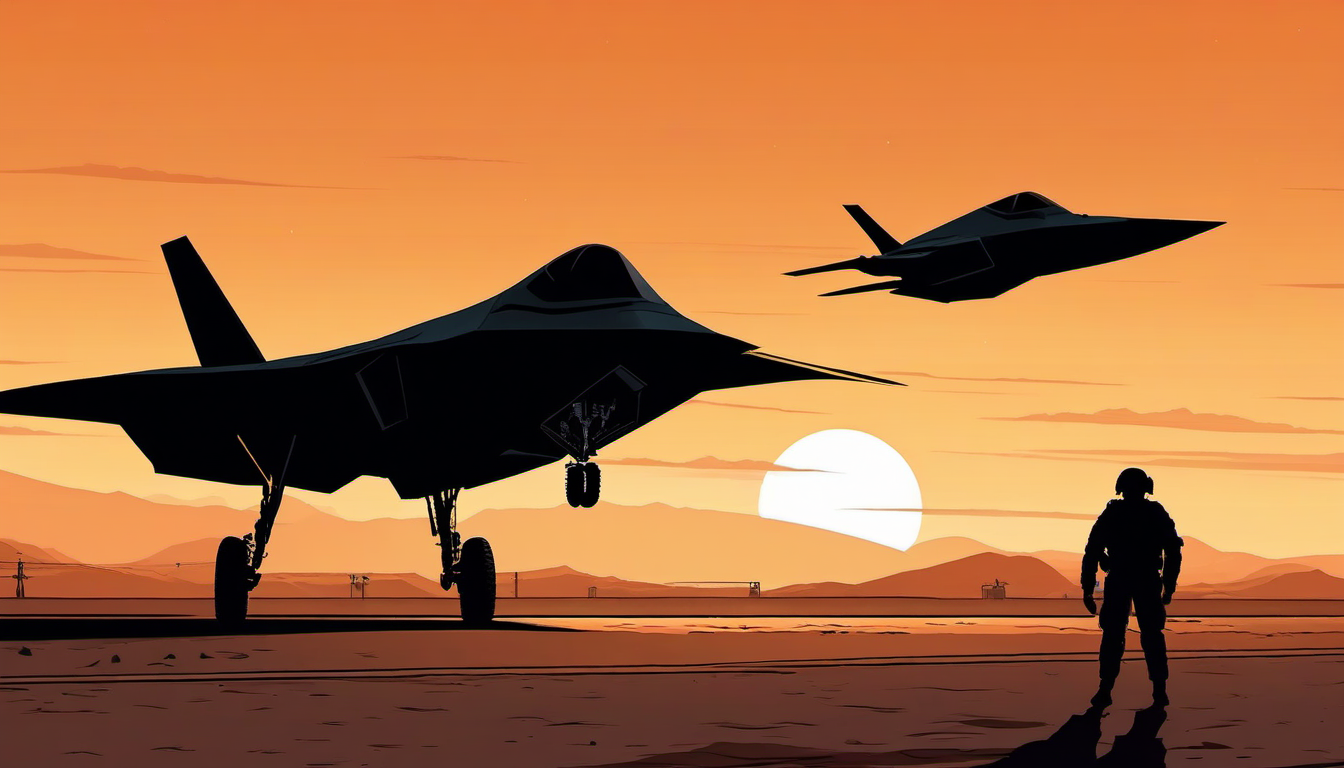
Twelve F-22 stealth fighters touch down at Ovda Airbase—the first-ever deployment of America's most classified combat aircraft to a foreign partner nation—as Geneva nuclear talks loom 48 hours away
Executive Summary
- The United States has deployed 12 F-22 Raptor stealth fighters to Israel's Ovda Airbase in the Negev desert, marking the first time the aircraft has ever been stationed at a foreign partner nation's military installation—a move that shatters a three-decade export and basing taboo.
- The deployment coincides with a convergence of diplomatic and military signals: the USS Gerald R. Ford is transiting the eastern Mediterranean to join the USS Abraham Lincoln, Indian PM Modi is conducting a historic two-day visit to Israel, and US-Iran nuclear talks are scheduled for February 26 in Geneva.
- The F-22's presence transforms the military calculus in any potential Iran strike scenario, providing the US with unmatched air superiority and suppression of enemy air defense (SEAD) capabilities that complement Israel's F-35I fleet—but it also signals that Washington views diplomacy and deterrence as inseparable tools.
Chapter 1: The Unprecedented Deployment
On the evening of February 24, 2026, twelve F-22 Raptors bearing the callsigns TREND51 through TREND64 departed RAF Lakenheath in Suffolk, England, and flew south across Europe. By early morning on February 25, they had touched down at Ovda Airbase, a remote Israeli Air Force installation in the Negev desert, roughly 60 kilometers north of Eilat.
The significance of this moment cannot be overstated. Since the F-22 entered service with the US Air Force in 2005, it has operated exclusively from American bases and, on occasion, forward-deployed to US installations abroad—Kadena Air Base in Japan, Al Dhafra in the UAE, bases in Poland and the Baltics. But never in its 21-year operational history has the F-22 been stationed at a base belonging to a foreign military.
This is not accidental. The F-22 is governed by the Obey Amendment, a 1998 congressional provision that prohibits the export of the aircraft or its technology to any foreign government. The rationale was straightforward: the Raptor's combination of stealth characteristics, supercruise capability (sustained supersonic flight without afterburners), and integrated avionics represented such a generational leap that lawmakers deemed any foreign transfer an unacceptable intelligence risk. Even Israel, America's closest Middle Eastern ally and an F-35 operator, was denied the F-22.
Deploying the aircraft to an Israeli airbase does not technically violate the Obey Amendment—the jets remain under US Air Force command and control—but it crosses a psychological and operational threshold that Washington has carefully maintained for decades. US ground crews, maintenance equipment, and presumably classified mission-planning systems have now been installed at a foreign partner's facility, creating what defense analysts call "technology proximity risks" that the Pentagon has historically worked to avoid.
Chapter 2: Why Now—The Three-Dimensional Chess Board
The F-22 deployment does not exist in isolation. It sits at the intersection of three converging dynamics that make the next 72 hours among the most consequential in Middle Eastern diplomacy since the original JCPOA was signed in 2015.
The Naval Armada. The USS Gerald R. Ford, a $13 billion supercarrier that has been operating in the eastern Mediterranean since its extended deployment from the Atlantic, has passed Crete and is moving eastward. It is expected to join the USS Abraham Lincoln carrier strike group, which has been stationed in the Arabian Sea for weeks. The combination of two carrier strike groups—roughly 150 aircraft, a dozen surface combatants, and multiple submarines—represents the largest sustained US naval presence in the region since the 2003 Iraq War.
The Geneva Talks. On February 26, US and Iranian negotiators are scheduled to meet in Geneva for what both sides have described as a critical round of nuclear talks. Iranian Foreign Minister Abbas Araghchi has signaled readiness, writing on social media that "a deal is within reach, but only if diplomacy is given priority." Deputy Foreign Minister Majid Takht-Ravanchi stated Tehran is prepared "at any moment" to take necessary steps, while warning that a US strike would be "a real gamble" whose consequences would engulf the entire region. The talks follow preliminary understandings reached in earlier rounds, with the core sticking points unchanged: Washington demands an end to enrichment beyond civilian levels, while Tehran insists on its "sovereign right to peaceful nuclear technology."
The Modi Visit. Indian Prime Minister Narendra Modi landed in Israel on February 25 for a two-day visit—his second to the country and one loaded with strategic significance. The agenda includes a Knesset address, signing of upgraded bilateral security agreements, and advancement of the India-Israel Free Trade Agreement. Israeli officials have pointed to Modi's presence as an indicator that a military strike before the weekend is unlikely—the diplomatic courtesy of not launching a war while hosting a visiting head of state from the world's most populous democracy is a constraint, albeit not an absolute one.
Chapter 3: The F-22's Strategic Value in an Iran Scenario
To understand why the Pentagon chose to break its F-22 basing precedent, one must examine what the Raptor brings to a potential Iran strike that no other platform can replicate.
Air Superiority. Iran's air force is a patchwork of aging American F-14 Tomcats (acquired before the 1979 revolution), Russian Su-35s purchased in recent years, and domestically produced fighters of uncertain capability. Against any of these, the F-22's combination of low-observable stealth, thrust-vectoring maneuverability, and AN/APG-77 radar gives it a kill ratio that the US Air Force has consistently assessed at greater than 10:1 in exercises against fourth-generation adversaries. In a strike scenario, F-22s would "kick down the door"—neutralizing Iranian air defenses and any fighter response—to create corridors for follow-on strikes by F-35s, B-2 bombers, and cruise missiles.
Suppression of Enemy Air Defenses (SEAD). Iran's air defense network has grown significantly since the 12-day war. Tehran has deployed Russian-origin S-300PMU-2 systems, domestically developed Bavar-373 batteries (roughly comparable to the S-300), and a dense network of shorter-range systems around nuclear facilities. The F-22's stealth profile allows it to penetrate these defense envelopes at altitudes and speeds that would be lethal for non-stealth aircraft, identifying and targeting radar emitters for destruction.
Electronic Warfare. Less discussed but equally important, the F-22 carries an advanced electronic warfare suite that can jam enemy radars, spoof missile tracking systems, and provide real-time electronic order of battle intelligence to other strike platforms. In a complex, layered air defense environment like Iran's, this capability is force-multiplying.
The Complementarity Factor. Israel operates the F-35I "Adir," a modified version of the F-35A with indigenous electronic warfare and weapons systems. The F-35 excels at precision strike and intelligence gathering but is optimized as a multirole platform rather than a pure air superiority fighter. The F-22 and F-35 operating in tandem create a combined force that is qualitatively different from either alone—the Raptor clears the sky and suppresses defenses while the Lightning strikes targets with precision.
| Capability | F-22 Raptor | F-35I Adir |
|---|---|---|
| Primary Role | Air superiority + SEAD | Multirole strike |
| Stealth Generation | 5th gen (optimized) | 5th gen (multirole) |
| Supercruise | Yes (Mach 1.5+) | No |
| Max Speed | Mach 2.25 | Mach 1.6 |
| Combat Radius | ~750 km | ~1,100 km |
| Operator | USAF only | Israel, US, allies |
| Export Status | Prohibited (Obey Amendment) | Available to allies |
Chapter 4: Coercive Diplomacy—The Paradox of Force and Negotiation
The simultaneous military escalation and diplomatic engagement is not contradictory—it is the textbook definition of coercive diplomacy, a strategy most closely associated with Thomas Schelling's theory of "the diplomacy of violence." The logic is simple: the threat of force is most credible when the capability to execute it is visibly in place.
Historical precedent is instructive. In October 1962, President Kennedy deployed a naval quarantine around Cuba while simultaneously pursuing back-channel negotiations with Moscow through Ambassador Dobrynin. The visible military preparation was not an alternative to diplomacy—it was the precondition for it. Khrushchev agreed to withdraw Soviet missiles precisely because the alternative was credible.
The current US posture mirrors this logic. Two carrier strike groups, F-22s on Israeli soil, B-2 bombers reportedly on alert at Diego Garcia (though the UK's refusal to allow strike operations from the base complicates this), and submarine-launched cruise missile platforms in the Arabian Sea—all communicate to Tehran that the military option is not theoretical. The Geneva talks on February 26 take place in the shadow of this armada.
But coercive diplomacy carries inherent risks. If the military buildup is perceived in Tehran not as leverage for negotiation but as preparation for an inevitable attack, it can trigger preemptive action—particularly given Iran's stated doctrine of "forward defense." Iran's Hormuz-area capabilities, including anti-ship cruise missiles, fast attack boats, and the ability to mine critical waterways, could inflict significant costs on US and allied forces if Tehran concludes that war is coming regardless of diplomatic outcomes.
Chapter 5: Scenario Analysis
Scenario A: Geneva Breakthrough (25%)
Thesis: The F-22 deployment and naval armada achieve their intended effect—coercing Iran into meaningful concessions on enrichment levels and inspection access.
Rationale: Iran's economy is under severe strain from maximum pressure sanctions 2.0, and the regime faces internal instability from ongoing protest movements and succession uncertainty around Supreme Leader Khamenei. Araghchi's public statements signal genuine willingness. The 2015 JCPOA precedent shows that Iran's leadership can make rational cost-benefit calculations when the alternative is sufficiently threatening.
Trigger: Iran agrees to cap enrichment at 3.67% (civilian power reactor grade) and accepts enhanced IAEA inspections, in exchange for phased sanctions relief.
Historical Precedent: The JCPOA itself was negotiated under conditions of significant military pressure (Israeli threats, Stuxnet cyber operations) combined with economic sanctions. The 2013-2015 diplomatic window opened after Rouhani's election signaled Iranian willingness—a parallel to Pezeshkian's current posture.
Scenario B: Managed Escalation Without War (45%)
Thesis: Geneva talks produce incremental progress but no breakthrough. The military buildup persists as a "permanent coercive posture," with periodic crises but no kinetic action.
Rationale: Both sides have incentives to avoid war. The US faces a 150-day clock on Section 122 tariffs, DHS shutdown fallout, and midterm election calculations that make a new Middle Eastern conflict politically toxic. Iran faces economic ruin from extended conflict but maintains enough escalatory leverage (Hormuz, proxy networks, missile arsenal) to deter attack. The result is a protracted standoff—tense, expensive, and unstable, but short of war.
Trigger: Talks extend into March with a "framework of principles" but no binding agreement. Military forces remain deployed. Oil markets price in a permanent risk premium.
Historical Precedent: The 2019-2020 US-Iran tensions following the Soleimani assassination—multiple escalatory cycles (tanker seizures, drone shootdown, missile strikes on Al Asad) that ultimately did not escalate to full-scale war.
Scenario C: Military Confrontation (30%)
Thesis: Geneva talks collapse, and the Trump administration—under domestic political pressure and with forces already deployed—authorizes limited strikes on Iranian nuclear and military infrastructure.
Rationale: The SOTU speech revealed a president at 36% approval, facing SCOTUS defeats and Congressional challenges. A "rally around the flag" effect from military action against Iran could provide political breathing room before midterm primaries. The F-22 deployment to Israel suggests operational planning has advanced beyond deterrence posturing. Iran's continued enrichment activities provide casus belli.
Trigger: IAEA reports evidence of enrichment beyond agreed levels, or Iran conducts a provocative missile test. Diplomatic channels break down.
Historical Precedent: The 2003 Iraq War—where military buildup created institutional momentum toward conflict even as diplomatic options remained theoretically available. The "sunk cost" of deploying forces at this scale creates pressure to use them.
Chapter 6: Investment Implications
Energy Markets. Brent crude has been surprisingly muted despite the military buildup, currently trading around $62-65/bbl. This reflects market skepticism that conflict will actually occur and the structural oversupply from OPEC+ unwinding. However, a Scenario C outcome would send oil to $90-120 within days as Hormuz transit risk materializes. Options markets show elevated call skew on crude—a hedge worth considering.
Defense Stocks. Lockheed Martin (F-22, F-35 manufacturer), Raytheon (missile systems), and Northrop Grumman (B-2, sensors) benefit from any scenario involving sustained US forward deployment. The European defense complex (Rheinmetall, BAE Systems, Leonardo) benefits from the demonstrated need for allied military capability as US assets are drawn to the Middle East—validating the "strategic vacuum" thesis.
Gold. Already at $5,000, gold would surge further in Scenario C as geopolitical risk premium and safe-haven flows intensify. In Scenarios A or B, current levels may represent a near-term ceiling.
Israeli Tech/Defense. Israel Aerospace Industries (IAI), Elbit Systems, and Rafael Advanced Defense Systems stand to benefit from upgraded India-Israel defense agreements regardless of Iran outcomes. The Modi visit is expected to produce $8-10 billion in defense procurement commitments.
Conclusion
The twelve F-22 Raptors sitting in the Negev desert represent more than an unprecedented military deployment. They are a physical manifestation of America's strategic posture at a moment of extraordinary global complexity—where diplomatic ambition and military capability must coexist in tension rather than contradiction.
The next 72 hours will test whether Thomas Schelling was right that the credible threat of force can substitute for its actual use, or whether the institutional momentum of a two-carrier, F-22-forward deployed military machine will follow the gravitational pull toward kinetic action that has characterized similar buildups in the past.
For investors, policymakers, and the 85 million Iranians whose lives hang in the balance, the Raptor's first foreign roost is not just a military milestone. It is a signal that the window for diplomacy, while still open, is narrowing—and that the machinery of war, once set in motion, develops its own logic.
Related Reading
Sources: Ynet News, Al Jazeera, India TV News, Israel Hayom, JFeed, CNBC, Reuters
Leave a Reply