
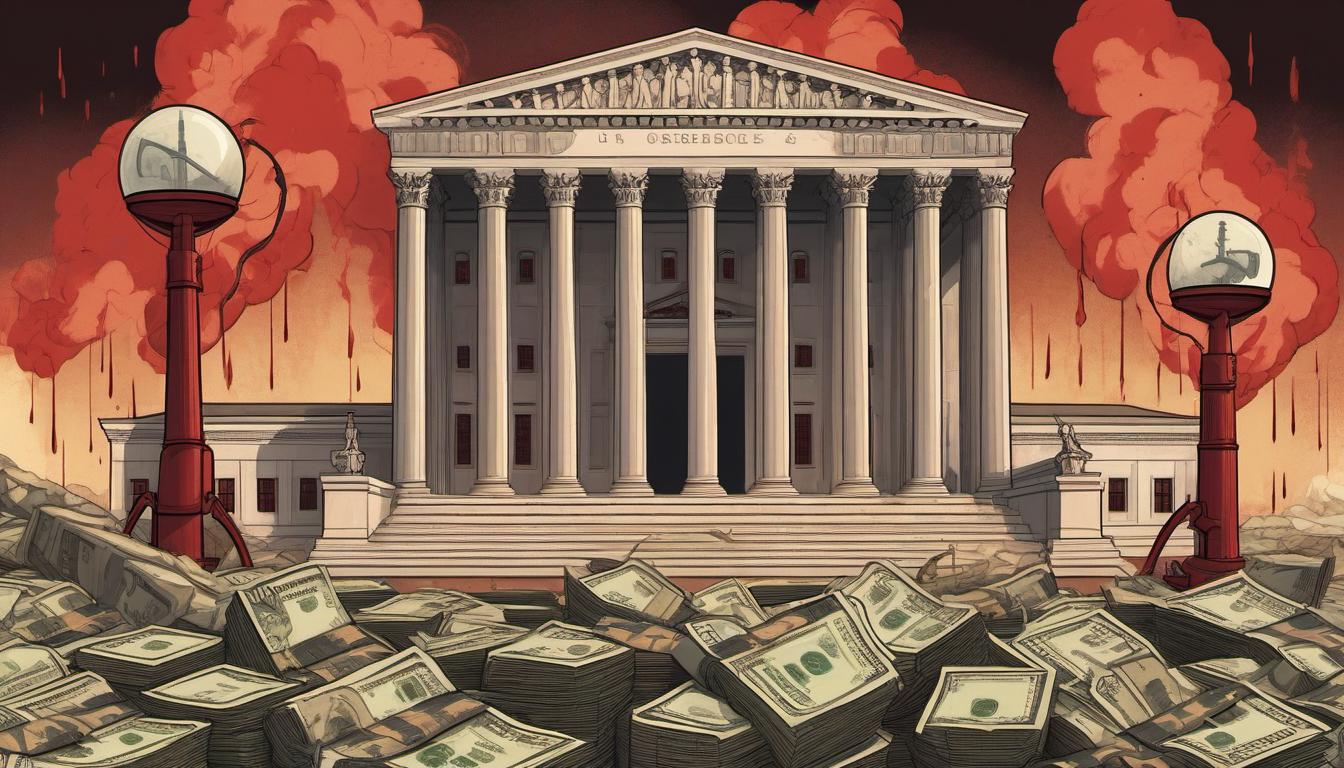
Boulder v. Exxon could reshape hundreds of billions in climate liability — or kill the movement entirely
Executive Summary
- The U.S. Supreme Court has agreed to hear Boulder v. ExxonMobil/Suncor, the first climate accountability case in the court's history, with nearly 60 similar lawsuits and potentially hundreds of billions in damages hanging in the balance.
- The case creates an extraordinary legal paradox: Trump's EPA just repealed the endangerment finding that established federal authority to regulate greenhouse gases, yet oil companies are arguing federal law should preempt state-level climate claims.
- A ruling expected by early 2027 will determine whether fossil fuel companies face tobacco-industry-scale liability or whether the entire climate litigation movement collapses — with massive implications for energy sector valuations, insurance markets, and municipal finance.
Chapter 1: Eight Years to the Highest Court
On February 23, 2026, the U.S. Supreme Court took a step that legal scholars have anticipated — and fossil fuel executives have dreaded — for nearly a decade. The justices agreed to hear arguments in Boulder v. ExxonMobil and Suncor Energy, the first time the nation's highest court has weighed in on the substance of a climate accountability lawsuit.
The case has a tortured history. Filed in 2018, the City of Boulder and Boulder County alleged that ExxonMobil and Suncor knowingly contributed to climate change while systematically misleading the public about its risks. For eight years, the lawsuit never reached the merits — instead, it ricocheted through procedural battles over where it should be heard.
The core question was deceptively simple: Could state courts hold fossil fuel companies financially responsible for local climate damages, or did federal law prevent such claims? Colorado's Supreme Court ruled in Boulder's favor, finding that the case belonged in state court under state law. ExxonMobil and Suncor petitioned the U.S. Supreme Court to overturn that decision.
When the justices agreed to take the case, it signaled that at least four of the nine believed the question was consequential enough to resolve. Pat Parenteau, a professor of environmental law at Vermont Law and Graduate School, called it "an unprecedented situation."
But the court did something unusual: it also ordered the parties to brief whether the justices even have jurisdiction to hear the case at this procedural stage. This suggests internal disagreement — some justices may believe the court is stepping in prematurely.
Chapter 2: The $100 Billion Question
Boulder's case is not an isolated dispute between a Colorado city and two oil companies. It is the tip of a litigation iceberg that has been growing since 2017.
Nearly 60 state and local governments across the United States have filed similar lawsuits against fossil fuel companies, collectively seeking what legal analysts estimate could amount to hundreds of billions of dollars in damages. The plaintiffs range from New York City to Honolulu, from the state of Michigan to rural counties in Oregon. The most recent addition was Michigan, which filed a federal antitrust lawsuit against BP, Chevron, ExxonMobil, Shell, and the American Petroleum Institute.
| Metric | Scale |
|---|---|
| Active climate liability lawsuits (U.S.) | ~60 |
| Defendant companies | ExxonMobil, Chevron, Shell, BP, Suncor, ConocoPhillips, API |
| Potential aggregate damages | $100B–$300B+ (legal analyst estimates) |
| Years of litigation without a single trial | 8+ |
| Supreme Court climate cases to date | 0 (until now) |
The lawsuits follow a common template drawn from the tobacco litigation playbook of the 1990s. Plaintiffs allege that fossil fuel companies knew — through their own internal research dating to the 1960s and 1970s — that burning fossil fuels would cause catastrophic warming. Rather than disclosing this, they funded climate denial campaigns, just as tobacco companies once funded research questioning the link between smoking and cancer.
The tobacco analogy is instructive. In 1998, the Master Settlement Agreement forced the four largest U.S. tobacco companies to pay $206 billion over 25 years to state governments. That settlement fundamentally reshaped the tobacco industry's economics, regulatory exposure, and public standing. Climate plaintiffs are seeking a similar reckoning for fossil fuels.
But there is a critical difference. Tobacco harmed its direct consumers. Fossil fuels power the global economy, and greenhouse gas emissions are a collective externality involving billions of actors — not a product defect in the traditional sense. This distinction is precisely what the Supreme Court must grapple with.
Chapter 3: The Endangerment Paradox
The legal terrain became dramatically more complex in February 2026, when Trump's EPA, under Administrator Lee Zeldin, repealed the 2009 endangerment finding — the scientific determination that greenhouse gases threaten public health and welfare, which served as the legal foundation for federal climate regulation under the Clean Air Act.
This creates what legal scholars are calling the "endangerment paradox."
ExxonMobil and Suncor's central argument is federal preemption: they claim that federal environmental law, particularly the Clean Air Act, occupies the regulatory field of greenhouse gas emissions, and therefore state courts cannot impose their own liability regime. In essence, they argue that climate change is a federal matter, not a state one.
But the endangerment finding repeal guts the very federal framework they claim preempts state action. If the federal government has declared that greenhouse gases are not an endangerment — and therefore will not regulate them — can it simultaneously argue that federal law prevents states from addressing the same gases?
"The companies are trying to have it both ways," said Alyssa Johl, vice-president of legal and general counsel at the Center for Climate Integrity. "They want federal law to block state claims while supporting an administration that's dismantling the federal laws they hide behind."
The paradox echoes a broader pattern in the Trump administration's environmental deregulation. By removing federal authority over greenhouse gases, the EPA may have inadvertently weakened the oil industry's strongest legal defense against state-level climate claims.
The Supreme Court could resolve this in several ways:
- Ignore the repeal: Proceed as though the Clean Air Act still preempts state claims regardless of the endangerment finding's status.
- Acknowledge the vacuum: Find that without a functioning federal regulatory framework, states have greater latitude to act.
- Punt on jurisdiction: Decide the court lacks authority to hear the case at this procedural stage, sending it back to Colorado.
Chapter 4: Scenario Analysis
Scenario A: Oil Companies Win — Federal Preemption Upheld (40%)
Rationale: The current 6-3 conservative majority has generally favored limiting regulatory overreach, and the "major questions doctrine" established in West Virginia v. EPA (2022) suggests skepticism of diffuse regulatory claims. Chief Justice Roberts has historically been cautious about expanding liability theories.
Historical precedent: In AEP v. Connecticut (2011), the Supreme Court unanimously held that the Clean Air Act displaced federal common-law nuisance claims against power plant emissions. The oil companies argue this logic extends to state-law claims as well. However, AEP specifically declined to address state-law claims — a gap the court must now fill.
Trigger conditions: The court accepts the federal preemption argument and extends AEP to cover state tort claims. The endangerment finding repeal is treated as irrelevant to the preemption analysis.
Impact: All ~60 climate liability cases are effectively killed. Fossil fuel companies see significant valuation uplift. Municipal governments lose a key avenue for recovering climate adaptation costs, increasing pressure on federal disaster relief and taxpayer-funded infrastructure.
Scenario B: Boulder Wins — State Claims Survive (30%)
Rationale: The court's 2025 denial of certiorari in the Honolulu case and rejection of red-state intervention suggest some justices are reluctant to shut down climate litigation. The endangerment paradox strengthens Boulder's position. Justices Gorsuch and Barrett, who crossed party lines in the IEEPA tariff ruling, have shown willingness to limit executive overreach.
Historical precedent: The tobacco litigation survived despite federal regulation of tobacco products. State tort claims coexisted with the Federal Cigarette Labeling and Advertising Act for decades. The Supreme Court in Cipollone v. Liggett Group (1992) held that federal law preempted some but not all state-law claims against tobacco companies.
Trigger conditions: The court rules narrowly that federal preemption does not apply at this procedural stage, or finds that the Clean Air Act does not occupy the field of state tort claims related to climate damages.
Impact: Climate litigation proceeds toward trials for the first time. Fossil fuel companies face potential multi-billion-dollar verdicts. Insurance and reinsurance markets begin pricing climate liability risk. Energy sector undergoes fundamental re-rating.
Scenario C: Jurisdictional Dismissal — Procedural Off-Ramp (30%)
Rationale: The court's unusual order to brief whether it even has jurisdiction suggests significant internal disagreement. At this interlocutory stage — before a trial has occurred — the Supreme Court typically does not intervene. Four justices may have voted to hear the case while others believe it is premature.
Historical precedent: The court has frequently used jurisdictional grounds to avoid politically charged decisions. In Rucho v. Common Cause (2019), it dismissed partisan gerrymandering claims on justiciability grounds rather than ruling on the merits.
Trigger conditions: A majority finds the case is not ripe for Supreme Court review because no trial has occurred and no final judgment exists.
Impact: Boulder's case returns to Colorado state court and moves toward trial. Other cases remain in legal limbo but are not killed. The fundamental question is deferred, likely for years, until a case reaches the court after a trial verdict.
Chapter 5: Investment Implications
For Fossil Fuel Companies
The combined market capitalization of the five major defendants (ExxonMobil, Chevron, Shell, BP, ConocoPhillips) exceeds $1.5 trillion. A Scenario B outcome — where state claims survive — would introduce a new category of contingent liability that markets have not yet priced in.
The tobacco parallel is instructive: after the 1998 Master Settlement Agreement, tobacco company valuations compressed significantly, and the industry traded at persistent discounts for over a decade. However, tobacco companies ultimately adapted and remained profitable.
For energy investors, the key metric to watch is the implied litigation discount. Currently, fossil fuel stocks trade with essentially zero climate liability premium, reflecting market consensus that these lawsuits will fail. Any signal of a Boulder victory would trigger a re-rating.
For Municipal Finance
Cities and counties across the United States are spending increasingly large portions of their budgets on climate adaptation — flood barriers, wildfire mitigation, heat-resilient infrastructure. Boulder estimates its climate-related costs at tens of millions annually. A successful litigation outcome would create a new revenue stream for municipalities, potentially improving credit quality for municipal bonds in climate-exposed areas.
For Insurance Markets
A Scenario B outcome would accelerate the repricing of climate risk across insurance and reinsurance markets. If courts establish that fossil fuel companies bear financial responsibility for climate damages, insurers may seek to subrogate claims against energy companies — fundamentally altering the risk-transfer chain.
Broader Implications
The case also intersects with the EPA endangerment finding repeal and the SCOTUS IEEPA tariff ruling. Together, these decisions are reshaping the boundary between federal executive power and state/judicial authority. The court that limited presidential tariff power may now limit — or expand — state power over climate accountability.
Conclusion
Boulder v. ExxonMobil is more than a legal dispute over who pays for climate change in Colorado. It is the opening act of what could become the defining corporate liability saga of the 21st century.
The Supreme Court's decision to hear the case has already frozen dozens of lawsuits nationwide, as state courts wait for guidance. Arguments are expected in fall 2026, with a decision likely by early 2027.
For fossil fuel companies, the stakes are existential in a financial sense — not because any single lawsuit could bankrupt ExxonMobil, but because a precedent allowing state-level climate claims would open the door to cumulative liability that could reshape the industry's cost structure for decades.
For cities and states bearing the accelerating costs of climate change — from the Boulder wildfires to Miami's sea-level rise to California's insurance crisis — the case represents a fundamental question of fairness: Who pays for the consequences of a warming planet?
The nine justices who hear this case will not answer that question definitively. But their ruling will determine whether the courts remain a viable arena for seeking that answer — or whether climate accountability becomes solely a matter of politics and legislation.
Leave a Reply