
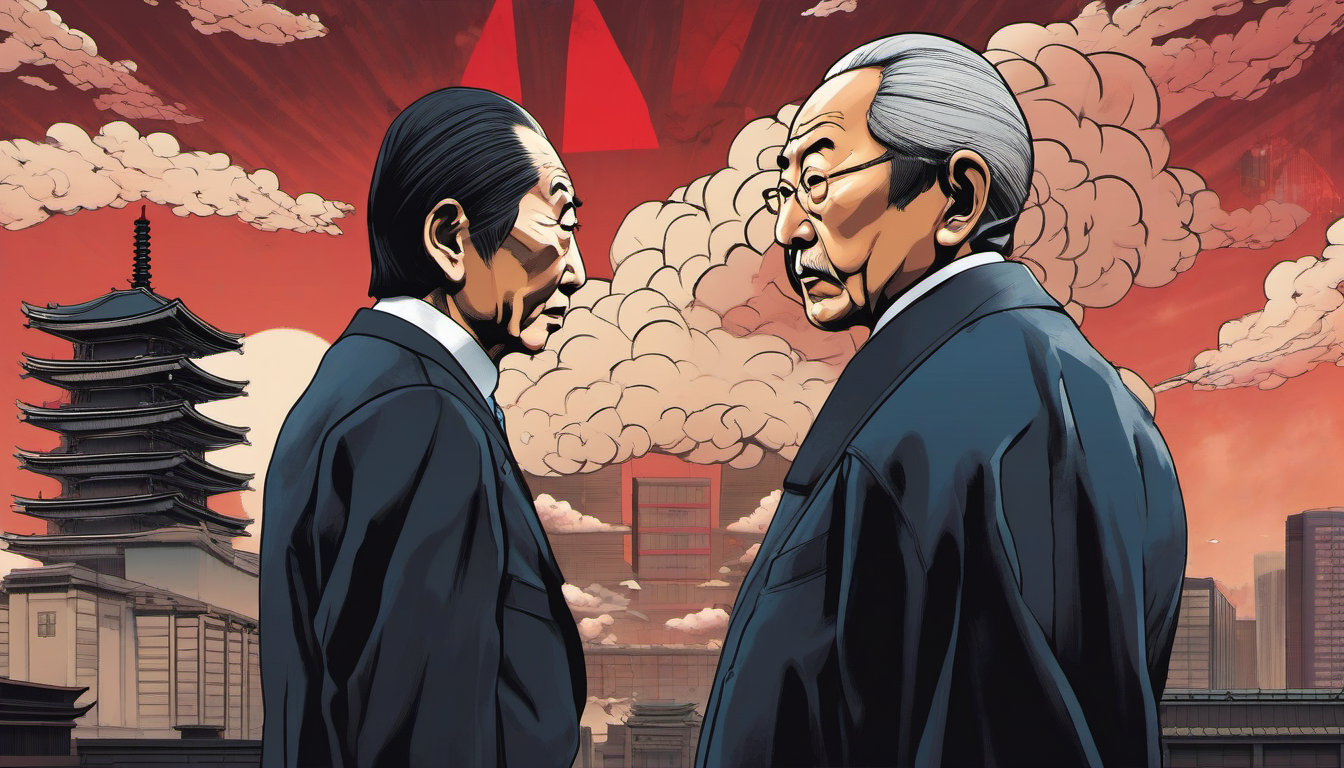
The architect of Japan's radical monetary experiment warns his own protégée that the country's economic reality has fundamentally changed — as the prime minister moves to stack the BOJ board with reflationist allies
Executive Summary
- Former BOJ Governor Haruhiko Kuroda publicly warned PM Takaichi against loose fiscal and monetary policy on February 25, calling for rate hikes and fiscal tightening — a stunning rebuke from the very man who launched Abenomics' monetary revolution in 2013.
- Takaichi nominated two reflationist academics to the BOJ's nine-member board the same day, signaling her intent to slow or halt the central bank's rate normalization cycle. The yen weakened past 155/dollar and long-term JGB yields surged.
- Japan faces a ¥122.3 trillion ($785 billion) record budget, Q4 GDP growth of just 0.1%, and 27-year-high bond yields — a combustible mix of fiscal expansion, monetary repression, and market skepticism that echoes the Liz Truss crisis of 2022.
Chapter 1: The Architect's Warning
On February 25, 2026, Haruhiko Kuroda — the man who spent a decade as BOJ governor flooding Japan with unprecedented monetary stimulus — delivered a message that would have been unthinkable during his tenure: Japan needs to raise interest rates and tighten fiscal policy.
"When Abenomics was deployed, Japan was suffering from deflation and a strong yen. Now, Japan is experiencing inflation and a weak yen," Kuroda told Reuters. "Japan needs to move toward tighter fiscal and monetary policy."
The statement carries extraordinary weight. Kuroda was not some peripheral critic. He was Abenomics' most ardent executor — the governor who introduced negative interest rates, yield curve control, and massive asset purchases that expanded the BOJ's balance sheet to over 130% of GDP. For him to now call those same tools inappropriate is the equivalent of Alan Greenspan warning against easy money in 2006.
Kuroda was specific. He said the BOJ could raise rates roughly twice a year in 2026 and 2027, bringing the policy rate from its current 0.75% toward a neutral range of 1.5–1.75%. On fiscal policy, he was equally direct: "I wonder whether increasing spending and cutting taxes would be appropriate."
The target of that question was unmistakable.
Chapter 2: Takaichi's Three-Pronged Offensive
Prime Minister Sanae Takaichi, who won a commanding supermajority on February 8, has moved swiftly to consolidate control over Japan's economic policy apparatus. Her offensive against BOJ independence operates on three fronts.
Front 1: Direct Pressure on Governor Ueda
The Mainichi daily reported on February 24 that Takaichi had personally conveyed "reservations about further interest rate hikes" to BOJ Governor Kazuo Ueda during their meeting the previous week. While Japanese prime ministers occasionally discuss economic conditions with BOJ governors, explicitly pressuring them on rate decisions crosses a line that successive post-bubble administrations had carefully respected.
The yen immediately weakened on the report, falling past 155 to the dollar — underscoring markets' sensitivity to any hint of political interference with monetary policy.
Front 2: Board Stacking
On February 25 — the same day Kuroda issued his warning — Takaichi's government nominated two academics to replace outgoing BOJ board members Asahi Noguchi and Junko Nakagawa:
| Nominee | Affiliation | Known Stance |
|---|---|---|
| Toichiro Asada | Chuo University | Reflationist, favors accommodative policy |
| Ayano Sato | Aoyama Gakuin University | Reflationist, skeptical of premature tightening |
Bloomberg described both as "reflationists," and the market reaction was immediate: long-term JGB yields surged and the yen weakened further. The nominations shift the board's balance, potentially creating a bloc that could resist Governor Ueda's normalization agenda.
Front 3: Fiscal Bazooka
Takaichi has submitted a record ¥122.3 trillion ($785 billion) FY2026 budget — a second consecutive year of record spending. Key components include:
- Suspension of the 8% consumption tax on food for two years
- Defense spending increase to ¥15 trillion (approaching the 2% GDP target)
- A supplementary budget worth $122 billion already passed in December
- Pledges to boost "growth sectors" through capital investment
Takaichi has framed this as "responsible and proactive" fiscal policy. Markets remain skeptical.
Chapter 3: The Numbers That Don't Add Up
Japan's fiscal position makes Takaichi's expansion particularly dangerous. Consider the data:
| Metric | Value | Context |
|---|---|---|
| Government debt/GDP | ~263% | Highest among developed nations |
| FY2026 budget | ¥122.3 trillion | Record, second consecutive year |
| Q4 2025 GDP growth | 0.1% (annualized) | One-quarter of the 0.4% forecast |
| 30-year JGB yield | ~3.5% | 27-year high |
| BOJ policy rate | 0.75% | Up from -0.1% in March 2024 |
| Yen/Dollar | ~155.80 | Well above the ~140 level seen as sustainable |
| CPI inflation | Above 2% | For years, exceeding BOJ's target |
| Real wage growth | Negative for 4 years | Despite nominal wage gains |
The contradiction is stark: Takaichi is expanding fiscal policy while pressuring the BOJ to keep rates low, at a time when inflation is already above target and the yen is dangerously weak. The last major economy to attempt this combination — expansionary fiscal policy with suppressed monetary tightening — was the United Kingdom under Liz Truss in September 2022. The result was a gilt market crash that ended her premiership in 45 days.
Japan's situation is more complex because the BOJ owns roughly half of all outstanding JGBs, creating a codependency between the central bank and the government that makes any disorderly repricing systemically dangerous. Kuroda himself acknowledged this: "There is no guarantee the impact [of intervention] could be sustained."
Chapter 4: The Truss Parallel and Why Japan May Be Worse
The comparison to Truss's "mini-budget" is instructive but potentially understates Japan's vulnerability.
Where Japan is more resilient:
- The BOJ owns ~50% of JGBs, providing a structural buyer
- Japan's current account surplus provides a buffer
- Domestic institutions (banks, insurers, pensions) hold most government debt
- The yen, while weak, is not collapsing uncontrollably
Where Japan is more vulnerable:
- Debt/GDP at 263% vs. the UK's ~100% in 2022
- The BOJ's massive balance sheet limits its policy flexibility
- Japanese life insurers hold ¥13.2 trillion in unrealized JGB losses (per recent reports)
- An aging population structurally limits growth potential
- The yen carry trade (estimated at $1–4 trillion in leverage) creates global contagion risk
The August 2024 precedent looms large. When the BOJ raised rates unexpectedly, the Nikkei plunged 12.4% in a single day as carry trade positions unwound violently. That was with a rate hike of just 15 basis points. If Takaichi's board picks slow or halt normalization, and then global conditions force a rapid adjustment, the unwinding could be far more severe.
Chapter 5: Scenario Analysis
Scenario A: Managed Normalization (30%)
Premise: Ueda maintains operational independence despite political pressure. The two new board members prove moderate in practice. BOJ raises rates twice in 2026 (to 1.25%) and signals gradual path toward neutral.
Triggers:
- Yen breaches 160, forcing intervention consensus
- JGB market volatility forces Takaichi to moderate rhetoric
- Kuroda's public warning rallies moderate voices within LDP
Historical precedent: BOJ under Shirakawa (2008–2013) maintained independence despite political pressure from the DPJ government, though at the cost of perceived inaction on deflation.
Market implications: Yen stabilizes 145–150 range, JGB yields rise gradually, Japanese bank stocks benefit from steeper yield curve.
Scenario B: Takaichi Dominance — Slow-Motion Truss (45%)
Premise: Reflationist board members tilt policy decisions. Rate hikes pause or slow to once annually. Fiscal expansion proceeds unchecked. Markets gradually lose confidence.
Triggers:
- New board members dissent on rate hikes at April or June meetings
- ¥122.3 trillion budget passes without significant modification
- Food tax suspension implemented, widening deficit further
Historical precedent: Turkey under Erdoğan (2021–2023), where political pressure led to rate cuts despite 85% inflation, causing lira collapse and eventual policy reversal. Japan's institutional strength makes a Turkish-style collapse unlikely, but sustained yen weakness and JGB stress are probable.
Market implications: Yen weakens past 160, JGB 30-year yields approach 4%, Japanese equity earnings boosted by weak yen but foreign investor exodus accelerates. The $1–4 trillion yen carry trade becomes a ticking time bomb.
Scenario C: Market Revolt (25%)
Premise: Bond vigilantes test Japan's fiscal credibility. A disorderly JGB selloff forces an emergency response, potentially including Takaichi reversing course (Truss scenario) or the BOJ implementing emergency yield curve control 2.0.
Triggers:
- JGB auction failure or dramatically weak demand
- Credit rating downgrade (Moody's already at A1 with "stable" outlook, but fiscal trajectory is deteriorating)
- Global risk-off event coincides with domestic JGB stress
- Life insurance sector unrealized losses trigger margin calls
Historical precedent: UK gilt crisis (September 2022). Truss announced unfunded tax cuts, gilt yields spiked 150bp in days, pension funds faced margin calls, BOE intervened with emergency bond purchases, Truss resigned 45 days later.
Market implications: Nikkei drops 15–25%, yen initially weakens sharply then strengthens on risk-off, global contagion through carry trade unwinding, policy U-turn likely within weeks.
Chapter 6: Investment Implications
Currency:
- Short yen positions remain crowded but profitable under Scenario B
- Risk/reward deteriorating as 160 level approaches intervention zone
- Volatility premium on JPY options rising — worth hedging
Bonds:
- JGB short positions carry negative carry but offer asymmetric payoff under Scenario C
- Japanese bank subordinated debt faces repricing risk from unrealized JGB losses
- Global bond contagion risk if yen carry trade unwinds (watch Australian, New Zealand, and emerging market bonds)
Equities:
- Japanese exporters (Toyota, Sony, Nintendo) benefit from weak yen but face demand headwinds
- Japanese banks (MUFG, SMFG, Mizuho) caught between rate hike hopes and JGB loss fears
- Defense stocks (Mitsubishi Heavy, Kawasaki Heavy, IHI) benefit from ¥15 trillion defense budget
- Global risk: sudden yen carry unwind would hit risk assets worldwide, particularly leveraged positions
The Kuroda Signal:
When the architect of the most aggressive monetary experiment in modern history says it's time to stop, investors should listen. Kuroda has no political axe to grind — he is retired, speaking from the National Graduate Institute for Policy Studies. His warning represents a genuine intellectual conclusion that Japan's economic conditions have fundamentally changed from the deflationary trap that justified Abenomics.
The question is whether Takaichi — who built her political identity on Abenomics 2.0 — can recognize that the medicine that cured deflation is now poisoning the patient.
Conclusion
Japan stands at a monetary policy inflection point. The extraordinary spectacle of Kuroda — Abenomics' creator — publicly opposing its current incarnation under Takaichi captures a deeper truth: Japan's economic reality has shifted from the deflationary stagnation of 2013 to an inflationary, weak-yen environment that demands entirely different policies.
Takaichi's response — pressuring Ueda, stacking the board with reflationists, and pursuing record fiscal expansion — suggests she either doesn't recognize the shift or has calculated that the political benefits of stimulus outweigh the financial risks. The market's judgment will arrive through the JGB yield curve, the yen exchange rate, and ultimately the carry trade positions that link Japanese monetary policy to global financial stability.
As Kuroda warned: "The BOJ must gradually raise interest rates toward levels deemed neutral to the economy." Whether Takaichi allows that to happen may determine not just Japan's economic trajectory, but the stability of the global financial system.
Eco Stream | February 25, 2026
Leave a Reply