
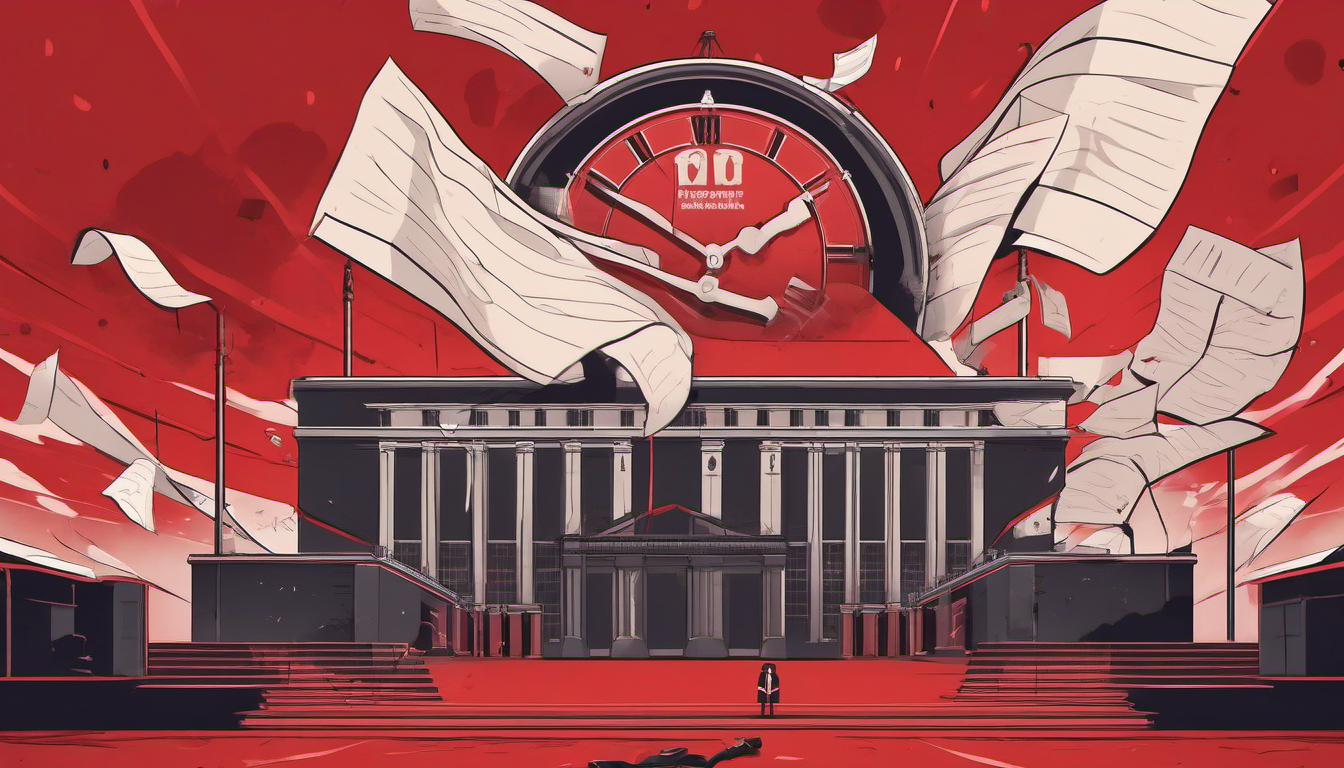
With 107 days to kickoff, frozen federal funding, cartel violence, and political paralysis converge to create an unprecedented mega-event crisis
Executive Summary
- The 2026 FIFA World Cup—the largest sporting event ever held in the Americas, expecting 5 million visitors to the US alone—faces a cascading governance crisis just 107 days before kickoff
- $625 million in congressionally appropriated FEMA security grants remain frozen on Day 11 of the DHS partial shutdown, with the Senate failing to advance a resolution vote on February 24
- Host cities including Miami, Kansas City, and Foxborough are threatening to cancel fan festivals and even withhold stadium entertainment licenses if funding isn't released within 30 days
- Simultaneously, cartel violence has erupted in Guadalajara—a host city—following the killing of CJNG leader El Mencho, with FIFA matches already postponed in Mexico
- The convergence of bureaucratic paralysis, political brinkmanship over immigration reform, and security threats creates a scenario without precedent in mega-event history
Chapter 1: The Frozen $625 Million
On February 24, 2026, representatives from three of America's most prominent World Cup host cities sat before the House Committee on Homeland Security and delivered a blunt message: without federal funding, the world's most-watched sporting event could be in jeopardy.
The money isn't missing—it's trapped. Last July, Congress appropriated $625 million through the FIFA World Cup Grant Program as part of the One Big Beautiful Bill Act. The funds were designated for security activities across the 11 US host cities: training exercises, cybersecurity defense, threat analysis, information-sharing infrastructure, and the massive personnel deployments required to protect an event expected to draw 5 million visitors over a month-long tournament.
But the money flows through FEMA, and FEMA sits within the Department of Homeland Security. DHS has been partially shut down since February 14—the third government shutdown in just over a year—after Senate Democrats refused to approve the agency's funding without new restrictions on ICE enforcement operations, a demand triggered by the fatal shootings of Alex Pretti and Renée Good during an ICE operation in Minneapolis.
On February 23, DHS Secretary Kristi Noem escalated by halting all non-disaster-related FEMA response efforts, scaling the agency to "bare-minimum, life-saving operations only." The grant processing apparatus ground to a halt.
The Senate vote to advance DHS funding failed on February 24. No resolution is in sight.
The Numbers
| Host City | Requested FEMA Funding | Matches Hosted | Expected Visitors | Deadline |
|---|---|---|---|---|
| Miami | $70 million | 7 (inc. quarterfinal, bronze final) | ~1 million | 30 days |
| Kansas City | Undisclosed (significant) | 6 (inc. quarterfinal) | 650,000 | "Immediate" |
| Foxborough/Boston | $7.8 million | 7 (inc. quarterfinal) | ~500,000 | March 17 |
| New Jersey | Portion of $625M | 7 (inc. the final) | ~1.5 million | Weeks |
| Other 7 cities | Remaining allocation | 37 matches | ~2 million+ | Various |
Chapter 2: The Small Town That Could Stop FIFA
The most dramatic confrontation is playing out not in Washington but in Foxborough, Massachusetts—a town of 18,000 residents that hosts Gillette Stadium (to be renamed "Boston Stadium" for the tournament).
Seven World Cup matches are scheduled there, including fixtures featuring England, France, and a tournament quarterfinal. The $7.8 million security bill represents nearly 10% of Foxborough's entire annual budget. Under normal circumstances, the Kraft Group (owners of the New England Patriots) covers Gillette's security costs. But FIFA is effectively renting the stadium, creating what Holy Cross sports economist Victor Matheson called "a huge egg on the face of every lawyer involved with vetting this contract."
The Foxborough Select Board has drawn a hard line. Vice Chair Stephanie McGowan stated: "We're not prepared to issue this license unless everything is in place. And I've seen people saying, 'Oh, there's no way they won't.' I'm gonna tell you: This board will not issue this license."
The deadline: March 17. The first match at the venue—Haiti vs. Scotland—is scheduled for June 13.
Elsewhere, the damage is already materializing:
- New Jersey scrapped its planned large-scale fan festival at Liberty State Park, replacing it with smaller watch parties
- Miami COO Raymond Martinez testified that fan festivals are "in jeopardy" and gave a 30-day deadline before cancellations begin
- Kansas City Deputy Police Chief Joseph Mabin warned that without funding, "decisions will be made on budget instead of threat assessment"
Chapter 3: The Guadalajara Powder Keg
The funding crisis collides with a live security emergency. On February 22, Mexican military forces killed Nemesio Oseguera Cervantes—"El Mencho"—the leader of the Jalisco New Generation Cartel (CJNG), in a firefight near Talpalpa. The retaliatory violence was immediate and devastating.
At least 25 soldiers and 34 cartel gunmen have died in subsequent fighting. Four Liga MX soccer matches in the Guadalajara metropolitan area were postponed. Narco-blockades paralyzed highways across Jalisco and Michoacán. FIFA confirmed it is "monitoring the situation" in Guadalajara, which is scheduled to host World Cup matches beginning in June.
President Claudia Sheinbaum pledged safety for World Cup visitors, but the CJNG's fragmentation into competing factions following El Mencho's death mirrors the pattern seen after every major kingpin elimination in Mexico's history: short-term chaos escalating into prolonged territorial warfare.
The Security Convergence
The DHS shutdown doesn't just freeze money—it degrades the intelligence infrastructure that protects events like the World Cup.
Mike Sena, president of the National Fusion Center Association, testified that his organization hasn't received its 2025 allocation and is facing cascading operational difficulties. Without FEMA funds, the fusion centers—the primary mechanism for federal-state-local threat intelligence sharing—cannot deploy threat liaison officers, conduct outreach and training, or operate the technology platforms designed to monitor emerging dangers.
"Without it, we will be blinded to the threats," Sena told Congress.
This is particularly alarming given the multi-jurisdictional nature of the tournament. Kansas City's World Cup operations span 10 counties across two states. The tournament itself spans three countries. The information-sharing architecture that connects FBI, DHS, state police, and local departments is exactly what the shutdown is degrading.
Chapter 4: Historical Precedents and Scenario Analysis
Previous Mega-Event Security Crises
| Event | Crisis | Resolution | Cost |
|---|---|---|---|
| 1972 Munich Olympics | Palestinian terrorist attack, 11 Israelis killed | Catastrophic failure—no adequate security | Incalculable |
| 2014 Brazil World Cup | $11B+ cost overruns, mass protests | Military deployed, 170,000 security personnel | $850M security |
| 2010 South Africa World Cup | Crime concerns, infrastructure gaps | Massive police deployment, incident-free | $600M security |
| 2022 Qatar World Cup | Human rights controversies, security concerns | Total state control, massive investment | $1B+ security |
| 2024 Paris Olympics | Terror threats, social unrest | 45,000 police + 10,000 military + private security | €320M |
No previous World Cup or Olympics has faced a scenario where the HOST GOVERNMENT's own political dysfunction froze the security funding apparatus 100 days before kickoff.
Scenario A: Last-Minute Resolution (45%)
Rationale: The political cost of a World Cup security failure on American soil would be devastating for both parties. The Kraft Group, NFL owners, and major corporate sponsors have enormous leverage. A narrow deal—perhaps a clean DHS funding bill separated from ICE reform—could pass under pressure.
Trigger: Rising bipartisan pressure from host-city Congress members, corporate lobbying, and FIFA ultimatums.
Precedent: The 2019 government shutdown ended after 35 days when airport security delays created visible public pressure. World Cup deadlines create similar urgency.
Scenario B: Patchwork Private Financing (30%)
Rationale: If the shutdown persists, host committees and stadium owners may be forced to front security costs, with federal reimbursement promised but not guaranteed. The Kraft Group in Foxborough has already been engaged to "cover the shortfall temporarily." Cities with deep-pocketed owners (Miami, Dallas, Los Angeles) could manage; smaller venues cannot.
Trigger: DHS shutdown extends past March 15 without resolution.
Risk: Creates a two-tier security system where wealthy venues are protected and others are not. Insurance and liability nightmares ensue.
Scenario C: Partial Cancellations and Venue Relocations (20%)
Rationale: If Foxborough withholds its entertainment license and other cities cancel fan festivals, FIFA faces the nightmare of relocating matches to alternative venues—with tickets already sold, broadcast schedules locked, and team logistics finalized.
Trigger: March 17 Foxborough deadline passes without funding resolution.
Precedent: No World Cup match has ever been relocated due to host government funding failures. This would be unprecedented.
Scenario D: Security Incident (5%)
Rationale: A degraded intelligence-sharing infrastructure combined with cartel violence in Mexico and the general threat environment creates elevated risk. A security incident during the tournament would be catastrophic for US credibility and the mega-event industry globally.
Trigger: Intelligence gaps from shutdown allow a preventable threat to materialize.
Historical frequency: Major security incidents at World Cups are rare but not zero (1972 Munich, 1998 Marseille riots, 2014 São Paulo attacks).
Chapter 5: Investment Implications
Directly Exposed
- FIFA broadcast partners: NBC/Comcast ($1.5B rights), Fox Sports, Telemundo—any match cancellations or relocations create contractual chaos
- Hospitality/travel: Marriott, Hilton, Airbnb bookings in host cities at risk if fan festivals cancel
- Kraft Group/NFL ecosystem: Gillette Stadium matches involve England and France—two of the tournament's biggest draws
- Mexican tourism: Guadalajara hotel and restaurant sectors face immediate losses from cartel violence
Indirect Effects
- Insurance sector: Event cancellation insurance claims could spike; Lloyd's of London mega-event policies tested
- Private security firms: Allied Universal, Securitas, Garda World may see emergency contracts if federal security gaps persist
- Sports betting platforms: DraftKings, FanDuel, Polymarket—venue uncertainty creates volatility in futures markets
The Broader Signal
The World Cup funding crisis is a microcosm of a deeper American governance problem. If the world's richest nation cannot fund the security for a sporting event that Congress already appropriated money for—while simultaneously fighting cartel wars in co-host Mexico—it raises fundamental questions about US institutional capacity.
The mega-event industry ($50B+ annually) relies on host government competence. Countries bidding for future Olympics and World Cups are watching. Saudi Arabia's 2034 World Cup bid suddenly looks more attractive to FIFA precisely because an autocratic state can guarantee seamless execution without legislative gridlock.
Conclusion
The 2026 World Cup was supposed to be America's moment—the largest sporting event in its history, a showcase for US organizational prowess. Instead, with 107 days to kickoff, it has become a cautionary tale about what happens when political dysfunction meets mega-event logistics.
The $625 million sits appropriated but undeliverable. Cities are drawing lines. A town of 18,000 people holds FIFA's schedule hostage. Cartel violence engulfs a co-host city. Intelligence-sharing networks degrade by the day.
The beautiful game has collided with ugly politics. And the clock, unlike the shutdown, has no pause button.
Sources: House Homeland Security Committee hearing (Feb 24, 2026), The Guardian, GBH News, FedScoop, AP News, FEMA FIFA World Cup Grant Program
Leave a Reply