
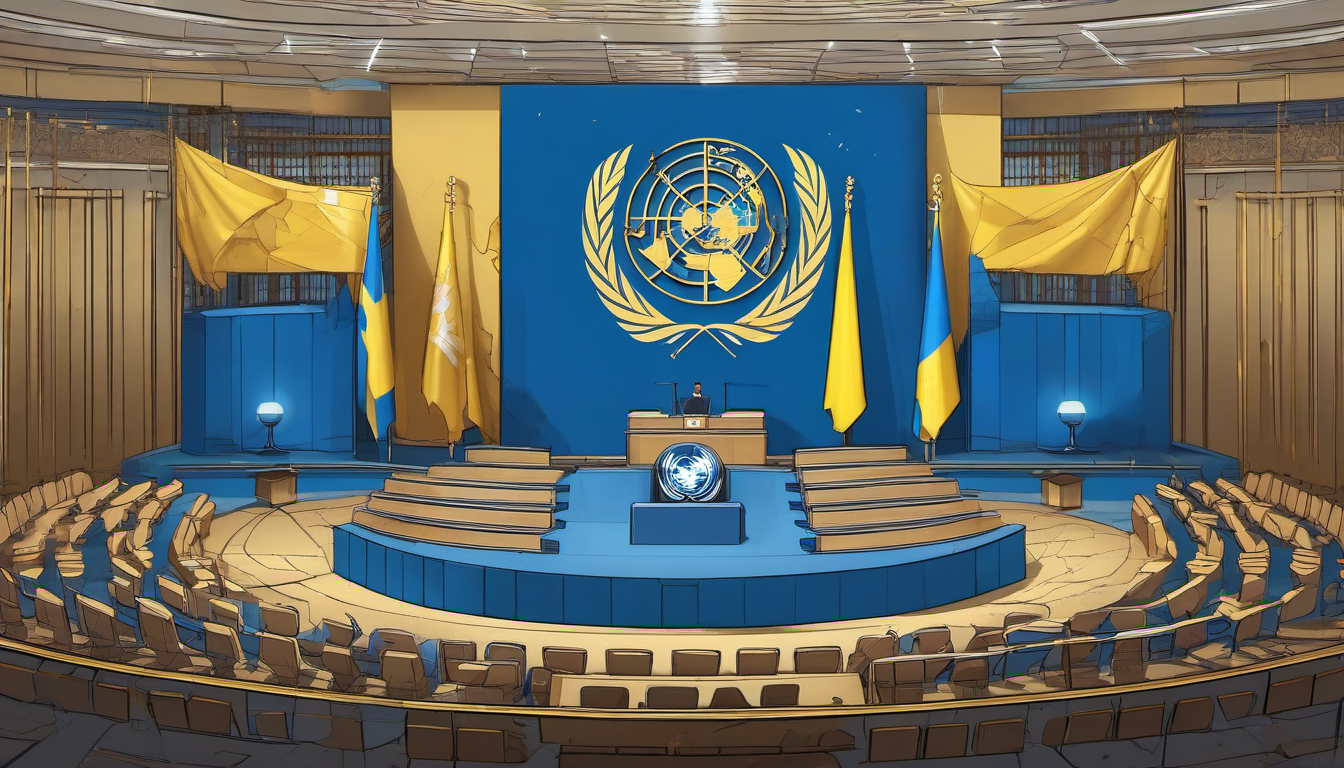
Washington voted alongside Moscow to strip sovereignty language from a Ukraine resolution — a diplomatic earthquake that exposes the true price of Trump's "deal"
Executive Summary
- On February 24, the US proposed deleting references to Ukraine's "sovereignty" and "territorial integrity" from a UN General Assembly resolution, then abstained when its motion was overwhelmingly rejected 11-69 — placing America alongside Russia, Belarus, and Hungary in the vote.
- The resolution passed 107-12-51, but with the US abstaining for the first time on a major Ukraine resolution — a tectonic shift from the 141-nation consensus of 2022.
- This is the clearest signal yet that Washington is preparing to accept territorial concessions in any negotiated settlement, undermining the foundational principle of post-WWII international order: borders cannot be changed by force.
Chapter 1: The 15-Minute Betrayal
At 2:47 PM Eastern on February 24, 2026 — four years to the day after Russian tanks rolled into Ukraine — US Deputy Permanent Representative Tammy Bruce rose in the UN General Assembly to propose something unprecedented. She moved to delete two paragraphs from resolution A/ES-11/L.17, co-sponsored by Ukraine and 47 nations. The targeted passages reaffirmed Ukraine's sovereignty and territorial integrity within its internationally recognized borders.
Ukraine's delegation received notice of the American maneuver just 15 minutes before Bruce spoke. Deputy Foreign Minister Mariana Betsa, visibly shaken, warned the Assembly that "weakening or removing this language would send a very dangerous signal that these principles are negotiable."
The motion for division failed spectacularly: 11 in favor, 69 against, 62 abstentions. The countries that voted yes alongside the US read like a roster of authoritarian regimes and Russian client states — Russia itself, Belarus, Hungary, and the Sahelian military juntas of Burkina Faso, Mali, and Niger.
France warned that removing sovereignty references would "weaken the credibility of the General Assembly." Britain's Stephen Doughty cautioned of "grave consequences if we turn away from our common values and the laws that uphold the international system."
Washington then abstained on the final resolution, which passed 107-12-51 — placing the US in the same column as China, a position unthinkable just two years ago.
Chapter 2: The Erosion of Consensus
The trajectory of UN General Assembly votes on Ukraine tells a story of steadily fracturing solidarity:
| Year | Resolution | Yes | No | Abstain | US Vote |
|---|---|---|---|---|---|
| 2022 (March) | Condemning invasion | 141 | 5 | 35 | Yes |
| 2022 (October) | Territorial integrity | 143 | 5 | 35 | Yes |
| 2023 | Peace principles | 141 | 7 | 32 | Yes |
| 2024 | Comprehensive peace | 101 | 14 | 65 | Yes |
| 2025 | Annual resolution | 93 | 18 | 65 | Yes |
| 2026 | Lasting peace | 107 | 12 | 51 | Abstain |
The 2026 vote marks the first time the US has not voted in favor of a major Ukraine resolution since the invasion began. More critically, it marks the first time Washington actively attempted to weaken the text's territorial integrity language — a principle the US itself championed in the Budapest Memorandum of 1994, where Ukraine surrendered the world's third-largest nuclear arsenal in exchange for sovereignty guarantees from the US, UK, and Russia.
The slight uptick from 93 to 107 yes votes compared to 2025 reflects European diplomatic mobilization in response to the American defection — a pattern that mirrors the broader transatlantic rupture visible at the Munich Security Conference two weeks earlier.
Chapter 3: What Washington Actually Said — and What It Means
Bruce's official explanation was carefully lawyered: the resolution included "language likely to distract from ongoing negotiations, rather than support discussion of the full range of diplomatic avenues." She emphasized that the war "will require sacrifices and compromises."
Decoded, the diplomatic language reveals three distinct signals:
First, "sacrifices and compromises" means territorial concessions. There is no other meaningful "sacrifice" Ukraine can offer that Russia would accept. The Donbas — comprising the Donetsk and Luhansk oblasts — remains the central sticking point in Geneva negotiations. By seeking to remove sovereignty language from the resolution, Washington was telegraphing its willingness to accept a deal that formalizes Russian control over occupied territories.
Second, the 15-minute warning was deliberate. Diplomatic practice requires pre-notification of such motions days or weeks in advance. The compressed timeline was designed to minimize organized opposition — a tactic that backfired spectacularly when European delegations rallied within minutes.
Third, the Security Council pivot was revealing. Hours later, in the Security Council, Bruce shifted blame from Russia to its "enablers" — Belarus, China, Iran, Cuba, North Korea — rather than condemning Moscow directly. This is the rhetorical framework of a mediator positioning itself as neutral between aggressor and victim.
Chapter 4: The Budapest Memorandum's Ghost
The historical irony is crushing. In December 1994, the United States, the United Kingdom, and Russia signed the Budapest Memorandum, providing security assurances to Ukraine in exchange for its renunciation of nuclear weapons. The memorandum's first three provisions committed all signatories to:
- Respect Ukraine's independence, sovereignty, and existing borders
- Refrain from the threat or use of force against Ukraine's territorial integrity
- Refrain from economic coercion
Russia shattered all three provisions in 2014 with the annexation of Crimea and again in 2022 with the full-scale invasion. Now the United States — the other guarantor — is actively seeking to remove the very sovereignty language that formed the memorandum's foundation from international resolutions.
This has implications far beyond Ukraine. Every non-nuclear state that ever considered or abandoned nuclear programs — South Africa, Libya, Kazakhstan, Belarus — is watching. The lesson is unambiguous: sovereignty guarantees from great powers are worthless. Nuclear weapons are the only reliable deterrent.
North Korea's Kim Jong Un, who presided over the 9th Workers' Party Congress this month and declared the DPRK a "permanent nuclear state," could not have scripted a better vindication of his strategy.
Chapter 5: The Coalition of the Willing vs. The Coalition of the Abstaining
The vote pattern reveals a world fracturing into three distinct camps:
The Sovereignty Bloc (107 votes in favor): Led by European nations, joined by Japan, South Korea, Australia, Canada, and a significant contingent from Latin America and Africa. This bloc now operates increasingly independent of Washington, as evidenced by the Coalition of the Willing's virtual summit the same day, where 30+ leaders demanded an "unconditional ceasefire" from Russia.
The Authoritarian Bloc (12 against): Russia, Belarus, North Korea, Syria, Eritrea, Mali, Niger, Burkina Faso, Nicaragua, Cuba, and two others. This bloc is shrinking — from 18 no votes in 2025 to 12 in 2026 — as some nations drift toward abstention amid war fatigue.
The Abstention Bloc (51): The most strategically significant group. Includes the US, China, India, much of the Gulf, and a substantial portion of Africa. This is the "transactional middle" — nations that see the war as an opportunity for leverage rather than a test of principle. America's migration into this bloc represents a fundamental realignment of US foreign policy.
The Gulf abstentions are particularly notable: Saudi Arabia, UAE, Qatar, Kuwait, Bahrain, and Oman all abstained, reflecting their delicate balancing act between Western energy customers and Russian/Chinese partnerships.
Chapter 6: Scenario Analysis
Scenario A: Territorial Freeze — The "Korean Model" (45%)
Basis: This is the outcome Washington's UN maneuvering most clearly signals. A ceasefire along current front lines, with Russia retaining de facto control of occupied territories (approximately 18% of Ukraine's internationally recognized territory) without formal legal recognition of annexation. The deletion of sovereignty language was preparation for this framing — no explicit endorsement of Russian claims, but no insistence on withdrawal either.
Historical precedent: The Korean Armistice of 1953 froze the conflict without a peace treaty, creating a 73-year status quo. The 1974 Cyprus division followed a similar pattern — Turkey's occupation of northern Cyprus was never recognized but became a permanent fact.
Trigger conditions: Russia agreeing to a genuine ceasefire (not just an energy truce), US pressure on Ukraine to accept, European acquiescence driven by energy and economic concerns.
Timeline: 3-6 months for framework, 1-2 years for implementation.
Scenario B: European Autonomy Acceleration (30%)
Basis: The UN vote galvanizes European conviction that the US is an unreliable partner. The Coalition of the Willing evolves into a permanent security structure, accelerating the EU SAFE defense bond program and bilateral UK-France nuclear discussions revealed at Munich. Europe increasingly acts as Ukraine's primary security guarantor.
Historical precedent: The Suez Crisis of 1956, when US opposition to the Anglo-French operation catalyzed European integration. De Gaulle's withdrawal from NATO's integrated command in 1966 similarly reflected transatlantic divergence.
Trigger conditions: A US-brokered deal perceived as capitulation in Europe, continued Russian military pressure, successful SAFE bond issuance.
Timeline: Structural shift over 12-24 months.
Scenario C: Nuclear Proliferation Cascade (25%)
Basis: The Budapest Memorandum's de facto nullification triggers a reassessment of nuclear posture among threshold states. South Korea (already debating tactical nuclear weapons under President Lee Jae-myung), Japan (with Takaichi's constitutional revision enabling remilitarization), Saudi Arabia, Turkey, and potentially Poland enter serious nuclear acquisition or hosting discussions.
Historical precedent: France's independent nuclear program in the 1960s was driven by distrust of US extended deterrence. China's 1964 test was accelerated by the Sino-Soviet split's destruction of Soviet security guarantees.
Trigger conditions: A finalized Ukraine deal perceived as legitimizing nuclear coercion, continued erosion of US extended deterrence credibility.
Timeline: 3-5 years for initial programs, though political decisions could come within months.
Chapter 7: Investment Implications
Defense stocks — European outperformance continues. The transatlantic security divergence accelerates European defense spending, benefiting Rheinmetall, Saab, Leonardo, BAE Systems, and Thales over US primes facing potential NATO procurement pushback.
Gold and hard assets — sovereignty premium rises. Every erosion of international norms adds to the geopolitical risk premium supporting gold above $5,000. Central bank purchases from countries reassessing US security guarantees will accelerate.
Energy — European gas premium persists. Any territorial freeze that leaves Russia empowered maintains the structural premium on European energy prices. TTF natural gas remains elevated versus historical norms.
Nuclear and uranium — proliferation tailwinds. Cameco, Kazatomprom, NexGen Energy, and Centrus Energy benefit from both civilian nuclear renaissance and the growing perception that nuclear deterrence is the only reliable security guarantee.
Emerging market debt — selective caution. Countries in the "abstention bloc" gain leverage from their neutrality, but those with territorial disputes (Taiwan, South Korea, Baltic states) face elevated risk premiums as the sovereignty norm weakens.
Conclusion
February 24, 2026, may be remembered as the day the United States formally abandoned the post-World War II principle that borders cannot be changed by force. Not with a speech or a treaty, but with a motion to delete two paragraphs from a non-binding UN resolution — and a quiet abstention when that motion failed.
The 15-minute warning to Ukraine was not a diplomatic oversight. It was a message: the deal is coming, sovereignty language is an obstacle, and Washington will not let principles stand in the way of a negotiated settlement.
For Europe, the signal is unmistakable: the security architecture that has sustained continental peace since 1945 now rests on European shoulders. For every non-nuclear state with a powerful neighbor, the lesson is equally clear: paper guarantees are worthless without the capacity for self-defense.
The 107 nations that voted yes on the resolution chose principle. The 51 that abstained — including, for the first time, the United States of America — chose pragmatism. History will judge which choice was wiser. But the immediate consequence is undeniable: the rules-based international order has lost its most powerful champion.
Leave a Reply