
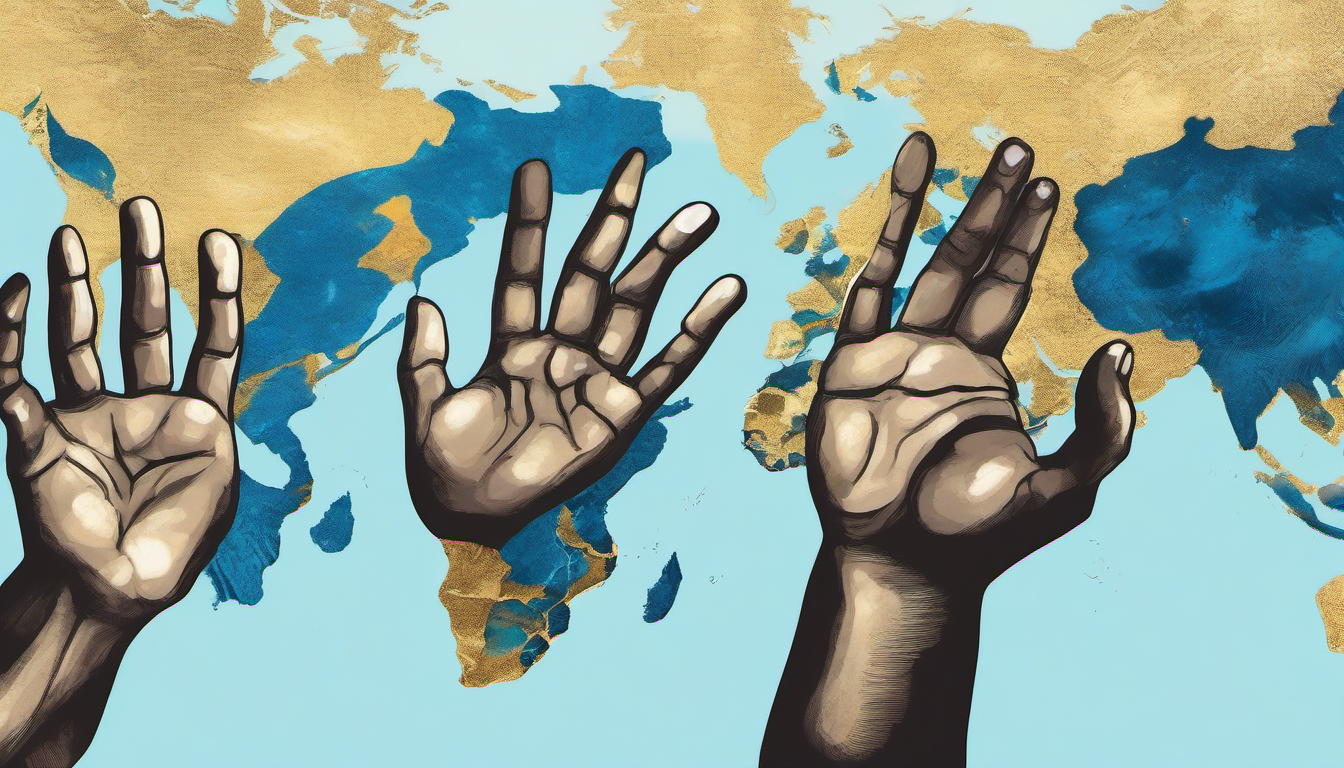
As U.S. tariff chaos reaches new heights, a coalition of middle powers is quietly building alternative resource networks that could reshape the 21st century economy
Executive Summary
- South Korea, Brazil, and India are forging a new axis of critical mineral partnerships that deliberately routes around U.S. trade uncertainty, with the Lee-Lula Seoul summit producing 10 MOUs covering rare earths, AI, and advanced manufacturing.
- The SCOTUS IEEPA ruling and Section 122 tariff chaos have accelerated "supply chain hedging" — middle powers are not decoupling from the U.S. but building redundancies that reduce American leverage over global resource flows.
- A structural shift is underway: countries that once competed for U.S. market access are now competing to build horizontal partnerships with each other, creating a multipolar resource architecture that neither Washington nor Beijing fully controls.
Chapter 1: The Seoul Reset
On February 23, 2026 — the eve of Trump's State of the Union address and the day before Section 122 tariffs took effect on every country in the world — Brazilian President Luiz Inácio Lula da Silva landed in Seoul with the largest diplomatic delegation in the history of Brazil-Korea relations: nearly 300 business executives, double the size of his last visit 21 years ago.
The timing was not coincidental.
President Lee Jae-myung, South Korea's progressive leader who took office in June 2025 after the dramatic impeachment and conviction of Yoon Suk-yeol, has pursued a fundamentally different foreign policy from his predecessor. Where Yoon aligned tightly with Washington and Tokyo, Lee has charted a more independent course: offering to mediate between China and Japan during their economic cold war, pursuing "peaceful coexistence" with North Korea rather than unification rhetoric, and — most significantly for global markets — aggressively diversifying Korea's supply chain dependencies.
The Lee-Lula summit produced a four-year action plan and 10 memorandums of understanding covering:
- Critical minerals: Brazil holds significant reserves of rare earth elements, nickel, and lithium — all essential to the batteries, EVs, and semiconductors that form the backbone of Korea's export economy
- Advanced manufacturing: Joint ventures to combine Brazilian raw materials with Korean processing technology
- AI and digital economy: Technology transfer and co-development partnerships
- MERCOSUR-Korea FTA negotiations: Resumption of long-stalled trade talks with South America's largest trading bloc
Samsung's Lee Jae-yong, Hyundai's Chung Euisun, LG's Koo Kwang-mo, and HD Hyundai's Chung Ki-sun all attended — a rare showing of Korea's entire chaebol leadership at a single diplomatic event.
"Both countries should move beyond trade-centered cooperation and expand their ties into investment and industrial partnerships," said FKI Chairman Ryu Jin, capturing the strategic intent behind the optics.
Chapter 2: The Tariff Catalyst
To understand why middle powers are racing to build alternative supply networks, one must grasp the scale of disruption emanating from Washington.
In the span of 72 hours between February 20-23, 2026:
- The Supreme Court struck down IEEPA tariffs in a 6-3 ruling, declaring Trump had exceeded his authority — potentially triggering $175 billion in refunds
- Trump immediately imposed 15% global tariffs under Section 122 of the Trade Act of 1974 — an untested legal authority with a hard 150-day expiration on July 24
- Section 232 investigations expanded into semiconductors, pharmaceuticals, and critical minerals — signaling tariffs of 25-250% could follow on entire sectors
The result is a trade policy environment that Moody's chief economist Mark Zandi described bluntly: "Perceptions of the U.S. are increasingly that we're a poorly managed economy, and objectively speaking, they're right."
For countries that had painstakingly negotiated bilateral deals with Washington — India at 18%, Japan at 15%, Taiwan's massive $500 billion investment pledge — the SCOTUS ruling created what we previously termed the "compliance trap." Countries that made concessions to the U.S. now face the same 15% tariff as those that didn't. Worse, China's effective tariff rate dropped from 145% to roughly 15% overnight, rewarding the one country that had refused to negotiate.
This perverse incentive structure has turbocharged middle power resource diplomacy.
Chapter 3: The Three Pillars of Middle Power Resource Diplomacy
Pillar 1: Seoul-Brasília (Critical Minerals)
Korea imports virtually 100% of its critical minerals. Under Yoon, this dependency was managed through the U.S.-led Minerals Security Partnership. Under Lee, Korea is hedging aggressively.
Brazil offers a compelling alternative:
- Rare earth reserves: Brazil holds the world's third-largest rare earth deposits (21 million tons), behind China and Vietnam
- Nickel: Essential for EV batteries, with Brazil ranking among the top 10 global producers
- Niobium: Brazil controls 98% of global niobium production, a critical material for high-strength steel and superconductors
- Iron ore: Already Korea's largest import from Brazil
The strategic logic is straightforward: Korea provides the technology and capital to move Brazilian resources up the value chain, while Brazil provides the raw materials Korea needs to maintain its semiconductor and EV manufacturing base. This vertical partnership model deliberately reduces reliance on both Chinese processing and American trade architecture.
Pillar 2: Delhi-Brasília (South-South Resource Axis)
Lula's Seoul visit followed his landmark trip to India earlier in February, where a 260-person delegation — the largest in Brazil's diplomatic history — signed critical mineral MOUs with the Modi government. The Lula-Modi partnership targets:
- Rare earths: India's reserves complement Brazil's, creating potential for a non-Chinese supply chain
- Biofuels: Petrobras-BPCL cooperation for ethanol blending
- Defense co-production: Embraer-HAL discussions on light combat aircraft
Combined with India's own $120 billion MANAV AI initiative announced at the Delhi AI Impact Summit, a South-South resource and technology axis is emerging that explicitly positions itself as a "third way" between U.S. and Chinese dominance.
Pillar 3: EU-MERCOSUR (The Resurrected Trade Deal)
The EU-MERCOSUR trade agreement, stalled for over 20 years, gained new momentum in late 2025 when the European Commission pushed for provisional implementation. While French agricultural protests delayed full ratification, the deal's critical minerals provisions are now seen as essential to European strategic autonomy.
For Brazil, the convergence of Korean, Indian, and European interest in its resources creates unprecedented leverage — and a deliberate counterweight to U.S. tariff pressure.
Chapter 4: The Lee Jae-myung Doctrine
Lee's foreign policy represents the most significant strategic recalibration in Korean diplomacy since the end of the Cold War. Its core principles:
1. Strategic Ambiguity on Great Power Competition
When China imposed dual-use technology export restrictions on Japan in January 2026, Lee declined to take sides, offering instead to mediate. His Ministry of Trade quietly reviewed whether Korean products could substitute for restricted Japanese items — simultaneously positioning Korea as a neutral broker and a commercial beneficiary.
2. Horizontal Middle Power Networks
Rather than relying solely on the U.S. security alliance for economic access, Lee is building bilateral partnerships with resource-rich middle powers. The Lula summit is the most visible example, but similar outreach is underway toward:
- Australia: Critical minerals and defense cooperation
- Indonesia: Nickel processing partnerships (despite Prabowo's domestic turmoil)
- Canada: Kanis-Lee discussions on Arctic minerals
- Saudi Arabia: MBS's entertainment investments flowing through Korean cultural content
3. K-Defense as Diplomatic Currency
Korea's $23 billion defense export industry has become a foreign policy instrument. NATO's PURL procurement framework is reviewing Korean participation, and Hanwha Aerospace, Hyundai Rotem, and KAI are all expanding European production partnerships. Defense exports create relationships that extend into broader economic cooperation.
4. Peaceful Coexistence with North Korea
By de-escalating the Northern threat and signaling reduced dependence on U.S. extended deterrence, Lee creates space for the economic diversification that U.S. hawks have traditionally constrained. The February announcement that Kim Ju-ae had been elevated as presumptive successor, combined with the 9th Workers' Party Congress, has paradoxically eased tensions by introducing dynastic stability calculations.
Chapter 5: Scenario Analysis
Scenario A: Structured Multipolar Resource Architecture (40%)
Premise: Middle power partnerships mature into formal supply chain agreements with standardized rules, creating a genuine alternative to both U.S. and Chinese-dominated systems.
Triggers:
- Section 122 expires in July without Congressional renewal
- EU-MERCOSUR ratification proceeds
- Korea-MERCOSUR FTA talks advance substantively
- India's FORGE initiative (with U.S.) fails to deliver competitive pricing
Historical precedent: The post-1971 oil market, where producer countries gradually built independent pricing mechanisms (OPEC) that reduced Western leverage. Timeline: 18-36 months for functional networks.
Probability basis: Middle power alignment is real but institutional capacity is limited. ASEAN's failure to build independent supply chains despite decades of effort suggests structural barriers. The 40% reflects strong political will but unproven execution.
Scenario B: U.S. Reassertion Through Sectoral Tariffs (35%)
Premise: Section 232 tariffs on semiconductors, pharmaceuticals, and critical minerals force middle powers back into bilateral negotiations with Washington, undermining horizontal partnerships.
Triggers:
- Section 232 semiconductor tariffs of 25%+ imposed by mid-2026
- Pharmaceutical tariffs threaten generic drug supply chains (India's 40% export base)
- Congress passes legislation granting permanent tariff authority under national security grounds
- Nvidia earnings (February 25) validate continued AI capex, reinforcing U.S. chip leverage
Historical precedent: The 1985 Plaza Accord, where the U.S. used financial leverage to force Japan, Germany, and others into currency realignment despite their preference for independence. Timeline: 3-6 months.
Probability basis: The U.S. still controls the dollar system, SWIFT, and the most advanced semiconductor technology. Middle powers can diversify but cannot fully escape American gravitational pull.
Scenario C: Fragmented Non-System (25%)
Premise: Neither structured multipolarity nor U.S. reassertion succeeds. Instead, a chaotic patchwork of bilateral deals creates a fragmented global trade landscape with no coherent rules.
Triggers:
- 150-day Section 122 expires without replacement
- Multiple simultaneous legal challenges to Section 232/301 authorities
- EU internal divisions (Hungary's veto power) prevent coherent European trade policy
- Chinese overcapacity floods markets that middle powers intended to serve
Historical precedent: The interwar period (1919-1939), when the collapse of the gold standard and British hegemonic trade architecture led to competitive devaluations and beggar-thy-neighbor tariffs. Timeline: Already underway.
Probability basis: This is the default path if no actor successfully imposes order. The 25% reflects the assumption that some combination of economic gravity and institutional inertia will prevent complete fragmentation.
Chapter 6: Investment Implications
Winners
| Sector | Rationale | Key Names |
|---|---|---|
| Korean defense exporters | NATO PURL + middle power diplomacy | Hanwha Aerospace, Hyundai Rotem, KAI |
| Brazilian mining | Multi-directional demand from Korea, India, EU | Vale, CMOC (niobium), Sigma Lithium |
| Korean semiconductor equipment | Diversification hedge against TSMC concentration | Samsung Electronics, SK Hynix |
| Indian IT/pharma | Positioned in every middle power network | TCS, Infosys (despite AI pressure), Sun Pharma |
| Logistics/shipping | Middle power trade routes bypass traditional U.S. lanes | Evergreen, HMM |
Losers
| Sector | Rationale |
|---|---|
| U.S. agricultural exporters | Brazil-Korea food partnership displaces American grains |
| U.S. LNG exporters | Middle powers building alternative energy partnerships |
| Traditional trade lawyers/consultants | Rules-based system they navigate is collapsing |
The KOSPI Signal
The Korean benchmark KOSPI hit an all-time high of 5,808 in recent weeks, driven by semiconductor and defense stocks. But the Lee-Lula summit suggests a deeper structural story: Korea is positioning itself as the manufacturing hub of a multipolar resource network. If this architecture materializes, Korean blue chips have years of re-rating ahead.
Conclusion
The Lee-Lula Seoul summit would barely register as a footnote in most global news cycles. Two presidents signing MOUs about minerals and manufacturing — routine diplomatic fare.
But viewed through the lens of February 24, 2026 — the day Section 122 tariffs hit every country on Earth, the day Trump delivers a State of the Union to a Congress that just overturned his signature economic policy, the day Ukraine marks four years of war with a multinational force headquarters now operational — the summit reveals something more consequential.
The middle powers are not waiting for the U.S. to sort out its constitutional crisis over trade authority. They are not waiting for China to offer terms. They are building their own networks, their own supply chains, their own rules — not to replace the existing order, but to survive its decomposition.
Korea's Industry Minister Kim Jung-kwan put it plainly at the Seoul business forum: "We should diversify our trading partners amid escalating trade uncertainties across the globe."
That sentence, delivered without drama on the eve of the most chaotic week in modern trade history, may prove to be the epitaph of American economic primacy — not because it was declared with fanfare, but because it was stated as obvious fact.
Sources: Reuters, Korea Times, Yonhap News Agency, Modern Diplomacy, CNBC, Al Jazeera, PIIE, FreightWaves, International Trade Insights
Leave a Reply