
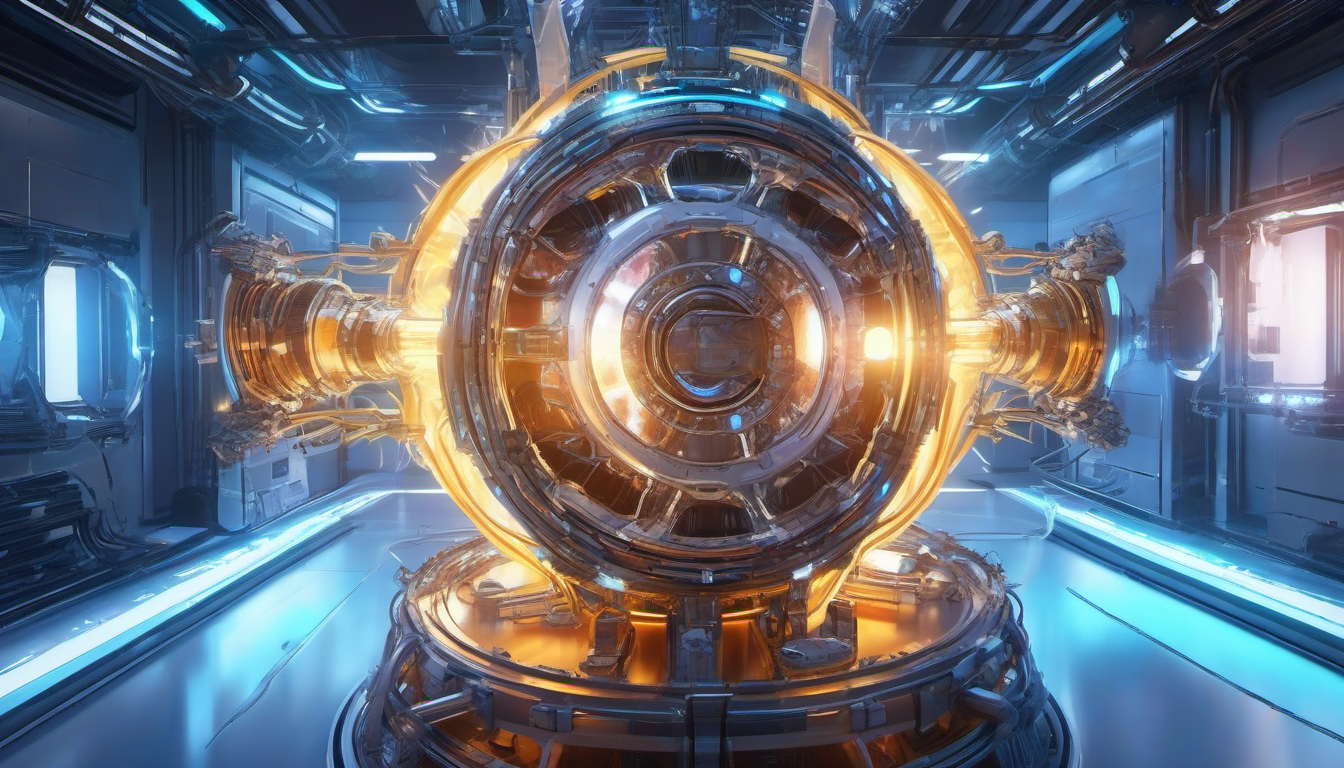
Private fusion startups are outpacing government megaprojects, and Big Tech's insatiable energy appetite is the accelerant
Executive Summary
- Helion Energy's Polaris prototype has achieved 150 million°C plasma and measurable deuterium-tritium fusion—the first private device to cross both thresholds simultaneously, with a Microsoft power purchase agreement targeting 2028 grid delivery.
- Private fusion investment has reached $13.2 billion cumulative, with at least six companies racing toward commercial-scale plants by the early 2030s, while the $25 billion ITER megaproject remains mired in delays and cost overruns.
- The fusion race is no longer a science experiment—it is a geopolitical contest between US private capital, Chinese state programs, and European multilateral projects, with AI data center energy demand providing the commercial urgency that decades of climate rhetoric could not.
Chapter 1: The 150-Million-Degree Moment
In a quiet industrial park in Everett, Washington, something remarkable happened in January 2026. Helion Energy's seventh prototype, Polaris, pushed plasma to 150 million degrees Celsius—roughly ten times the temperature at the core of the Sun—and produced measurable deuterium-tritium (D-T) fusion reactions. External auditors confirmed the data. The milestone was achieved by a private company, with private capital, on a private timeline.
This matters for a simple reason: D-T fusion at 150 million degrees is the performance regime long associated with commercially viable fusion energy. The National Ignition Facility (NIF) at Lawrence Livermore, a $3.5 billion government facility, first demonstrated fusion ignition in December 2022. But NIF fires its lasers once every few hours. Helion's pulsed approach is designed for repeated, rapid cycles—the kind needed for a power plant, not a laboratory demonstration.
Helion is now building Orion, its first commercial-scale system, in Malaga, Washington. The machine is designed to deliver fusion-generated electricity to Microsoft under a binding power purchase agreement, with a target date of 2028. If Helion meets that deadline, it would represent the fastest transition from laboratory milestone to grid-connected commercial asset in the history of energy technology.
The company has raised approximately $600 million to date, valuing it at $5.4 billion. Its investors include Sam Altman (who personally invested $375 million), SoftBank's Vision Fund 2, and Nucor Corporation, America's largest steel producer. The involvement of an industrial buyer like Nucor signals something important: fusion is beginning to attract customers, not just speculators.
Chapter 2: The Private Fusion Explosion
Helion is not alone. The private fusion sector has undergone a Cambrian explosion of investment and technical progress. Total private funding reached $13.2 billion by the end of 2025, according to the Fusion Industry Association's Global Fusion Report. At least 45 companies worldwide are pursuing fusion energy, with half a dozen approaching commercial-scale demonstrations.
The leading contenders:
| Company | Technology | Total Funding | Key Milestone | Commercial Target |
|---|---|---|---|---|
| Helion Energy | Field-Reversed Configuration | ~$600M ($5.4B valuation) | 150M°C D-T fusion (Jan 2026) | Microsoft PPA, 2028 |
| Commonwealth Fusion Systems | High-field tokamak (HTS magnets) | ~$2.86B | World-record 20-tesla magnet (2021) | Google 200MW PPA, early 2030s |
| TAE Technologies | Field-reversed configuration (p-B11) | ~$1.2B | Trump Media merger, utility-scale plant | Construction start late 2026 |
| Inertia Enterprises | Inertial confinement (laser) | $450M (Series A) | Founded by NIF ignition team | Gigawatt plant within decade |
| General Fusion | Magnetized target fusion | ~$300M+ (Chevron-backed) | Pilot plant in UK | Mid-2030s |
| Tokamak Energy | Spherical tokamak | ~$250M+ | 100M°C plasma achieved | 2030s demonstration |
Two features of this landscape are historically unprecedented. First, the involvement of Big Tech as both investors and customers. Microsoft (Helion), Google (CFS, Inertia), and the Trump Media-TAE merger all represent technology companies betting that fusion will solve their most acute operational problem: energy.
Second, the speed of iteration. Helion has built seven prototypes in roughly 13 years. CFS went from founding in 2018 to a world-record magnet in 2021. Inertia, founded in 2024 by former NIF scientists, raised $450 million in its first funding round. These timelines would have been inconceivable in the government-lab paradigm that dominated fusion research for six decades.
Chapter 3: The ITER Problem—How Governments Lost the Fusion Race
To understand why private fusion is surging, one must understand why public fusion stalled.
ITER, the International Thermonuclear Experimental Reactor, was conceived in 1985 as a collaboration between the US, Soviet Union, European Union, Japan, China, India, and South Korea. It was supposed to demonstrate net energy gain from fusion by 2025 at a cost of roughly $5 billion.
As of February 2026, ITER's estimated cost has ballooned to approximately $25 billion. First plasma, originally scheduled for 2025, has been pushed to 2034 at the earliest. Full deuterium-tritium operations are not expected until the late 2030s or early 2040s. The project's management has been criticized for bureaucratic paralysis inherent in a 35-nation collaboration where every major component is manufactured in a different country and shipped to a construction site in Cadarache, France.
The contrast with private fusion is stark:
| Metric | ITER | Helion Energy |
|---|---|---|
| Timeline | 40+ years (1985-2034+) | 13 years (2013-2026) |
| Cost | ~$25 billion | ~$600 million |
| Prototype iterations | 1 (still under construction) | 7 completed |
| D-T fusion demonstrated | Not yet | January 2026 |
| Commercial delivery target | None (research only) | 2028 (Microsoft PPA) |
This is not to dismiss ITER's scientific value. Its tokamak design, if completed, would operate at a scale no private device can yet match. But the project's glacial pace has inadvertently created the market opportunity that private fusion is now exploiting. Venture capitalists and technology companies looked at ITER's timeline, concluded that governments would not solve the fusion problem within any commercially relevant timeframe, and decided to fund alternatives.
The historical parallel is instructive. In the 1960s, governments dominated space launch. By 2020, SpaceX had reduced launch costs by 90% through rapid iteration—exactly the methodology now being applied to fusion. The question is whether fusion's physics will cooperate with Silicon Valley's timelines.
Chapter 4: China's Fusion Ambitions—The State-Backed Challenger
While the US leads in private fusion, China is pursuing a state-directed approach that should not be underestimated.
In January 2026, China's Experimental Advanced Superconducting Tokamak (EAST), often called the "artificial sun," broke what scientists had considered an unbreakable fusion limit, sustaining plasma operations at conditions that pushed beyond previous duration and stability records. The Chinese Academy of Sciences has committed to building CFETR (China Fusion Engineering Test Reactor), a device designed to produce 1 gigawatt of fusion power by the 2040s, with construction expected to begin around 2028.
China's fusion program benefits from several structural advantages:
- Centralized decision-making: No need for 35-nation consensus
- Massive manufacturing base: China produces many of the superconducting components that ITER itself depends on
- Strategic patience: The CAS fusion program has received consistent multi-decade funding
- Talent pipeline: China graduates more nuclear engineers annually than any other country
The geopolitical dimension is critical. Fusion energy, if achieved, would fundamentally alter the global energy landscape. A country that masters commercial fusion would possess an effectively unlimited, fuel-secure energy source—eliminating dependence on oil, gas, uranium, or any other imported fuel. In a world where energy sanctions, pipeline politics, and resource wars dominate geopolitics, fusion represents the ultimate strategic asset.
The US-China fusion competition mirrors the broader technology rivalry. Just as semiconductor export controls aim to constrain China's AI capabilities, fusion technology could become the next frontier of technology denial—or, conversely, of technology leakage. Several of the advanced superconducting magnet technologies being developed by CFS and others have dual-use potential, and export control discussions have already begun in Washington.
Chapter 5: The AI Energy Crisis as Fusion's Catalyst
The single most important accelerant for fusion is not climate change, not government policy, and not scientific curiosity. It is the ravenous energy demand of artificial intelligence.
The numbers are staggering. Big Tech companies have committed over $690 billion in AI infrastructure spending for 2026 alone. Data centers currently consume approximately 4% of US electricity, a figure projected to reach 12-15% by 2030. Microsoft, Google, Amazon, and Meta have collectively announced plans requiring over 50 GW of new power generation—equivalent to the entire electrical capacity of a mid-sized country.
This creates an existential problem. Natural gas plants take 3-5 years to build and emit carbon. Solar and wind are intermittent. Nuclear fission faces regulatory timelines of 10-15 years. Fusion, if it works on the timelines promised, offers something no other technology can: baseload, carbon-free, fuel-unlimited power that can be sited anywhere.
This is why Microsoft signed a PPA with Helion. Why Google invested in both CFS and Inertia. Why Trump Media merged with TAE Technologies. The AI companies are not making philanthropic bets on clean energy—they are securing future power supply for their core business.
The irony is profound. For 70 years, fusion advocates argued that the technology deserved funding because it could save the planet from climate change. That argument failed to mobilize sufficient capital. What finally opened the checkbooks was not environmental urgency but commercial necessity: AI needs power, and fusion might provide it.
Chapter 6: Scenario Analysis—When Does Fusion Actually Arrive?
Scenario A: The Breakthrough Decade (25% probability)
At least one private company delivers grid-connected fusion power by 2030. Helion meets its Microsoft deadline; CFS completes ARC on schedule. Fusion becomes a $50-100 billion annual market by 2035.
Basis: Helion's D-T milestone suggests the physics works. The PPA with Microsoft creates commercial accountability. The rapid iteration model (7 prototypes in 13 years) parallels SpaceX's trajectory.
Trigger conditions: Orion achieves sustained net energy gain; regulatory frameworks accommodate fusion's unique characteristics (lower radiation than fission, different fuel cycle); supply chains for tritium and specialized components scale.
Historical precedent: SpaceX achieved commercial orbital launch 8 years after founding (2002-2010). If fusion follows a similar trajectory from current milestones, 2028-2032 delivery is plausible.
Scenario B: The Long March (50% probability)
Technical challenges delay commercial fusion to 2033-2038. Helion's Microsoft deadline slips by 3-5 years. Several companies fail; 2-3 survive and consolidate. Fusion becomes commercially viable but does not fundamentally alter the energy landscape until the 2040s.
Basis: Every fusion timeline in history has been optimistic. The gap between "measurable fusion reactions" and "sustained net energy gain" is enormous. Materials science challenges (neutron damage to reactor walls, tritium breeding, heat management) remain unsolved at commercial scale.
Historical precedent: The semiconductor industry took roughly 20 years from the first transistor (1947) to integrated circuits in commercial computers (late 1960s). Fusion may follow a similar maturation curve from current milestones.
Scenario C: The Fusion Winter (25% probability)
A major technical failure or safety incident at a leading company triggers investor retreat. Funding dries up; the industry enters a "fusion winter" similar to the AI winters of the 1970s and 1990s. Government programs survive but private innovation stalls.
Trigger conditions: A tritium leak or facility accident; consistent failure to achieve net energy gain despite capital expenditure; competing technologies (advanced geothermal, next-gen fission) prove cheaper and faster.
Chapter 7: Investment Implications
Direct exposure (high risk, high reward):
- TAE Technologies/Trump Media (DJT): The only publicly traded pure-play fusion company. Highly speculative, politically entangled, but offers direct exposure to the fusion thesis.
- Pre-IPO: Helion and CFS are both likely IPO candidates within 2-3 years if milestones continue.
Indirect beneficiaries (moderate risk):
- Superconducting materials: Companies producing high-temperature superconducting (HTS) wire and magnets (AMSC, Bruker) supply critical components.
- Laser technology: IPG Photonics, Coherent, and II-VI for inertial confinement approaches.
- Industrial gases: Air Liquide, Linde—tritium handling and cryogenic systems.
- Nuclear-adjacent utilities: Companies with nuclear regulatory expertise and grid connection capabilities.
Potential losers:
- Natural gas utilities: If fusion delivers on its promises, the long-term demand outlook for gas-fired power erodes.
- Uranium miners: Fusion uses hydrogen isotopes, not uranium. However, this risk is decades away.
- Traditional nuclear fission: SMR companies (NuScale, Oklo) could see their market opportunity narrowed if fusion timelines accelerate.
Conclusion
The fusion energy landscape in February 2026 looks nothing like it did even five years ago. The combination of private capital velocity, Big Tech energy desperation, and genuine scientific milestones has compressed timelines that once stretched to infinity. Helion's 150 million-degree achievement is not proof that fusion will work commercially—but it is proof that the private sector is now generating results that government programs spent decades failing to produce.
The "joke" about fusion—that it is always 30 years away—may finally be losing its punchline. The question is no longer whether fusion is physically possible. It is whether the engineering, materials science, and economics can be solved on a timeline that matters. For the first time in 70 years of fusion research, there are companies with customers, deadlines, and accountability. That alone represents a phase transition in the history of energy.
Sources: Fusion Industry Association Global Fusion Report 2025, Environment+Energy Leader, 3DVF, Carbon Credits, WTOP, Adopter Climate Tech, ScienceDaily, Helion Energy, Inertia Enterprises
Leave a Reply