
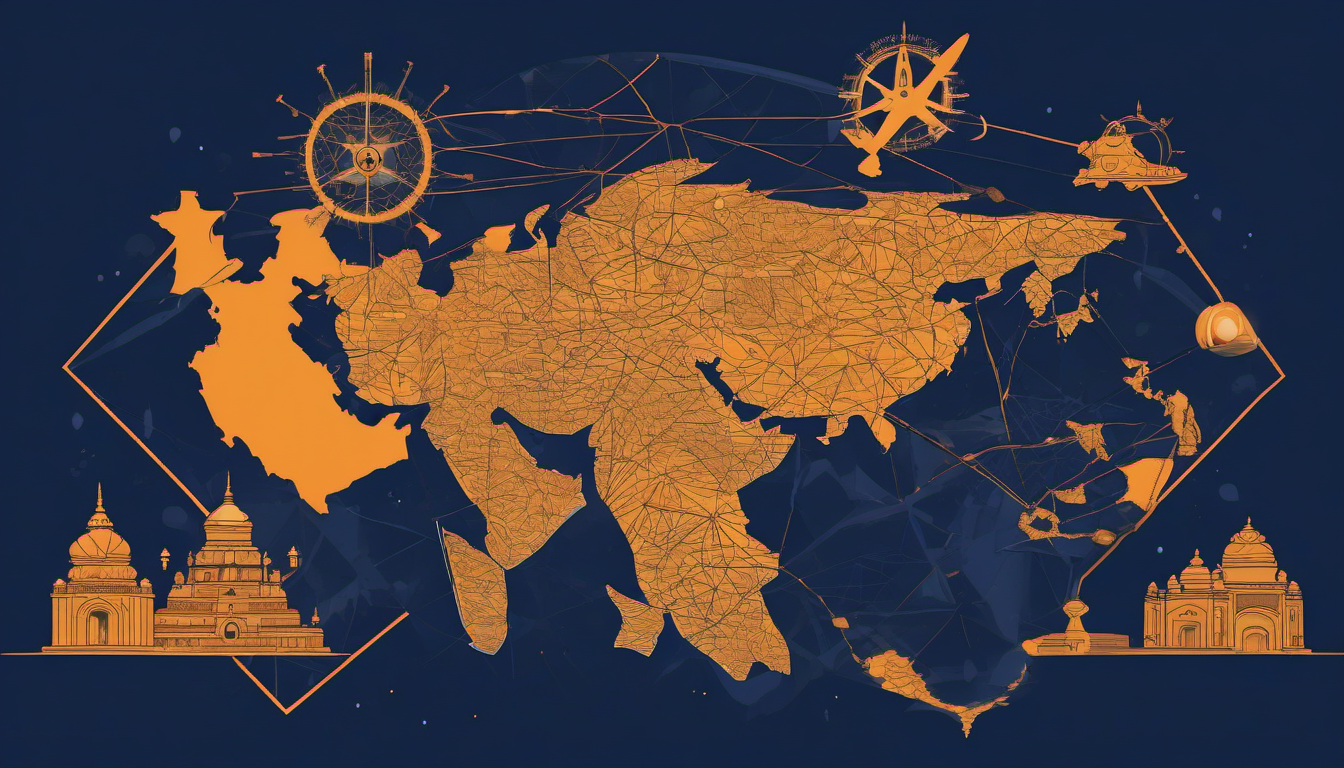
New Delhi's first comprehensive national CT policy marks the doctrinal capstone of a decades-long transformation from reactive defense to proactive deterrence
Executive Summary
- India's Ministry of Home Affairs unveiled PRAHAAR on February 23, 2026 — the country's first-ever national counter-terrorism policy — formalizing a shift from ad hoc responses to a systematic, intelligence-driven framework spanning cross-border terrorism, cyber warfare, drone threats, and CBRN scenarios.
- The doctrine arrives at a strategic inflection point: post-Operation Sindoor, a $40 billion Rafale megadeal, the Great Nicobar military-civilian base, and a record $8.6 billion defense relationship with Israel, PRAHAAR provides the doctrinal "software" to match India's rapidly expanding security "hardware."
- For investors, PRAHAAR signals sustained demand for defense technology, cybersecurity, drone countermeasures, and surveillance systems — a multi-billion dollar market as India institutionalizes its counter-terrorism industrial complex.
Chapter 1: The Doctrine — What PRAHAAR Actually Says
For a country that has endured decades of cross-border terrorism, from the 1993 Mumbai serial blasts to the 2008 Mumbai attacks to the persistent threat along the Line of Control, India has operated without a formal counter-terrorism doctrine. That changed on February 23, 2026, when the Ministry of Home Affairs published PRAHAAR — a comprehensive national counter-terrorism policy and strategy.
The name itself is telling. "Prahaar" means "strike" in Hindi — not "shield" or "guard," but strike. This linguistic choice reflects a fundamental reorientation: India's CT posture is no longer primarily defensive. The document articulates a "pro-active approach to prevent and counter terrorist threats," built on six pillars:
1. Prevention over reaction. Intelligence-led disruption through the Multi Agency Centre (MAC) and Joint Task Force on Intelligence (JTFI), with real-time coordination across central and state agencies. This addresses the chronic problem that hobbled India's response in 2008 — intelligence siloes between the Intelligence Bureau, Research and Analysis Wing, and state police forces.
2. Full-spectrum threat recognition. PRAHAAR explicitly identifies cross-border terrorism sponsored by state actors (a thinly veiled reference to Pakistan's ISI), jihadi organizations including Al-Qaeda and ISIS sleeper cells, drone-based attacks along the Punjab and Jammu & Kashmir borders, and emerging CBRNED threats (Chemical, Biological, Radiological, Nuclear, Explosive, Digital).
3. Cyber-terrorism as a primary front. The policy acknowledges that "criminal hackers and nation states continue to target India through cyber-attacks," targeting critical infrastructure including power grids, railways, aviation, ports, defense installations, and space and atomic energy facilities. The inclusion of "nation states" as cyber adversaries is significant — it implicitly names both Pakistan and China.
4. Counter-radicalization as prevention. A graduated response system for identified radicalized youth, engaging community leaders, moderate religious figures, and NGOs. The policy addresses radicalization in prisons and schools — a recognition that India's CT challenge extends beyond border security into domestic social dynamics.
5. Legal integration from day one. Legal experts embedded in investigations from FIR registration through prosecution — addressing the chronic problem of terror cases collapsing in court due to procedural failures.
6. International cooperation as force multiplier. Transnational terrorism requires transnational response — PRAHAAR formalizes India's CT cooperation architecture with partner nations.
Chapter 2: Why Now? The Strategic Context
The timing of PRAHAAR is not coincidental. Three converging developments made this doctrine both possible and necessary.
The Sindoor aftermath. Operation Sindoor in 2025 demonstrated India's willingness to conduct cross-border strikes, but also exposed the need for a formalized doctrinal framework. Military operations require political authorization, legal justification, and institutional coordination — the kind of structured decision-making that PRAHAAR codifies. India's pre-emptive strikes against terrorist infrastructure in Pakistan-administered territory represented a paradigm shift. PRAHAAR transforms that shift from a one-off decision into a sustainable posture.
The technology revolution. The policy explicitly addresses drone threats along India's borders — a challenge that barely existed five years ago. Pakistani handlers are using commercial drones to deliver weapons and narcotics across the Punjab and J&K borders. Meanwhile, encrypted communications, dark web recruitment, and cryptocurrency financing have made terrorist networks harder to penetrate. PRAHAAR acknowledges that the CT battlefield has moved into cyberspace.
India's defense buildup demands doctrinal coherence. In the past 12 months, India has signed a $40 billion Rafale deal (114 aircraft), launched the Great Nicobar $9.5 billion military-civilian mega-project at the western gate of the Malacca Strait, hosted MILAN 2026 with 72 nations, signed an $8.6 billion defense package with Israel, and is pursuing nuclear energy liberalization under the SHANTI Act. This hardware buildup — the largest in India's independent history — requires a doctrinal framework to give it strategic coherence. PRAHAAR provides that framework on the counter-terrorism front.
Chapter 3: The Comparative Lens — How PRAHAAR Stacks Up
United States: The National Strategy for Counterterrorism (2018). The US CT strategy, revised under the Trump and Biden administrations, emphasizes "protect the homeland, combat terrorists abroad, and prevent radicalization." PRAHAAR mirrors this structure but adds a distinctive element: the explicit naming of state-sponsored terrorism as the primary threat. The US strategy, shaped by the post-9/11 focus on non-state actors (Al-Qaeda, ISIS), treats state sponsorship as secondary. For India, state sponsorship is the primary challenge — the ISI's role in facilitating cross-border terrorism is the elephant in the room that PRAHAAR addresses without directly naming Pakistan.
United Kingdom: CONTEST Strategy (2023 revision). Britain's four-pillar CT framework — Prevent, Pursue, Protect, Prepare — has been the gold standard for Western democracies. PRAHAAR's counter-radicalization elements (community engagement, prison deradicalization, school programs) closely parallel the UK's Prevent program, though India's version emphasizes religious moderation rather than the UK's broader "fundamental British values" approach.
Israel: No published doctrine, but operational precedent. Israel's CT approach is famously operational rather than doctrinal — targeted killings, preemptive strikes, intelligence penetration. India's PRAHAAR attempts to combine Israeli operational aggressiveness (the "strike" emphasis) with Western institutional frameworks (legal integration, community engagement). This hybrid approach is unprecedented among large democracies.
Historical precedent: India's own evolution. India's CT apparatus was built crisis by crisis: the NIA (National Investigation Agency) was created after the 2008 Mumbai attacks. The NSG (National Security Guard) was reformed after the painfully slow response to the same attack. The MAC was established to prevent intelligence failures. PRAHAAR consolidates these reactive institutional creations into a proactive doctrinal whole.
Chapter 4: The Pakistan-China Dual Challenge
PRAHAAR cannot be understood without its geopolitical context. India faces a unique two-front CT challenge:
The Pakistan front: State-sponsored terrorism. The doctrine explicitly addresses "sponsored terrorism from across the border" and "Jihadi terror outfits as well as their frontal organizations." Pakistan's Inter-Services Intelligence (ISI) has maintained a network of proxy militant groups — Lashkar-e-Taiba, Jaish-e-Mohammed, Hizbul Mujahideen — for decades. Post-Sindoor, Islamabad's calculus has changed: India has demonstrated both capability and willingness for cross-border strikes. PRAHAAR institutionalizes this deterrent posture. The doctrine's emphasis on drone countermeasures along the Punjab border reflects the evolving ISI playbook: as traditional infiltration routes are hardened, Pakistan-based handlers have pivoted to commercial drone delivery of weapons and drugs.
The China front: Cyber-warfare and gray zone operations. PRAHAAR's inclusion of "nation states" as cyber adversaries implicitly acknowledges China's persistent cyber campaigns against Indian critical infrastructure. Chinese APT groups (Advanced Persistent Threats) have targeted Indian power grids, defense networks, and border infrastructure. The 2020 power outage in Mumbai was linked to Chinese state-affiliated hackers. PRAHAAR's emphasis on protecting power, railways, aviation, ports, defense, space, and atomic energy from "State/non-State actors" reflects this dual threat.
The timing is also significant in the context of India's rapidly evolving relationships:
- India-US $500 billion trade deal (February 2026): Counter-terrorism cooperation is a key deliverable in the bilateral relationship.
- Modi-Israel $8.6 billion defense visit (planned for February 25-26): CT technology transfer is central to the partnership.
- India-France Rafale deal: France's own CT experience (post-Bataclan) has informed bilateral CT cooperation.
Chapter 5: Scenario Analysis
Scenario A: Successful Implementation — India as Regional CT Hub (40%)
Rationale: India has demonstrated institutional capacity in building the NIA, reforming the NSG, and conducting complex operations (Sindoor, Balakot). The Modi government's political will is strong, and bipartisan support for CT measures is robust.
Trigger conditions: Effective MAC-JTFI coordination within 12 months. Successful disruption of a major cross-border plot using the new framework. State-level CT units actually modernized (historically the weakest link).
Historical precedent: Israel's evolution from reactive (post-Munich 1972) to proactive (Mossad's targeted operations from the 1970s onward) took roughly a decade. India's timeline could be compressed given existing institutional infrastructure.
Investment implications: Indian defense stocks (Bharat Electronics, Data Patterns, Zen Technologies, Paras Defence) benefit from procurement of surveillance systems, counter-drone technology, and communications equipment. Cybersecurity firms (Quick Heal, Cyient) gain from critical infrastructure protection mandates.
Scenario B: Partial Implementation with Bureaucratic Friction (45%)
Rationale: India's federal structure means CT is shared between central and state governments. Historically, coordination between central agencies (NIA, IB, RAW) and state police has been fraught. Many states have weak CT capacity.
Trigger conditions: Political opposition from states governed by rival parties. Insufficient funding for state-level modernization. Continued intelligence siloes despite doctrinal mandates for integration.
Historical precedent: India's National Health Policy (2017) and National Education Policy (2020) both faced significant implementation gaps at the state level. CT policy may follow the same pattern.
Investment implications: Defense spending continues to rise but procurement delays persist. Companies with direct central government contracts (defense PSUs) benefit more than those dependent on state-level procurement.
Scenario C: Doctrine as Symbolic — Minimal Operational Change (15%)
Rationale: India has a history of producing excellent policy documents that fail to translate into operational change. The National Counter Terrorism Centre (NCTC), proposed after 2008, was blocked by states over jurisdictional concerns and never fully implemented.
Trigger conditions: No major terror attack to force implementation urgency. Budget constraints as India balances defense spending with social programs. Bureaucratic resistance from agencies protecting turf.
Historical precedent: The NCTC failure of 2012-2013, when state governments led by both BJP and Congress objected to central overreach.
Chapter 6: Investment Implications
PRAHAAR institutionalizes a multi-year demand cycle for several defense and technology sectors:
| Sector | Key Beneficiaries | PRAHAAR Driver |
|---|---|---|
| Counter-drone systems | Zen Technologies, BEL, ideaForge | Punjab/J&K border drone threat |
| Cybersecurity | Quick Heal, Cyient, KPIT | Critical infrastructure protection |
| Surveillance/Intelligence | Data Patterns, Avantel, Centum Electronics | MAC/JTFI real-time coordination |
| Communication systems | BEL, ITI Limited | Encrypted secure communications |
| Training & simulation | Zen Technologies, Tonbo Imaging | State-level CT unit modernization |
India's defense budget for FY2026-27 is expected to exceed $85 billion, with CT-related spending growing faster than the headline figure. The Great Nicobar project alone represents $9.5 billion in dual-use infrastructure that supports both military power projection and CT capability.
More broadly, PRAHAAR signals that India is building a counter-terrorism industrial complex — an ecosystem of government agencies, private defense firms, and technology companies that creates sustained demand independent of any single procurement cycle. For investors in global defense, India's CT modernization represents one of the largest untapped markets in the world.
Conclusion
PRAHAAR is more than a policy document. It is the doctrinal expression of India's transformation from a reactive, crisis-driven security apparatus into a proactive, intelligence-led counter-terrorism power. Coming after Operation Sindoor, the Rafale megadeal, and the Great Nicobar project, it provides the strategic "software" to match the rapidly expanding "hardware."
The key test will be implementation — India's federal structure, bureaucratic fragmentation, and state-level capacity gaps have historically undermined centrally designed security frameworks. But the political will is unmistakable, the institutional infrastructure is in place, and the threat environment demands action.
For the broader Indo-Pacific, PRAHAAR has implications beyond India's borders. As the world's most populous democracy formalizes its CT doctrine with a "strike-first" orientation, the balance of power in South Asia shifts further. Pakistan's proxy warfare model faces an increasingly sophisticated adversary. China's gray zone operations encounter a hardening target. And India's defense technology market opens new corridors for international partnership.
The name says it all. Prahaar — strike.
Leave a Reply