
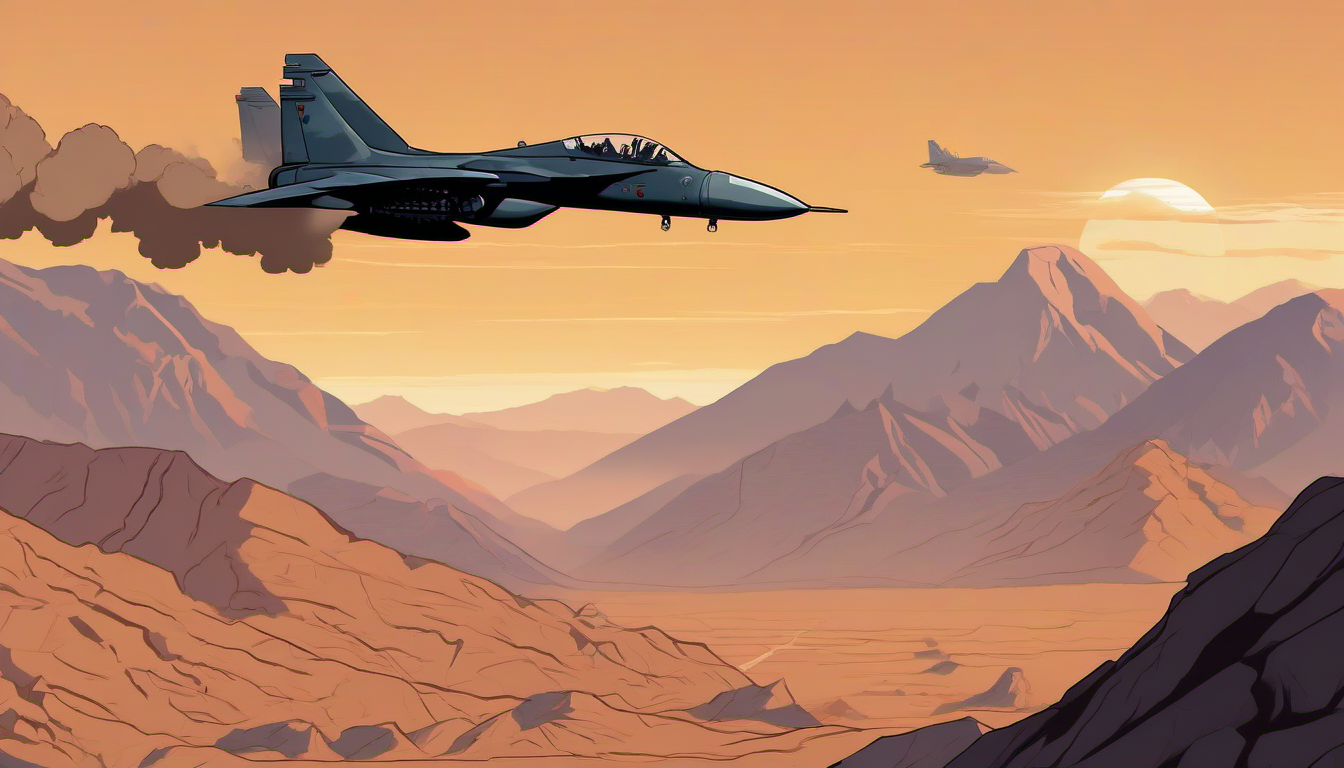
The fragile ceasefire shatters as Islamabad launches its most provocative air raids since October 2025, killing dozens and pushing two nuclear-threshold neighbors to the brink
Executive Summary
- Pakistan conducted "intelligence-based" air strikes on seven targets in Afghanistan's Nangarhar and Paktika provinces on February 22, claiming 70-80 militant kills; Afghanistan reports dozens of civilian deaths including women and children at a religious school
- The Taliban government summoned Pakistan's ambassador, condemned the strikes as a violation of international law, and vowed an "appropriate response" — language that preceded the deadly October 2025 retaliatory operations that killed 23 Pakistani soldiers
- The strikes shatter a fragile ceasefire negotiated after the October 2025 border war and come amid Pakistan's worst domestic security crisis in a decade: the Islamabad mosque bombing (32 dead), Bajaur military post attack (12 dead), and Bannu convoy bombing — all within three weeks
Chapter 1: The Strikes — What Happened
In the predawn hours of February 22, Pakistan's military launched what it described as "intelligence-based, selective operations" against seven camps and hideouts belonging to the Tehrik-i-Taliban Pakistan (TTP) and its affiliates, including an Islamic State-Khorasan Province (ISKP) cell, in Afghanistan's eastern border provinces of Nangarhar and Paktika.
Pakistan's Deputy Interior Minister Talal Chaudhry told Geo News that at least 70 militants were killed, a figure later revised upward to 80 by state media. Islamabad offered no independent verification.
The view from across the border was starkly different. Afghanistan's Ministry of Defence said the strikes hit "a religious school and residential homes," resulting in "dozens of deaths and injuries, including women and children." In Nangarhar's Bihsud district, at least 18 people were confirmed killed and six others remained missing under rubble. Habib Ullah, a local tribal elder, told the Associated Press that those killed "were neither Taliban, nor military personnel, nor members of the former government. They lived simple village lives."
Afghanistan's Ministry of Foreign Affairs summoned Pakistan's ambassador to Kabul and issued a formal protest note. The Defence Ministry's statement carried an ominous warning: "We will respond to these attacks in due course with a measured and appropriate response."
That language matters. In October 2025, similar language preceded retaliatory operations that killed at least 23 Pakistani soldiers along the border.
Chapter 2: The Trigger — Pakistan's Security Spiral
The strikes did not emerge from a vacuum. Pakistan has experienced an extraordinary cascade of deadly attacks in February 2026 alone:
February 7 — Islamabad Shia Mosque Bombing: ISKP claimed responsibility for a suicide attack that killed 32 worshippers at a Shia mosque in the capital, the deadliest attack in Islamabad in over a decade. Pakistan alleged the attacker was linked to Afghanistan-based handlers.
February 15 — Bajaur Military Post Attack: A suicide bomber backed by gunmen rammed an explosives-laden vehicle into a military post in Bajaur district, Khyber Pakhtunkhwa, killing 11 soldiers and a child. Pakistani authorities identified the attacker as an Afghan national.
February 22 — Bannu Convoy Bombing: Just hours before the cross-border strikes, a suicide bomber targeted a security convoy in Bannu, killing two soldiers including a lieutenant colonel. Pakistan's military warned afterward that it would "not exercise any restraint."
Pakistan's Information Minister Attaullah Tarar said Islamabad possessed "conclusive evidence" linking all three attacks to fighters operating "at the behest of their Afghanistan-based leadership and handlers." The TTP, which Pakistan considers the primary threat, maintains a complex relationship with the ruling Afghan Taliban — allied by ideology and Pashtun kinship, yet formally distinct organizations.
Militant violence in Pakistan has surged dramatically since 2023, when the TTP ended a fragile ceasefire. According to the Pakistan Institute for Conflict and Security Studies, terrorism-related deaths in Pakistan exceeded 3,500 in 2025, the highest since the peak of the insurgency in 2013-2014. The February 2026 attacks represented a qualitative escalation — hitting the capital and breaching the military's presumed security perimeter.
Chapter 3: The Pattern — Escalation Since 2024
The February 22 strikes are not Pakistan's first cross-border operations, but they represent the most significant since the October 2025 border war. Understanding the escalation pattern is essential:
| Date | Event | Casualties | Aftermath |
|---|---|---|---|
| March 2024 | Pakistan pre-dawn strikes in Khost and Paktika | Afghan civilians reported killed | Taliban protests, limited response |
| October 9, 2025 | Pakistan strikes in Kabul targeting TTP leader Noor Wali Mehsud | TTP leader survived, civilians killed | Full-scale border war erupted |
| October 10-25, 2025 | Afghan retaliatory operations | 23 Pakistani soldiers, 9+ Afghan soldiers killed | Ground fighting across multiple sectors |
| November 2025 | Ceasefire negotiated via Doha/Istanbul/Riyadh mediation | – | Fragile truce held for ~3 months |
| February 22, 2026 | Pakistan strikes in Nangarhar and Paktika | 70-80 militants (Pakistan), dozens of civilians (Afghanistan) | Taliban vows retaliation |
The October 2025 crisis was the worst military confrontation between the two countries since the Taliban takeover in 2021. Pakistan launched strikes directly in Kabul — an extraordinary escalation targeting a sovereign capital. Afghanistan's retaliatory operations demonstrated that the Taliban's conventional military capabilities, hardened by two decades of guerrilla warfare, posed a genuine threat to Pakistani forces along the border.
The fragile ceasefire that followed was always conditional. Pakistan demanded verifiable action against TTP sanctuaries on Afghan soil. The Taliban government, which views the TTP as a domestic Pakistani issue, refused to disarm a movement that shares its ideological DNA. The February attacks gave Islamabad the pretext to act unilaterally.
Chapter 4: The Durand Line — A Century of Contested Sovereignty
The Pakistan-Afghanistan conflict is inseparable from the Durand Line, the 2,670-kilometer border drawn in 1893 by British colonial diplomat Sir Mortimer Durand. No Afghan government — neither monarchist, communist, republican, nor Taliban — has ever recognized it as a legitimate international boundary.
The line bisects the Pashtun homeland, splitting approximately 50 million ethnic Pashtuns between the two countries. For the TTP, which draws its fighters primarily from Pakistan's Pashtun tribal areas, the border is operationally meaningless. Fighters cross freely through dozens of unmanned mountain passes, making Pakistan's demand that the Taliban "seal the border" practically impossible — and politically unacceptable in Kabul, where acknowledging the Durand Line would be tantamount to surrendering the Pashtun irredentist claim.
Pakistan's 2023 decision to fence significant portions of the border represented a unilateral attempt to impose physical reality on a legal fiction. The fencing program has created its own flashpoints, with Taliban forces repeatedly removing fence posts and firing on construction crews.
The deeper irony is structural: Pakistan's Inter-Services Intelligence (ISI) spent decades cultivating the Afghan Taliban as a strategic asset against India's influence in Afghanistan. The TTP's emergence — a Pakistani Taliban inspired by but distinct from the Afghan movement — represents the classic case of blowback. Pakistan now finds itself fighting the ideological children of the very movement it nurtured.
Chapter 5: Stakeholder Analysis — Who Gains, Who Loses
Pakistan's Military Establishment: The strikes serve multiple purposes. Domestically, they respond to mounting public anger after three devastating attacks in three weeks. Institutionally, they reassert the military's capability after the October 2025 debacle exposed operational weaknesses. Politically, they bolster the Sharif government against Imran Khan's imprisoned opposition, which has criticized the security establishment's competence.
Afghanistan's Taliban Government: The Taliban faces a dilemma. Failure to respond would signal weakness — both domestically among Pashtun populations who view the strikes as national humiliation, and regionally among armed groups who see Taliban governance as protection. But escalation risks a repeat of October 2025 or worse, threatening the Taliban's primary objective: international recognition and access to frozen assets ($9.5 billion held by the US Federal Reserve).
The TTP: Paradoxically, the strikes may strengthen the TTP. If Afghan civilian casualties are confirmed, they generate recruitment propaganda. If the Taliban retaliates, it creates chaos that the TTP can exploit. The TTP's strategic objective — destabilizing the Pakistani state — is advanced by the cycle of violence regardless of which government claims victory.
China: Beijing has the most to lose from escalation. The China-Pakistan Economic Corridor (CPEC), a $62 billion infrastructure program, runs through some of the most insecure regions along the Pakistan-Afghanistan border. Chinese workers have been repeatedly targeted. Pakistan's inability to guarantee security has already caused significant project delays. A full border war would effectively freeze CPEC operations.
India: New Delhi watches from a position of strategic advantage. India's intelligence establishment has long accused Pakistan of sponsoring cross-border terrorism in Kashmir; Pakistan now finds itself making identical accusations against Afghanistan. The role reversal has not been lost on Indian strategists. India's recent engagement with the Taliban government — including humanitarian aid and quiet diplomatic contacts — positions it to gain influence at Pakistan's expense.
The United States: Washington's primary concern is ISKP, which intelligence assessments identify as the most capable external operations branch of the Islamic State. The 2020 Doha Agreement, which the US signed with the Taliban, included commitments that Afghan soil would not be used for attacks against other countries. Pakistan's argument that this commitment is being violated aligns with American counterterrorism interests, but Washington has limited leverage over either party.
Chapter 6: Scenario Analysis
Scenario A: Managed De-escalation (35%)
Premise: Both sides absorb the shock, the Taliban issues a strong verbal response but limits military retaliation, and international mediators (Qatar, Turkey, Saudi Arabia) facilitate a return to the ceasefire framework.
Supporting Evidence:
- After the October 2025 war, both sides ultimately accepted mediation rather than full escalation
- The Taliban government's overriding priority — international recognition and unfreezing of assets — incentivizes restraint
- Pakistan's economic fragility (IMF 24th bailout program, GDP-to-export ratio of 10.4%) limits its appetite for prolonged conflict
- China would exert significant pressure on Pakistan through CPEC leverage
Trigger Conditions: Taliban limits response to diplomatic protests and small-scale border skirmishes; Pakistan declares the strikes a "one-off" operation.
Timeline: 1-3 weeks for tensions to recede.
Scenario B: Tit-for-Tat Escalation (45%)
Premise: The Taliban conducts retaliatory strikes or border operations, Pakistan responds, and a cycle of escalation produces casualties on both sides, mirroring October 2025 but at a higher intensity.
Supporting Evidence:
- The Taliban's Defence Ministry explicitly promised a "measured and appropriate response" — the same language used before October 2025 retaliation
- Taliban military capabilities are stronger than in October 2025, with forces consolidated after the Durand Line blockade
- Pakistan's domestic political pressure makes de-escalation without "victory" politically costly
- The February attack cycle (three major bombings in three weeks) has created a "no restraint" mentality in Pakistan's military command
- Historical pattern: of the four major Pakistan cross-border strike episodes since 2024, three produced Afghan military responses
Trigger Conditions: Taliban retaliatory operations kill Pakistani soldiers; Pakistan escalates with heavier strikes or ground incursions.
Timeline: 2-6 weeks of active confrontation, potentially leading to another mediated ceasefire.
Scenario C: Full Border War (20%)
Premise: Escalation spirals beyond tit-for-tat into sustained military operations across the border, potentially including Pakistani ground incursions into Afghan territory or Taliban attacks on Pakistani military installations.
Supporting Evidence:
- Pakistan's October 2025 precedent of striking Kabul directly demonstrates willingness to escalate
- Taliban forces have been reorganized into conventional military units capable of holding territory
- The Durand Line blockade already created a logistical infrastructure for sustained military operations
- Both sides have irreconcilable core demands: Pakistan wants TTP eliminated; Taliban refuses to disarm an allied movement
Trigger Conditions: Mass civilian casualties in Afghan strikes generate Taliban mobilization; Pakistani ground forces cross the border; a single catastrophic event (e.g., downed aircraft, high-ranking military casualty) triggers nationalist fury on either side.
Historical Precedent: The India-Pakistan Kargil War (1999) demonstrated how limited border operations between nuclear-capable states can escalate beyond initial intentions. The Pakistan-Afghanistan dynamic lacks the nuclear deterrence that ultimately constrained Kargil, making conventional escalation potentially more dangerous.
Timeline: Weeks to months of active fighting; international intervention would be required to prevent a humanitarian catastrophe.
Chapter 7: Investment and Market Implications
Pakistan's Economy:
- Pakistan's stock market (PSX KSE-100) fell 2.3% on escalation fears in the week following October 2025 strikes; similar or worse reaction expected
- The Pakistani rupee faces renewed pressure; the IMF program's stability conditions could be threatened
- Insurance premiums for CPEC-related projects will increase
- Sovereign credit spreads on Pakistan's Eurobonds likely to widen
Commodities:
- Limited direct commodity impact, but disruption to Afghanistan-Pakistan transit trade (estimated $5-7 billion annually) affects Central Asian supply chains
- Afghan pine nuts, gemstones, and marble exports through Pakistan — a $400 million trade — face immediate disruption
- If Scenario C materializes, potential disruption to natural gas pipelines from Central Asia
Defense Sector:
- Pakistan's defense spending (currently ~3.5% of GDP) faces upward pressure
- Turkish drones (Bayraktar TB2) used in both October 2025 and February 2026 operations — continued demand signal for Turkish defense exports
- Chinese military equipment sales to Pakistan likely to increase
Regional Risk Premium:
- South Asian geopolitical risk premium increases across Indian, Pakistani, and Bangladeshi markets
- The Pakistan-Afghanistan corridor is critical for landlocked Central Asian states; sustained conflict raises overland trade costs
Conclusion
Pakistan's February 22 air strikes represent a calculated gamble: that overwhelming force against identified militant targets will deter future attacks on Pakistani soil without triggering a catastrophic Afghan response. History suggests this calculus is dangerously optimistic.
Every previous episode of Pakistani cross-border strikes — in 2024, in October 2025, and now — has produced Afghan retaliation rather than deterrence. The strikes target symptoms (TTP hideouts) while leaving the disease untreated: a border that neither side recognizes, a militant movement that thrives on the chaos between two states, and a fundamental contradiction in Pakistan's strategic posture — demanding that the Taliban disarm its ideological cousins while never having resolved its own legacy of cultivating those very networks.
The next 72-96 hours will be decisive. If the Taliban responds with force, the fragile ceasefire architecture collapses entirely. If restraint prevails, it will be temporary — until the next TTP attack provides Pakistan with another pretext for strikes, and the cycle begins anew.
The Durand Line, drawn with a colonial pen 133 years ago, continues to draw blood.
Leave a Reply