
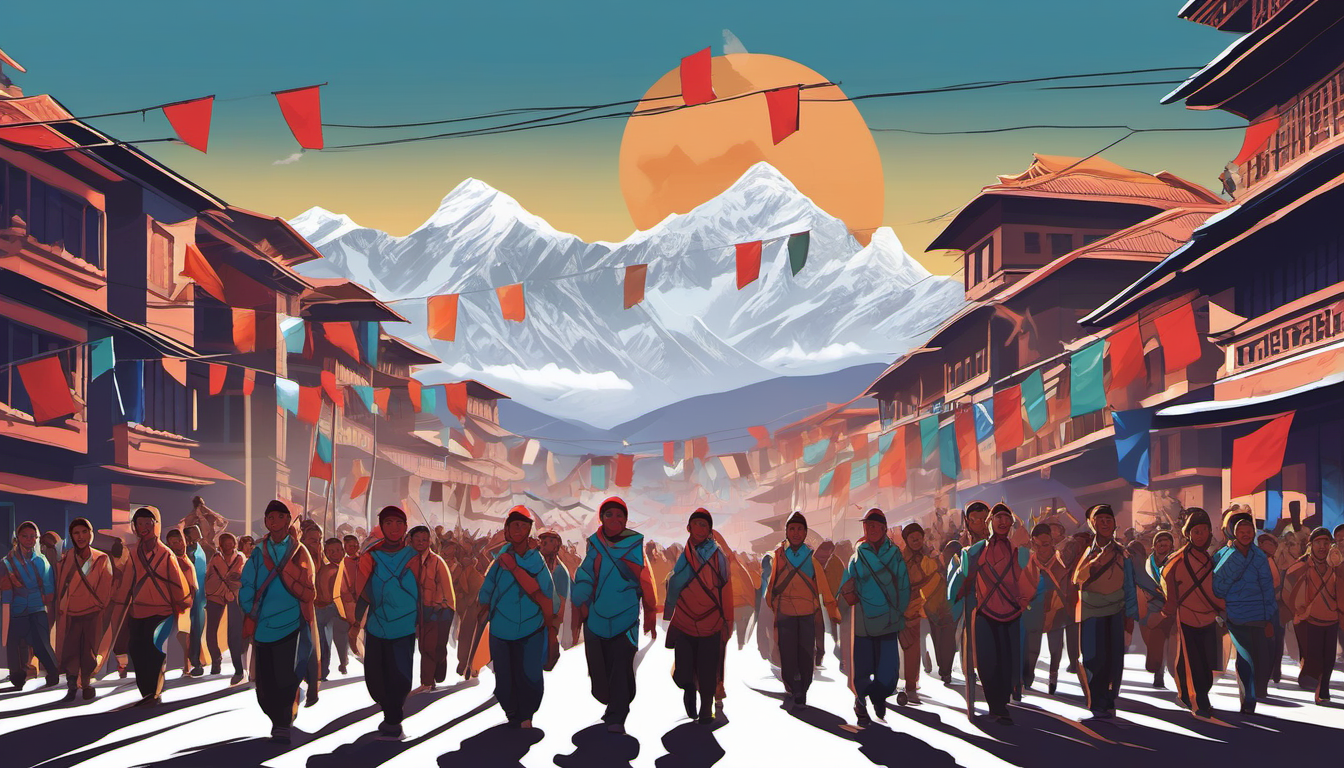
A rapper, a protest leader, and 120 new parties walk into an election — 10 days before Nepal's most consequential vote since abolishing the monarchy
Executive Summary
- Nepal's March 5 election is a direct product of the September 2025 Gen Z uprising that toppled PM Oli's government, killed 75 civilians, and burned Parliament to the ground — the most violent political transition in the country's democratic history.
- Over 120 parties — more than a third formed after the uprising — are competing for 275 seats, with rapper-turned-politician Balendra "Balen" Shah challenging ex-PM Oli directly in his home constituency, symbolizing a generational collision with no parallel in South Asian electoral history.
- The outcome will reshape the India-China competition in the Himalayas: India fears an Oli victory that could accelerate BRI projects, while Beijing watches warily as youth parties campaign on anti-corruption platforms that directly threaten Chinese-linked infrastructure deals.
Chapter 1: The September That Changed Everything
On the morning of September 8, 2025, tens of thousands of Nepali students marched toward the Federal Parliament in Kathmandu. Prime Minister KP Sharma Oli dismissed it as "staged drama." By nightfall, his government had collapsed.
What began as a jubilant, social media-organized anti-corruption rally spiraled into the most violent political upheaval in Nepal's democratic history. Parliament, the Supreme Court, and the Singha Darbar — the seat of executive power — were set ablaze. Former five-term Prime Minister Sher Bahadur Deuba was nearly beaten to death by a mob that broke into his home. Oli and most of his cabinet fled the capital. In two days, 75 civilians died and over 2,000 were injured.
Forensic reports later revealed that nearly all gunfire victims were shot above the waist — a clear violation of Nepal's crowd control protocols. The scale of state brutality was unprecedented: 19 people were killed by police on the first day alone, more than the entire death toll of the 2006 pro-democracy movement that ended the monarchy.
The structural roots ran deep. Since 2008, when Nepal held its first post-monarchy elections, Kathmandu had witnessed 15 governments in 17 years. Three septuagenarian leaders — Deuba (Nepali Congress), Prachanda (Maoist Centre), and Oli (CPN-UML) — had dominated politics for decades, forming and breaking coalitions in every possible combination. Meanwhile, youth unemployment had reached 21% (compared to 13% globally), and 14% of the labor force had fled abroad. Remittances accounted for nearly a third of GDP. Nepal ranked in the bottom 30 countries worldwide by GDP per capita.
The corruption was brazen. Just months before the uprising, Nepal's anti-corruption watchdog charged 55 officials for colluding with the Chinese construction company CAMC to inflate the cost of the BRI flagship Pokhara International Airport by $75 million — one-third of the entire project cost. All three major parties had been complicit.
By September 12, Parliament was dissolved, Chief Justice Sushila Karki was sworn in as interim Prime Minister — Nepal's first female head of government — and elections were set for March 5, 2026.
Chapter 2: The Youth Alliance vs. The Old Guard
The March 5 election has produced a political landscape unlike anything Nepal — or South Asia — has seen before. Over 120 political parties registered, with more than a third emerging directly from the Gen Z uprising. This is the most parties to participate in an election since Nepal's democracy was restored in 2006.
The New Guard:
The most dramatic challenger is Balendra "Balen" Shah, 35, an engineer-rapper-turned-politician. In 2022, he won the Kathmandu mayoral race in a landslide as an independent anti-corruption candidate — remarkable in a city that holds 10% of Nepal's population. Now running under the Rastriya Swatantra Party (RSP) banner, Shah is challenging Oli directly in Jhapa-5, the ex-PM's home constituency. RSP has projected him as their prime ministerial candidate.
RSP itself is a phenomenon. Founded in June 2022 by former television host Rabi Lamichhane, it campaigned for just five months before emerging as the fourth-largest party in the November 2022 election. The party has formed a "youth alliance" with other newcomers, positioning itself as the anti-establishment force.
Other youth candidates include Kishori Karki, a 25-year-old law graduate who went viral for carrying an injured protester to the hospital during the September demonstrations, and Sudan Gurung, a main organizer of the Gen Z protests and founder of the youth nonprofit Hami Nepal.
The Old Guard's Adaptation:
The establishment parties have been forced to respond. Nepali Congress, the country's oldest party, replaced the nearly 80-year-old Deuba with 49-year-old Gagan Thapa — a generational shift, if modest by the uprising's standards. Thapa made the unusual decision to contest from Sarlahi-4 instead of his traditional Kathmandu stronghold, signaling a push beyond the capital.
Oli, 73, remains a formidable force leading CPN-UML. Prachanda, 71, has formed a left-party platform under the Nepali Communist Party (NCP) banner. The Rastriya Prajatantra Party (RPP) continues to carry monarchist sympathies — former King Gyanendra still commands pockets of support among those disillusioned with republican politics entirely.
The Numbers:
| Party/Alliance | Leader | Age | 2022 Result | Key Proposition |
|---|---|---|---|---|
| CPN-UML | KP Sharma Oli | 73 | 26.95%, 78 seats | Stability, BRI development |
| Nepali Congress | Gagan Thapa | 49 | 25.71%, 89 seats | Generational renewal within the establishment |
| NCP (Maoist) | Pushpa K. Dahal | 71 | 16.57%, 45 seats | Left unity platform |
| RSP | Rabi Lamichhane | 40s | 10.70%, 20 seats | Anti-corruption, youth empowerment |
| RPP | Rajendra Lingden | 50s | 5.58%, 14 seats | Monarchist sympathies |
With 18.9 million registered voters — 5% more than 2022 — and nearly a million new young voters, the youth demographic could be decisive. But translating protest energy into electoral organization is a fundamentally different challenge.
Chapter 3: The Geopolitical Chessboard
Nepal sits precisely between India and China, and every election in Kathmandu reverberates in New Delhi and Beijing. The March 5 vote is no exception.
India's Calculus:
The consensus in strategic circles in Kathmandu is clear: if there is one outcome India wants to avoid, it is a decisive Oli victory. During his previous tenure as PM, Oli signed a BRI framework with Beijing in December 2024 and maintained a prickly relationship with New Delhi. India shares a 1,770 km open border with Nepal, deep cultural and economic ties, and views Kathmandu as falling squarely within its sphere of influence.
India's preferred outcome is a Nepali Congress-led coalition, potentially with RSP support — a combination that would be more amenable to Indian infrastructure investments and less inclined toward deepening BRI engagement. Modi's government has maintained high-level exchanges with Kathmandu, and bilateral cooperation spans trade, power, education, and cultural sectors.
China's Interests:
Beijing's footprint in Nepal expanded significantly under successive Maoist governments through the BRI. The 2017 framework agreement and its 2024 extension under Oli promised infrastructure development and economic collaboration. However, implementation has been plagued by delays — no major BRI projects have been finalized — and the Pokhara Airport corruption scandal directly implicates Chinese contractors.
A youth-led government campaigning on anti-corruption would be inherently hostile to opaque BRI deals. But a fragmented parliament — the most likely outcome — might paradoxically serve Beijing's interests by producing weak coalition governments susceptible to project-by-project negotiations.
The Sri Lanka Shadow:
Nepal's cautious public increasingly references Sri Lanka's experience with Chinese-financed infrastructure, particularly the Hambantota port debt trap. This has become a political issue: candidates across the spectrum invoke the Sri Lankan precedent when discussing BRI engagement. The Pokhara Airport scandal — $75 million inflated by a Chinese contractor — has given this concern concrete domestic evidence.
Chapter 4: Scenario Analysis
Scenario A: Fragmented Parliament, Coalition Paralysis (45%)
The most likely outcome mirrors Nepal's post-2008 pattern. No party wins a majority; a messy coalition forms after weeks of negotiation; governance continues to be transactional.
Evidence: With 120+ parties and a divided electorate, Nepal's mixed electoral system (165 FPTP + 110 proportional with 3% threshold) almost guarantees fragmentation. In 2022, the largest party won just 89 of 275 seats. The youth vote is split across dozens of new parties.
Trigger: Multiple parties clear the 3% proportional threshold, preventing any bloc from assembling 138 seats easily.
Historical precedent: Nepal has had 15 governments in 17 years. Coalition instability is the norm, not the exception.
Scenario B: Youth Breakthrough, Reform Coalition (25%)
RSP and allied youth parties win 40-60 seats — enough to be kingmakers in coalition formation. A Nepali Congress-RSP alliance under Thapa-Shah produces Nepal's most reform-oriented government since 2008.
Evidence: Nearly one million new voters registered since 2022. RSP already shocked the establishment in 2022 by winning 20 seats after a five-month campaign. Balen Shah's Kathmandu mayoral landslide demonstrated youth candidates' electoral viability. Bangladesh's February 2026 election showed Gen Z parties can translate protest energy into parliamentary seats.
Trigger: Youth voter turnout exceeds 65%, and RSP/allied parties consolidate the anti-corruption vote rather than splitting it.
Historical precedent: Bangladesh's BNP landslide (212/297 seats) in February 2026 came after a similar Gen Z uprising, though Bangladesh's banned Awami League left a larger vacuum.
Scenario C: Oli Returns, BRI Acceleration (30%)
Oli's CPN-UML wins enough seats to lead a coalition, potentially with Prachanda's NCP. Nepal pivots back toward Beijing.
Evidence: Oli remains the strongest individual brand in Nepali politics. Rural voters outside Kathmandu are less influenced by social media-driven youth movements. CPN-UML's organizational machinery is the strongest among all parties. Anti-incumbency benefits Oli since he was toppled, not voted out.
Trigger: Youth vote splits across too many parties; rural constituencies go to established parties; coalition math favors left parties.
Historical precedent: Oli has been PM three times, demonstrating remarkable political resilience. Nepal's communist parties have historically outperformed expectations in FPTP constituencies.
Chapter 5: Investment Implications and Regional Ripple Effects
Nepal's Economy:
Nepal's economy is modest — $40 billion GDP — but the election outcome has outsized implications for regional investment flows. Key sectors to watch:
- Hydropower: Nepal has 83,000 MW theoretical hydropower potential, with less than 3,000 MW developed. Indian and Chinese companies compete for concessions. A youth-led government would likely demand more transparent bidding processes.
- Infrastructure: The BRI's future in Nepal hangs in the balance. The Trans-Himalayan Multi-Dimensional Connectivity Network — including the Kerung-Kathmandu railway — would be accelerated under Oli and shelved under a reform coalition.
- Remittances: At 30% of GDP, remittance flows make Nepal's economy uniquely sensitive to labor migration policies in the Gulf, Malaysia, and South Korea. No party has a credible plan to reduce this dependency.
The Gen Z Template:
Nepal's election is the second test of whether Gen Z uprisings can produce governing majorities, following Bangladesh's February 12 vote. If the youth alliance performs strongly, it validates a political template that could spread to other protest-prone South Asian nations. If it fails to translate into seats, it reinforces the sobering lesson that street power and electoral power require fundamentally different organizational capacities.
| Factor | Bangladesh (Feb 12) | Nepal (Mar 5) |
|---|---|---|
| Uprising | July 2024 | September 2025 |
| Deaths | 1,500+ | 75 |
| PM toppled | Sheikh Hasina | KP Sharma Oli |
| Youth parties | NCP (limited seats) | 40+ new parties |
| Main beneficiary | BNP (old opposition) | Unclear |
| Turnout | ~70% | ? |
South Asian Democracy:
Within 12 months, South Korea (Yoon life sentence), Bangladesh (BNP landslide), and Nepal will have all tested democratic resilience after constitutional crises. The pattern is striking: in each case, citizens — often led by young people — used institutions (courts, elections, protests) to constrain executive overreach. Whether this constitutes a "democratic resilience wave" or a coincidence of unrelated national crises is a question scholars will debate for years.
Conclusion
Ten days before Nepal goes to the polls, the only certainty is uncertainty. The March 5 election is a collision between the oldest political forces in Nepali democracy and the youngest generation to demand a voice. Over 120 parties, nearly 19 million voters, and the geopolitical ambitions of two Asian giants converge on a Himalayan nation of 30 million that has never managed to keep a government for a full term.
The September 2025 uprising shattered the fiction that Nepal's political rotation among three aging leaders was sustainable. Whether the election produces genuine renewal or merely reshuffles the same deck — with younger faces on older cards — will determine not just Nepal's trajectory but the credibility of youth-led political movements across the Global South.
Sources: CFR, Engelsberg Ideas, Wikipedia, NewKerala, Outlook India, BBC, Kathmandu Post, The Diplomat
Leave a Reply