
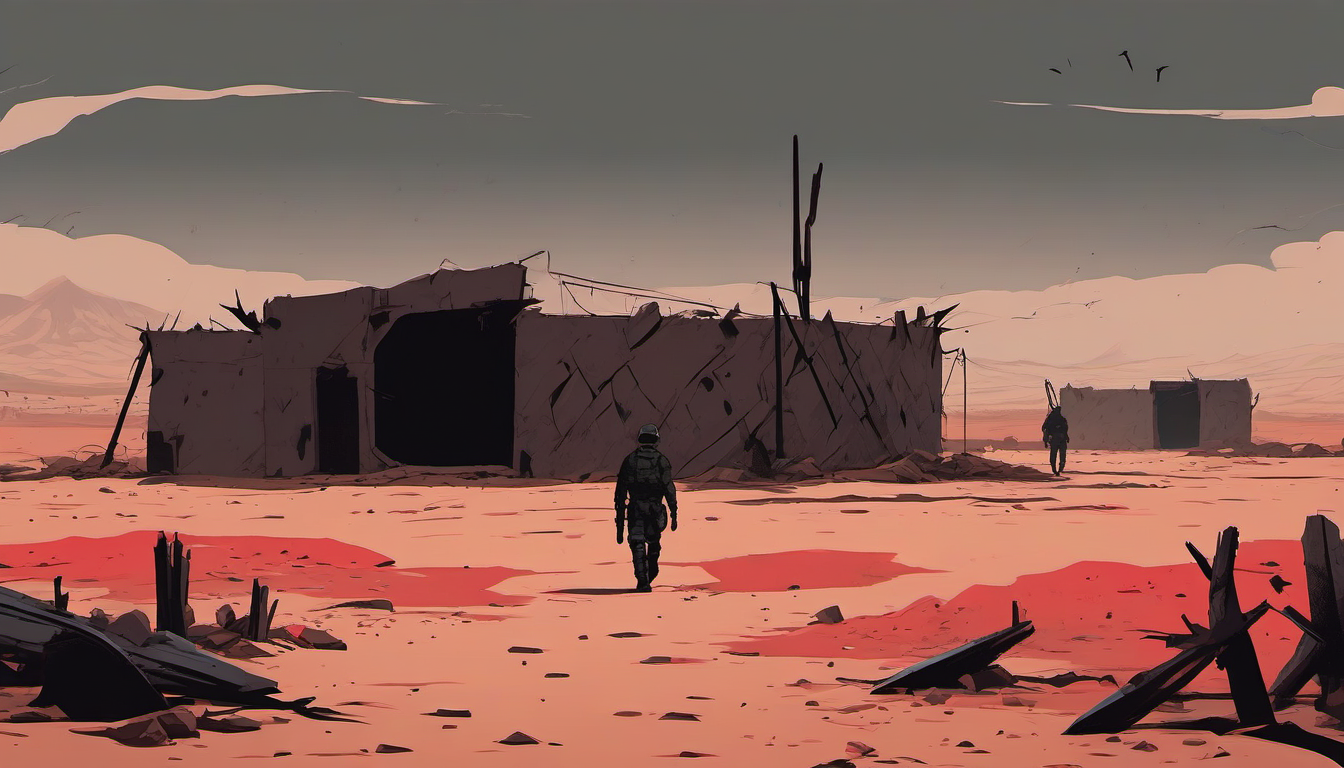
As America withdraws and detention camps empty, the Islamic State announces a "new phase" of operations targeting the very forces that toppled Assad
Executive Summary
- ISIS has declared a "new phase of operations" in Syria, claiming attacks in Deir Ezzor and Raqqa against Ahmad Al Shara's government—the former Al Qaeda commander who overthrew Assad and is now Washington's partner against jihadism.
- The declaration arrives at a moment of maximum vulnerability: the US has withdrawn from al-Tanf base, is pulling all remaining troops, and Al-Hol camp—the world's largest ISIS detention facility—has essentially emptied, with thousands of radicalised individuals dispersing across Syria with minimal screening.
- The convergence of security vacuum, personnel dispersal, and US withdrawal creates conditions eerily similar to 2013-2014, when ISIS exploited the chaos of civil war to build its caliphate. The question is whether Shara's untested government can contain a threat that required a 70-nation coalition to defeat.
Chapter 1: The Declaration
On Saturday, February 22, 2026, ISIS released a recorded statement through its Dabiq news agency that marked a deliberate escalation. Spokesman Abu Hudhayfa Al Ansari declared that Syria had "moved from Iranian occupation to Turkish-American occupation," framing Ahmad Al Shara—the former Hayat Tahrir Al Sham (HTS) leader who overthrew Bashar Al Assad in late 2024—as a "watchdog" of the global coalition.
The statement announced the beginning of a "new phase of operations" and vowed that Shara's fate would be "no different from that of Assad." To underscore the point, ISIS claimed responsibility for two simultaneous attacks: a pistol assassination of a Syrian army member in Mayadin, Deir Ezzor province, and a machine gun assault on two personnel in Raqqa. Syria's Defence Ministry confirmed one soldier and one civilian killed by "unknown assailants."
The timing is not coincidental. ISIS social media channels and Telegram accounts have been calling for intensified attacks using motorcycles and firearms—low-cost, low-tech methods that exploit the security gaps now permeating eastern Syria.
This is personal for ISIS. Shara—born Ahmad Al Sharaa—was once an Al Qaeda operative who broke with the group in 2016 to lead HTS. His evolution from jihadist to Western-aligned statesman represents the kind of ideological apostasy that ISIS views as unforgivable. In jihadi theology, the "near enemy" (apostate Muslim rulers) is a more legitimate target than the "far enemy" (Western powers). Shara has become the ultimate near enemy.
Chapter 2: The Great Unravelling
The ISIS declaration arrives amid a cascading collapse of the containment architecture that had kept the group suppressed since its territorial defeat in 2019.
The Camp System Collapses
Al-Hol, once home to approximately 24,000 people—mostly families of ISIS fighters from Syria, Iraq, and over 60 foreign countries—has been essentially emptied in a matter of weeks. When the Syrian government's January offensive against Kurdish-led SDF forces displaced the camp's administrators, security rapidly deteriorated.
What followed was chaos:
- Militants set fire to medical tents and dismantled fences
- Guards were sometimes complicit in escapes
- Smugglers ferried detainees out under cover of darkness
- Foreign fighters aligned with the new government openly removed their compatriots, unchallenged by security forces
- The camp's population plummeted from 24,000 to a few thousand remaining Iraqis with nowhere to go
Most Syrian nationals reportedly returned to their hometowns, though the degree of screening they underwent remains unclear. Foreign nationals and committed ISIS adherents have dispersed in multiple directions—towards Idlib, Aleppo province, and parts of the Syrian desert that remain effectively ungoverned.
The Roj camp, smaller but housing many high-profile foreign nationals, illustrates the dysfunction. On February 16, thirty-four Australian women and children were released for repatriation, only for their convoy to turn back within hours due to coordination failures with Damascus. Belgian and Albanian women reportedly managed to leave Syria entirely with smuggling networks, pressing their governments directly for travel documents.
The Prison Transfer Gamble
Recognising the danger, US Central Command airlifted over 5,700 suspected ISIS fighters from SDF-run prisons in Syria to Iraq over several weeks. The detainees, originating from more than 60 countries, represent the hardcore remnant of the caliphate's fighting force. But the transfer was itself fraught: many detainees are feared to have escaped during the chaotic handover of camps from SDF to government control.
Iraq now faces the enormous legal and logistical burden of processing these fighters through its judicial system—a system that has drawn criticism from Human Rights Watch for conducting "10-minute trials" and maintaining 8,000 people on death row. The risk of re-radicalisation in Iraqi prisons, which served as the incubator for ISIS itself (Camp Bucca produced Abu Bakr al-Baghdadi and much of ISIS's senior leadership), creates a deeply ironic circular dynamic.
The American Exit
On February 11, US forces completed their withdrawal from al-Tanf, the strategic base in southeastern Syria that had served as a blocking position against Iranian militia movements and an anchor for counter-ISIS operations. The base was handed to Syrian government forces.
By February 19, reports indicated the US was pulling all remaining troops from Syria, completing a drawdown that leaves Washington entirely dependent on Shara's government—an untested administration built from former jihadists—to contain the ISIS threat.
This comes just two months after a December 2025 attack in Palmyra, where a lone gunman with ISIS sympathies killed two US soldiers and an American civilian interpreter. The attacker was a member of Syria's internal security forces—the very institution now tasked with filling the security vacuum.
Chapter 3: The Security Vacuum Anatomy
The conditions enabling ISIS's resurgence form an interconnected web of failures:
| Factor | Status | Risk Level |
|---|---|---|
| Al-Hol camp | Emptied; thousands dispersed unscreened | Critical |
| Roj camp | Partially under SDF control; repatriation chaotic | High |
| US military presence | Al-Tanf withdrawn; full withdrawal underway | Critical |
| SDF capability | Integrated into government; reduced autonomy | High |
| Eastern Syria governance | Nominal government control; limited security apparatus | Critical |
| Iraqi border | Porous; 5,700+ prisoners transferred | High |
| Foreign fighter tracking | 42+ countries refused repatriation; location unknown | Critical |
The geography matters. Eastern Syria's Deir Ezzor province and the Badia desert have always been ISIS's refuge of last resort—a vast, sparsely populated region where small cells can operate with impunity. The Syrian government's forces, concentrated in western population centres, have limited reach in these areas.
The SDF, which spent years building intelligence networks and conducting counter-terrorism operations in this region, has been systematically dismantled. Its integration into government structures means a loss of the Kurdish-specific intelligence capabilities—human networks, tribal relationships, local knowledge—that were the backbone of anti-ISIS operations.
Chapter 4: Scenario Analysis
Scenario A: Contained Insurgency (40%)
Thesis: ISIS's declaration is aspirational rather than operational. The group lacks the resources and territorial base to mount a serious challenge.
Supporting evidence:
- ISIS's global capabilities have been significantly degraded since 2019
- The group holds no territory and has limited revenue streams
- Shara's government has joined the anti-ISIS coalition and has tactical competence from years of fighting Assad
- US airstrikes remain an option even without ground troops—CENTCOM conducted 90+ munition strikes in January 2026 alone
- The January 2026 US-Jordanian airstrikes on dozens of ISIS positions near Deir Ezzor demonstrated continued commitment
Historical precedent: Al Qaeda in Iraq was similarly "defeated" in 2007-2008 by the US surge and Sunni Awakening, yet continued low-level operations for years before reconstituting. The difference: AQI had significantly more resources and fighters than today's ISIS remnant.
Trigger conditions: Shara's government demonstrates effective security in eastern Syria; international intelligence sharing continues; Iraqi judicial processing prevents mass re-radicalisation.
Scenario B: Slow Burn Resurgence (40%)
Thesis: ISIS exploits the security vacuum to rebuild networks, recruit from dispersed camp populations, and establish a persistent insurgency that destabilises but does not topple the government.
Supporting evidence:
- The unscreened dispersal of thousands from Al-Hol provides a ready recruitment pool
- Eastern Syria's governance gap mirrors conditions in 2012-2013
- The Palmyra attack (December 2025) demonstrated ISIS can penetrate security forces themselves
- 42+ countries have refused to repatriate their nationals, leaving thousands of radicalised individuals in limbo
- ISIS retains global propaganda capabilities and can inspire lone-wolf attacks
- Iraq's prison system may re-radicalise the 5,700 transferred fighters (Camp Bucca precedent)
Historical precedent: ISIS itself emerged from the remnants of Al Qaeda in Iraq, which was "defeated" but used the 2011-2013 Syrian civil war chaos to rebuild. The group went from 700 fighters in 2010 to controlling territory the size of Britain by 2014. Current conditions share several features: security vacuum, displaced populations, sectarian tensions, and distracted international attention.
Trigger conditions: Continued security failures in eastern Syria; Iraqi prison conditions facilitate re-radicalisation; repatriation stalemate persists; Shara government fails to extend services to Sunni communities.
Timeline: 12-24 months for network reconstitution; 2-4 years for operational capability restoration.
Scenario C: Caliphate 2.0 (20%)
Thesis: ISIS seizes the opportunity to establish a new territorial presence, exploiting the US withdrawal and governance gaps.
Supporting evidence:
- The speed of camp collapses suggests deeper operational planning
- ISIS's "new phase" declaration parallels its 2013 "Breaking the Walls" campaign, which preceded territorial expansion
- The US departure removes the most effective military constraint
- Iraq's eastern provinces remain vulnerable to cross-border operations
- Global ISIS affiliates (Sahel, Mozambique, Afghanistan) provide strategic depth
Why only 20%:
- Unlike 2013-2014, there is no civil war providing cover for expansion
- Regional powers (Turkey, Iran, Russia) have competing interests but shared opposition to an ISIS state
- Military technology (drone surveillance, precision strikes) makes territorial control far more difficult
- The group's ideology has been discredited among many former supporters
Trigger conditions: Major failure of Shara's government; Iraqi security collapse; simultaneous regional crises diverting international attention; successful mass prison break in Iraq.
Chapter 5: The Shara Paradox
Ahmad Al Shara embodies a paradox at the heart of this crisis. A former Al Qaeda operative who broke with global jihadism, he now leads a government recognised by Washington as Syria's legitimate authority—and has been tasked with containing the very movement his own history helped create.
Trump himself has claimed credit: "I essentially put him in office," the president said on February 21, referring to the US role in facilitating Assad's overthrow. This creates an uncomfortable dynamic where American credibility is tied to a former jihadist's ability to suppress current jihadists, without American troops on the ground to ensure it happens.
Shara has taken concrete steps: joining the anti-ISIS coalition, allowing US airstrikes, and deploying forces to eastern Syria. But his government faces a fundamental capacity problem. Syria's security apparatus was built around Assad's intelligence services and Iranian-backed militias—both now dismantled. The new security forces are largely comprised of former opposition fighters with limited training in counter-terrorism operations.
The ISIS strategy of framing Shara as an apostate and "watchdog" is designed to erode his legitimacy among conservative Sunni populations—the same demographic that initially welcomed ISIS's governance in 2014 as an alternative to Assad's brutality and Kurdish autonomy.
Chapter 6: Investment Implications
Defence & Security
- Counter-drone and surveillance companies stand to benefit as the need for persistent ISR (intelligence, surveillance, reconnaissance) over eastern Syria grows without US ground presence
- Private military contractors may see increased demand as the gap between government capabilities and security needs widens
- Cybersecurity and intelligence firms tracking radicalised individuals across borders face growing demand
Energy
- Syria's eastern oil and gas fields (al-Omar, Conoco) are in the most vulnerable regions; any disruption affects reconstruction revenue
- Chevron's MOU for Syrian offshore development faces increased political risk
- Regional energy infrastructure (Iraqi pipelines, Jordanian supply routes) faces elevated threat
Regional Stability
- Turkish defence stocks benefit from continued military presence in northern Syria
- Iraqi reconstruction plays face renewed instability risk from prisoner processing burden
- Jordan faces refugee and security spillover risk; sovereign credit under pressure
Risk Factors to Monitor
- Frequency and sophistication of ISIS attacks in Deir Ezzor and Raqqa
- Status of 5,700+ prisoners in Iraqi custody
- Repatriation progress for foreign nationals from camps
- US CENTCOM strike frequency as indicator of threat assessment
- Cross-border movement between Syria and Iraq
Conclusion
ISIS's declaration of a "new phase" arrives at a moment when the stars have aligned for jihadist resurgence: an emptying camp system, a withdrawing American military, a fragmented security architecture, and a government led by a man the jihadists consider the ultimate traitor.
The international community's failure to resolve the detention question—42 countries refusing to repatriate their nationals, chaotic camp closures, and a prison transfer that may have created as many problems as it solved—has transformed a contained problem into a dispersed one. Tracking thousands of radicalised individuals across a fractured region is exponentially harder than guarding them in camps.
History counsels caution. The last time the world declared ISIS defeated, the group used a four-year incubation period to build a caliphate the size of Britain. The conditions today are not identical—but the complacency is familiar.
The $100 billion question: can a government built by former jihadists defeat current jihadists, without the military that spent a decade and trillions of dollars fighting them?
Sources: The National, Reuters, Al Jazeera, BBC, The New Arab, The Week, NY Times, CENTCOM, Wikipedia
Leave a Reply