
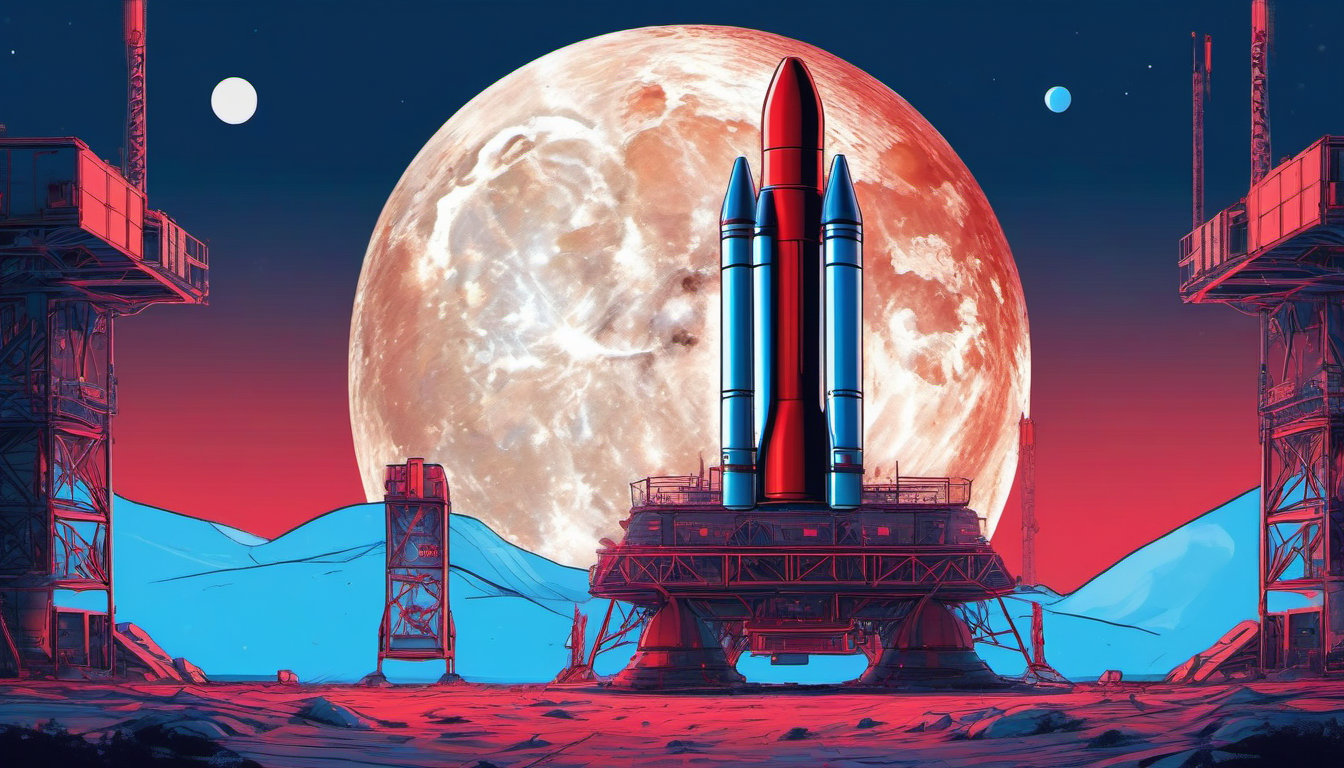
Artemis II's latest delay hands Beijing a propaganda victory — and potentially the Moon itself
Executive Summary
- NASA chief Jared Isaacman confirmed on February 21 that Artemis II will miss its March 6 launch window due to helium flow problems in the SLS rocket, the latest in a string of delays for America's flagship Moon program.
- Just ten days earlier, China successfully tested its Long March-10 rocket and Mengzhou crewed capsule — the vehicles that will carry taikonauts to the Moon by 2030, demonstrating a tempo of execution that NASA cannot match.
- The delay crystallizes a deeper structural crisis: the US is spending $93 billion on a program that has launched once in four years, while China's vertically integrated state-directed model is rapidly closing the gap in what may become the most consequential geopolitical competition of the century — the race to establish permanent sovereignty on the Moon.
Chapter 1: Helium and Hubris
On Saturday, February 21, NASA Administrator Jared Isaacman — himself a former SpaceX-flying billionaire appointed by Trump — posted a terse update on X: a helium flow anomaly detected during final preparations would "take the March launch window out of consideration." The SLS rocket and Orion spacecraft would need to be rolled back from Launch Pad 39B at Kennedy Space Center to investigate the problem.
It was a gut punch, but hardly a surprise. Artemis II has been delayed repeatedly since its original 2024 target date. The program's first mission, Artemis I, launched uncrewed in November 2022 — more than three years ago. In the intervening period, the Orion capsule's heat shield was found to have eroded more than expected, requiring redesign work. Earlier this month, a liquid hydrogen leak during the wet dress rehearsal forced engineers to swap out seals. Now helium.
The four astronauts — Reid Wiseman, Victor Glover, Christina Koch, and Canadian Jeremy Hansen — had already entered quarantine for a March launch. They have now been released. Glover, who would become the first Black astronaut to travel beyond low-Earth orbit, will have to wait longer for a moment that was supposed to arrive two years ago.
The broader context makes the delay sting. Artemis II is not a Moon landing — it is merely a flyby, a 10-day loop around the far side of the Moon and back. The actual landing mission, Artemis III, is now unlikely before mid-2028 at the earliest. The entire Artemis architecture — SLS rocket, Orion capsule, SpaceX Starship lunar lander, and the planned Lunar Gateway station — has consumed an estimated $93 billion since 2012, according to NASA's Office of Inspector General. For that sum, the program has achieved a single uncrewed test flight.
Chapter 2: The Dragon Awakens
On February 11, ten days before Isaacman's deflating announcement, China executed a flawless dual-objective test at its new Wenchang crewed lunar launch pad. The Long March-10 rocket — purpose-built for lunar missions — completed a low-altitude verification flight while simultaneously conducting a maximum dynamic pressure abort test of the Mengzhou ("Dream Vessel") crewed capsule.
The significance cannot be overstated. China demonstrated in a single flight that its escape system works under the most extreme aerodynamic conditions, and that the new launch pad — the "departure gate" for crewed lunar journeys — is operational. The Long March-10 is designed to lift 27 tonnes to trans-lunar injection, comparable to the Apollo-era Saturn V's capability when paired with the separately launched Lanyue lunar lander.
China's roadmap is aggressive but methodical. Chang'e 7 will launch later in 2026 to explore the Moon's south pole — the same region where NASA hopes to land. A crewed lunar mission is targeted for 2030. The International Lunar Research Station (ILRS), a permanent base to be built in phases through 2035, already has formal partners including Russia, Pakistan, Venezuela, South Africa, and several other nations.
The contrast in execution tempo is stark. China has launched five increasingly capable Chang'e missions since 2018, including the world's first far-side landing (Chang'e 4, 2019) and the first far-side sample return (Chang'e 6, 2024). Each mission built directly on the previous one. The program operates under a single authority — the China National Space Administration — with no budget battles, no contractor disputes, and no election-cycle disruptions.
Chapter 3: The Governance Gap
The Moon race is not primarily about flags and footprints. It is about who writes the rules for humanity's expansion into space — and who controls the resources that make that expansion possible.
Two competing frameworks now divide the world. The US-led Artemis Accords, signed by 48 nations as of February 2026 (including Portugal and Oman, which joined this year), establish principles for lunar operations: transparency, interoperability, emergency assistance, and critically, the right to extract and use space resources. The Accords also introduce "safety zones" — areas around lunar operations where other actors must coordinate before approaching.
China's ILRS framework takes a different approach, positioning itself as a strictly multilateral alternative that adheres more conservatively to the 1967 Outer Space Treaty. Beijing has pitched the ILRS to post-colonial nations wary of Western resource extraction, framing the Artemis Accords' safety zones as potential sovereignty claims by another name. Some countries — notably Thailand — have hedged by joining both frameworks.
The real prize is the Moon's south pole, where permanently shadowed craters contain billions of tonnes of water ice. Water can be split into hydrogen and oxygen — rocket propellant that would make the Moon a refueling station for deeper space operations. Whoever establishes infrastructure at the south pole first will possess an enormous first-mover advantage, not unlike controlling a critical port in the age of maritime empires.
The Outer Space Treaty prohibits national sovereignty over celestial bodies. But it says nothing about commercial extraction or de facto control through infrastructure. The legal ambiguity is deliberate — and will be resolved by whoever arrives first.
Chapter 4: The Budget Battlefield
Artemis exists in a political environment that China's program does not face. Trump's fiscal year 2026 budget proposal sought to cut NASA's $24.8 billion budget by 24% ($6 billion) while earmarking $1 billion specifically for SpaceX. Congress largely rejected these cuts — the final appropriations bill held NASA roughly flat — but the signal was clear: the administration views commercial space (read: SpaceX) as the future and legacy programs like SLS as expendable.
DOGE's crusade against government spending further complicates matters. While Artemis has bipartisan congressional support — SLS components are manufactured across multiple states — the program's cost trajectory invites scrutiny. Each SLS launch costs approximately $4.1 billion, compared to the roughly $100 million for a SpaceX Falcon Heavy or the projected $10 million for a fully reusable Starship. The SLS is expendable: every flight destroys the rocket.
This cost disparity creates an existential question for Artemis. SpaceX's Starship — which NASA has contracted as the Artemis III lunar lander — can theoretically deliver far more cargo to the Moon at a fraction of the cost. If Starship achieves full reusability, the rationale for SLS evaporates. Some analysts argue the SLS should already have been cancelled, and that the billions spent on it would have been better invested in lunar surface infrastructure.
But cancelling SLS would mean cancelling Artemis II, the crew-rated Orion capsule, and the political coalition that sustains NASA's human spaceflight budget. It is a classic path-dependency trap: the US is locked into an architecture it can barely afford because the political cost of change exceeds the financial cost of continuation.
Chapter 5: Scenario Analysis
Scenario A: Delayed American Triumph (40%)
Premise: Artemis II launches in Q2-Q3 2026 after helium fix. Artemis III lands astronauts by 2028. The US establishes first south pole presence.
Supporting evidence:
- Despite delays, the US retains a technological lead in deep-space human operations. Orion's life support and heat shield are proven.
- SpaceX Starship development, while behind schedule, is the most ambitious rocket program in history. Flight 12 is expected in early March.
- 48 Artemis Accords signatories provide diplomatic weight to the US-led framework.
Trigger conditions: Successful Artemis II flight; Starship orbital refueling demonstration; Congressional funding stability.
Historical precedent: Apollo program overcame the Apollo 1 fire (1967) and Apollo 13 crisis (1970) to land six missions on the Moon. Setbacks did not prevent ultimate success when political will held.
Scenario B: Chinese Overtake (30%)
Premise: Continued Artemis delays push landing beyond 2029. China lands taikonauts by 2030 or earlier, establishing ILRS infrastructure first.
Supporting evidence:
- China's space program has met or beaten every stated deadline in the past decade (Tiangong station completed on schedule, Chang'e 5/6 sample returns on schedule).
- Long March-10 and Mengzhou both passed key tests in February 2026 — China's program is on track.
- DOGE-era budget pressure and political instability (SCOTUS tariff ruling, government shutdowns) divert American institutional attention.
Trigger conditions: Further SLS delays; Starship landing test failures; US budget sequestration; successful Chang'e 7 south pole mission.
Historical precedent: The Soviet Union led the space race from Sputnik through the first space station (1971) before Apollo reversed the dynamic. Sustained investment beat early leads.
Scenario C: Convergence and Competition (30%)
Premise: Both programs succeed within similar timeframes, creating a contested lunar environment with competing infrastructure.
Supporting evidence:
- The south pole's scale (Shackleton Crater alone is 21 km in diameter) allows multiple operations.
- Neither framework prohibits the other's presence. Dual-framework nations like Thailand suggest coexistence is plausible.
- Commercial actors (ispace, Intuitive Machines, Astrobotic) operate alongside both state programs.
Trigger conditions: Both sides achieve crewed landings within 2028-2031; diplomatic engagement prevents direct confrontation.
Historical precedent: Antarctic Treaty (1959) established shared governance over a resource-rich continent despite Cold War tensions. Multiple stations operate peacefully in overlapping zones.
| Factor | United States (Artemis) | China (ILRS) |
|---|---|---|
| Total program cost (est.) | $93B+ since 2012 | ~$30-40B est. |
| Crewed flights completed | 0 | 0 (Shenzhou to LEO: 14) |
| Launch vehicle status | SLS: helium issue, rollback | LM-10: successful test Feb 11 |
| Lunar landing target | 2028 (Artemis III) | 2030 |
| Alliance partners | 48 (Artemis Accords) | 12+ (ILRS) |
| Commercial ecosystem | SpaceX, Blue Origin, Intuitive Machines | Limited, state-directed |
| Key vulnerability | Cost, politics, SLS architecture | Untested deep-space life support |
Chapter 6: Investment Implications
Space defense and infrastructure:
- Rocket Lab (RKLB), which builds spacecraft for both NASA and defense clients, benefits from either scenario as a supplier to the broader cislunar economy.
- Intuitive Machines (LUNR) and Astrobotic are building lunar landers for NASA's Commercial Lunar Payload Services (CLPS) program — their value proposition increases as human missions approach.
Rare earth and resources:
- Lunar operations require advanced materials. Companies positioned in the ISRU (in-situ resource utilization) supply chain — from robotics to life support — represent a nascent but potentially enormous market estimated at $170 billion by 2040 (Northern Sky Research).
Defense contractors:
- Lockheed Martin (LMT) builds Orion. Northrop Grumman (NOC) builds the SLS boosters. Boeing builds the SLS core stage. Budget instability is a risk, but cancellation risk is low given congressional support.
- The convergence of cislunar operations with military space (US Space Command's growing interest in cislunar domain awareness) creates a defense-space investment thesis.
Historical analog: The Apollo program generated an estimated 8:1 return on investment through technology spinoffs, workforce development, and strategic positioning. The cislunar economy's scale — potentially $1 trillion by 2040 — dwarfs Apollo's economic legacy.
Conclusion
The helium leak that grounded Artemis II is a technical problem that will be fixed. The deeper issue is architectural and institutional. The United States is attempting to return to the Moon using a disposable rocket designed by committee, funded through annual congressional appropriations, and managed by a bureaucracy that must navigate election cycles, government shutdowns, and DOGE audits. China is attempting the same feat with a vertically integrated state apparatus that can sustain multi-decade programs without interruption.
Neither system is inherently superior. Apollo proved that democratic systems can achieve extraordinary things when political will aligns with institutional capacity. But Apollo also demonstrated that such alignment is fragile — the program was cancelled after just six landings, its capabilities discarded in favor of the Space Shuttle, a vehicle that could never leave low-Earth orbit.
The question is not whether humans will return to the Moon. They will. The question is whether the rules governing humanity's expansion beyond Earth will be written in Washington or Beijing — and whether there is still time for a democratic superpower distracted by tariff wars, constitutional crises, and partisan dysfunction to maintain its lead in the most consequential race of the 21st century.
Related Reading:
Leave a Reply