
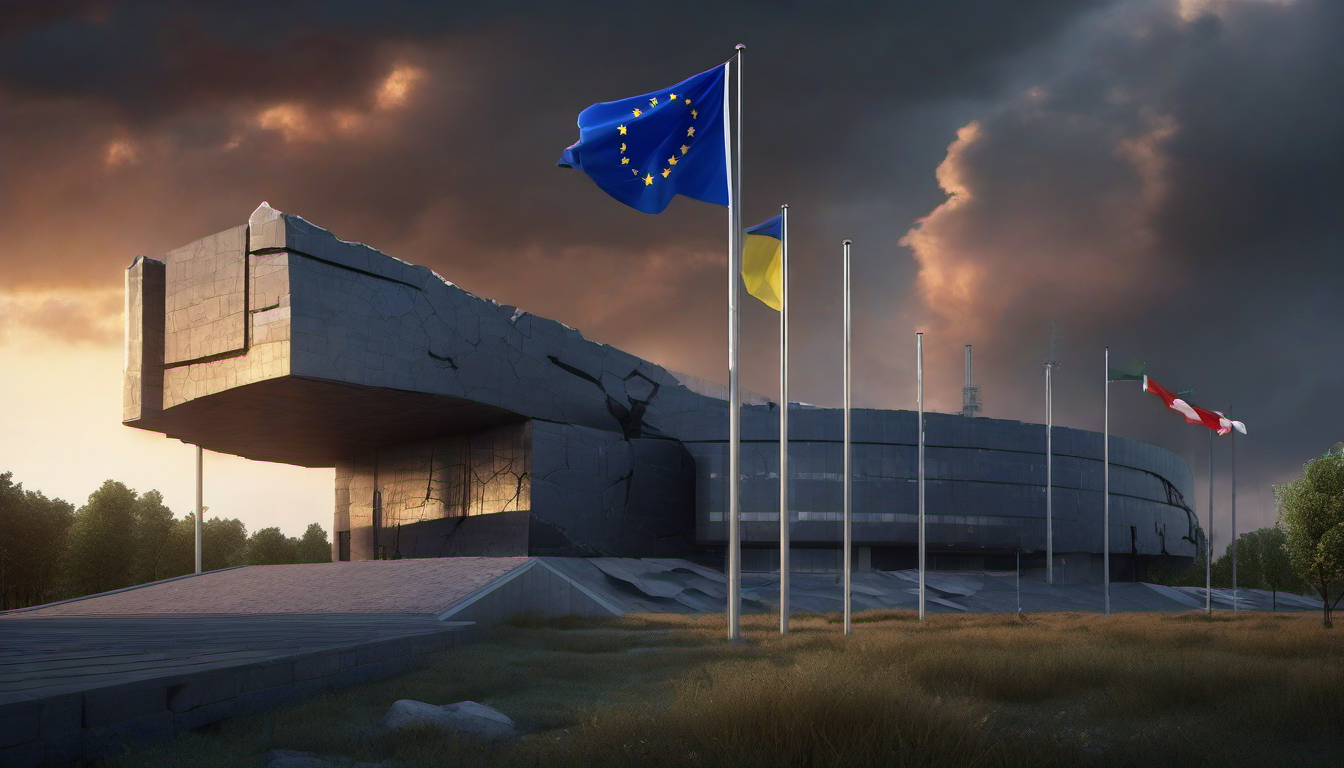
Hungary and Slovakia weaponize energy supplies against Kyiv, blocking €90 billion in EU aid and threatening to plunge the bloc into its worst internal crisis since Brexit
Executive Summary
- Hungary is blocking a €90 billion EU emergency loan to Ukraine — two-thirds of Kyiv's 2026–2027 budget needs — while simultaneously halting diesel exports, creating a two-pronged economic siege days before the war's fourth anniversary.
- Slovakia has threatened to cut electricity to Ukraine by February 23 unless the Druzhba pipeline is repaired, despite the damage being caused by Russian strikes — not Ukrainian negligence.
- The European Commission has called an extraordinary Oil Coordination Group meeting for next Wednesday, but the deeper crisis is institutional: the EU's unanimity requirement gives individual members veto power over collective security commitments.
Chapter 1: The Druzhba Trigger
The Druzhba pipeline — "Friendship" in Russian — has been anything but friendly since a Russian missile strike in late January 2026 severed the Soviet-era artery that still feeds Hungary and Slovakia with crude oil. With a capacity of roughly two million barrels per day, Druzhba is one of the largest pipeline networks in the world, stretching from western Siberia across Ukraine into Central Europe.
Hungary and Slovakia are the only EU member states that still import Russian crude through this system, having secured exemptions from the EU's phased embargo. When the pipeline went down, both countries accused Kyiv of deliberately delaying repairs — a charge Ukraine categorically denies, pointing out that the damage was caused by Russian bombardment of its own energy infrastructure during the harshest winter in years.
The accusation is rich in irony. Ukraine is enduring grueling sub-zero temperatures with a shattered energy grid, blackouts lasting 12–18 hours daily, and heating systems pushed to the breaking point. The suggestion that Kyiv would voluntarily keep a revenue-generating transit pipeline offline while its own citizens freeze strains credulity — but credulity has never been Budapest's concern.
Chapter 2: The Double Squeeze
On February 19, Hungary and Slovakia announced the suspension of diesel exports to Ukraine. The following day, Hungarian Foreign Minister Péter Szijjártó escalated further, declaring that Budapest would block the EU's €90 billion Ukraine Support Loan until Druzhba oil flows resume.
The loan, preliminarily approved in December 2025 and backed by common EU debt, covers critical needs for 2026–2027: €30 billion for budget support and €60 billion for military assistance. Without it, Ukraine risks running out of cash by mid-2026 — precisely when the fighting season peaks.
The blocking mechanism exploits a structural vulnerability in EU decision-making. While two of the three legislative pieces governing the loan require only a qualified majority (and were approved on February 20 without issue), the budget amendment enabling the borrowing requires unanimity. Hungary's veto is technically legal, if morally indefensible.
Slovakia, meanwhile, raised the stakes further. Prime Minister Robert Fico threatened to cut electricity exports to Ukraine starting February 23 if the pipeline is not repaired — a deadline that falls on the eve of the war's fourth anniversary, when EU Commission President von der Leyen and European Council President Costa are scheduled to visit Kyiv in a symbolic show of solidarity.
The timing is not coincidental. It is choreographed humiliation.
Chapter 3: The Electoral Calculus
Understanding Hungary's behavior requires looking at one date: April 12, 2026 — the day Hungarians go to the polls in parliamentary elections.
Prime Minister Viktor Orbán is trailing opposition leader Péter Magyar by roughly 10 points in polls. After 14 years in power, Fidesz faces its most serious electoral challenge. Orbán's playbook has always relied on manufacturing external enemies — Brussels, George Soros, migrants — and now Ukraine has been added to the rotation.
In early February, Orbán crossed a previously unthinkable line by declaring Ukraine an "enemy of Hungary." Szijjártó's accusation that Kyiv, Brussels, and Hungarian opposition forces are conspiring to disrupt energy supplies and spike fuel prices before the election is a conspiracy theory dressed as diplomacy.
The logic is transparent: by creating an energy crisis, Orbán can blame Ukraine and the EU, rally nationalist sentiment, and distract from his record. If fuel prices rise, he points to Kyiv. If the EU retaliates, he points to Brussels. The war-torn country being bombed into darkness becomes a prop in Hungary's domestic theater.
Slovakia's Fico operates from a similar playbook. Both leaders have filed legal challenges against the EU's 2027 deadline for phasing out Russian fossil fuels. Both have cultivated relationships with Moscow that their European partners view as uncomfortably close. Both use "peace" rhetoric that translates, in practice, to Ukrainian capitulation.
Chapter 4: The Institutional Trap
The European Commission's response — convening an "extraordinary" Oil Coordination Group meeting for next Wednesday — reveals the limits of EU crisis management. Commission spokesperson Anna-Kaisa Itkonen framed it as a technocratic exercise: "We have called an ad hoc Oil Coordination Group meeting to discuss the impact of the supply disruption and possible alternatives to fuel supply."
But this is not a supply disruption. It is political extortion within a mutual defense framework. The distinction matters.
The Commission has confirmed that Hungary and Slovakia possess sufficient oil reserves and face no immediate supply security risk. The real vulnerability is Ukraine's — already suffering from devastating Russian attacks on its energy infrastructure — and the EU's institutional coherence.
Hungary's request for Croatia to facilitate seaborne Russian oil through its Adriatic pipeline was declined. Croatia's refusal reflects a broader unwillingness among member states to enable Budapest's dependency on Russian energy while the rest of the bloc works to sever those ties.
The unanimity requirement for budget-related decisions has long been recognized as the EU's Achilles heel. In December 2025, when the loan package was agreed at the European Council level — including Hungary's own negotiated exemption from contributing financially — the assumption was that political agreement at the summit level would translate into smooth legislative passage. That assumption has been demolished.
| Mechanism | Status | Requirement | Hungary's Position |
|---|---|---|---|
| €90B Loan Budget Amendment | Blocked | Unanimity | Veto |
| Loan Structure Regulation | Approved Feb 20 | Qualified Majority | Overruled |
| Loan Conditions Regulation | Approved Feb 20 | Qualified Majority | Overruled |
| 20th Sanctions Package | Stalled Feb 20 | Unanimity | Objections |
The sanctions package against Russia also failed to reach agreement on February 20, with Hungary among those raising objections. The dual blockage — aid to Ukraine and sanctions on Russia — creates a perverse alignment of interests between Budapest and Moscow.
Chapter 5: Historical Precedents and Scenario Analysis
The Energy Weapon in European History
Energy weaponization within the EU is not unprecedented, but it has never been deployed this brazenly by a member state against a country the bloc has collectively committed to defend.
The closest parallel is the 1973 oil embargo, when OPEC states weaponized energy against Western nations supporting Israel. But that was an external threat. What Hungary and Slovakia are doing is internal — using EU membership benefits (access to common markets, exemptions, veto rights) while actively undermining EU collective commitments. It is the geopolitical equivalent of eating at the family table while poisoning the food.
A more relevant comparison is Charles de Gaulle's 1965 "empty chair" crisis, when France boycotted European Council meetings to block qualified majority voting. That crisis led to the Luxembourg Compromise, which ironically entrenched the unanimity principle that Hungary now exploits.
Scenario A: Diplomatic Resolution (40%)
Rationale: EU ambassadors have indicated they intend to revisit the loan once Hungary lifts its reserve. Budapest has a history of extracting last-minute concessions before releasing vetoes — it did so with the €50 billion aid package in early 2024 and with sanctions packages multiple times before that. With Orbán trailing in polls, a visible "win" (additional exemptions, face-saving language, perhaps a bilateral energy deal) could serve his domestic narrative.
Trigger: Commission brokers a compromise at Wednesday's emergency meeting — possibly involving Croatian Adriatic pipeline access for non-Russian oil, or an accelerated timeline for Druzhba repair with EU funding.
Timeline: 1–2 weeks. The February 24 war anniversary and von der Leyen's Kyiv visit create political pressure for resolution.
Scenario B: Protracted Standoff (35%)
Rationale: Orbán may calculate that maintaining the blockade through April 12 serves his electoral interests. The 2024 precedent (where Hungary blocked €50 billion for several weeks) showed that sustained vetoes generate media attention and reinforce the strongman image. The EU lacks enforcement mechanisms to compel compliance from a member exercising its legal veto right.
Trigger: Hungary rejects compromise terms, demanding full Druzhba restoration before releasing the veto. Slovakia follows through on electricity cutoffs.
Timeline: 6–8 weeks (through April elections). Risk of Ukrainian fiscal crisis by mid-2026 increases significantly.
Scenario C: Institutional Breakthrough (25%)
Rationale: The crisis accelerates the ongoing debate about eliminating unanimity requirements for foreign policy and security decisions — a reform backed by Commission President von der Leyen and the E5/E6 defense groupings. The European Parliament has already called for treaty revision. Hungary's behavior could provide the political momentum needed to bypass the unanimity trap through "enhanced cooperation" mechanisms (Article 20 TEU), where a subset of willing states proceeds without unanimous consent.
Trigger: Von der Leyen or Costa use the February 24 anniversary to announce a "coalition of the willing" lending mechanism that circumvents Hungary's veto. Legal basis contested but politically unstoppable.
Timeline: 2–4 weeks for announcement; 3–6 months for implementation.
Chapter 6: Investment Implications
European Energy Stocks: Hungarian MOL and Slovak Slovnaft face supply chain uncertainty. Croatian INA (JANAF pipeline operator) could benefit if compromise involves Adriatic routing. European refining margins may tighten in Central Europe.
Ukrainian Sovereign Risk: The €90B loan is existential for Kyiv's 2026–2027 fiscal survival. Prolonged blockage raises default risk and could force emergency bilateral lending from G7 partners (likely US, UK, Japan). Ukrainian hryvnia under pressure.
EU Defense Stocks: Paradoxically, the crisis may accelerate the broader European rearmament narrative. If the EU demonstrates it cannot even deliver financial aid to Ukraine due to internal vetoes, the argument for independent European defense capabilities (SAFE bonds, E5 coordination) strengthens. Rheinmetall, Leonardo, BAE Systems, Thales benefit from the political tailwind.
Currency Markets: Euro faces conflicting pressures — institutional crisis is bearish, but resolution via deeper integration is bullish. DXY reaction depends on whether the standoff undermines confidence in European unity as a counterweight to dollar hegemony.
Conclusion
The Hungary-Slovakia energy standoff is not about oil. It is about whether the European Union can function as a collective security actor when individual members weaponize their veto rights to pursue domestic political agendas aligned with Moscow's interests.
Four years into Europe's largest land war since 1945, the EU's response to Russian aggression remains hostage to the very institutional design that was supposed to protect minority interests — not enable them to sabotage majority commitments. The Druzhba pipeline may be named "Friendship," but what it has exposed is the fragility of European solidarity when tested by members who treat the alliance as a buffet, taking what they want while refusing to contribute to the bill.
The next seven days — from the emergency meeting on Wednesday to the war anniversary on Monday — will reveal whether Europe's institutions can adapt faster than their adversaries can exploit them. History suggests the answer is usually no. But history also records that the EU's most transformative moments have emerged from its deepest crises.
Leave a Reply