
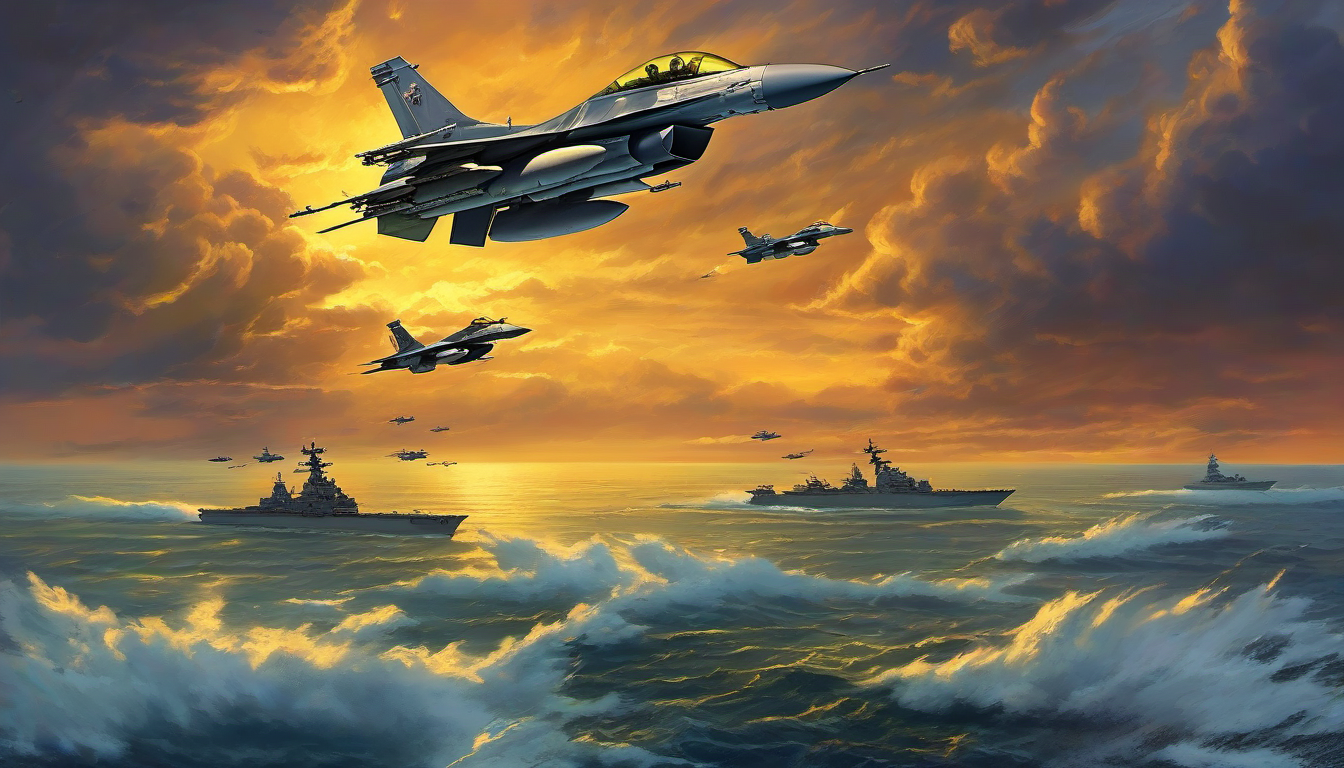
A rare aerial confrontation between American and Chinese fighter jets over the Yellow Sea signals Washington's quiet transformation of its Korean Peninsula forces from a North Korea deterrent into a China containment asset — with Seoul caught in the crossfire.
Executive Summary
- On February 18, approximately 10 USFK F-16s from Osan Air Base conducted a unilateral exercise near China's Air Defense Identification Zone over the Yellow Sea, prompting Beijing to scramble fighters in a rare aerial standoff — the first visible manifestation of USFK's strategic pivot from North Korea to China deterrence.
- The operation was conducted without detailed coordination with Seoul, which only learned of the specifics after the fact and subsequently conveyed concerns to Washington — exposing a widening gap between alliance rhetoric and operational reality.
- This incident, coupled with the 2026 National Defense Strategy's language about South Korea taking the "lead" on North Korea deterrence with "more limited" US backing, marks the beginning of a structural transformation that could fundamentally alter the security architecture of Northeast Asia.
Chapter 1: The Incident — Ten F-16s and a Strategic Signal
On the evening of February 18, 2026, approximately ten F-16 fighter jets belonging to the 51st Fighter Wing of US Forces Korea lifted off from Osan Air Base in Pyeongtaek, roughly 65 kilometers south of Seoul. Rather than heading east toward the East Sea for routine training against a simulated North Korean threat, the formation turned west — toward the Yellow Sea and the approaches to China's coastline.
The F-16s flew into international airspace between South Korea's Korea Air Defense Identification Zone (KADIZ) and China's Air Defense Identification Zone (CADIZ), operating in a narrow band where the two zones do not overlap. As the American jets neared the vicinity of China's declared defensive perimeter, the People's Liberation Army responded by scrambling its own fighters. What followed was a brief but tense aerial standoff — neither side crossed into the other's ADIZ, and the encounter ended without incident.
But the significance of the episode lies not in what happened, but in what it represents.
USFK had informed South Korea's military that an exercise would take place, but withheld operational details including the flight plan, purpose, and the fact that the training would occur so close to China's ADIZ. Seoul only grasped the full picture after the fact. According to Korea Times reporting, the South Korean military subsequently "conveyed its concerns" to the US side — diplomatic language for something closer to alarm.
"It is quite unusual for USFK to conduct a major drill over the West Sea unilaterally, not during a scheduled joint exercise with South Korea," noted Cho Han-bum, senior research fellow at the Korea Institute for National Unification. "The operation near China's ADIZ suggests the move was clearly aimed at Beijing."
Chapter 2: The Doctrine Shift — From DMZ to First Island Chain
To understand why ten F-16s flying west matters so profoundly, one must grasp the historical context. Since the Korean War armistice in 1953, the 28,500 US troops stationed in South Korea have served a single primary purpose: deterring North Korean aggression. Their training, positioning, and operational planning have been oriented northward, toward the Demilitarized Zone and beyond.
That paradigm is now being deliberately dismantled.
The 2026 National Defense Strategy, released in January, contained a single sentence that sent tremors through Seoul's defense establishment: South Korea is described as capable of taking the "lead" in deterring North Korea with "critical, but more limited" US backing. The implication was clear — Washington wants to repurpose USFK assets for the broader Indo-Pacific competition with China.
USFK Commander General Xavier Brunson has been telegraphing this shift for months. In November 2025, he offered a revealing formulation: "Forces already positioned on the Korean Peninsula are revealed not as distant assets requiring reinforcement, but as troops already positioned inside the bubble perimeter that the United States would need to penetrate in the event of crisis or contingency."
The "bubble" Brunson refers to is China's Anti-Access/Area Denial (A2/AD) defensive envelope — the layered missile, air, and naval defenses designed to keep American forces at bay in a Taiwan contingency or other Indo-Pacific crisis. Brunson was articulating, in plain language, that USFK's value to Washington is increasingly defined not by the DMZ but by geography: these forces are already inside China's defensive perimeter.
The Yellow Sea exercise was the operational debut of this doctrine.
Chapter 3: Seoul's Impossible Position
South Korea now faces what analysts are calling the "strategic squeeze" — pressure from Washington to accept USFK's expanded role against China, while simultaneously managing a relationship with Beijing that is essential to its economic survival.
| Dimension | US Pressure | China Pressure |
|---|---|---|
| Military | Accept USFK China pivot, increase defense spending | No THAAD expansion, no trilateral alliance deepening |
| Economic | Reduce China dependency, join tech controls | $230B bilateral trade, rare earth supply |
| Political | OPCON transfer timeline, burden-sharing | Historical issues, diplomatic signaling |
| Strategic | First Island Chain integration | No Taiwan involvement commitment |
China is South Korea's largest trading partner, accounting for roughly 20% of total trade. Beijing has demonstrated its willingness to use economic coercion — the 2017 THAAD retaliation, which cost South Korea an estimated $7.5 billion in tourism and consumer goods losses, remains seared into Seoul's institutional memory.
The timing compounds the problem. South Korea is in the midst of a constitutional crisis following President Yoon Suk-yeol's insurrection trial, with acting leadership lacking the political capital to make bold strategic decisions. The prospect of alienating either Washington or Beijing while the country navigates its worst domestic political crisis since 1987 is a nightmare scenario for Seoul's foreign policy establishment.
The fact that South Korea's military was not fully briefed on the Yellow Sea operation is itself telling. It suggests Washington may be willing to test China's responses without Seoul's full buy-in — treating the Korean Peninsula as a staging ground for Indo-Pacific operations rather than a bilateral alliance theater.
Chapter 4: The ADIZ Chess Game — Historical Context
Air Defense Identification Zones are not sovereign airspace. They are self-declared notification zones with no binding status under international law. But in practice, they function as trip wires — and the Yellow Sea is one of the most densely overlapping ADIZ environments on Earth.
South Korea's KADIZ was established by the United States in March 1951, during the Korean War. China's CADIZ was unilaterally declared in November 2013, primarily over the East China Sea but extending influence into Yellow Sea approaches. Japan's JADIZ, also overlapping in parts, adds a third layer of complexity.
The precedents for aerial confrontation in this region are deeply worrying:
- December 2025: Chinese and Russian military aircraft entered KADIZ over the East Sea and South Sea simultaneously — a joint probe that tested South Korea's response capabilities.
- 2013-2024: Over 1,000 Chinese military aircraft entered Taiwan's ADIZ, normalizing aerial coercion as a tool of statecraft.
- April 2001: A Chinese J-8 interceptor collided with a US EP-3 surveillance aircraft over the South China Sea, killing the Chinese pilot and forcing the American plane to make an emergency landing on Hainan Island — the most dangerous US-China military incident since the end of the Cold War.
The Yellow Sea standoff of February 2026 did not escalate. But it established a new pattern: USFK aircraft operating near China's ADIZ from Korean bases, without full allied coordination, for purposes that extend beyond the Korean Peninsula's traditional security framework.
Chapter 5: Scenario Analysis
Scenario A: Managed Competition (45%)
Thesis: The Yellow Sea exercise becomes a one-off or infrequent event. Washington and Seoul negotiate a framework for USFK's expanded role that keeps China-oriented operations below Beijing's escalation threshold.
Supporting evidence: Both the US and China maintained professional separation during the standoff. Seoul's diplomatic complaint suggests institutional pushback that may constrain future unilateral operations. The April Beijing summit between Trump and Xi creates incentive for restraint.
Trigger conditions: Successful US-China trade deal extension; Seoul secures assurances on advance coordination; no further unilateral USFK exercises near CADIZ.
Historical parallel: The 2001 EP-3 incident led to the establishment of military-to-military communication protocols that reduced (but did not eliminate) dangerous encounters for over a decade.
Scenario B: Gradual Escalation (35%)
Thesis: USFK increases China-oriented exercises from Korean bases, Beijing responds with more aggressive interceptions, and Seoul is progressively drawn into the US-China military competition despite its objections.
Supporting evidence: The NDS language about "more limited" US support for North Korea deterrence suggests a structural shift, not a one-off. General Brunson's "inside the bubble" doctrine explicitly frames Korean Peninsula forces as China contingency assets. China's December 2025 joint KADIZ incursion with Russia shows Beijing is already probing.
Trigger conditions: OPCON transfer negotiations stall; Taiwan Strait tensions escalate; North Korea's 9th Party Congress produces new provocations requiring a South Korean military response that frees USFK for other missions.
Historical parallel: The gradual militarization of the South China Sea from 2013-2020 — a slow-motion escalation where each side's "defensive" measures became the other's justification for further buildup.
Scenario C: Alliance Fracture (20%)
Thesis: South Korea refuses to accept USFK's China pivot, leading to a fundamental renegotiation of the alliance or even a partial US withdrawal.
Supporting evidence: South Korea's political instability creates conditions where populist pressure could resist Washington's demands. China's economic leverage gives Seoul powerful incentives to resist becoming a China containment platform. The burden-sharing dispute — Trump has historically demanded South Korea pay more for US troop presence — could become the vehicle for renegotiation.
Trigger conditions: A progressive president takes power post-Yoon crisis and pursues balanced diplomacy; China offers significant economic concessions in exchange for USFK constraints; US-China détente reduces the perceived need for forward-deployed forces.
Historical parallel: France's 1966 withdrawal from NATO's integrated military command — a major ally deciding that alliance integration compromised its strategic autonomy.
Chapter 6: Investment Implications
The USFK pivot has immediate and structural implications for defense markets and the broader East Asian investment landscape.
Defense sector: South Korean defense companies (Hanwha Aerospace, Korea Aerospace Industries, LIG Nex1) stand to benefit from increased domestic defense spending as Seoul takes on greater North Korea deterrence responsibility. Korean defense exports — already surging to over $20 billion annually — could accelerate as Seoul builds a more self-sufficient military.
THAAD-adjacent risk: Any expansion of USFK's China-facing posture risks triggering another THAAD-style Chinese economic retaliation against South Korean companies. Sectors most exposed: cosmetics, tourism, entertainment, automotive (Hyundai/Kia China sales), and electronics (Samsung/SK Hynix China operations).
Semiconductor nexus: South Korea's semiconductor industry — which accounts for roughly 20% of exports — operates in the crossfire. SK Hynix's massive DRAM operations in Dalian, China, and Samsung's NAND flash facilities in Xi'an represent tens of billions in assets that could become hostages to geopolitical friction.
Won vulnerability: Escalation in Yellow Sea tensions could trigger won weakness against the dollar, particularly if combined with the ongoing political uncertainty from the Yoon trial.
Conclusion
The ten F-16s that flew west over the Yellow Sea on February 18 crossed more than airspace — they crossed a strategic Rubicon. For seven decades, the implicit bargain of the US-South Korea alliance was straightforward: American forces deter North Korea, and South Korea provides basing and burden-sharing. That bargain is being unilaterally rewritten by Washington, which increasingly views the Korean Peninsula not as an endpoint but as a forward operating position in its competition with China.
Seoul faces a choice it has spent decades avoiding: whether to accept its transformation from a North Korea alliance partner into a node in America's China containment architecture, or to resist — and face the consequences of defying a hegemon that stations 28,500 troops on its soil.
The Yellow Sea standoff was brief. The strategic reckoning it portends will not be.
Sources: SCMP, Korea Times, Korea Herald, Taipei Times, Defence Security Asia, Bloomberg/Yonhap, The Diplomat
Leave a Reply