
As Pentagon plans advance to target Iran's supreme leader, the real question isn't whether to strike — it's what comes after
Executive Summary
- The U.S. military has drawn up advanced strike plans that include targeting individual Iranian leaders — including Supreme Leader Khamenei — and pursuing regime change, marking a qualitative escalation beyond the June 2025 campaign that focused on nuclear infrastructure.
- Iran is simultaneously fortifying nuclear sites, rebuilding missile facilities destroyed eight months ago, and appointing war veterans to security positions, creating a "strike-ready but negotiation-open" dual posture that mirrors Washington's own ambiguity.
- Four post-war scenarios — from democratic transition to IRGC military junta — carry radically different implications for regional stability and energy markets, yet U.S. planning appears focused almost exclusively on the kinetic phase, with virtually no post-conflict strategy.
Chapter 1: From Obliteration to Decapitation — The Escalation Ladder
Eight months ago, the United States and Israel conducted Operation Midnight Hammer, a 12-day campaign that Trump claimed had "totally obliterated" Iran's nuclear program. The June 2025 strikes targeted nuclear facilities at Natanz, Fordow, and Isfahan, along with missile production sites and air bases. Iran retaliated with hundreds of missiles and drones against Israeli cities. Both sides agreed to a ceasefire, and indirect negotiations resumed through Omani mediation.
Now the dynamic has fundamentally shifted. According to Reuters, Pentagon planning has reached "an advanced stage with options including targeting individuals as part of an attack and even pursuing regime change in Tehran." This is not merely a repeat of Midnight Hammer. The shift from infrastructure strikes to decapitation represents a qualitative leap on the escalation ladder — from degrading capability to eliminating the regime itself.
Trump told reporters on February 20 that he believes "10 to 15 days is enough time" for Iran to reach a deal. Polish Prime Minister Donald Tusk urgently warned Polish citizens to leave Iran immediately, saying "within a few, a dozen, or even a few dozen hours, the possibility of evacuation will be out of the question." Germany has already moved personnel out of northern Iraq.
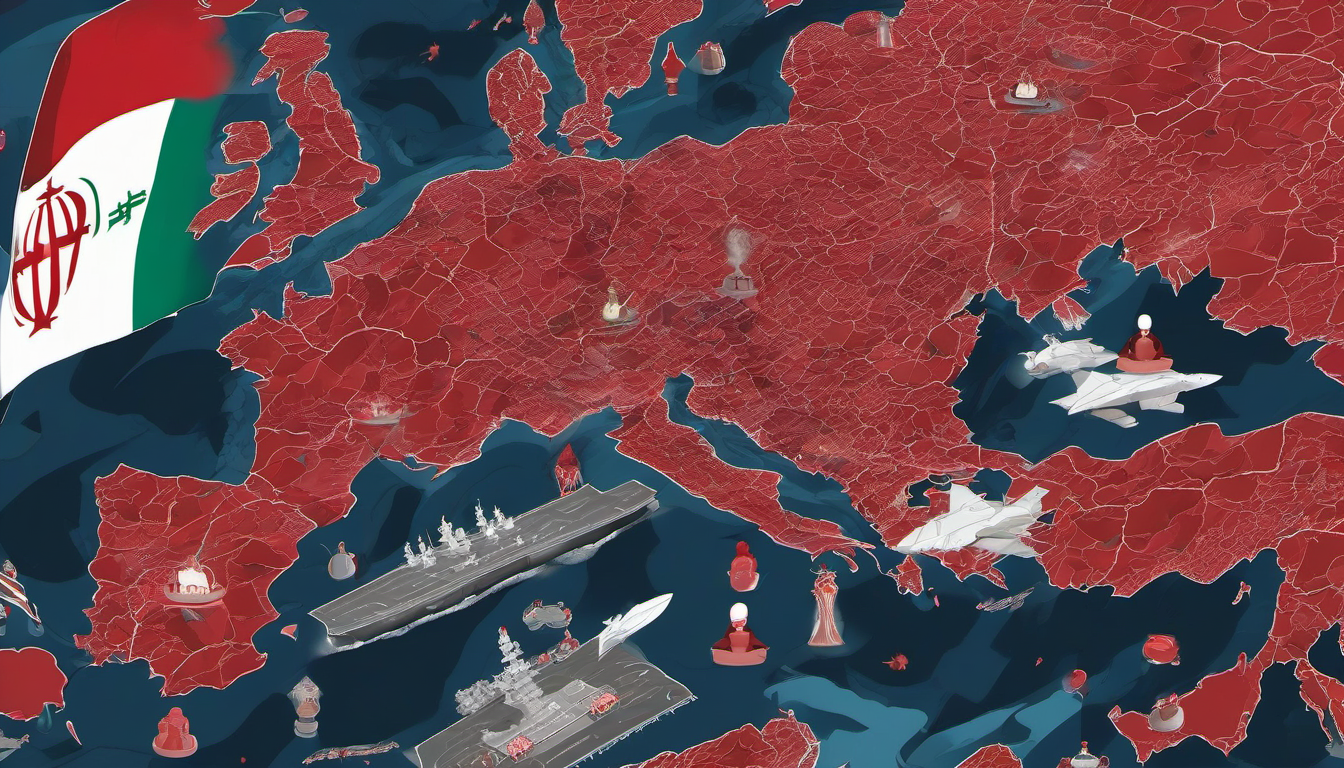
The military posture tells its own story. Two carrier strike groups — the USS Abraham Lincoln and USS Gerald R. Ford — are converging on the region. Dozens of fighter jets, B-2 bombers, and refueling aircraft are massing within striking distance. Senior U.S. officials told CBS News that the military briefed Trump it is "ready for potential strikes as soon as Saturday," though the timeline is likely to extend.
Chapter 2: Iran's War Preparation — Lessons from June
Iran is not the same target it was eight months ago. CNN's analysis of satellite imagery reveals a systematic fortification campaign:
Missile Infrastructure Rebuilding: At the Imam Ali Missile Base in Khorramabad — where Israel destroyed a dozen structures — three have been rebuilt, one repaired, and three more are under construction. The Tabriz air base's runways and taxiways have been restored. Most critically, the Shahrud solid-propellant missile production facility has been rebuilt so rapidly that "solid propellant missile motor production might be greater now than before the war," according to Sam Lair of the James Martin Center for Non-proliferation Studies.
Nuclear Hardening: Iran is burying its most sensitive nuclear facilities under layers of concrete and soil. At Natanz, fresh concrete is being poured at tunnel entrances into Pickaxe Mountain. At the Taleghan 2 facility in the Parchin military complex, Iran has completed a concrete sarcophagus and is covering it with soil. David Albright of the Institute for Science and International Security warned the facility "may soon become a fully unrecognizable bunker."
Leadership Security: Iran has appointed Ali Shamkhani — a war veteran and former secretary of the Supreme National Security Council — to a senior position, signaling preparations for a potential decapitation strike. The IRGC has conducted live-fire drills in the Strait of Hormuz, and Iran held joint naval exercises with Russia in the Indian Ocean on February 19.
Domestic Crackdown: The January protests were violently suppressed, but 40-day mourning ceremonies for slain protesters are producing new anti-government chants. Iran's regime faces the classic authoritarian dilemma: the security forces needed to resist external attack are the same ones needed to suppress internal dissent.
In a letter to the UN Security Council, Iran's ambassador declared that while Tehran "does not seek tension or war," any U.S. aggression would be met "decisively and proportionately," with "all bases, facilities, and assets of the hostile force in the region" constituting "legitimate targets."
Chapter 3: The Coercive Diplomacy Paradox
The current crisis embodies what political scientists call the "coercive diplomacy paradox" — where the threat of force designed to produce concessions may instead eliminate the possibility of a deal.
The American Calculus: Trump's team appears to believe that massing military force will compel Iran to make concessions it has refused for years: not just nuclear enrichment limits, but scaling back its ballistic missile program and severing ties with proxy groups. The June 2025 war demonstrated that the U.S. can inflict devastating damage. The logic is that Iran, having experienced it once, will not want to endure it again.
The Iranian Calculus: Tehran sees the situation through a different lens. The June ceasefire came without fundamental concessions on either side. Iran's written proposal to address U.S. concerns — expected within days — focuses on nuclear issues alone, excluding missiles and proxies. A senior regional official told NPR that "Trump ordering a limited strike aimed at pressuring Iran could backfire and lead to Supreme Leader Ali Khamenei withdrawing Iran from the talks entirely."
The Historical Parallel: The closest analogy is not the Iraq War but the Cuban Missile Crisis of 1962 — a moment when massive military forces converge while diplomatic back-channels remain active. The critical difference: in 1962, both sides had clear communication channels and a shared interest in avoiding nuclear war. Today, talks are indirect (through Omani mediators), trust is near zero after the June "negotiations-as-smokescreen" episode, and the U.S. explicitly includes regime change among its options.
| Factor | June 2025 (Midnight Hammer) | February 2026 (Current) |
|---|---|---|
| Target Set | Nuclear sites, missile bases | Leaders, IRGC, regime apparatus |
| Objective | Degrade capability | Regime change possible |
| Iranian Preparation | Caught off guard | 8 months of fortification |
| Diplomatic Channel | Pre-strike smokescreen | Active but mistrusted |
| Regional Allies | Israel co-belligerent | Israel + broader coalition |
| Iranian Retaliation Capacity | Hundreds of missiles/drones | Rebuilt + potentially greater |
| Proxy Network | Hezbollah weakened | Partially reconstituted |
| International Evacuations | Post-hoc | Pre-emptive (Poland, Germany) |
Chapter 4: Four Scenarios for a Post-Khamenei Iran
As Georgetown University's Marc Lynch argues in Foreign Policy, one thing is virtually certain: even if the U.S. strikes, there will be no ground invasion or occupation. Trump has consistently called Iraq a "big fat mistake." The pattern — from the Maduro capture to the Soleimani killing to the Nasrallah assassination — is to "target top leaders and then let the cards fall where they may."
But where will those cards fall?
Scenario A: The Regime Survives (40%)
Premise: Strikes destroy some nuclear and military infrastructure but fail to kill Khamenei and senior leadership. The regime weathers the storm as it did in June 2025.
Why this probability: History shows that air power alone rarely topples regimes. Serbia's Milošević survived 78 days of NATO bombing in 1999. Saddam Hussein survived Operation Desert Fox in 1998. Iran has spent eight months precisely preparing for this contingency — dispersing leadership, hardening bunkers, and rooting out intelligence penetrations.
Trigger conditions: Iran's counter-intelligence succeeds in hiding senior leaders; strike packages focus on military rather than leadership targets; Iran retaliates proportionately without triggering wider escalation.
Market impact: Oil spikes 15-25% short-term, then normalizes. Gold rises. Status quo resumes within months. Iran accelerates nuclear reconstitution underground.
Scenario B: IRGC Military Junta (25%)
Premise: Khamenei is killed, but the IRGC — with 190,000+ personnel and deep economic interests — seizes control, establishing an overtly military government that drops the theocratic veneer.
Why this probability: The IRGC controls an estimated 20-40% of Iran's economy. It has its own parallel military, intelligence, and economic structures. In a leadership vacuum, it is the best-organized institution to fill the void. Egypt's post-Mubarak trajectory (military-to-military transition) and Myanmar's 2021 coup provide templates.
Trigger conditions: Successful decapitation of clerical leadership; IRGC command structure survives intact; rapid consolidation before rival factions organize.
Market impact: Moderate disruption. Junta likely maintains oil exports for economic survival. Nuclear program continues covertly. Regional proxy policies may intensify as junta seeks nationalist legitimacy.
Scenario C: Fragmentation and Civil Conflict (25%)
Premise: Strikes decimate both the clerical and IRGC leadership, creating a power vacuum that Iran's diverse ethnic and political factions rush to fill. Kurds, Azeris, Baluchis, Arabs, and various political factions contest control.
Why this probability: Iran's multi-ethnic composition (Persians ~61%, Azeris ~16%, Kurds ~10%, Lurs ~6%, Arabs ~2%, Baluchis ~2%) makes fragmentation a genuine risk if central authority collapses. Libya post-Gaddafi and Iraq post-Saddam both followed this trajectory despite optimistic Western predictions.
Trigger conditions: Comprehensive decapitation striking both clerical and military leadership; simultaneous ethnic uprisings; external actors (Turkey, Saudi Arabia, Russia) backing different factions.
Market impact: Severe and prolonged. Iranian oil production (currently ~3.2 million bpd) could collapse. Hormuz transit risk elevates. Refugee crisis impacts Turkey, Iraq, Pakistan. Brent crude could exceed $90-100.
Scenario D: Democratic Transition (10%)
Premise: The regime falls, and Iran's vibrant civil society, educated diaspora, and democratic traditions produce a negotiated transition.
Why this probability: While many Iranians desire democracy — as shown by the 2022-2023 protests and the January 2026 uprising — airstrikes create the worst possible conditions for democratic institution-building. No external power is willing to fund or support a transition. Iraq's post-2003 experience shows that removing a regime without a reconstruction plan produces chaos, not democracy. Lynch notes that Trump "could not care less about democracy promotion."
Trigger conditions: Regime collapse accompanied by immediate formation of a broad-based transitional council; international willingness to provide reconstruction aid; restraint by regional powers.
Market impact: Long-term positive, but transition period highly volatile. Potential normalization of Iranian oil exports (5+ million bpd capacity) would restructure global energy markets over 3-5 years.
Chapter 5: Investment Implications — Pricing the Unthinkable
Energy Markets: The immediate risk is not Iranian production disruption but Hormuz transit. Some 21 million barrels per day flow through the strait. Iran's UN letter explicitly threatened "all bases, facilities, and assets" in the region. Even a partial disruption would dwarf any supply shock since the 1973 oil embargo.
Defense Sector: A second Iran campaign would validate the global rearmament thesis. Precision munitions inventories, already strained by Ukraine, would require emergency replenishment. Raytheon (RTX), Lockheed Martin (LMT), and Northrop Grumman (NOC) stand to benefit.
Gold and Safe Havens: Gold at $5,000 already reflects geopolitical risk premium. A strike scenario could push toward $5,500-6,000. The dollar's reaction would depend on the strike's success — a clean operation strengthens it, a protracted conflict weakens it.
Insurance and Shipping: War risk premiums in the Persian Gulf would spike to levels not seen since the Iran-Iraq War tanker war (1984-1988). Shipping rates for Gulf-origin crude would rise sharply.
| Asset Class | Scenario A (Survive) | Scenario B (Junta) | Scenario C (Fragmentation) | Scenario D (Democracy) |
|---|---|---|---|---|
| Brent Crude | +15-25% (temp) | +10-15% (sustained) | +40-60% (prolonged) | +20% then -30% (normalization) |
| Gold | +5-8% | +3-5% | +10-15% | Flat to -5% |
| Defense Stocks | +8-12% | +5-8% | +15-20% | +3-5% |
| Gulf Shipping | +200-300% WR premium | +150-200% | +400%+ | +100% then normalization |
Conclusion: The Graveyard of Decisive Victories
Lynch's most piercing observation is this: "Whether through a deal or war, Trump's goal seems to be to decisively end the United States' decades-long struggle with Iran. But decisive victories tend to be elusive." The June 2025 campaign was supposed to "totally obliterate" Iran's nuclear program. Eight months later, missile production capacity may exceed pre-war levels, nuclear sites are being buried deeper underground, and the regime — battered but standing — is preparing for round two.
The decapitation gambit represents the ultimate escalation of a strategy that has failed to produce results through lesser means. If it succeeds in killing Khamenei, the aftermath will be determined not by American military power but by forces Washington cannot control: Iranian factional politics, ethnic tensions, regional power dynamics, and the stubborn reality that destroying a regime is far easier than building what comes after.
The 10-15 day clock is ticking. The cards are about to be dealt. The question is whether anyone at the table knows what game they're playing.
Related Reading
- Iran's Last Gamble: The Dual Strategy — EcoStream analysis of the military buildup
- The Nuclear Thaw Trap — Geneva 'basic principles' agreement analysis
- Energy & Resources Hub — Oil market coverage
- Middle East Hub — Regional geopolitics
Sources: Reuters, NPR, CNN, Foreign Policy, CBS News, Institute for Science and International Security, James Martin Center for Non-proliferation Studies
Leave a Reply