
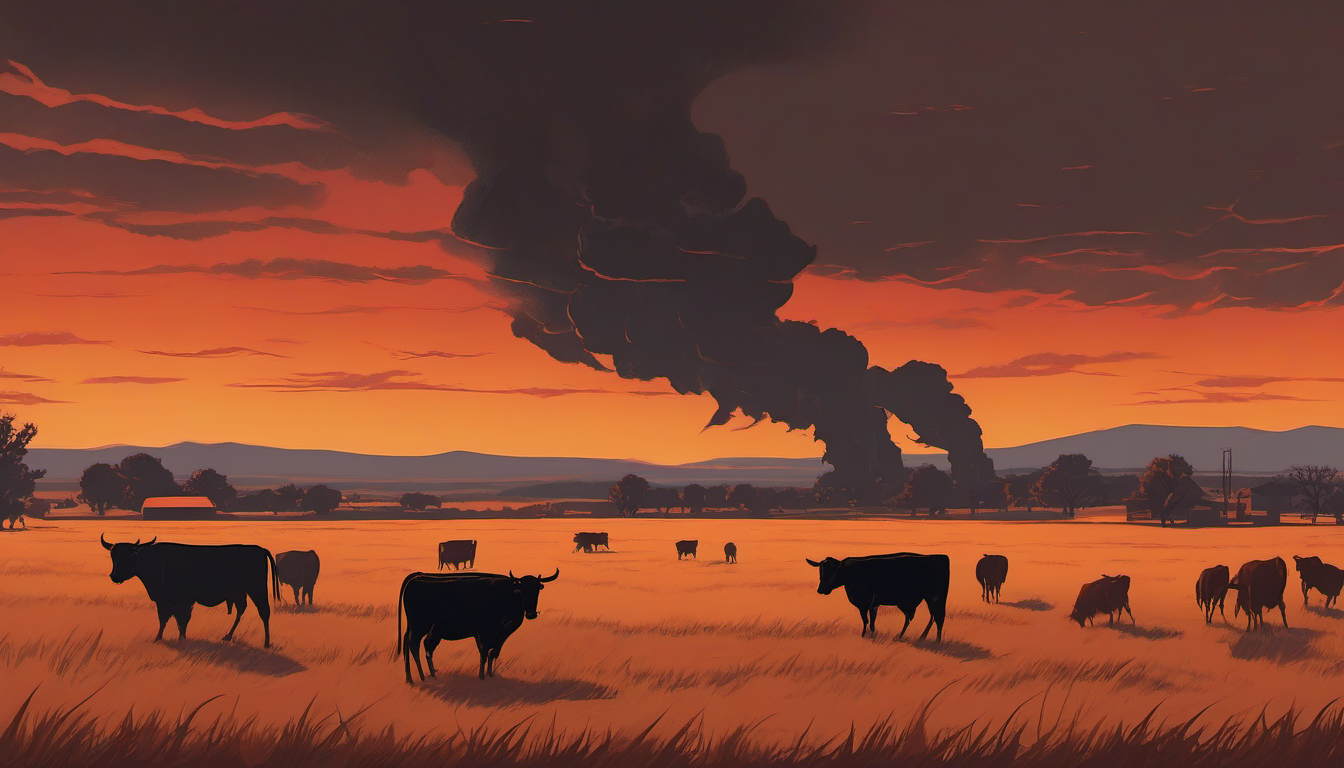
A 300,000-acre inferno exposes the compounding fragility of the Southern Plains — where six years of relentless drought, a shrinking cattle herd, and a warming climate collide
Executive Summary
- The Ranger Road megafire has scorched over 300,000 acres across Oklahoma and Kansas in four days — nearly twice the size of Chicago — killing at least two people, an estimated 10,000 cattle, and destroying structures across three counties, while separate fires burn across Texas, Colorado, and New Mexico.
- This disaster is not an anomaly but the predictable consequence of a six-year drought cycle that has already cost the Southern Plains agriculture industry $23.6 billion since 2020, with five consecutive La Niña winters draining reservoirs to record lows and leaving rangelands as tinderboxes.
- The megafire arrives at the worst possible moment for American ranchers: the U.S. cattle herd sits at a 75-year low, farm bankruptcies surged 46% in 2025, and the federal safety net is fraying as OBBBA slashes agricultural disaster programs — threatening a structural transformation of the American beef industry and accelerating the rural economic crisis.
Chapter 1: The Anatomy of a Megafire
On Tuesday, February 17, 2026, at approximately 1:00 PM Central Time, a wildfire ignited in Beaver County, Oklahoma — the remote northwestern panhandle that locals call "No Man's Land." Within eight hours, the Ranger Road Fire had consumed an area equivalent to three to four football fields every second, driven by winds gusting over 60 mph across bone-dry grasslands.
By Thursday evening, the fire had burned 283,283 acres in Oklahoma and Kansas, reaching 60 miles northward from its origin to cross the state line. The blaze was only 20% contained. This is a megafire — defined as any wildfire exceeding 100,000 acres — and it is the largest wildfire event in the Southern Plains since the Smokehouse Creek Fire devastated the Texas Panhandle in 2024, burning over 500 structures.
The human toll has been severe but, given the fire's scale, remarkably contained by rapid evacuations. At least two residents died. In Woodward, Oklahoma — a city of 12,000 — approximately 4,000 people were evacuated Tuesday afternoon as flames raced toward residential neighborhoods. In Kansas, the towns of Englewood and Ashland were fully evacuated. Eight firefighters were injured across both states.
But it is the agricultural devastation that will define this disaster's economic legacy. An estimated 10,000 head of cattle have perished. One Kansas rancher alone lost 500 head. Senator Casey Murdock (R-OK), whose district encompasses all four major fire zones, captured the deeper loss: "Ranchers spend a lifetime building their herds, building that genetics. It's not the monetary value — it's that genetic loss, that lifetime of building is gone."
The fires did not stop at the Ranger Road blaze. Across the Southern Plains this week:
| Fire | Location | Acres Burned | Containment |
|---|---|---|---|
| Ranger Road | Beaver Co., OK / Kansas | 283,283 | 20% |
| Lavender | Texas Panhandle | 18,300 | 40% |
| Stevens | Texas Co., OK | 12,428 | Active |
| Side Road | Texas Co., OK | 3,680 | Active |
| 43 Fire | Woodward Co., OK | 1,680 | Contained |
Beyond the fires, the same wind event killed at least six people in dust storm-related vehicle crashes — five in a 30-vehicle pileup on Interstate 25 south of Pueblo, Colorado, and one in Thomas County, Kansas — a grim echo of the Dust Bowl-era "black blizzards" that devastated these same plains nine decades ago.
Chapter 2: Six Years of Drought — The Slow Catastrophe
The Ranger Road megafire did not emerge from nothing. It is the product of six consecutive years of drought — the longest sustained dry period in the Southern Plains since the Dust Bowl itself.
Since 2020, Kansas, Oklahoma, and Texas have endured a relentless cycle of flash droughts, failed monsoons, and La Niña-driven dry winters. A joint assessment by the Southern Regional Climate Center and the National Integrated Drought Information System, published in February 2026, documented $23.6 billion in agricultural losses across the three states from 2020 through 2024 alone — and 2025 and 2026 have only added to the toll.
Three structural factors explain why this drought refuses to break:
The La Niña trap. Five of the past six years exhibited La Niña conditions, which systematically suppress winter precipitation in the Southern Plains. Winter 2025-2026 is no exception. Nearly 200 weather stations across the region are recording their warmest winter on record, according to NOAA data.
Water supply depletion. San Antonio's reservoirs reached record lows in 2024-2025. The Edwards Aquifer, which supplies 2.5 million people, remains critically depleted. Along the Rio Grande, the Elephant Butte reservoir stands at just 11% capacity, Amistad at 34%, Falcon at 20%. Colorado's concurrent snow drought means less snowmelt to replenish these systems come summer — a cascading failure across state lines.
Incomplete recovery cycles. The Southern Plains suffered a severe drought from 2010 to 2015. Rangelands and ranching operations had only five years to recover before the current drought began in 2020. As the drought assessment noted, the landscape behaved "like someone with an already weakened immune system who caught a cold." Historically, droughts of this magnitude strike the region roughly once per decade. But with back-to-back events and rising temperatures accelerating flash drought frequency, the recovery window is shrinking.
The result: millions of acres of dead, dormant grassland — perfect fuel for precisely the kind of fire that erupted this week.
Chapter 3: The American Cattle Crisis
The megafire strikes an industry already in existential distress. The U.S. cattle herd sat at a 75-year low entering 2026, the result of years of forced liquidations as ranchers sold animals they could no longer afford to feed on drought-scorched pastures.
The economics are devastating. At current cattle prices — near historic highs due to the supply squeeze — each lost animal represents roughly $2,000-$3,000 in value. But Senator Murdock's point about genetics goes deeper: many of these herds represent decades of selective breeding, a form of agricultural intellectual property that cannot be replaced by simply purchasing new animals. Rebuilding a genetically optimized herd takes 5-10 years.
Even ranchers who saved their cattle face a feed crisis. Thousands of acres of grazing land are now ash. As one Oklahoma State University extension officer noted, producers will need to purchase hay to feed their herds until grass grows back — a period of months — at a time when hay prices are already elevated by regional drought.
This compounds a broader crisis in American agriculture:
- Farm bankruptcies surged 46% in 2025, reaching 315 Chapter 12 filings — with Wisconsin up 700% and Iowa up 220%.
- 76% of crop-sector operations declared themselves in financial distress.
- Total U.S. farm debt exceeds $540 billion.
- The One Big Beautiful Bill Act (OBBBA) is poised to cut $187 billion from SNAP and agricultural disaster programs.
- 15,000 farming operations disappeared in 2025 alone.
The cattle industry's plight is particularly acute. The 2024 Smokehouse Creek Fire in Texas — the state's largest wildfire ever — killed an estimated 7,000 cattle and burned over a million acres of rangeland. The industry had barely begun to recover when the Ranger Road Fire struck. The Southern Plains, which accounts for a substantial share of America's beef production, is losing productive capacity faster than it can rebuild.
Chapter 4: Climate, Insurance, and the Feedback Loop
The megafire fits a pattern that climate scientists have warned about for years: warming temperatures create drier conditions, which produce more and larger wildfires, which destroy the vegetation that would otherwise retain soil moisture, which makes subsequent droughts worse. It is a self-reinforcing cycle.
The insurance industry is already responding — or, more accurately, retreating. The "Great Uninsuring" trend that has seen insurers flee California and Florida is beginning to affect agricultural regions. Crop insurance and livestock risk protection programs, administered through the USDA's Risk Management Agency, remain available, but coverage limits often lag behind the true replacement cost of genetically optimized herds. And the federal disaster declaration process — Governor Stitt declared emergencies for Beaver, Texas, and Woodward counties — unlocks state resources but may be insufficient for a disaster of this scale.
The broader insurance mathematics are sobering:
- The global property insurance industry has recorded six consecutive years of $100 billion+ in catastrophic losses.
- Wildfire losses, once considered a California problem, are increasingly affecting the Plains and Rockies.
- The 2024 Smokehouse Creek Fire generated over $100 million in insured losses — and the Ranger Road Fire may exceed that.
- Agricultural insurance premiums have risen 15-25% annually in drought-affected regions since 2022.
Meanwhile, the federal government's capacity to respond is diminished. The 43-day partial government shutdown that ended only recently disrupted USDA services. The OBBBA's proposed cuts to agricultural safety net programs threaten to reduce disaster assistance precisely when it is most needed. And the broader erosion of federal climate data — including the USDA's suspension of its 30-year food security survey — means policymakers are increasingly flying blind.
Chapter 5: Scenario Analysis
Scenario A: Managed Decline (45%)
Premise: Drought conditions persist through spring 2026 as La Niña weakens but does not fully dissipate. Additional fires are likely but smaller. Federal disaster assistance flows but is insufficient for full recovery.
Evidence: The current La Niña cycle is weakening but forecasters project neutral conditions only by mid-2026. Historical patterns suggest the drought will not fully break until a strong El Niño event delivers above-normal winter precipitation — which may not occur until 2027-2028. The six-year drought assessment found that even when rains return, water supplies and rangelands require 3-5 years to recover.
Outcome: Continued cattle herd liquidation. U.S. beef production falls further, pushing retail beef prices 15-25% higher by late 2026. Ranching operations consolidate as smaller operators exit. The Southern Plains gradually shifts toward fewer, larger corporate ranching operations — a structural transformation that mirrors what happened in the Midwest grain belt after the 1980s farm crisis.
Historical precedent: The 2010-2015 Southern Plains drought led to a decade-long cattle herd contraction. Full recovery to pre-drought herd levels was never achieved before the current drought began.
Scenario B: El Niño Relief (30%)
Premise: An El Niño pattern develops by late 2026, delivering above-normal winter precipitation to the Southern Plains and beginning to refill depleted reservoirs.
Evidence: ENSO forecasts show increasing probability of El Niño development in the second half of 2026, though confidence is low this far out. When El Niño does arrive, it historically delivers 20-40% above-normal precipitation to the Southern Plains in winter months.
Trigger: A definitive El Niño forecast from NOAA's Climate Prediction Center by August-September 2026.
Outcome: Drought conditions ease significantly by early 2027. Rangeland begins to recover. Cattle rebuilding begins but takes 5-10 years to restore herd genetics. Agricultural losses still exceed $30 billion for the 2020-2026 period, but the crisis stabilizes. Insurance markets cautiously return.
Scenario C: Dust Bowl Redux (25%)
Premise: La Niña persists or ENSO-neutral conditions deliver below-normal precipitation through 2027. Additional megafire events in spring and summer 2026. Climate change-driven temperature increases push the region beyond historical drought thresholds.
Evidence: Climate models project that the Southern Plains will experience 15-25% more flash drought events per decade by 2050 due to rising temperatures. The current drought has already exceeded the 2010-2015 event in duration and is approaching it in cumulative economic damage. If the 2026-2027 winter fails to deliver adequate precipitation, the six-year drought becomes a seven-year event — matching the worst sustained droughts in the instrumental record.
Trigger: NOAA Climate Prediction Center confirms La Niña persistence or below-normal precipitation through spring 2027.
Outcome: Wholesale transformation of the Southern Plains agricultural economy. Cattle ranching contracts dramatically in western Oklahoma, the Texas Panhandle, and western Kansas. Rural depopulation accelerates. Water rationing becomes permanent in parts of central and western Texas. Agricultural insurance becomes prohibitively expensive or unavailable. Federal intervention at the scale of the 1930s Dust Bowl relief programs becomes necessary.
Historical precedent: The Dust Bowl (1930-1936) displaced 2.5 million people from the Plains and permanently transformed American agricultural policy, leading to the creation of the Soil Conservation Service and modern farm subsidy programs.
Chapter 6: Investment Implications
Beef and livestock markets: U.S. cattle futures are likely to see renewed upward pressure. The 75-year low in the national herd, combined with ongoing losses from fire and drought, constrains supply for years. Live cattle futures (CME: LE) and feeder cattle futures (CME: GF) reflect this tightness, but additional wildfire-driven losses could push prices to new highs.
Agricultural inputs: Hay and feed prices in the Southern Plains will spike in the near term. Companies with exposure to livestock feed (ADM, Bunge) may see margin impacts as demand rises and regional supply constraints bite.
Insurance: Agricultural reinsurers face growing exposure. Munich Re and Swiss Re have both flagged increasing wildfire losses outside traditional wildfire zones. Crop and livestock insurance programs administered through the USDA's Risk Management Agency may require additional federal appropriations.
Water infrastructure: The chronic depletion of Southern Plains water supplies creates long-term demand for water infrastructure investment — desalination, aquifer recharge, and inter-basin transfer projects. Companies like Xylem (XYL) and Mueller Water Products (MWA) are positioned beneficiaries.
Energy: The fires have not yet disrupted Oklahoma's oil and gas production, but the concentration of pipeline infrastructure in the affected region creates latent risk. Natural gas prices could see upward pressure if fire damage disrupts gathering systems.
Conclusion
The Ranger Road megafire is not a natural disaster in the traditional sense. It is the predictable result of six years of compounding drought, a warming climate that turns grasslands into accelerants, and an agricultural economy already stretched to breaking point. The 300,000 acres of scorched earth across Oklahoma and Kansas are a physical manifestation of a deeper crisis: the American Plains are drying out, and the human systems that depend on them — ranching, farming, water supply, rural communities — are being stretched beyond their adaptive capacity.
The federal response will be critical. But with agricultural disaster programs facing cuts, federal workforce capacity diminished, and climate data collection disrupted, the institutional infrastructure needed to manage this crisis is itself in crisis. The Southern Plains is experiencing what drought researchers call a "recovery deficit" — each successive drought arrives before the last one's damage is fully healed. Without a break in the cycle, the question is not whether the next megafire will come, but when.
Sources: CNN, KCUR/KOSU (NPR), NOAA, Oklahoma Forestry Service, NASA FIRMS, Southern Regional Climate Center, National Integrated Drought Information System, Insurance Journal, USA Today, Fox Weather
Leave a Reply