
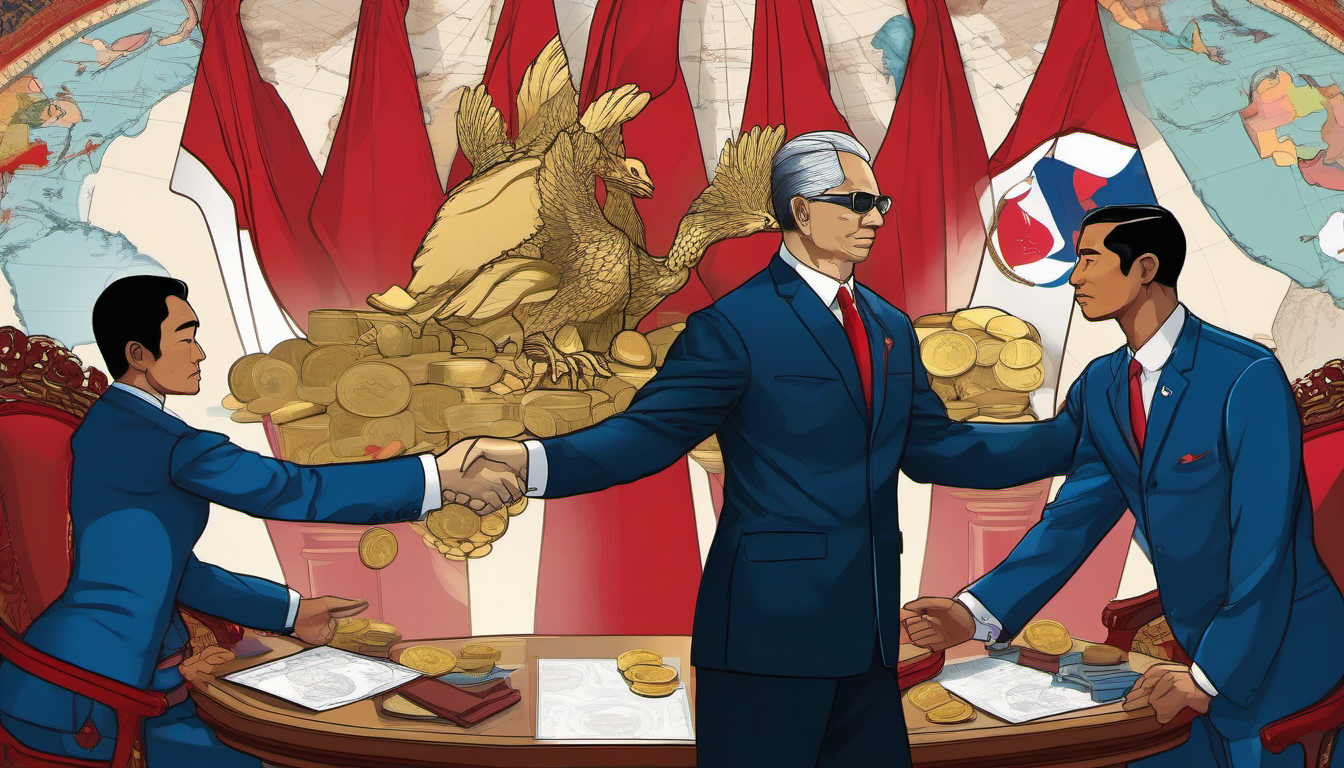
How Southeast Asia's largest economy traded sovereignty for survival in Trump's new world order
Executive Summary
- Indonesia signed the most comprehensive bilateral trade deal any ASEAN nation has ever struck with the United States—a $71 billion package combining trade concessions, military commitments, and critical mineral access that reveals the true price of admission to Trump's tributary system.
- President Prabowo Subianto secured a tariff reduction from 32% to 19% while committing 8,000 troops for Gaza, opening 99% of Indonesia's market to American products, accepting US regulatory standards wholesale, and extending Freeport-McMoRan's control over the world's second-largest copper mine.
- The deal establishes a new template for middle-power diplomacy in the post-SCOTUS era: bundle everything—security, trade, minerals, market access—into one grand bargain, and pray the terms hold before the next executive order.
Chapter 1: The Architecture of Capitulation
On February 19, 2026, as Donald Trump gaveled the inaugural Board of Peace meeting in Washington, Indonesian President Prabowo Subianto sat among the assembled heads of state with something no other leader in the room possessed: a signed trade agreement in hand and a military commitment on the table. The timing was not accidental.
The numbers tell a story of calculated submission. Indonesia agreed to eliminate tariff barriers on over 99% of American exports—agricultural products, pharmaceuticals, automotive goods, chemicals, information technology. In exchange, Washington agreed to lower tariffs on Indonesian goods from 32% to 19%, with exemptions for palm oil, coffee, chocolate, natural rubber, and spices at 0%. A textile quota mechanism would be negotiated separately.
But the tariff headline obscures the deeper concessions. Indonesia committed to:
- Accept FDA standards for medical devices and pharmaceuticals, effectively surrendering regulatory sovereignty over its $12 billion healthcare market
- Accept US federal motor vehicle safety and emission standards, opening the door for American automakers to bypass Indonesia's existing certification regime
- Exempt US companies from local content requirements, dismantling a cornerstone of Indonesia's industrialization strategy that has protected domestic manufacturers since the Suharto era
- Eliminate barriers to US digital trade, including a permanent moratorium on customs duties for electronic transmissions at the WTO—a position Indonesia had long resisted alongside other developing nations
- Adopt a forced labor import ban, subjecting Indonesia's palm oil and mining sectors to American supply-chain scrutiny
- Allow US investment in critical minerals and energy resources under conditions equivalent to domestic investors
The White House fact sheet framed this as "reciprocal trade." Indonesia's Coordinating Minister for Economic Affairs Airlangga Hartarto called it "win-win." Independent trade analysts might reach a different conclusion.
Chapter 2: The $71 Billion Envelope
The commercial component of Prabowo's Washington visit dwarfed any previous Indonesian trade mission. Over the course of the week, Indonesian and American companies signed deals worth approximately $38.4 billion, with the White House highlighting $33 billion in specific commitments:
| Category | Value | Key Details |
|---|---|---|
| Energy commodities | $15B | LNG, crude oil purchases |
| Aviation/Boeing | $13.5B | Commercial aircraft, services |
| Agriculture | $4.5B | US farm products |
| Freeport-McMoRan | ~$10B/yr | Grasberg mine license extension |
| Total announced | $71B+ | Including Freeport revenue |
The Freeport-McMoRan deal deserves particular scrutiny. The company signed a Memorandum of Understanding to extend its mining license and expand operations at the Grasberg minerals district in Papua—the world's second-largest copper mine and largest gold mine. With copper prices at historic highs above $14,000 per tonne and AI-driven demand accelerating, this concession alone could generate $10 billion in annual revenue.
For context: Indonesia nationalized 51% of Freeport's local subsidiary PT Freeport Indonesia in 2018, a move celebrated as a sovereignty milestone. The new MOU effectively reverses this trajectory, granting expanded operations under terms favorable to the American company in exchange for "strengthening US supply chains for critical minerals."
The Boeing order—$13.5 billion in commercial aircraft and aviation services—follows a familiar pattern in Trump-era diplomacy. Like Saudi Arabia, Japan, and India before it, Indonesia's national carrier Garuda and budget airlines Lion Air and Citilink are expected to absorb aircraft purchases that serve as geopolitical tribute as much as commercial procurement.
Chapter 3: Troops for Trade—The Gaza Bargain
Prabowo did not travel to Washington merely to sign a trade agreement. At the Board of Peace inaugural meeting, he committed up to 8,000 Indonesian troops "or more if necessary" to the planned International Stabilization Force (ISF) in Gaza.
This is not a minor commitment. The planned ISF comprises 20,000 soldiers across five sectors, meaning Indonesia would provide 40% of the total force—a staggering ratio for a country with no historical military presence in the Middle East and no strategic interest in Gaza beyond its leverage in Washington.
The force composition proposed by Major General Jasper Jeffers III reveals the deal-making behind the peacekeeping:
| Country | Troop Commitment | What They Got |
|---|---|---|
| Indonesia | 8,000 | Trade deal (32%→19%), Freeport extension |
| Albania | TBD | NATO pathway? |
| Kazakhstan | TBD | Trump "peace prize" mention |
| Kosovo | TBD | US recognition reinforcement |
| Morocco | TBD | Western Sahara recognition maintained |
The pattern is unmistakable: troops for trade. Countries contributing soldiers to Trump's Gaza force are rewarded with bilateral concessions. Indonesia's package is simply the most explicit example.
This echoes a historical pattern that should alarm Jakarta's strategic planners. The Korean War's UN coalition included nations seeking American trade preferences. The Iraq "coalition of the willing" in 2003 featured countries that received preferential treatment in reconstruction contracts. In both cases, the military commitments outlasted the commercial benefits.
Chapter 4: What Prabowo Avoided
Perhaps the most revealing aspect of the deal is what Indonesia successfully excluded. According to Airlangga, Washington dropped several non-economic provisions during negotiations:
-
Nuclear reactor development requirements — The US had initially sought commitments on nuclear energy cooperation, likely tied to the SMR export push that has become a pillar of American energy diplomacy (see: Armenia 123 Agreement, India SHANTI Act). Indonesia resisted.
-
South China Sea provisions — Washington attempted to insert language regarding maritime security in the South China Sea, where Indonesia's Natuna Islands sit at the edge of China's nine-dash line claim. Jakarta refused to turn a trade agreement into a security pact.
-
Transshipment restrictions — The US sought to address Chinese goods being routed through Indonesia to avoid tariffs. Airlangga simply denied such transshipment exists—a diplomatically convenient fiction given that Chinese FDI in Indonesia has surged 400% since 2020.
These exclusions suggest Prabowo's negotiators were more sophisticated than the headline concessions imply. By yielding on regulatory standards and market access while holding firm on sovereignty-sensitive issues, Indonesia preserved its strategic flexibility vis-à-vis China—its largest trading partner and the primary rival to American influence in Southeast Asia.
Chapter 5: Scenario Analysis—Where This Goes
Scenario A: The Model Tributary (40%)
Indonesia implements the deal faithfully. American agricultural exports flood Indonesian markets, displacing local producers. Freeport-McMoRan's expanded Grasberg operations generate copper and gold revenues that flow primarily to American shareholders. Indonesian troops deploy to Gaza, suffer casualties in an intractable conflict, and become politically toxic at home. Prabowo's popularity drops as rising import competition hurts SMEs—the backbone of Indonesia's informal economy.
Historical precedent: Philippines under Marcos Sr.'s Laurel-Langley Agreement (1955-1974), which granted American businesses parity rights with Filipino nationals. The agreement fueled economic dependence and political resentment that lasted decades.
Trigger: Implementation of FDA/vehicle standards leads to closure of Indonesian pharmaceutical manufacturers and auto parts suppliers within 18 months.
Scenario B: The Strategic Hedger (35%)
Prabowo uses the deal as a shield against American pressure while quietly maintaining—and deepening—economic ties with China. The 90-day implementation period and "changes could still occur" clause provide legal off-ramps. Indonesia delays full regulatory harmonization through bureaucratic friction. The Gaza troop commitment gets downsized in practice as operational difficulties mount.
Historical precedent: Thailand under Thaksin Shinawatra (2001-2006), which signed a US-Thailand FTA framework while simultaneously deepening economic ties with China. The FTA was never ratified; the China relationship endured.
Trigger: China offers a counter-deal—perhaps accelerated Belt and Road investment in the new capital Nusantara, or preferential access for Indonesian palm oil.
Scenario C: The SCOTUS Unraveling (25%)
The Supreme Court's IEEPA ruling on February 20—one day after Indonesia signed—casts the entire deal into legal uncertainty. Trump's tariff regime was the stick that drove countries to negotiate; with IEEPA tariffs struck down and Section 122 capped at 15%, Indonesia's 19% rate may need renegotiation. If the effective US tariff rate drops to 8-9% globally, Indonesia's hard-won concessions may have been unnecessary.
Historical precedent: Mexico's experience after the original NAFTA was renegotiated into USMCA, only for Trump to threaten withdrawal again in 2026. Bilateral deals with unilateral presidents are inherently unstable.
Trigger: Section 122's 150-day sunset forces tariff restructuring by July 2026, rendering the current deal terms moot.
Chapter 6: Investment Implications
Winners:
- Freeport-McMoRan (FCX): Grasberg expansion is transformative. With copper in structural deficit and gold at $5,000, the mine extension could add $15-20B to FCX's market capitalization.
- Boeing (BA): $13.5B order book addition at a time when the company desperately needs orders to compete with Airbus's 870-aircraft 2026 delivery target.
- US agricultural exporters: Indonesia's 280 million consumers represent one of the last major untapped markets for American soybeans, beef, and dairy.
Losers:
- Indonesian pharmaceutical manufacturers: FDA standard acceptance could eliminate 40-60% of domestic drug makers that cannot meet US Good Manufacturing Practice requirements.
- Indonesian automotive parts suppliers: Acceptance of US vehicle safety standards bypasses Indonesia's existing certification ecosystem that has protected local industry.
- Danantara sovereign wealth fund: The deal's critical mineral provisions may conflict with Danantara's mandate to consolidate state control over natural resources—the same mandate that triggered the MSCI downgrade scare.
Watch list:
- Nickel and copper miners: Indonesia holds 22% of global nickel reserves. The "critical minerals access" clause could reshape global supply chains for EV batteries.
- Palm oil producers: Zero-tariff access to the US sounds positive, but the forced labor import ban could trigger compliance costs that offset tariff savings.
Conclusion
Prabowo's Grand Bargain is the most comprehensive bilateral deal of the Trump era—and the most revealing. It demonstrates that in the new tributary trade system, the price of American market access is not merely economic concession but military commitment, regulatory surrender, and mineral extraction rights.
The deal's timing—signed one day before the Supreme Court invalidated the tariff regime that created it—adds a layer of dark irony. Indonesia negotiated for months under duress from 32% tariffs imposed under emergency powers that the nation's highest court has now declared unconstitutional. Whether the concessions can be clawed back remains to be seen.
For Southeast Asia's largest economy, the grand bargain represents a bet on American power at precisely the moment that power's legal foundations have been shaken. Prabowo has calculated that proximity to Washington is worth the price. History suggests that middle powers who make such calculations rarely get to renegotiate the terms.
Sources: White House Fact Sheet (Feb 19, 2026), Reuters, Channel News Asia, The Guardian, CNBC, NPR
Leave a Reply