
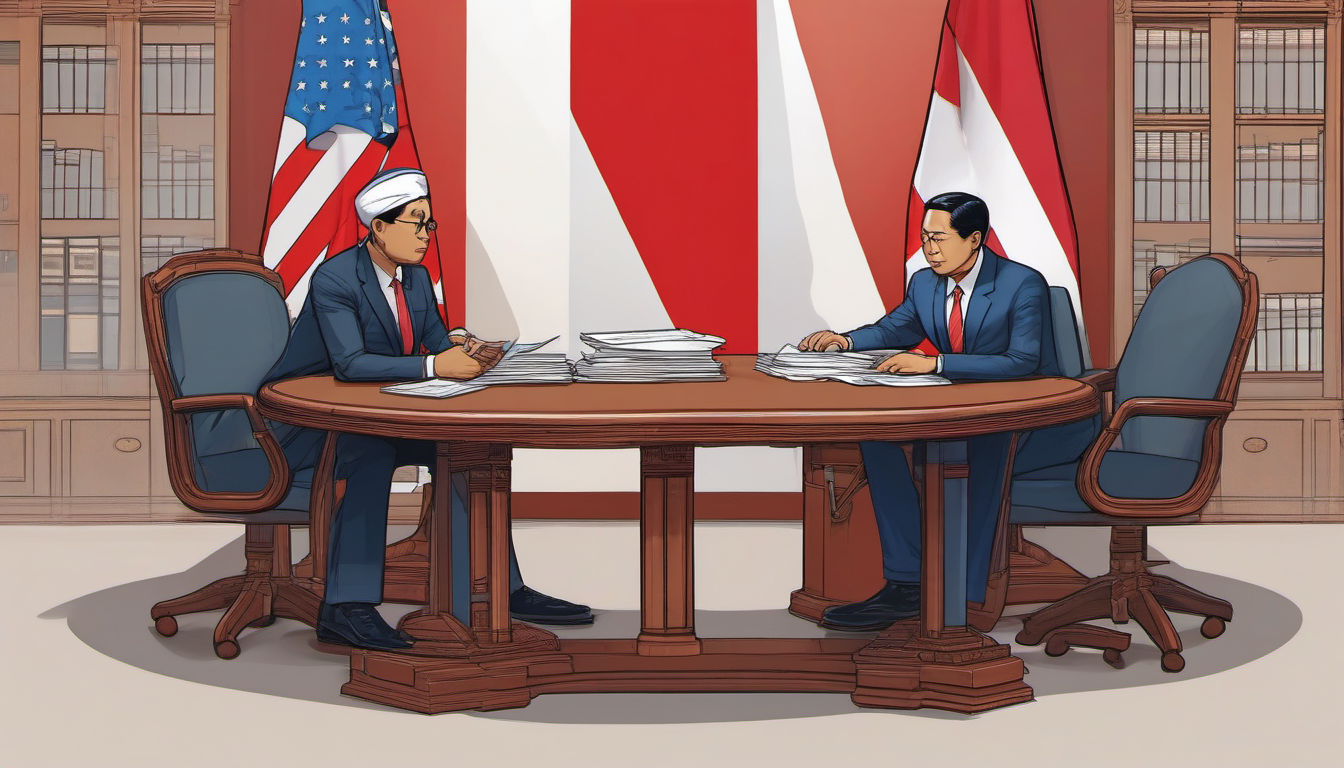
Prabowo signs a sweeping trade agreement with Washington—but the fine print reveals an asymmetry that critics call economic colonization
Executive Summary
- Indonesia signed a landmark trade agreement with the United States on February 20, locking in a 19% tariff rate (down from 32%) in exchange for eliminating barriers on 99% of U.S. imports and committing to $38.4 billion in commercial deals—but the agreement contains 217 obligations for Jakarta versus just 6 for Washington.
- The deal dismantles core pillars of Indonesia's industrial policy, including local content requirements (TKDN), export restrictions on critical minerals, and barriers to 100% foreign ownership in mining, fisheries, and finance—raising fears that Indonesia will regress to a raw material supplier.
- The agreement arrives at a critical juncture for Prabowo's presidency, already battered by an $80 billion stock market crash, Moody's negative outlook, and the Danantara sovereign wealth fund controversy, making this deal both a political lifeline and a potential economic trap.
Chapter 1: The Deal on Paper
On February 20, 2026, President Prabowo Subianto stood alongside Donald Trump in Washington to sign what the White House called a "landmark trade agreement." The headline numbers were impressive: Indonesia's tariff rate locked at 19% (down from 32%), over 1,700 Indonesian goods exempted from additional tariffs—including palm oil, coffee, spices, chocolate, and natural rubber—and $38.4 billion in commercial deals spanning mining, technology, textiles, and energy.
Indonesia committed to purchasing approximately $15 billion of U.S. energy commodities, $13.5 billion of Boeing aircraft and aviation services, and $4.5 billion of American agricultural products. Freeport-McMoRan signed a memorandum of understanding to extend its mining license at the Grasberg complex—the world's second-largest copper mine—a deal expected to generate $10 billion in annual revenue.
Coordinating Minister for Economic Affairs Airlangga Hartarto declared that 90% of Indonesia's requests on tariff terms were accepted, calling the agreement a "win-win" that respects the sovereignty of both nations.
But the fine print told a different story.
Chapter 2: The Asymmetry — 217 Versus 6
The 45-page Agreement on Reciprocal Trade (ART) document reveals a stark structural imbalance. According to an analysis by the Center of Economic and Law Studies (Celios), Indonesia accepted at least 217 specific obligations. The United States committed to just six, with three additional mutual obligations.
What Indonesia conceded:
| Category | Key Concessions |
|---|---|
| Market Access | Eliminate tariff barriers on 99%+ of U.S. products |
| Industrial Policy | Exempt U.S. firms from local content requirements (TKDN) |
| Standards | Accept FDA standards for medical devices/pharmaceuticals, U.S. motor vehicle safety and emission standards |
| Digital Trade | Eliminate tariffs on "intangible products," support permanent WTO e-commerce moratorium |
| Critical Minerals | Remove all export restrictions on minerals to the U.S. |
| Foreign Ownership | No divestment requirements in mining, fisheries, and finance |
| Labor | Adopt forced labor import ban, reform union restrictions |
| Geopolitical | Cooperate on export controls, investment security screening |
What the United States conceded:
| Category | Key Concessions |
|---|---|
| Tariff Rate | Maintain 19% (down from 32%) |
| Textile Exemptions | Zero-tariff for certain textiles using U.S. cotton/fiber inputs |
| Section 232 | "Positively consider" effects on national security tariffs |
The imbalance is not merely quantitative. The Indonesian obligations represent structural policy changes that will take years to reverse—dismantling the TKDN framework, opening the mining sector to unrestricted foreign ownership, and abandoning export controls on critical minerals. The U.S. concessions, meanwhile, are largely discretionary and revocable.
Chapter 3: The Domestic Backlash
Bhima Yudhistira Adhinegara, Celios director, did not mince words: "This reciprocal trade agreement is poised to damage the national economy. It is a form of economic colonization under President Trump."
His organization identified seven fundamental concerns:
- Sovereignty erosion — A flood of food, oil, and technology imports will undercut domestic producers
- No technology transfer — U.S. firms have zero obligation to share technology, locking Indonesia into an assembly/extraction role
- TKDN elimination — Without local content requirements, the downstreaming strategy that transformed Indonesia's nickel industry could stall
- 100% foreign ownership — Mining, fisheries, and financial sectors open without divestment clauses
- Geopolitical alignment — Cooperation on "export controls" and "investment security" effectively aligns Indonesia with U.S. sanctions policy, potentially closing off the Chinese market for downstream products like batteries
- Trade balance reversal — Celios predicts the current trade surplus with the U.S. ($23.7 billion in 2025) will flip to a deficit
- Mass layoffs — Agriculture and manufacturing sectors face existential pressure
The criticism carries particular weight because Indonesia's nickel downstreaming policy—which the TKDN framework supported—was a rare success story in developing-world industrial policy. Indonesia's ban on raw nickel ore exports in 2020 forced the construction of $30+ billion in nickel smelting and battery processing capacity, transforming the country from a raw material exporter to a player in the EV supply chain. The new agreement could unravel that progress by removing the policy tools that made it possible.
Chapter 4: The Tribute Pattern
Indonesia's deal follows a now-familiar template. Since imposing sweeping tariffs in April 2025, the Trump administration has negotiated bilateral agreements that share a common structure: trading partners accept deep structural concessions in exchange for tariff relief, while committing to large-scale purchases of American goods and investments in the U.S.
| Country | Deal Date | Tariff Rate | Investment/Purchase Pledge | Key Concessions |
|---|---|---|---|---|
| Japan | Feb 2026 | 15% | $550 billion | JBIC financing, project selection by U.S. |
| Taiwan | Feb 2026 | ~0% | $500 billion | TSMC expansion, near-total tariff elimination |
| India | Feb 2026 | 18% | $500 billion | Agricultural market opening, Boeing orders |
| Indonesia | Feb 2026 | 19% | $38.4 billion | 217 obligations, TKDN elimination, mineral access |
| Argentina | Jan 2026 | Reduced | $200 billion swap | Glacier law revision, mining access |
The pattern is consistent: the United States leverages the credible threat of punitive tariffs (Indonesia faced 32%) to extract concessions that go far beyond traditional trade agreements. These are not simply tariff negotiations—they are comprehensive policy realignment packages that reshape domestic economic governance.
What distinguishes Indonesia's deal is the sheer asymmetry. Japan negotiated from a position of financial strength; Taiwan had the leverage of irreplaceable semiconductor manufacturing; India brought the scale of its 1.4-billion-person market. Indonesia, already under financial stress (Moody's negative outlook, MSCI frontier downgrade threat, $80 billion stock market loss), negotiated from weakness—and the terms reflect it.
Chapter 5: Scenario Analysis
Scenario A: Managed Integration (35%)
Indonesia successfully leverages the deal to attract U.S. investment, particularly in critical minerals processing and energy. The $38.4 billion in commercial deals materializes, creating jobs that offset losses in protected sectors. Prabowo uses the deal as credibility signal to stabilize markets and reverse Moody's negative outlook.
Why 35%: Historical precedent from NAFTA shows that trade liberalization can generate net positive outcomes for developing economies when combined with competent implementation. Indonesia's labor cost advantage and mineral endowment provide genuine comparative advantages. However, the rapid pace of liberalization (90 days to implementation) makes smooth adjustment unlikely.
Trigger: Strong FDI inflows in H1 2026, positive market response, successful Freeport-McMoRan extension generating revenue.
Scenario B: Dutch Disease Trap (40%)
The flood of U.S. imports—particularly agricultural products, automotive parts, and medical devices—overwhelms domestic producers. The elimination of TKDN requirements stalls the nickel downstreaming pipeline. Indonesia becomes increasingly dependent on commodity exports (palm oil, minerals) while losing manufacturing capacity. The trade surplus inverts within 18 months.
Why 40%: This is the most likely outcome based on historical patterns. When developing countries rapidly liberalize under external pressure—Mexico under NAFTA's early years, the Philippines under WTO commitments in the 1990s—the adjustment costs typically exceed projections. Indonesia's manufacturing sector is already under pressure from Chinese imports; adding U.S. competition on a 90-day timeline is a double squeeze.
Trigger: Manufacturing PMI decline below 48, textile sector layoffs exceeding 50,000, trade surplus narrowing by 50% within 12 months.
Scenario C: Geopolitical Blowback (25%)
The deal's implicit alignment with U.S. export controls and investment screening antagonizes China—Indonesia's largest trading partner ($136 billion in 2025). Beijing retaliates by restricting imports of Indonesian palm oil, nickel products, or other commodities, forcing Jakarta into a painful choice between its two largest economic relationships.
Why 25%: China has shown willingness to use economic coercion against countries that align too closely with the U.S. (Lithuania's Taiwan office, Australia's 2020-2024 trade war). However, China's own dependence on Indonesian nickel (critical for EV batteries) and palm oil provides Jakarta some protection. The probability rises significantly if the U.S. pressures Indonesia to restrict technology exports to China.
Historical precedent: South Korea's THAAD crisis (2016-2017), where China imposed informal sanctions after Seoul allowed U.S. missile deployment, costing Korean companies an estimated $7.5 billion in lost China revenue.
Trigger: Chinese restrictions on Indonesian commodities, Beijing's demand for Indonesia to leave Pax Silica, or U.S. pressure to block battery exports to Chinese firms.
Chapter 6: Investment Implications
Short-term positives:
- Boeing (BA): $13.5 billion in orders provides immediate backlog support
- Freeport-McMoRan (FCX): Grasberg license extension secures world-class copper/gold asset
- U.S. energy exporters: $15 billion in Indonesian purchases
Short-term negatives:
- Indonesian manufacturing/textile stocks: Exposure to import competition
- Indonesian banks with TKDN-linked lending: Policy framework disruption
- Jakarta Composite Index (JCI): Further downside risk after $80 billion loss
Medium-term watch:
- Critical minerals: Indonesia's commitment to remove export restrictions could lower prices for nickel, bauxite, and rare earths—negative for Indonesian mining companies, positive for Western processors
- Chinese EV supply chain: If geopolitical alignment limits Indonesia-China mineral trade, global battery costs could rise
- ASEAN domino effect: Other ASEAN nations (Vietnam, Thailand, Philippines) may face pressure to sign similar agreements, accelerating the "tribute economics" pattern
Conclusion
Indonesia's Agreement on Reciprocal Trade is the most asymmetric bilateral deal of the Trump tariff era. The 217-to-6 obligation ratio, the dismantling of industrial policy tools, and the implicit geopolitical alignment represent concessions that go far beyond what a traditional trade negotiation would produce.
For Prabowo, the calculation was straightforward: a 32% tariff would have devastated Indonesia's export-dependent economy at a moment of maximum vulnerability. The 19% rate, combined with exemptions for palm oil and textiles, preserves the most critical export flows. But the price—surrendering the policy tools that enabled Indonesia's rare industrial policy success—may prove far costlier than the tariffs themselves.
The deal also reveals a deeper structural reality: in the emerging bilateral trade order, negotiating leverage is everything. Countries that bring irreplaceable assets (Taiwan's chips, Japan's capital, India's market) extract better terms. Countries negotiating from financial distress—as Indonesia is—accept what is offered.
Related Reading:
Leave a Reply