
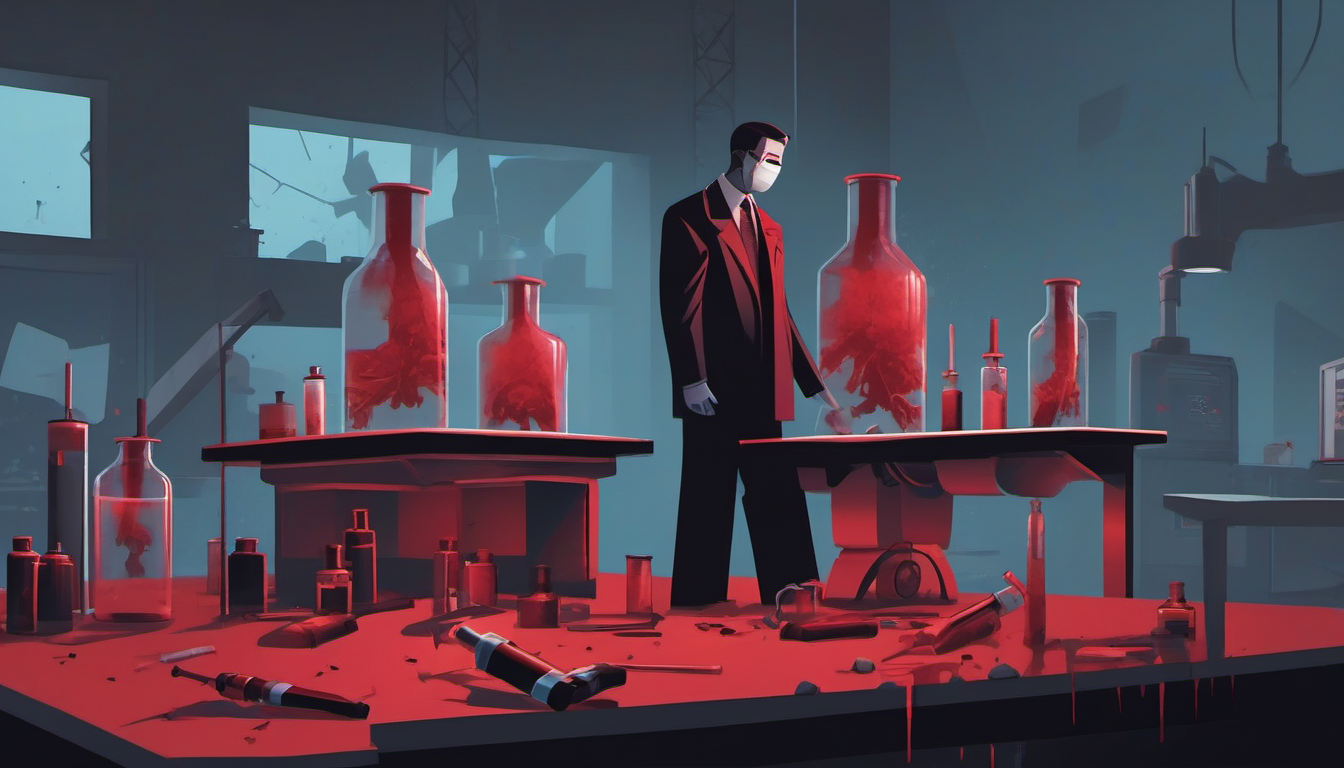
How a single political appointee is dismantling a century of vaccine innovation — and why the world may pay the price
Executive Summary
- The U.S. vaccine industry is entering a structural decline driven not by science but by politics: HHS Secretary Robert F. Kennedy Jr. has canceled $500 million in mRNA research contracts, the FDA refused to review Moderna's flu vaccine under unprecedented conditions, and the CDC has slashed the childhood immunization schedule from 17 diseases to 11 — the most dramatic rollback in modern public health history.
- Moderna has lost over $180 billion in market value since its 2021 peak, venture capital investment in mRNA vaccines has collapsed 66% (from $510 million in 2023 to $174 million in 2025), and major manufacturers report double-digit U.S. sales declines while their international revenues surge — creating a two-speed global vaccine economy.
- The consequences are already measurable: U.S. kindergarten vaccination rates have fallen to 90.2% (from 93.6% in 2018-19), measles cases surged to nearly 2,000 in 2025, and the country faces the real possibility of losing its measles elimination status — a reversal that would mark the first retreat from disease eradication in American history.
Chapter 1: The Anatomy of a Regulatory Ambush
On February 10, 2026, the U.S. Food and Drug Administration did something nearly unprecedented: it refused to even review Moderna's application for an mRNA-based flu vaccine. Not rejected — refused to look at. The agency's stated reason was that Moderna had not compared its vaccine against a high-dose flu shot approved only for people over 65, even though the company had tested it against the standard-dose vaccine that the vast majority of Americans actually receive each year.
The decision was made by a single political appointee, Dr. Vinay Prasad, overruling the recommendation of career FDA scientists who had supported the review. As Michael Osterholm, director of the Center for Infectious Disease Research and Policy at the University of Minnesota, told PBS NewsHour: "Despite the vast majority of the FDA staff supporting it, a single individual basically decided against approving it. This sent chills up the spines of all of us in public health."
The reversal came quickly — within eight days, the FDA reversed course and agreed to review the application — but the damage was already done. The message to the pharmaceutical industry was clear: the rules can change overnight, without warning, without data, based on ideology rather than evidence.
The stakes were enormous. Blackstone, the private equity giant, had invested $750 million specifically in Moderna's flu vaccine development. The initial rejection sent shockwaves through not just the vaccine sector but the entire pharmaceutical investment ecosystem. "There will be less invention, investment and innovation in vaccines generally, across all the companies," Moderna President Stephen Hoge warned.
Chapter 2: The $500 Million Demolition
The FDA's Moderna debacle was not an isolated incident. It was the latest salvo in a systematic campaign by HHS Secretary Robert F. Kennedy Jr. to dismantle the federal government's century-old partnership with the vaccine industry.
The timeline of destruction:
August 2025: Kennedy ordered the cancellation of 22 mRNA-based vaccine development projects under BARDA (the Biomedical Advanced Research and Development Authority), totaling nearly $500 million. His stated rationale: that mRNA vaccines "fail to protect effectively against upper respiratory infections like COVID and flu." This claim contradicts extensive peer-reviewed research showing the vaccines significantly reduce severe illness, hospitalization, and death.
January 2026: The CDC, under Kennedy's direction, overhauled the childhood vaccination schedule, reducing recommended immunizations from 17 diseases to 11. Six vaccines — previously considered routine — were reclassified to require individual consultation with a clinician. The practical effect: fewer children will receive them, as the administrative burden falls on already-stretched pediatric practices.
February 2026: The NIH yanked dozens of research grants supporting studies of vaccine hesitancy — the very research designed to understand and counter the kind of skepticism Kennedy himself has championed for decades.
Kennedy's office defended these changes. "Vaccine policy at HHS is guided by evidence-based science, public health outcomes and transparency, not by the business models or public statements of pharmaceutical executives," spokesman Andrew Nixon stated. But the pharmaceutical industry sees it differently. Pfizer CEO Albert Bourla was blunt: "There is almost like a religion there," he said of the administration's vaccine stance. Asked what needs to change, Bourla responded: "The health secretary."
Chapter 3: The Two-Speed Vaccine Economy
The financial impact is stark — and reveals an emerging divide between the U.S. and the rest of the world.
| Company | Product | U.S. Sales Change (2025) | International Sales Change (2025) |
|---|---|---|---|
| Sanofi | Beyfortus (RSV) | -28% | +36% (Europe), +168% (RoW) |
| GSK | Shingrix (Shingles) | -20% | +44% (Europe) |
| Moderna | All vaccines | Revenue collapse, 90%+ market cap loss from peak | Expanding internationally |
| Pfizer | All products | 2026 guidance cut by $1.5B | Diversifying globally |
| Sanofi | Total vaccines | Q4 2025: -2.5% | Forecasting "slightly negative" 2026 |
The pattern is unmistakable: U.S. vaccine sales are cratering while international markets are growing. The American market — historically the world's largest and most lucrative for vaccine manufacturers — is becoming a liability.
Venture capital has noticed. Investment in mRNA vaccine companies collapsed from $510 million in 2023 to $174 million in 2025 — a 66% decline. This matters because VC funding drives the early-stage research that eventually produces breakthrough vaccines. When the pipeline dries up, the effects are felt a decade later.
Moderna's trajectory tells the story most dramatically. From a peak market capitalization of approximately $200 billion in August 2021, the company has shed over $180 billion in value. Its stock has declined 90% from its all-time high, 75% over five years, and trades around $42 per share. The company that produced one of the two mRNA vaccines credited with ending the worst pandemic in a century is now fighting for its survival as a diversified biotech.
Chapter 4: The Disease Dividend
The public health consequences are not theoretical — they are already unfolding.
Measles: The U.S. recorded nearly 2,000 measles cases in 2025, the most in over three decades (excluding 2019). Multi-state outbreaks linked Texas, Arizona, and South Carolina. The CDC reports that 11% of measles cases resulted in hospitalization. The Pan American Health Organization (PAHO) was set to review the U.S.'s measles elimination status in April — losing it would mark the first time a developed nation has lost disease elimination status due to policy-driven vaccination decline rather than conflict or infrastructure collapse.
Childhood Vaccination: Average U.S. kindergarten vaccination rates fell to 90.2% in the 2024-25 school year, down from 93.6% in 2018-19. The herd immunity threshold for measles is approximately 95%. Multiple counties and states are now below the critical threshold.
Whooping Cough and Other Diseases: With six vaccines removed from the routine childhood schedule, epidemiologists warn of potential resurgences of diseases that have been effectively controlled for decades, including hepatitis A, hepatitis B, and rotavirus.
The irony is cruel: Operation Warp Speed, the Trump administration's signature first-term achievement, leveraged federal funding and regulatory acceleration to produce mRNA vaccines in record time. The same administration in its second term is systematically dismantling the ecosystem that made that achievement possible.
Chapter 5: Scenario Analysis — The Three Futures of American Vaccines
Scenario A: Regulatory Stabilization (25%)
Premise: Political pressure and industry pushback force the administration to moderate its approach. The FDA's reversal on Moderna's flu vaccine is the beginning of a correction.
Evidence:
- The FDA did reverse its Moderna decision within 8 days, suggesting internal resistance
- Blackstone's $750 million investment demonstrates powerful financial interests aligned against vaccine suppression
- A White House official told Politico that "vaccines will not be the primary focus going forward"
Trigger conditions: Measles outbreak reaching crisis proportions (10,000+ cases), bipartisan Congressional backlash, or industry litigation
Historical precedent: The FDA's thalidomide moment in the 1960s — a crisis that ultimately strengthened regulatory authority. But in that case, the crisis preceded the reform. Here, the crisis is being manufactured by the regulator itself.
Probability rationale: While there are moderating forces, Kennedy's ideological commitment to vaccine skepticism is deep and longstanding. The 25% reflects the possibility that political survival instincts override ideology, particularly if measles deaths occur among children.
Scenario B: Slow Erosion (50%)
Premise: The current trajectory continues: declining U.S. vaccination rates, shrinking domestic vaccine investment, growing international divergence. No dramatic crisis forces a course correction.
Evidence:
- The childhood schedule reduction is already implemented and unlikely to be reversed
- VC funding is already in steep decline
- Major manufacturers are pivoting R&D investment internationally
- State-level policy divergence is accelerating (some states maintaining stricter schedules, others loosening)
Trigger conditions: This is the default path requiring no additional catalysts.
Historical precedent: The U.K.'s MMR-autism scare in the late 1990s following Andrew Wakefield's fraudulent 1998 Lancet paper. British vaccination rates dropped from 92% to 73% over several years, measles cases surged, and it took over a decade to recover — even after Wakefield's paper was retracted and his medical license revoked in 2010. The U.S. situation is more severe because the skepticism is now embedded in federal policy, not just public sentiment.
Probability rationale: Institutional inertia and the 2026 midterm election cycle suggest neither dramatic reversal nor dramatic escalation. The most likely outcome is continued slow degradation.
Scenario C: Vaccine Exodus (25%)
Premise: Major manufacturers begin exiting the U.S. vaccine market, concentrating R&D and production in Europe and Asia. The U.S. becomes dependent on imported vaccines, reversing a century of domestic pharmaceutical leadership.
Evidence:
- The U.S.-international sales gap is already widening dramatically (Sanofi RSV: -28% U.S. vs +168% internationally)
- European regulatory environments remain stable and supportive of vaccine innovation
- India's Serum Institute and other non-U.S. manufacturers are scaling globally
- Moderna has explicitly warned of reduced "invention, investment and innovation"
Trigger conditions: A second major regulatory surprise (rejection of another late-stage vaccine), Congressional failure to restore BARDA funding, or a major manufacturer announcing relocation of vaccine R&D headquarters
Historical precedent: The U.S. vaccine shortage crisis of the early 2000s, when consolidation left the country with only two flu vaccine manufacturers — and the loss of one (Chiron's contaminated Liverpool plant in 2004) created a national shortage. The industry is more concentrated now than it was then.
Probability rationale: The 25% reflects the 12-18 month timeline needed for corporate reorganization decisions. Companies won't exit overnight, but the current trajectory makes strategic realignment increasingly rational.
Chapter 6: Investment Implications
Losers:
- U.S.-focused vaccine pure plays: Moderna (MRNA), Novavax (NVAX) face existential pressure. Moderna's mRNA platform, once valued as transformative, is now a liability in the U.S. regulatory environment.
- Small-cap mRNA startups: The VC funding collapse is already killing early-stage companies. Arcturus Therapeutics, CureVac, and others face capital starvation.
- Domestic vaccine supply chain: Contract manufacturing organizations (CMOs) dependent on U.S. vaccine production face declining volumes.
Winners:
- European and Asian vaccine manufacturers: Sanofi, GSK, and India's Serum Institute benefit from the U.S. vacuum. European regulatory stability becomes a competitive advantage.
- International diversification plays: Companies with strong non-U.S. revenue bases are better positioned. GSK's Shingrix sales growth in Europe (+44%) demonstrates the opportunity.
- Pandemic preparedness infrastructure: Paradoxically, the weakening of U.S. vaccine capacity increases the premium on alternative preparedness — diagnostics, therapeutics, and international vaccine supply chains.
- Health security ETFs and pandemic preparedness bonds: Growing institutional interest in hedging pandemic risk outside the U.S. vaccine ecosystem.
| Asset Class | Direction | Rationale |
|---|---|---|
| MRNA (Moderna) | ▼ Bearish | Regulatory headwinds, $180B market cap erosion, U.S. revenue decline |
| GSK.L (GSK) | ▲ Bullish | International vaccine revenue growth, European regulatory stability |
| Sanofi (SNY) | ▲ Moderate | Portfolio diversification, international growth offsets U.S. decline |
| mRNA VC (sector) | ▼ Bearish | 66% funding collapse, regulatory uncertainty |
| European pharma ETFs | ▲ Bullish | Relative regulatory advantage, R&D migration |
Conclusion
The United States is conducting an experiment unprecedented in modern public health history: a deliberate, policy-driven dismantlement of the world's most advanced vaccine ecosystem. This is not a budget-driven austerity measure or a response to safety signals — it is an ideologically motivated campaign led by a health secretary who has spent decades questioning the fundamental premise of vaccination.
The consequences will not be immediate. Vaccines already in widespread use will continue to protect most Americans. But the erosion of the pipeline — the cancellation of research grants, the collapse of venture funding, the regulatory uncertainty that makes every new vaccine application a political gamble — will compound over years. The diseases that return will be the ones we stopped thinking about precisely because vaccines made them invisible.
The cruelest irony is temporal. The same administration that mobilized Operation Warp Speed to produce mRNA vaccines in less than a year is now systematically destroying the institutional capacity that made that miracle possible. Future pandemics will not find the same ecosystem waiting. The factories that could have been built, the researchers who could have been trained, the companies that could have been funded — these are the invisible casualties of the vaccine recession.
When the next pandemic arrives — and it will — the question will not be whether mRNA technology can produce a vaccine quickly enough. It will be whether anyone in America is still willing to try.
Sources: New York Times, PBS NewsHour, Reuters Breakingviews, STAT News, Fierce Pharma, NPR, CDC, KFF, GlobalData, PharmExec
Leave a Reply