
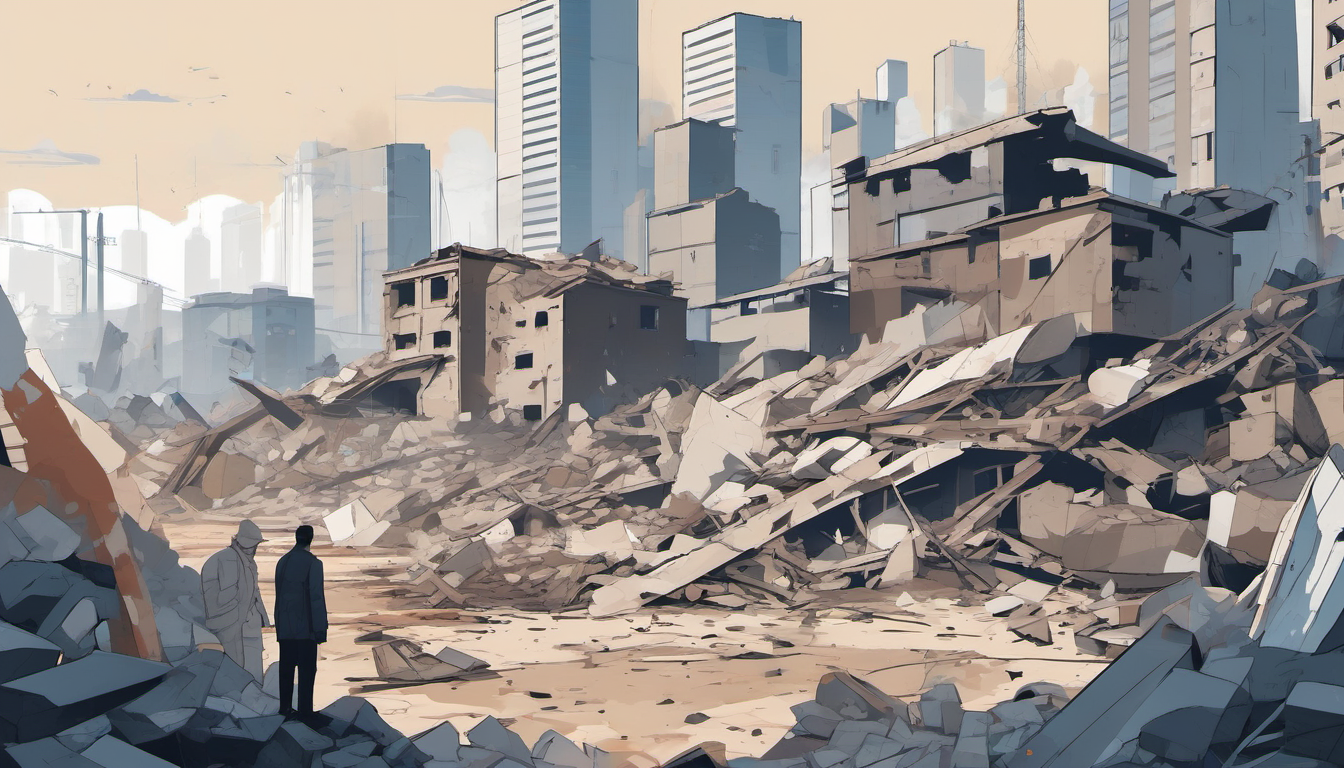
When science confronts the cost of reconstruction, the numbers tell a devastating story
Executive Summary
- A landmark Lancet Global Health study confirms at least 75,200 people were killed violently in Gaza's first 16 months — 35% higher than official health ministry figures, validating long-suspected undercounts through rigorous household surveys of 2,000 families
- The same day the study dropped, Trump's Board of Peace convened its inaugural meeting, pledging $7 billion toward Gaza reconstruction — roughly 10% of the estimated $70 billion needed, raising fundamental questions about whether the international community is pricing catastrophe correctly
- The research reveals a "central paradox" of modern conflict documentation: the more devastating the destruction, the harder it becomes to count the dead — with 12 of 36 hospitals still operational, 29,000–46,000 people awaiting reconstructive surgery, and a decade-long surgical backlog even under best-case scenarios
Chapter 1: The Science of Counting the Dead
On February 18, 2026, the Lancet Global Health published what may become the definitive epidemiological reckoning of the Gaza war's early phase. The Gaza Mortality Survey (GMS), led by Michael Spagat of Royal Holloway University of London, departed from the statistical modeling that had characterized earlier efforts. Instead of probability-based capture-recapture methods, the team conducted direct household interviews with 2,000 carefully selected families representing 9,729 individuals across the Gaza Strip.
The result: an estimated 75,200 violent deaths between October 7, 2023 and January 5, 2025 — approximately 3.4% of Gaza's pre-war population of 2.2 million. This figure sits 34.7% above the 49,090 deaths reported by the Gaza Ministry of Health (MoH) for the same period.
What makes this study extraordinary is not just the number. It is the methodological rigor brought to bear on a warzone where the very infrastructure of documentation — hospitals, civil registries, morgues — had been systematically destroyed. The researchers worked with experienced Palestinian pollsters who had decades of survey experience in the territory, a critical choice given the sensitivity of asking families to recount violent deaths among their members.
The study also demolished a persistent claim by Israeli officials that Gaza health authorities were inflating civilian casualty figures. Women, children, and elderly people comprised 56.2% of those killed — a proportion remarkably consistent with MoH reporting. In January 2026, a senior Israeli security officer privately told journalists that the ministry's figures were "broadly accurate," a quiet reversal after years of official attacks on Palestinian casualty data.
The Undercounting Paradox
A separate commentary published alongside the GMS identified what researchers called the "central paradox" of casualty documentation in Gaza: the more devastating the attack on the health system, the harder it becomes to analyze the total death toll. With hospitals bombed, medical staff killed, and civil registries destroyed, the administrative machinery needed to count the dead collapsed at precisely the moment when deaths were occurring at their highest rate.
This paradox is not unique to Gaza. It has characterized nearly every modern urban siege, from Aleppo to Mariupol. But the Gaza case is unusually well-documented because multiple independent research teams — using different methodologies at different times — arrived at convergent conclusions: official figures represent a floor, not a ceiling.
| Study | Period | Method | Estimated Deaths | MoH Figure | Difference |
|---|---|---|---|---|---|
| Lancet Jan 2025 | Oct 2023–Jul 2024 | Capture-recapture | 64,260 | ~45,500 | +41% |
| Lancet GMS Feb 2026 | Oct 2023–Jan 2025 | Household survey | 75,200 | 49,090 | +35% |
| Israeli military (leaked) | Oct 2023–Jan 2026 | Internal assessment | ~70,000 | — | — |
The consistency of undercounting — roughly 35–41% across different methods and timeframes — suggests a structural limitation in warzone documentation rather than any deliberate manipulation.
Chapter 2: The Invisible Toll — Beyond Violent Deaths
The GMS did not stop at violent deaths. It estimated an additional 16,300 "non-violent deaths" during the same period, of which 8,540 were classified as "excess" deaths — people who died from causes directly attributable to the collapse of living conditions: untreated infections, renal failure, complications from surgery that never happened, malnutrition.
Spagat pushed back against an earlier Lancet estimate that suggested four indirect deaths for every direct death. "There is a huge variation depending on the specific circumstances of every conflict," he noted. "In Kosovo, almost all the deaths were violent. In Darfur, you see something very different. In Gaza, at least initially, there were resources — well-trained doctors, a health system."
But "initially" is the operative word. By May 2025, only 12 of Gaza's 36 hospitals remained capable of providing care beyond basic emergency triage. The pre-war medical infrastructure — which was already strained by decades of blockade — had been reduced to a skeletal framework.
The Surgical Backlog
A parallel study published in eClinicalMedicine quantified the war's lasting medical legacy: an estimated 116,020 cumulative injuries as of April 2025, with 29,000 to 46,000 requiring complex reconstructive surgery. More than 80% of these injuries resulted from explosions — primarily airstrikes and shelling in densely populated urban zones.
Before the war, Gaza had eight board-certified plastic and reconstructive surgeons for 2.2 million people. The math is devastating: even if surgical capacity were miraculously restored to pre-war levels, the backlog of reconstructive cases alone would take approximately a decade to clear.
This is the invisible toll that no peace deal, no reconstruction fund, no Board of Peace can easily address. Severed limbs, shattered bones, and burn injuries persist long after ceasefires are signed. They create a generational burden — families reorganized around disability, children who will never regain full function, an economy permanently diminished by the loss of productive capacity.
Chapter 3: The $7 Billion Gap
The Lancet study landed on the same day that Trump's Board of Peace convened its inaugural meeting in Washington. The timing was coincidental but devastating. As researchers documented the scale of destruction, diplomats were announcing reconstruction commitments that amount to roughly 10 cents on every dollar needed.
Nine Board of Peace member countries pledged a combined $7 billion toward Gaza reconstruction. Trump announced the U.S. would contribute $10 billion. Five countries agreed to deploy troops for an international stabilization force. But the estimated reconstruction cost — $70 billion at minimum, according to UN and World Bank assessments — dwarfs these commitments.
The gap is not merely financial. It reflects a fundamental disconnect between the scale of destruction documented by science and the political appetite for repair.
Who Pledged What
The Board of Peace drew 40+ countries and the EU as participants or observers, but the membership list reveals as much about geopolitical positioning as about humanitarian commitment. Notable joiners include Saudi Arabia, UAE, Qatar, Egypt, Indonesia, and Pakistan. Notable absences: the EU's major powers attended as observers rather than members, signaling discomfort with a structure that bypasses the UN framework.
Several structural contradictions threaten the board's effectiveness:
-
Hamas disarmament impasse: Israel demands complete Hamas disarmament before reconstruction begins. Hamas has shown no willingness to comply. Without resolution, the $7 billion sits in an escrow of political fiction.
-
Administrative vacuum: Who governs a rebuilt Gaza? The Ali Shaath-led technocratic committee has no presence on the ground. Hamas has already installed loyal district governors with al-Qassam Brigades connections.
-
The 10:1 ratio: At $7 billion committed against $70 billion needed, the Board of Peace has raised enough to rebuild roughly one-tenth of what was destroyed — before accounting for population displacement, psychological trauma, and the decade-long surgical backlog.
Chapter 4: Scenario Analysis — What Comes Next
Scenario A: Slow Institutional Build-Up (40%)
Premise: The Board of Peace becomes a functioning, if imperfect, coordination mechanism. Additional pledges trickle in over 2026–2027, eventually reaching $20–25 billion.
Basis for probability: This mirrors the trajectory of post-conflict reconstruction in Iraq, where initial pledges at the 2003 Madrid Conference ($33 billion) delivered roughly 40% of commitments within five years. The presence of Gulf states with deep pockets and strategic interests in normalizing post-conflict governance increases the likelihood.
Historical precedent: Iraq reconstruction post-2003 — the Madrid Conference pledged $33 billion; actual disbursement reached approximately $13 billion by 2008. The ratio of pledge-to-delivery (40%) is a useful baseline.
Trigger conditions: Hamas agrees to some form of arms reduction (not full disarmament); Israel withdraws from expanded West Bank operations to reduce international pressure; Gulf states see reconstruction contracts as economic opportunity.
Timeline: 2–3 years to reach meaningful reconstruction scale.
Scenario B: Frozen Conflict, Frozen Funds (35%)
Premise: The Hamas disarmament impasse persists. Israel maintains security operations. The $7 billion remains largely unspent. Gaza enters a prolonged humanitarian limbo — neither at war nor at peace.
Basis for probability: This is the modal outcome of post-conflict reconstruction efforts where political preconditions block fund disbursement. The precedent of the 2014 Cairo Conference — which pledged $5.4 billion for Gaza reconstruction but delivered less than half — is directly relevant.
Historical precedent: Gaza after the 2014 war — the Cairo Conference raised $5.4 billion in pledges; by 2016, less than 40% had been disbursed due to the Israeli-Egyptian blockade and Hamas governance.
Trigger conditions: No progress on Hamas disarmament; Israel escalates West Bank annexation; donor fatigue sets in as other crises compete for attention.
Timeline: Indefinite stasis, with periodic humanitarian crises.
Scenario C: Board of Peace Collapse (25%)
Premise: The institutional experiment fails. Key members withdraw due to domestic political pressure or disagreements over governance. Gaza reconstruction reverts to fragmented bilateral aid.
Basis for probability: Trump's track record with international institutions (withdrawal from Paris Agreement, UNESCO, WHO funding cuts) suggests institutional commitment is contingent on personal engagement. If the board fails to show results before the 2026 midterms, it loses White House attention.
Historical precedent: The Quartet on the Middle East (2002) — established with similar ambitions to coordinate Israeli-Palestinian peace, it gradually became irrelevant as political conditions shifted.
Trigger conditions: Midterm election losses shift Trump's attention; a major escalation (Iran conflict, West Bank crisis) displaces Gaza from the agenda; key Gulf donors redirect funds.
Timeline: 6–12 months to functional irrelevance.
Chapter 5: Investment Implications
The Lancet study and Board of Peace meeting, taken together, crystallize several investment-relevant dynamics:
Reconstruction equities: Companies positioned for Middle East infrastructure contracts — Bechtel, Fluor, Gulf construction conglomerates — face a classic "announced vs. disbursed" risk. The $7 billion headline overstates near-term opportunity. Until the Hamas disarmament question is resolved, major construction projects remain speculative.
Medical technology and humanitarian supply chains: The decade-long surgical backlog creates sustained demand for prosthetics, reconstructive surgical equipment, and telemedicine platforms. Companies like Stryker, Medtronic, and emerging healthtech firms serving conflict zones stand to benefit from prolonged medical rehabilitation cycles.
Defense and security: Five countries committing troops to a stabilization force implies sustained demand for peacekeeping equipment, communication systems, and logistics. Indonesia's 8,000-troop commitment is the largest single contingent — Indonesian defense contractors and their partners may see procurement boosts.
Energy: Oil prices hit a six-month high on February 19, driven primarily by US-Iran tensions. The Board of Peace meeting did nothing to ease these concerns. Crude's trajectory remains hostage to the dual Iran nuclear talks and Gaza reconstruction dynamics.
Risk factor: The 35% death toll undercount documented by the Lancet suggests the true economic cost of reconstruction may also be significantly understated. If the "invisible dead" represent a broader pattern of invisible destruction — collapsed infrastructure, contaminated water systems, agricultural land rendered unusable — then the $70 billion estimate may itself be a floor.
Conclusion
The Lancet Global Health study does what science does best: it replaces narrative with data. In doing so, it transforms the Gaza death toll from a political football into an epidemiological fact — one that multiple independent methodologies now converge upon. At least 75,200 people died violently in the first 16 months. At least 8,500 more died from the collapse of the systems meant to keep them alive. The true total, including the ongoing period after January 2025, is certainly higher.
The Board of Peace's $7 billion is a start. But when measured against the scientific reality of what was destroyed — human lives, medical infrastructure, the administrative capacity to even count the dead — it is a fraction of a fraction. The invisible dead demand not just commemoration but an honest accounting of what it will take to rebuild what was lost. On current trajectories, Gaza is heading toward Scenario B: a frozen conflict with frozen funds, where the gap between destruction and reconstruction becomes a permanent feature of the landscape.
The paradox endures: the more we learn about the scale of loss, the clearer it becomes that the political response remains fundamentally inadequate.
Leave a Reply