
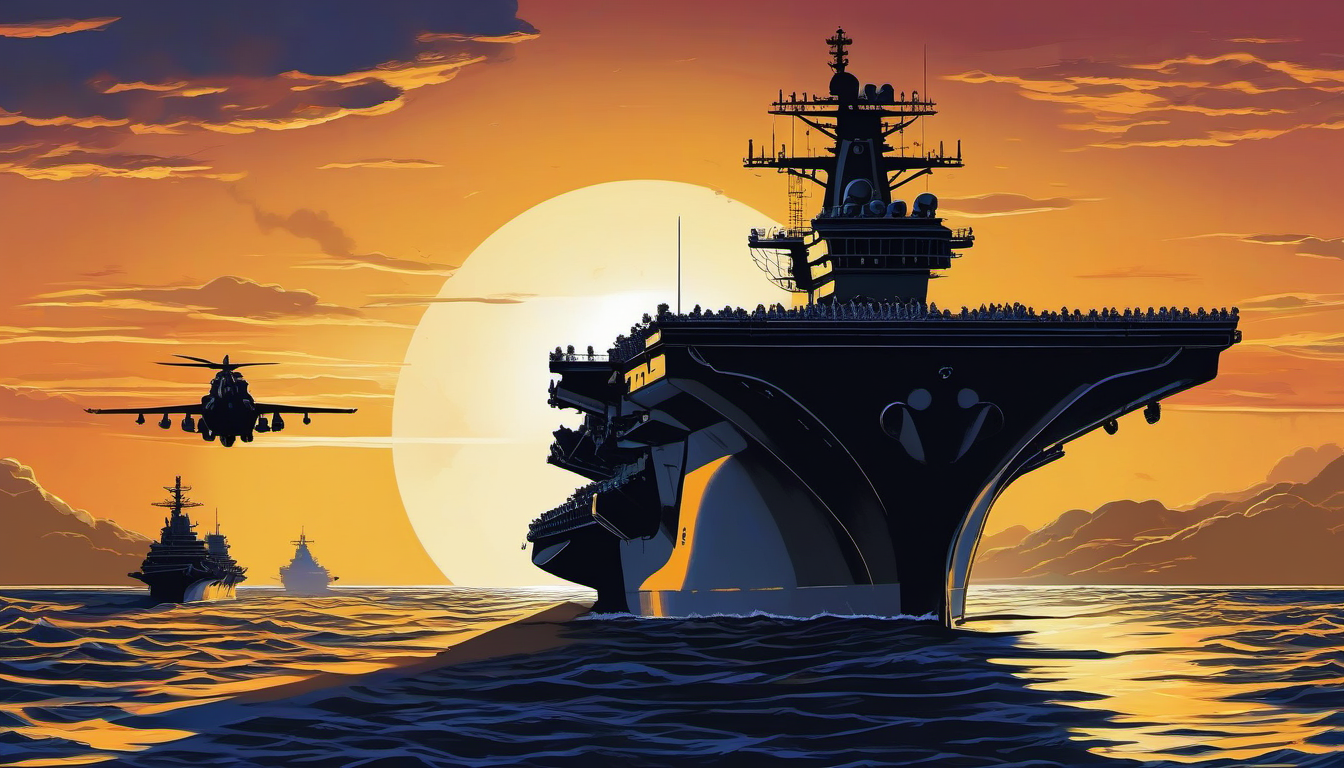
The Pentagon's own strategy says China is the priority. Its force deployments say otherwise.
Executive Summary
- The U.S. military has redeployed its most capable assets from the Indo-Pacific to the Middle East for the third time in two years, creating the widest security gap in the Western Pacific since 2017.
- A Trump adviser told Axios there is a "90% chance" of kinetic action against Iran in coming weeks, with 2 carrier strike groups, 50+ fighter jets, and 150+ cargo flights surging into the region.
- China now faces its most permissive military environment in the Taiwan Strait and South China Sea since the 2022 crisis, just as Japan, the Philippines, and Australia depend most heavily on American presence.
Chapter 1: The Armada Goes East — Again
On January 26, 2026, the USS Abraham Lincoln (CVN-72) and Carrier Strike Group 3 arrived in the Arabian Sea. The warship had been operating in the Indo-Pacific — until it was abruptly redirected to the Middle East to support a potential campaign against Iran.
This was not an anomaly. It was the third time in two years that a U.S. Navy carrier strike group had been pulled from Indo-Pacific operations and redeployed to the Middle East. The pattern is now unmistakable: every time tensions escalate with Iran — which is to say, continually — the Pentagon raids its Pacific forces to plug the gap.
The scale of the current buildup is staggering. According to open-source intelligence tracking and Pentagon statements, the U.S. has deployed to the Middle East since mid-January 2026:
| Asset Category | Details | Quantity |
|---|---|---|
| Aircraft Carriers | USS Abraham Lincoln (CVN-72), USS George H.W. Bush (CVN-77) en route | 2 |
| Carrier Escorts | Arleigh Burke-class destroyers | 12+ warships |
| Fighter Jets | F-35A/C, F-15E, F-22A, F/A-18E/F, F-16C | 200+ aircraft |
| Support Aircraft | KC-135 tankers, C-17 transports, E-2D, EA-18G | Dozens |
| Cargo Flights | Weapons systems and ammunition | 150+ flights |
On February 18, OSINT analysts documented "one of the busiest days for the US Air Force in Europe that I have seen in recent history," with close to a dozen KC-135 Stratotankers airborne across the Mediterranean and a steady stream of C-17 Globemaster transports shuttling between U.S. bases and the Middle East.
A senior Trump adviser told Axios bluntly: "I think there is a 90% chance we see kinetic action."
Chapter 2: The Pentagon's Own Contradiction
The irony is almost too neat. Just weeks before the Iran buildup began, the Pentagon released its 2026 National Defense Strategy (NDS), which explicitly deprioritized the Middle East in favor of the Indo-Pacific and the Western Hemisphere. The document framed China as the pacing threat, called for maintaining deterrence in the Taiwan Strait, and signaled that the era of large-scale Middle Eastern deployments was over.
Yet here we are. The NDS says the Indo-Pacific is the priority theater. The force flow says the Middle East is. This is not a new tension — it has haunted American strategy since the pivot to Asia was first announced under Obama in 2011 — but it has never been this acute.
The fundamental problem is structural. The U.S. Navy operates roughly 49 deployable surface combatants against a requirement for 66. The submarine force is similarly stretched. There are only 11 aircraft carriers. When two of them are in the Arabian Sea, the Pacific Fleet's combat power drops precipitously. The math is unforgiving: the Navy cannot be in two places at once, and Iran keeps pulling it east.
The Force Gap in Numbers
| Metric | Pre-Buildup (Dec 2025) | Current (Feb 2026) | Change |
|---|---|---|---|
| Carrier Strike Groups in Indo-Pacific | 2 | 0-1 | -50% to -100% |
| Forward-deployed fighters (Pacific) | ~180 | ~130 (est.) | -28% |
| Destroyer/cruiser presence (W. Pacific) | ~15 | ~10 (est.) | -33% |
| Tanker/ISR availability (Pacific) | Baseline | Degraded | Significant |
Chapter 3: China's Window
Beijing is watching. It would be extraordinary if it were not.
The People's Liberation Army (PLA) has spent two decades building the world's largest navy precisely to exploit moments like this. With 370+ warships — more hulls than the U.S. Navy — and a strategy designed around keeping the American fleet out of the Western Pacific, China now faces the most permissive operational environment in the Taiwan Strait since the 2022 crisis triggered by Nancy Pelosi's visit.
This does not mean China will invade Taiwan tomorrow. The calculus is far more complex than simple naval arithmetic. But the reduced American presence creates opportunities for gray-zone escalation — the kind of incremental pressure that has defined Chinese behavior in the South China Sea:
- Increased air defense identification zone (ADIZ) intrusions around Taiwan
- Expanded maritime militia operations near the Philippines' Second Thomas Shoal and Scarborough Shoal
- Accelerated military construction on artificial islands
- More aggressive coast guard behavior in disputed waters
- Pressure on Japan around the Senkaku/Diaoyu Islands
The historical precedent is clear. In October 2023, when the USS Gerald R. Ford was rushed from the Mediterranean to the Eastern Mediterranean after the Hamas attack on Israel, Chinese naval and air activity around Taiwan increased measurably. In April 2024, when the USS Dwight D. Eisenhower remained on station in the Red Sea to counter Houthi attacks, Beijing conducted its largest-ever military exercises around Taiwan (Joint Sword-2024A and B).
The pattern is consistent: when America looks away, China tests boundaries.
Chapter 4: The Alliance Anxiety
For America's Indo-Pacific allies, the repeated Middle Eastern diversions are not abstract strategic concerns — they are existential questions about the reliability of American security guarantees.
Japan
Prime Minister Takaichi's government has just secured a constitutional supermajority to revise Article 9, partly driven by the recognition that American protection cannot be taken for granted. Japan's defense budget has surged to ¥15 trillion. But Japan's own forces cannot compensate for the loss of American carrier-based aviation and Aegis missile defense in a Taiwan contingency. Tokyo privately worries that the $550 billion investment deal — essentially tribute to maintain the relationship — is paying for protection that is physically located 8,000 miles away in the Persian Gulf.
The Philippines
Manila is in the most exposed position. The February 16 Philippines-US Bilateral Strategic Dialogue reaffirmed the alliance, but the Philippines depends on American naval presence to deter Chinese maritime coercion around its claimed features in the South China Sea. With U.S. destroyers and fighters diverted to CENTCOM, the 2016 UNCLOS arbitral tribunal ruling — already difficult to enforce — becomes even more theoretical.
Australia
Canberra's $368 billion AUKUS submarine program is predicated on American strategic commitment to the Indo-Pacific. If the U.S. cannot sustain carrier presence in the Pacific while managing a Middle Eastern crisis, the rationale for AUKUS — extended American deterrence underwritten by nuclear-powered submarines — becomes harder to defend politically.
Taiwan
Taipei faces the most direct risk. The island's 2026 defense budget has been blocked ten times by KMT-dominated legislature, and the U.S. has signaled reduced arms sales as leverage. With American carriers in the Arabian Sea and diplomatic bandwidth consumed by Iran, Taiwan's deterrent posture is at its weakest point in years.
Chapter 5: Scenario Analysis
Scenario A: Diplomatic Resolution with Iran — U.S. Forces Return (25%)
Rationale: The Geneva "guiding principles" agreement provides a framework, but Vice President Vance stated on February 17 that Iran has not met U.S. red lines. With a 90% kinetic action probability cited by a Trump adviser, diplomatic resolution appears unlikely in the near term.
Trigger: Iran agrees to halt enrichment above 3.67%, allow enhanced IAEA inspections, and address missile/proxy concerns. Both sides claim victory.
Indo-Pacific Impact: Forces gradually return over 3-6 months. The gap closes but confidence damage persists. Allies accelerate indigenous defense programs regardless.
Historical Precedent: The 2015 JCPOA required 2+ years of negotiations and only temporarily reduced Middle Eastern force requirements.
Scenario B: Limited Strikes, Prolonged Deployment (50%)
Rationale: This is the most likely scenario based on current force positioning. A "weeks-long campaign" targeting nuclear facilities and IRGC assets, followed by an extended presence to deter Iranian retaliation, would keep forces in the Middle East through at least mid-2026.
Trigger: Iran enriches to weapons-grade (90%), or the June deadline passes without a deal. Joint US-Israeli strikes follow.
Indo-Pacific Impact: The security vacuum persists for 6-12 months. China exploits the window for gray-zone operations. Allies face a credible deterrence gap. Japan and Australia increase bilateral coordination to partially compensate. Taiwan becomes more vulnerable to political coercion.
Historical Precedent: Operation Desert Fox (1998) against Iraq led to a permanent increase in Middle Eastern force posture that lasted until 2003, pulling resources from Pacific Command throughout.
Scenario C: Major War with Iran, Indo-Pacific Crisis (25%)
Rationale: A sustained air campaign escalates into a broader conflict. Iran retaliates through Hormuz closure, proxy attacks, and regional destabilization. The U.S. is locked into a multi-year Middle Eastern commitment.
Trigger: Iran's retaliation exceeds American red lines — attacks on Gulf state oil infrastructure, mining the Strait of Hormuz, or launching ballistic missiles at Israel.
Indo-Pacific Impact: Catastrophic for deterrence. China sees a historic window and accelerates Taiwan pressure. The U.S. faces the nightmare two-front scenario its strategists have warned against for decades. Alliance system faces its most severe test since the Cold War.
Historical Precedent: The 2003 Iraq invasion consumed American strategic bandwidth for a decade, during which China completed its South China Sea island-building campaign virtually unopposed.
Chapter 6: Investment Implications
The strategic vacuum has concrete market consequences:
Defense Stocks — Regional Differentiation
- Japanese defense companies (Mitsubishi Heavy Industries, Kawasaki Heavy) benefit as Tokyo accelerates indigenous capabilities
- Australian defense spending supports ASC, Austal
- South Korean defense exporters (Hanwha Aerospace, Korea Aerospace Industries) gain as regional demand surges
Energy Markets
- Oil prices carry a permanent geopolitical premium ($5-10/barrel) as long as the Iran crisis persists
- Asian LNG importers (Japan, South Korea, Taiwan) face supply route vulnerability if Hormuz is disrupted
Semiconductor Supply Chain
- Taiwan's TSMC concentration risk intensifies — any Taiwan Strait incident could trigger a global chip crisis
- Beneficiaries of diversification: Intel (U.S.), Samsung (South Korea), GlobalFoundries
Safe Haven Flows
- Gold's move above $5,000 partly reflects the Indo-Pacific uncertainty premium
- Japanese government bonds face conflicting pressures — safe haven demand vs. fiscal expansion for defense
Conclusion: The Price of Strategic Incoherence
The United States faces a problem it created for itself. By maintaining maximalist objectives in the Middle East — regime change aspirations in Venezuela, nuclear zero-tolerance with Iran — while simultaneously declaring the Indo-Pacific as its strategic priority, Washington has stretched its forces to a breaking point that no amount of defense spending can solve.
The 2026 NDS acknowledged this tension in theory. In practice, the Iran crisis has made a mockery of it. For the third time in two years, the Pacific Fleet has been raided to support a Middle Eastern contingency. Each time, the gap grows wider and the allies grow more anxious.
The deepest risk is not that China will launch a surprise attack while America is distracted. It is that a succession of gray-zone provocations — each individually below the threshold of military response — will gradually erode the territorial status quo in the Western Pacific while American carriers patrol the Persian Gulf. By the time Washington turns its attention back to the Indo-Pacific, the strategic landscape may have shifted irreversibly.
As one Japanese defense official reportedly told colleagues after learning of the Abraham Lincoln's diversion: "They keep telling us we are the priority. Their ships keep telling us we are not."
Sources: Axios, Common Dreams, Aerospace Global News, Business Insider, Reuters, Pentagon statements, OSINT tracking data
Leave a Reply