
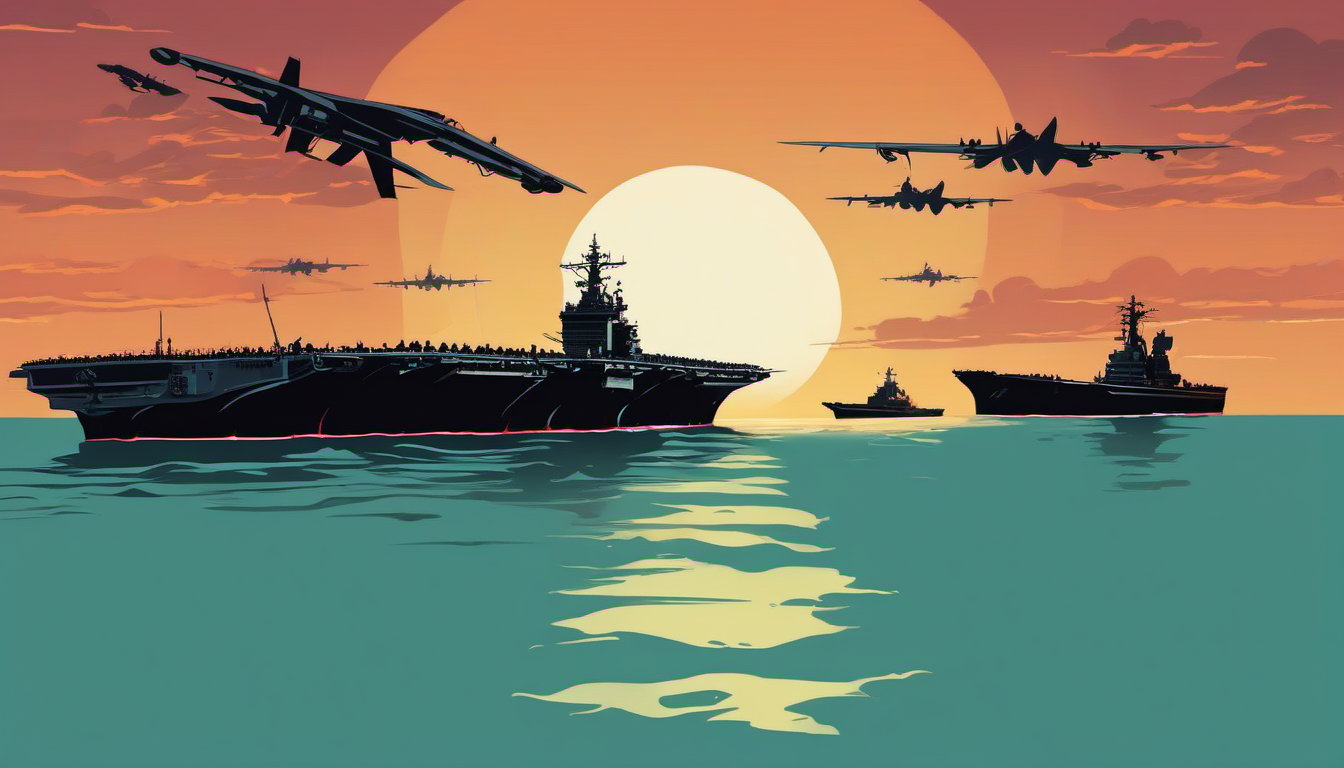
When diplomacy and deterrence collide in the world's most dangerous chokepoint
Executive Summary
- Iran, Russia, and China are conducting joint naval exercises — "Marine Security Belt 2026" — in the Strait of Hormuz this week, directly overlapping with U.S.-Iran nuclear negotiations in Geneva and a massive American military buildup in the region featuring two carrier strike groups.
- The convergence of three rival navies alongside the world's most powerful fleet in a 33-kilometer-wide waterway that handles one-third of global seaborne crude oil creates the most dangerous accidental escalation scenario since the 1988 Operation Praying Mantis.
- Oil prices surged 4% after Vice President Vance declared Iran had not met U.S. "red lines," while CNN reported the Pentagon is "prepared to strike" as early as this weekend — making the naval exercise a potential tripwire for miscalculation.
Chapter 1: The Chokepoint
The Strait of Hormuz is, by any measure, the single most consequential bottleneck in global energy markets. Roughly 21 million barrels of oil pass through its waters daily — approximately one-third of all seaborne crude shipments worldwide. At its narrowest, the strait measures just 33 kilometers, with shipping lanes that compress to roughly 3 kilometers in each direction. It is the kind of geography that converts small incidents into global crises.
This week, the strait became something unprecedented: a simultaneous staging ground for four separate naval operations by rival powers.
On Monday, February 17, Iran's Islamic Revolutionary Guard Corps (IRGC) launched "Smart Control" military drills in the strait, conducting live-fire exercises and briefly restricting commercial shipping traffic. By Wednesday, the Russian Steregushchiy-class corvette Stoikiy had docked at Bandar Abbas, Iran's primary naval base on the strait's southern shore. Chinese naval vessels joined the formation. Together, the three navies commenced "Marine Security Belt 2026," a recurring exercise first established in 2019 but now freighted with an entirely different strategic significance.
Across the water, the USS Abraham Lincoln carrier strike group — comprising at least eight surface combatants — was already on station. The USS Gerald R. Ford, America's most advanced carrier, was transiting the Atlantic at speed, with open-source tracking placing it off the Moroccan coast as of Wednesday. At its current pace, the Ford could reach the eastern Mediterranean by Sunday and the Persian Gulf approaches within days.
Two carrier strike groups. Three rival navies. One narrow waterway. And nuclear negotiations happening 4,000 kilometers away in Geneva.
Chapter 2: Marine Security Belt — From Routine to Strategic Signal
The Marine Security Belt exercise series began in 2019 as a relatively modest trilateral affair — a way for Iran, Russia, and China to demonstrate cooperative naval capability in the Indian Ocean. The first iteration attracted attention primarily for the symbolism: three countries under varying degrees of Western sanctions or tension exercising together in waters traditionally dominated by the U.S. Fifth Fleet.
By 2026, the context has transformed the exercise's meaning entirely.
Nikolai Patrushev, a senior aide to President Putin, framed this year's iteration in explicitly geopolitical terms. "We will tap into the potential of BRICS, which should now be given a full-fledged strategic maritime dimension," Patrushev declared, directly linking the naval exercise to the broader challenge against Western-led international order. He cited ongoing U.S. and NATO operations to seize Russian oil tankers — the "shadow fleet" enforcement campaign — as proof that maritime security required a collective non-Western response.
Iran's Navy Commander Rear Admiral Shahram Irani was blunter. "If the extra-regional fleet feels it has come with power, it should know that the Iranian people will confront them with greater power," he warned. "The faith of the people and missiles are the Islamic Republic of Iran's deterrent weapons against the enemy."
The exercise was likely planned months before the current crisis escalated. But its timing — during live nuclear negotiations and amid explicit American military threats — transforms a routine drill into a strategic signal of the first order.
| Feature | Marine Security Belt 2019 | Marine Security Belt 2026 |
|---|---|---|
| Context | Routine trilateral cooperation | Active nuclear crisis, U.S. strike preparation |
| U.S. presence | Standard Fifth Fleet deployment | Two carrier strike groups, enhanced air assets |
| Russia framing | Maritime cooperation | BRICS strategic maritime dimension |
| Iran IRGC | No separate exercise | Simultaneous "Smart Control" drills with live fire |
| Oil price impact | Minimal | +4% single-day surge |
| Strait restrictions | None | Partial commercial traffic closure |
Chapter 3: The USS Stark Ghost
Military analysts are focused less on the exercise's offensive capability — the Russian corvette and Chinese vessels pose no serious threat to two American carrier groups — and more on the risk of accidental escalation.
Tom Shugart, a retired U.S. Navy submarine warfare officer and adjunct senior fellow at the Center for a New American Security (CNAS), identified three specific operational concerns:
Sensor leakage. Russian and Chinese warships carry advanced electronic intelligence (ELINT) equipment. During any American strike on Iranian targets, these vessels could provide early warning to Tehran — potentially undermining surprise and increasing U.S. pilot risk. "You'd want to make sure that their sensors don't give advanced warning of your strike to the Iranians," Shugart warned.
Physical deconfliction. In a narrow waterway crowded with warships from four different navies, the risk of a vessel being in the wrong place at the wrong time is non-trivial. Shugart drew a direct parallel to the USS Stark incident of May 17, 1987, when an Oliver Hazard Perry-class frigate was struck by two Iraqi Exocet anti-ship missiles in the Persian Gulf, killing 37 American sailors. The Stark was hit not by an enemy, but by Iraq — then a de facto U.S. ally in its war against Iran. The missiles were fired in error, or at least with reckless indifference to the frigate's identity.
"You'd also of course want to ensure that there is no way they could be inadvertently struck, à la USS Stark during the Iraq-Iran Tanker Wars of the 1980s," Shugart said.
Political complication. Even a minor incident involving Russian or Chinese naval vessels during a U.S. strike on Iran could escalate the conflict far beyond the bilateral U.S.-Iran dimension. A stray missile hitting a Russian corvette, however improbable, would create a crisis between nuclear powers.
Former CENTCOM commander General Joseph Votel (ret.) offered a more measured assessment: "I don't think this fundamentally changes anything. It is an easy way for Russia and China to show support after having abandoned Iran last summer." Votel was referring to the muted Russian and Chinese response during the "12 Days" — the period of intense U.S.-Israeli military operations against Iranian nuclear facilities in late 2025 — when neither Moscow nor Beijing provided material assistance.
Chapter 4: The Diplomacy-Deterrence Paradox
The most striking aspect of this week's events is the simultaneous pursuit of diplomacy and military escalation by all parties.
In Geneva, Omani-mediated indirect talks between U.S. envoys Steve Witkoff and Jared Kushner and Iranian Foreign Minister Abbas Araghchi produced what both sides characterized as progress. Araghchi described an agreement on "guiding principles" — a framework for further negotiation. The U.S. side acknowledged the talks "went well" in some respects.
Yet within hours of these diplomatic signals, Vice President Vance publicly declared that Iran had failed to address American "red lines": zero nuclear enrichment, abandonment of its ballistic missile program, and cessation of support for regional armed groups. "The United States has certain red lines," Vance told Fox News. "Our primary interest here is we don't want Iran to get a nuclear weapon. We don't want nuclear proliferation."
Vance then explicitly invoked military force: "We do have a very powerful military — the president has shown a willingness to use it."
CNN subsequently reported that Pentagon planning for a strike campaign against Iran had advanced to operational readiness, with assets positioned and awaiting only presidential authorization. Sources described a potential campaign that would be "massive, last weeks, and look more like a full-fledged war" than recent limited operations.
The White House, for its part, maintained studied ambiguity. Spokesperson Karoline Leavitt said Iran was expected to provide "more clarity" on its negotiating position "in the next couple of weeks" — but refused to say whether Trump would refrain from military action during that period. "I'm not going to set deadlines on behalf of the president," she said.
Secretary of State Rubio is scheduled to travel to Israel on February 28 to brief Netanyahu on the negotiations — a meeting that could prove decisive in shaping the trajectory of any military action.
Chapter 5: Scenario Analysis
Scenario A: Negotiated De-escalation (30%)
Premise: Iran provides sufficient concessions on enrichment levels and accepts enhanced IAEA monitoring in exchange for partial sanctions relief. Naval exercises conclude without incident.
Supporting evidence:
- Araghchi's "guiding principles" language suggests a framework is emerging
- Iran's economy remains under severe stress from secondary sanctions and the January uprising
- Historical precedent: the 2015 JCPOA was negotiated under comparable military pressure (Obama-era deployments to the Gulf)
Trigger conditions:
- Iran agrees to cap enrichment at 20% (below weapons-grade 90%)
- U.S. offers limited oil sanctions relief
- Rubio's Israel visit produces Netanyahu acquiescence
Why 30%: The gap between U.S. demands (zero enrichment) and Iran's position (sovereign right to enrichment) is structurally wider than during JCPOA negotiations. Supreme Leader Khamenei's political weakness post-uprising makes concessions domestically costly.
Scenario B: Prolonged Standoff (45%)
Premise: Neither side escalates to military conflict, but negotiations stall. The naval buildup becomes a semi-permanent feature. Oil prices remain elevated.
Supporting evidence:
- The "next couple of weeks" timeline from the White House suggests patience, not urgency
- Trump's pattern: maximum pressure rhetoric followed by deal-seeking (North Korea 2018-19, India tariffs, China Phase 1)
- Military strikes would disrupt the April Beijing summit with Xi Jinping — a higher Trump priority
- Ford CSG arrival creates leverage that need not be immediately spent
Trigger conditions:
- Iran offers partial concessions insufficient for a deal but enough to keep talks alive
- Congressional pressure and IEEPA Supreme Court ruling (expected Feb 20-25) absorb White House bandwidth
- Marine Security Belt exercises end without incident
Why 45%: This is the path of least political cost for all parties. Trump gets to maintain the threat; Iran buys time; Russia and China demonstrate solidarity without military risk. The 1987-88 Tanker War precedent shows the Gulf can sustain prolonged tensions without tipping into full conflict.
Scenario C: Military Escalation (25%)
Premise: Diplomacy breaks down. The U.S. launches strikes against Iranian nuclear and military targets. Russian/Chinese vessels create a political crisis but do not engage militarily.
Supporting evidence:
- Pentagon operational readiness reported as imminent
- Two carrier strike groups represent the largest Gulf deployment since 2003
- Iran's IRGC Hormuz exercises include live missile testing with active NOTAMs
- Vance's explicit "military force" statement represents deliberate escalation of rhetoric
- 43% historical rate of U.S. military buildups in the Gulf leading to actual strikes (1987, 1988, 2003, 2020 near-miss)
Trigger conditions:
- IAEA detects enrichment above 60% threshold
- Iran retaliates against Israeli or Gulf state targets
- Accidental engagement with U.S. forces during overlapping naval exercises
- Rubio-Netanyahu meeting produces agreement on military option
Why 25%: The risks are real but constrained. An attack would spike oil prices above $100, threatening U.S. consumer sentiment ahead of midterm elections. China would retaliate economically. The Marine Security Belt presence adds a "tripwire" dimension that Pentagon planners must account for.
Chapter 6: Investment Implications
Oil markets: Brent crude surged 4.35% to $70.35 on Vance's comments alone. A Scenario C outcome could push prices to $90-110, with Goldman Sachs estimating a $20-30 premium from Hormuz disruption. Even the prolonged standoff (Scenario B) supports a $65-75 range — well above the sub-$60 levels that prevailed in early February.
Defense stocks: The naval standoff reinforces the global rearmament thesis. Raytheon (RTX), Lockheed Martin (LMT), and Huntington Ingalls (HII) — the latter a key carrier and submarine builder — benefit from any scenario that validates large naval force structures. European defense names (Rheinmetall, BAE Systems) benefit from the broader re-militarization trend.
Gold: Already at $5,000, gold's safe-haven bid strengthens in all scenarios. A military conflict would likely push toward $5,500-6,000 near-term.
Shipping: Tanker stocks (Frontline, Euronav) benefit from rate spikes during Hormuz disruptions but face severe downside risk if commercial traffic is suspended. War risk insurance premiums for Gulf transit have already risen 300% since January.
Key risk: The Marine Security Belt exercises create an asymmetric information problem for markets. If Russian/Chinese ELINT capabilities provide Iran advance warning of strikes, the element of surprise — and thus the military calculus — shifts significantly.
Conclusion
The Strait of Hormuz has witnessed confrontation before. The 1987-88 Tanker War, the 2019 tanker seizures, and Iran's periodic threats to close the waterway are part of a recurring pattern. What makes February 2026 genuinely different is the multipolar dimension: for the first time, rival great powers have warships physically present alongside American forces in the strait during an active crisis.
This is not the Cold War, where Soviet and American naval forces maintained careful distance and established communication protocols. There are no hotlines between the USS Abraham Lincoln and the Russian corvette Stoikiy. No agreed rules of engagement between Chinese intelligence vessels and American strike aircraft. No mechanism to prevent a misidentified radar signature from becoming a casus belli.
The Marine Security Belt 2026 exercise will likely end without incident. The three navies involved are dwarfed by American firepower. But the precedent it establishes — of Russia and China physically positioning military assets alongside a U.S. adversary during a confrontation — introduces a new variable into an already volatile equation.
The most dangerous moments in military history have not been grand strategic decisions. They have been errors: a radar operator misreading a signal, a captain misidentifying a ship, a politician misinterpreting silence as weakness. The Strait of Hormuz in February 2026 has all the ingredients for such an error.
The question is not whether the exercise is militarily significant. It is not. The question is whether, in a waterway this narrow and a moment this tense, significance is the right metric.
Sources: CNBC, The War Zone, Moscow Times, Gulf News, Al Jazeera, Reuters, Axios, CNAS
Leave a Reply