
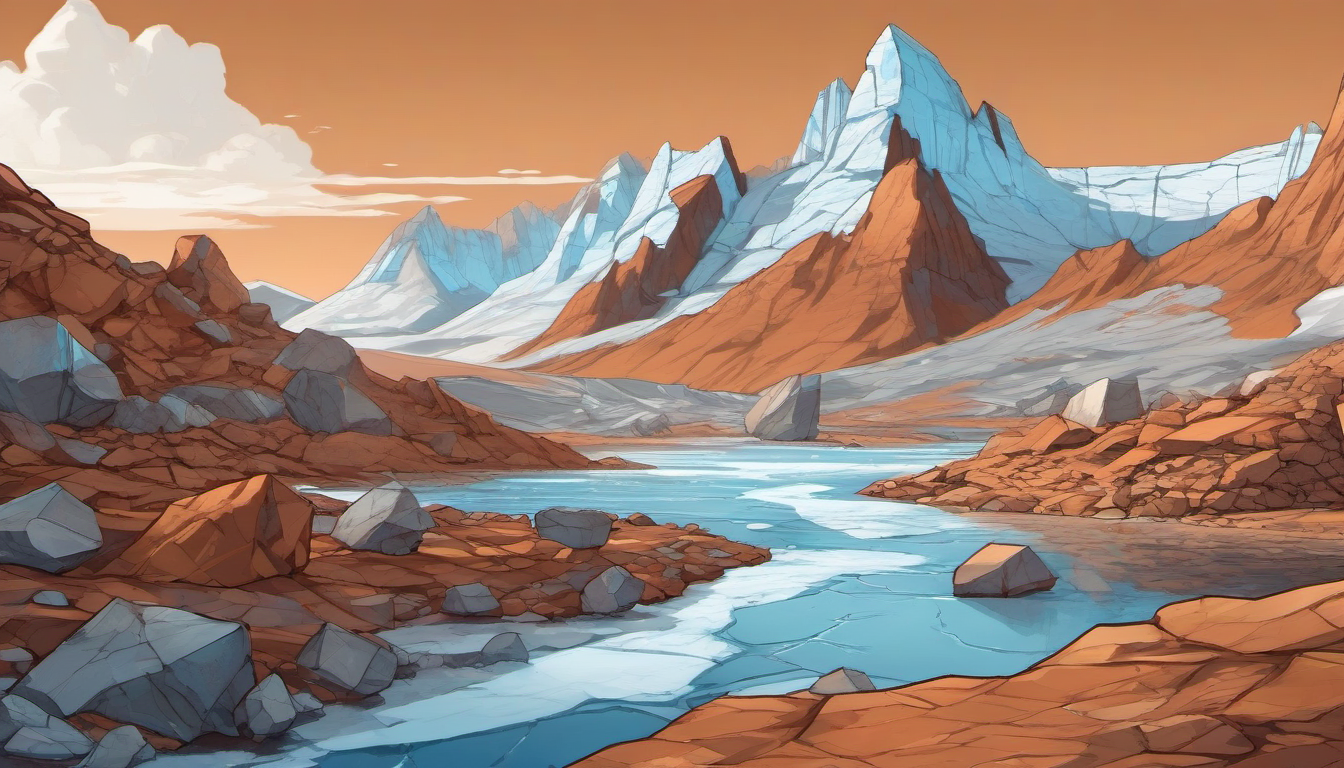
Milei's push to dismantle the world's first glacier protection law pits critical mineral sovereignty against the survival of Andean water systems
Executive Summary
- Argentina's Congress votes this week on amending the landmark 2010 Glacier Law, potentially unlocking $35 billion in frozen copper projects across the Andes — including BHP-Lundin's $18 billion Vicuña mega-project announced February 17, 2026
- The legislative push coincides with a US-Argentina critical minerals supply deal and surging global copper demand driven by AI data centers, EVs, and energy transition — with the IEA warning of a 30% supply deficit by 2035
- At stake: 17,000 glaciers and periglacial zones that serve as essential freshwater reservoirs for millions of Argentines and the agricultural sector, at a time when Andean glaciers are retreating at historically unprecedented rates due to climate change
Chapter 1: The Law That Froze an Industry
On September 30, 2010, Argentina became the first country in the world to adopt a glacier protection law. The "Regime of Minimum Standards for the Preservation of Glaciers and Periglacial Environments" (Law 26.639) prohibited mining, oil drilling, and industrial activity on glaciers and surrounding periglacial areas — the frozen ground formations that act as slow-release water reservoirs feeding rivers, aquifers, and agricultural systems downstream.
The law's path to passage was itself dramatic. It was first approved by Congress in 2008 under President Cristina Fernández de Kirchner, only to be immediately vetoed by her own government under pressure from mining lobbies — particularly Barrick Gold, the Canadian giant operating the controversial Pascua-Lama gold mine straddling the Argentine-Chilean border. A public backlash forced a second, stronger version through Congress in 2010.
For 15 years, the law stood firm. In 2023, Argentina's Supreme Court unanimously upheld it against a constitutional challenge from Barrick Gold, rejecting the company's argument that the law created "uncertainty" for mining operations above 4,000 meters — precisely where the Andes' richest mineral deposits and most critical glacial formations overlap.
That overlap is the crux of the current battle. Argentina's glaciers account for less than 1% of its territory, but they sit atop some of the world's largest undeveloped copper deposits. For the mining industry, the glacier law has been a $35 billion padlock. For environmental scientists, it has been the thin legal line protecting the water supply of millions.
Chapter 2: The Copper Imperative
The timing of Milei's legislative push is no accident. Global copper markets are entering what analysts describe as a structural deficit era driven by three converging mega-trends:
The Energy Transition: Every wind turbine requires approximately 4.7 tonnes of copper. Solar panels use roughly 5.5 tonnes per megawatt. The global shift to renewables is creating unprecedented demand for the red metal.
The AI Infrastructure Boom: Data centers consume vast quantities of copper for wiring, cooling systems, and power distribution. With hyperscalers committing over $690 billion to AI infrastructure in 2026 alone, copper demand from the tech sector is surging.
The Electric Vehicle Revolution: A single EV uses approximately 83 kg of copper — four times more than a conventional car. With global EV sales projected to exceed 30 million units annually by 2030, automotive copper demand is accelerating.
The International Energy Agency warned in December 2025 that copper faces a 30% supply deficit by 2035 — one of the most severe shortages projected for any critical mineral. S&P Global has estimated that the world will need to nearly double copper production by 2035 to meet demand, a feat that would require discovering and developing the equivalent of eight new Escondida mines (the world's largest copper operation, in Chile).
Copper prices reflect this anxiety. The metal hit $14,000 per tonne in early 2026, near historical highs — more than double its price five years ago.
Against this backdrop, Argentina's frozen copper deposits represent a geopolitical prize. The country does not currently produce copper — its last mine, Alumbrera, closed in 2018. But its Andean provinces host at least five world-class copper projects in various stages of development, all constrained by the glacier law.
| Project | Operator | Est. Investment | Province | Status |
|---|---|---|---|---|
| Vicuña (Josemaría + Filo del Sol) | BHP / Lundin Mining | $18B | San Juan | RIGI application filed |
| El Pachón | Glencore | $9.5B | San Juan | Feasibility |
| Agua Rica (MARA) | Glencore | $4B | Catamarca | Feasibility |
| Los Azules | McEwen Mining | $2.5B+ | San Juan | Pre-feasibility |
| Taca Taca | First Quantum | $3B+ | Salta | Feasibility |
Combined, these projects could transform Argentina into a top-five global copper producer within a decade, generating annual output of over 1 million tonnes — rivaling Chile's current dominance.
Chapter 3: The Vicuña Signal
The announcement on February 17, 2026 — one day before the Senate debate on the glacier law — was carefully choreographed. BHP-Lundin's Vicuna Corp revealed an $18 billion multi-year investment plan for the Josemaría and Filo del Sol deposits in San Juan province. The numbers are staggering:
- 47 million tonnes of contained copper
- 97 million ounces of gold
- 1.8 billion ounces of silver
- Average annual production of 395,000 tonnes of copper, 711,000 ounces of gold, and 22.2 million ounces of silver over 25 years
- Potential to reach 800,000 tonnes per year of copper equivalent at first-quartile costs
The initial $7 billion phase focuses on Josemaría, with capital deployment from 2027 and first production targeted for 2030. Vicuna applied for benefits under Argentina's RIGI (Large Investment Incentive Regime) in December, committing to spend $2 billion in its first 24 months. Economy Minister Luis Caputo celebrated publicly: "This project would not exist without RIGI."
The timing is inseparable from the glacier law debate. While Vicuna's deposits may not directly overlap with glaciers catalogued by the National Glacier Inventory, the broader package of projects — particularly El Pachón and MARA — operate in periglacial zones that would become accessible only if Milei's amendments pass.
Six of the world's largest mining corporations — Barrick Gold, Lundin Mining, BHP, Glencore, Rio Tinto, and Chinese state-owned Shandong Gold — have lobbied intensively for the reform, arguing that "legal certainty" is needed to unlock investment.
Chapter 4: What the Amendment Actually Does
Milei's proposed amendment does not repeal the glacier law outright. Instead, it fundamentally restructures the mechanism of protection through a single critical change: devolving authority from the national government to provincial governments.
Under the current law, the National Glacier Inventory — conducted by Argentina's National Council for Scientific and Technical Research (CONICET) — defines which glacial and periglacial zones are protected. Mining is prohibited across all inventoried areas.
Under Milei's amendment, provincial authorities would gain the power to determine which periglacial areas merit protection based on their own assessments. Provinces could then grant mining permits in areas they deem non-essential to water systems.
Environmental groups call this a "fox guarding the henhouse" arrangement. Argentina's mining provinces — San Juan, Salta, Catamarca, Mendoza, Jujuy — derive significant fiscal revenue from mining royalties and have consistently pushed for weakened environmental regulations. San Juan's governor has been among the most vocal advocates for the reform.
Guillermo Folguera, an environmental researcher at CONICET, told Climate Home News: "There is a clear intention among those pushing for these modifications to portray the current protection of the periglacial environment as a legal exaggeration, minimising the importance of these areas within the glaciers themselves and the ecosystem services they provide."
The Argentine environmental NGO FARN (Foundation for Environment and Natural Resources) has identified at least four major copper projects that currently violate the glacier law and could begin operating if the amendments pass.
Chapter 5: The Water Equation
The environmental stakes extend far beyond local ecosystems. Argentina's Andean glaciers and periglacial formations serve as critical water infrastructure for:
- Agriculture: The Cuyo wine region (Mendoza, San Juan) depends almost entirely on glacial meltwater for irrigation. Argentina is the world's fifth-largest wine producer and a major agricultural exporter.
- Urban water supply: Cities like Mendoza (population 1 million+) rely heavily on Andean snowmelt and glacial runoff for drinking water.
- Hydropower: Glacial rivers feed hydroelectric systems that provide a significant share of regional electricity generation.
Climate change is accelerating glacial retreat across the Andes. Studies published in Nature have documented that Andean glaciers have lost approximately 30% of their volume since the 1980s, with the rate of loss accelerating in recent years. The periglacial zones — frozen ground that stores water and releases it slowly during dry seasons — are particularly vulnerable to large-scale mining operations that disturb surface and subsurface thermal regimes.
The Pascua-Lama precedent haunts the debate. Barrick Gold's $8.5 billion gold mine on the Argentine-Chilean border was ultimately suspended after evidence emerged that mining operations had damaged glaciers in the project area. The Chilean side imposed environmental penalties; the Argentine side's response was the glacier law itself.
Mining advocates counter that modern techniques can extract minerals without damaging water systems, and that establishing "technical criteria" — such as measuring the ice content of periglacial zones — could allow responsible development. But critics note that provincial governments lack the scientific capacity to conduct independent assessments, and that the economic incentive to approve permits would overwhelm environmental caution.
Chapter 6: Scenario Analysis
Scenario A: Amendment Passes — The Copper Rush (50%)
Rationale: Milei's ruling coalition (La Libertad Avanza) has gained significant congressional support since the labor law victory in January 2026. Mining-friendly provincial governors provide additional votes. The $18 billion Vicuña announcement creates powerful momentum.
Trigger: Senate approval this week, followed by lower house vote within 30 days.
Consequences:
- $35B+ in mining investment unlocked over 5-10 years
- Argentina becomes a top-5 copper producer by 2032-2033
- US-Argentina critical minerals axis strengthened
- Significant environmental litigation from NGOs and indigenous communities
- Potential water conflicts in Cuyo region within 5-10 years
Historical precedent: Chile's experience with Pascua-Lama and the Atacama lithium brine extraction — initial economic euphoria followed by environmental damage, community resistance, and eventual regulatory tightening.
Scenario B: Partial Amendment — Compromise (30%)
Rationale: Opposition senators force modifications that preserve national-level oversight for areas with confirmed glacial formations while opening periglacial zones to case-by-case provincial review with federal veto power.
Trigger: Senate committee negotiations produce a modified text.
Consequences:
- Some projects proceed (Vicuña, Los Azules), others remain blocked (El Pachón, MARA)
- Slower but steadier investment inflow
- Legal uncertainty persists, deterring the most risk-averse investors
- Environmental NGOs challenge provincial decisions in federal courts
Historical precedent: Colombia's approach to mining regulation — gradual opening with constitutional court checks that created a "stop-and-go" investment environment.
Scenario C: Amendment Blocked — Status Quo (20%)
Rationale: Environmental protests escalate. Opposition mobilizes around water rights narrative. Supreme Court's 2023 ruling cited as precedent. Milei lacks supermajority.
Trigger: Senate vote fails or is indefinitely postponed.
Consequences:
- Argentina remains shut out of global copper boom
- BHP-Lundin Vicuña project proceeds but at smaller scale in non-glacial zones
- Critical minerals supply deal with US delivers less than promised
- Chile and Peru maintain copper production dominance
Historical precedent: Ecuador's 2008 constitutional "rights of nature" provisions that initially blocked mining, later partially reversed but continuing to constrain investment.
Chapter 7: Investment Implications
Direct beneficiaries if amendment passes:
- BHP (ASX: BHP): Copper already overtook iron ore as top earnings driver (EBITDA $8B, +59%). Vicuña would add 800,000 tpa copper equivalent to its portfolio. BHP shares have hit $272B market cap — a historical record.
- Lundin Mining (TSX: LUN): 50% Vicuña stake represents transformative upside. Currently trades at a discount to NAV due to Argentina country risk.
- Glencore (LON: GLEN): El Pachón ($9.5B) and Agua Rica ($4B) represent its largest greenfield copper projects globally.
Indirect beneficiaries:
- Argentine peso and sovereign bonds — mining FDI inflow supports external balance
- Water technology companies — any mining development will require massive water management systems
- Chilean copper producers face a new major competitor medium-term
Risks to watch:
- Environmental litigation could delay projects by 3-5 years even if law passes
- Community resistance in San Juan and Catamarca — Argentina has a history of violent mining protests (Esquel, Famatina)
- Climate change impacts could make water conflicts more acute than models predict
- Political reversal risk — Milei's successor could restore protections
Conclusion
Argentina's glacier law debate crystallizes one of the defining tensions of the 21st century: the minerals needed to decarbonize the global economy often lie beneath the ecosystems most vulnerable to extraction. The copper required for wind turbines, EVs, and AI data centers is locked in mountains that also store the water supply of millions.
Milei frames the choice as jobs versus environmental extremism. Environmentalists frame it as short-term profit versus civilizational survival. The reality, as with most geopolitical resource contests, lies in the details — the specific periglacial zones assessed, the quality of provincial oversight, the rigor of water monitoring, and the willingness of multinational miners to internalize environmental costs rather than externalize them.
What is certain: with $35 billion in investment and a 30% global copper deficit looming, Argentina's glaciers have become a frontline in the critical minerals war. The votes this week will determine whether the world's first glacier protection law survives the age of the energy transition — or becomes its first casualty.
Sources: Climate Home News, Mining.com, Reuters, S&P Global, FARN Argentina, IEA Global Critical Minerals Outlook, BHP Half-Year Results 2026
Leave a Reply