
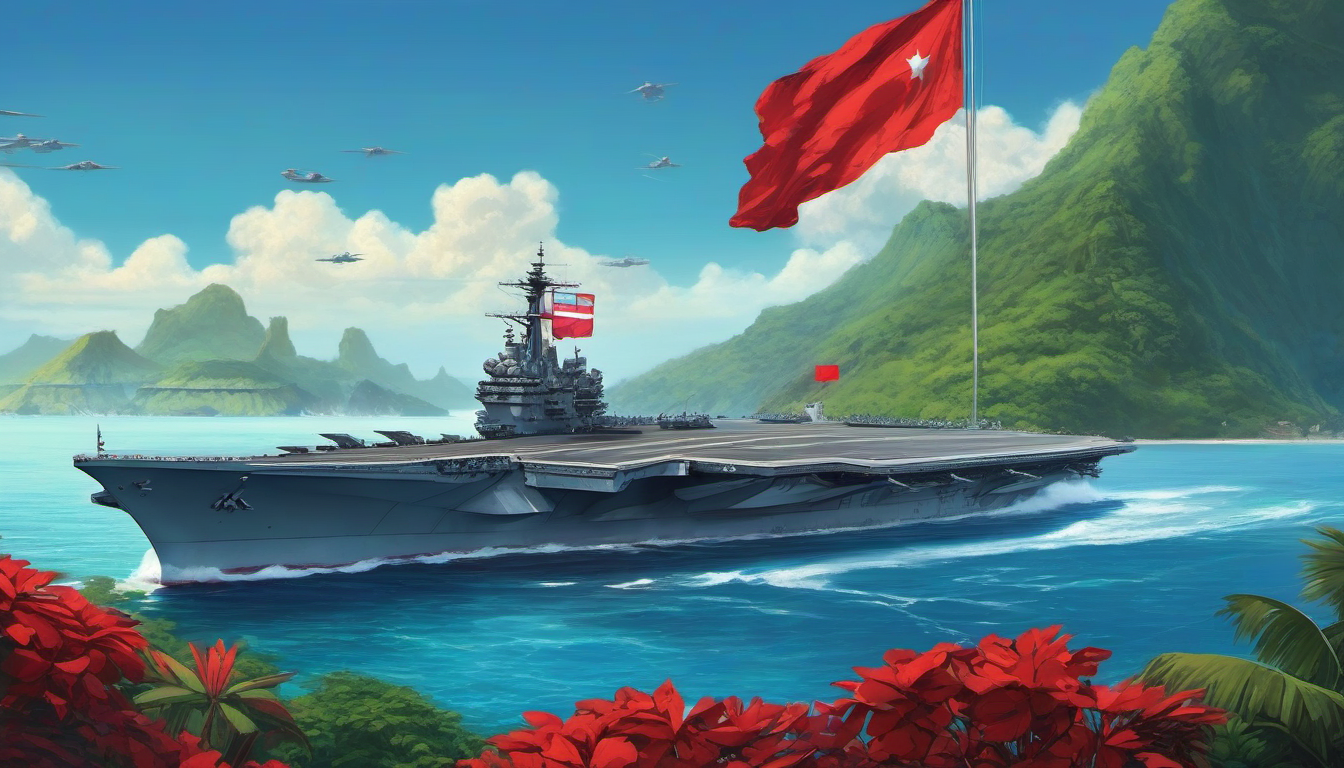
A retired Italian warship could reshape the maritime balance of power across the world's most contested waters
Executive Summary
- Indonesia is set to receive Italy's retired aircraft carrier Giuseppe Garibaldi by October 2026, making it the first Southeast Asian nation to operate a full-deck aviation ship — a strategic inflection point for Indo-Pacific maritime security.
- The $1 billion grant-and-refit package represents a calculated blue-water ambition under President Prabowo, who has dramatically expanded military spending despite an $80 billion market crash and MSCI downgrade warnings.
- The acquisition intensifies an already accelerating Asian naval arms race: China operates three carriers, India two, Japan has converted two helicopter destroyers, and now Indonesia joins the club — raising the stakes in the South China Sea, Malacca Strait, and across critical shipping lanes carrying 40% of global trade.
Chapter 1: The Ship That Changed Everything
On February 13, 2026, Indonesia's Defense Ministry confirmed what naval analysts had speculated about for two years: Jakarta will receive the Giuseppe Garibaldi, a 13,850-tonne light aircraft carrier decommissioned by the Italian Navy in October 2024, as a strategic grant from Rome. Admiral Muhammad Ali, Chief of Staff of the Indonesian Navy, set an ambitious target — arrival before the Armed Forces' 81st anniversary on October 5, 2026.
The Garibaldi is no museum piece. Commissioned in 1985 and built by Fincantieri at Monfalcone, she served as Italy's flagship for nearly four decades, accumulating combat experience across Kosovo (1999), Afghanistan (2001–2002), and Libya (2011). Her 174-meter flight deck, equipped with a ski-jump ramp, can support up to 18 helicopters or a mixed air wing of 16 Harrier jump jets alongside rotary-wing aircraft. Her four GE/Avio LM2500 gas turbines deliver speeds exceeding 30 knots with a range of 7,000 nautical miles — sufficient for sustained Indo-Pacific deployments.
While the hull itself comes as a grant, the total package is far from free. The reported financial structure includes approximately $450 million for acquisition-related costs and retrofitting, $250 million for transport helicopters, and $300 million for carrier-optimized utility helicopters — a total approaching $1 billion. Indonesia's Defense Ministry has confirmed budget allocation for "retrofit and adjustments to ensure the vessel meets the operational requirements of the Indonesian Navy," including propulsion systems, communications, and onboard technology.
The tight delivery timeline raises operational questions. Indonesia has never operated an aircraft carrier. Naval News analysis suggests the vessel would likely arrive with Italian crew members assisting basic operations, with major refit work potentially conducted in Indonesia after delivery. An Indonesian private company, Republikorp, has already expressed interest in carrying out modifications.
Chapter 2: Prabowo's Blue-Water Vision
The carrier acquisition must be understood within President Prabowo Subianto's broader military transformation agenda — one that has alarmed economists while thrilling defense hawks.
Since taking office, Prabowo has pursued an aggressive defense modernization program even as Indonesia faces serious economic headwinds. In late 2025, the launch of the controversial Danantara sovereign wealth fund triggered an $80 billion market crash, Moody's downgraded Indonesia's outlook to Negative, and MSCI warned of a potential downgrade to Frontier Market status. The rupiah has been under persistent pressure.
Yet defense spending has surged. Indonesia's 2026 defense budget reached $25 billion — a 40% increase over 2024 — with Prabowo personally driving procurement decisions. The carrier is the crown jewel of a broader naval expansion that includes:
- Two new Fincantieri-built frigates: KRI Brawijaya (320) and KRI Prabu Siliwangi (321), which share design elements with the Garibaldi, easing maintenance integration
- Submarine fleet expansion: Negotiations with France for Scorpène-class submarines and with South Korea for additional KSS-III boats
- Drone and unmanned systems: Investment in Turkish-made Bayraktar TB2 and indigenous MALE UAV programs
- Base expansion: New naval facilities at Natuna Islands, directly facing the South China Sea
For Prabowo — himself a former special forces commander and son-in-law of Suharto — the carrier represents something deeply personal. His vision of Indonesia as a "Global Maritime Fulcrum," first articulated by his predecessor Jokowi, has evolved into something more assertive: a nation capable of projecting power, not merely defending coastlines.
Chapter 3: The Archipelagic Imperative
Indonesia's geography makes the carrier case almost self-evident. The world's largest archipelagic nation spans 17,000 islands across 5,000 kilometers — a maritime domain larger than the continental United States. Its territorial waters encompass three critical international chokepoints:
| Strait | Annual Shipping Volume | Global Trade Share |
|---|---|---|
| Malacca | 100,000+ vessels | ~25% of global trade |
| Sunda | 3,500+ vessels | Alternative Pacific route |
| Lombok | 3,000+ vessels | Supertanker passage |
Together, these straits carry roughly 40% of all global maritime commerce, including 80% of China's oil imports and the majority of Japan's and South Korea's energy supplies. Whoever controls these waters influences the economic lifeline of East Asia.
Yet Indonesia's ability to police this vast domain has historically been limited. The Indonesian Navy (TNI AL) operates approximately 150 vessels, many aging, spread across a maritime zone of 6.4 million square kilometers. Illegal fishing costs Indonesia an estimated $20 billion annually. Chinese fishing militia regularly probe Indonesian waters around the Natuna Islands, which China claims overlap with its "nine-dash line."
A carrier provides what Indonesia has always lacked: a mobile command platform capable of projecting aviation assets — surveillance, anti-submarine warfare, search-and-rescue, and potentially combat air patrols — across vast oceanic distances without relying on shore-based infrastructure. For disaster response alone — in a nation struck by the 2004 tsunami, recurring volcanic eruptions, and seasonal flooding — a carrier's utility is difficult to overstate.
Chapter 4: The Asian Carrier Arms Race
Indonesia's acquisition does not occur in a vacuum. It enters a rapidly intensifying Asian naval competition:
China operates three carriers — Liaoning, Shandong, and the catapult-equipped Fujian — with a fourth under construction. The PLAN's carrier battle groups have conducted increasingly aggressive exercises in the Western Pacific and South China Sea, including 2025 transits through Indonesian waters near the Natuna Islands.
India operates INS Vikramaditya and the indigenous INS Vikrant, with a third carrier under design. India's Exercise MILAN 2026 in February brought 72 nations to Visakhapatnam, signaling Delhi's ambition to dominate the Indian Ocean.
Japan has converted its two Izumo-class helicopter destroyers to accommodate F-35B Lightning II fighters, effectively creating light carriers. Prime Minister Takaichi's supermajority government has pushed through constitutional reinterpretation allowing offensive military capabilities.
South Korea operates the Dokdo-class amphibious assault ship and has announced plans for a 40,000-tonne light carrier, CVX, though the program faces budget pressure.
Thailand technically operates the HTMS Chakri Naruebet, the world's smallest aircraft carrier, but it has been largely non-operational for years — serving more as a royal yacht than a military asset.
Indonesia's Garibaldi would be the first truly operational full-deck carrier in Southeast Asia, instantly elevating Jakarta's status in the regional naval hierarchy.
| Country | Carrier(s) | Type | Displacement |
|---|---|---|---|
| China | 3 (+ 1 building) | CATOBAR/STOBAR | 60,000–80,000t |
| India | 2 | STOBAR | 40,000–45,000t |
| Japan | 2 (converted) | STOVL | 27,000t |
| South Korea | 1 (LPH) + CVX planned | LPH/STOVL | 14,500t–40,000t |
| Indonesia | 1 (incoming) | STOVL/Helo | 13,850t |
| Thailand | 1 (non-operational) | STOVL | 11,500t |
Chapter 5: Scenario Analysis
Scenario A: Successful Integration and Regional Deterrence (40%)
Rationale: Indonesia has a track record of absorbing donated military equipment, including ex-German submarines and ex-British frigates. Fincantieri's existing relationship through the two new frigates provides a built-in support ecosystem. Italian crew assistance during the transition period mitigates the zero-experience problem.
Trigger conditions: Timely delivery by October 2026; Italian technical support team of 100+ personnel; successful helicopter operations within 12 months; training partnership with India or Japan.
Historical precedent: India successfully integrated the ex-British INS Viraat (ex-HMS Hermes) in 1987, operating it for 30 years despite having no prior carrier experience. The vessel served in the 1999 Kargil conflict.
Investment implications: Positive for Fincantieri (FCT.MI), Indonesian defense stocks, and helicopter manufacturers (Leonardo, Airbus Helicopters). Strengthens Indonesia's negotiating position with China on maritime boundaries.
Scenario B: Prestige Platform Without Teeth (35%)
Rationale: Operating a carrier requires an entire ecosystem — escorts, supply ships, integrated air defense, trained aircrew, and massive maintenance infrastructure. Indonesia has none of this. The Garibaldi may become a symbolic showpiece used for parades and disaster relief but lack combat credibility.
Trigger conditions: Insufficient escort vessels; delayed helicopter procurement; budget constraints from economic downturn; no fixed-wing capability (no Harriers or F-35Bs available).
Historical precedent: Thailand's Chakri Naruebet, commissioned in 1997, became operational within a year but quickly fell into disuse due to lack of aircraft and maintenance funding. It has been nicknamed "the world's most expensive royal yacht."
Investment implications: Limited strategic impact; Indonesia remains a green-water navy with one large liability. Defense budget strain could accelerate the economic crisis Moody's has warned about.
Scenario C: Regional Destabilization and Arms Race Acceleration (25%)
Rationale: China views any expansion of naval capability near the South China Sea with suspicion. If Indonesia deploys Garibaldi near the Natuna Islands or conducts exercises with the US/Japan/India, Beijing may respond with increased military pressure — more fishing militia incursions, PLAN carrier patrols, or economic coercion similar to the treatment it inflicted on Lithuania over the Taiwan representative office.
Trigger conditions: Indonesia joins a carrier exercise with Quad nations; Garibaldi deploys to Natuna; Malaysia or Vietnam pursue their own carrier programs in response; China issues diplomatic protests.
Historical precedent: Australia's AUKUS submarine deal in 2021 triggered a diplomatic crisis with France and accelerated Chinese naval buildup in the Indo-Pacific. Japan's carrier conversion prompted strong Chinese media reaction and increased PLAN activity near the Senkaku/Diaoyu Islands.
Investment implications: Accelerates the global defense supercycle; positive for Asian defense stocks broadly; negative for Indonesia-China trade relations ($98 billion bilateral trade at risk).
Chapter 6: Investment Implications
Direct beneficiaries:
- Fincantieri (FCT.MI): Italian shipbuilder already supplying Indonesia's two new frigates; the carrier refit cements a long-term partnership potentially worth billions over the vessel's 15-20 year service life
- Leonardo (LDO.MI): Leading candidate to supply carrier-based helicopters (AW101 Merlin or NH90); already a major Italian defense exporter to ASEAN
- Indonesian defense sector: PT Pindad, PT PAL Indonesia could benefit from local maintenance and modification contracts
Broader implications:
- The carrier acquisition validates the global defense supercycle thesis: from EU SAFE bonds to Japan's Article 9 revision to NATO's 5% GDP target, military spending is accelerating worldwide
- ASEAN naval modernization is an underappreciated investment theme: Vietnam, Philippines, Malaysia, and Singapore are all expanding maritime capabilities
- Critical shipping lane protection becomes increasingly important as US-China competition intensifies — logistics and port infrastructure companies with ASEAN exposure benefit
Risk factors:
- Indonesia's economic fragility (Moody's Negative outlook, MSCI downgrade risk) could force defense budget cuts
- The carrier's 40-year-old hull requires extensive refurbishment — cost overruns are likely
- Absence of fixed-wing aircraft limits combat utility to helicopter-based operations
Conclusion
The Giuseppe Garibaldi's journey from Mediterranean flagship to Southeast Asian power projection platform encapsulates the dramatic reshaping of Indo-Pacific security in 2026. At the Munich Security Conference just days ago, Ray Dalio pronounced the post-1945 world order dead and declared the arrival of "Stage 6" — an era where might makes right and military capability determines diplomatic weight.
Indonesia's carrier gambit is a perfect Stage 6 move. In a fracturing world where the US is retrenching from its role as global security guarantor, where China is expanding its naval footprint relentlessly, and where every nation must increasingly look to its own defense, Jakarta is betting that a 40-year-old Italian warship can buy it a seat at the big table.
Whether that bet pays off — or whether the Garibaldi becomes another Chakri Naruebet, a gleaming hull with empty flight decks — depends on whether Prabowo can match his military ambitions with the fiscal discipline his economy desperately needs. For now, the world's largest archipelago is about to acquire its most powerful warship. The Indo-Pacific will never look the same.
Sources: Jakarta Globe, Naval News, Defence Security Asia, Antara News, Fincantieri, Indonesian Defense Ministry
Leave a Reply