
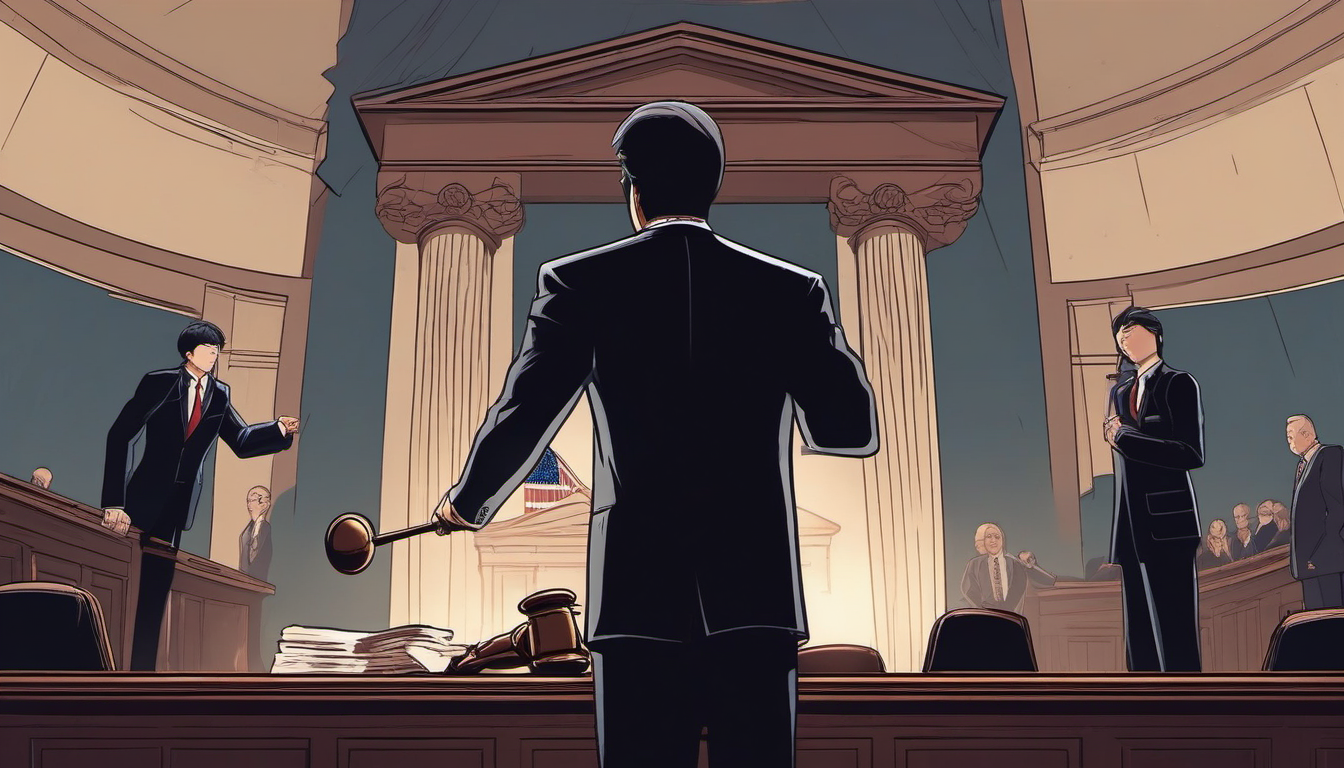
Two days before the verdict that could sentence a former president to death, South Korea confronts the ghosts of its authoritarian past
Executive Summary
- On February 19, South Korea's Seoul Central District Court will deliver a live-broadcast verdict on former President Yoon Suk Yeol's insurrection charges—prosecutors have demanded the death penalty, making this only the second time in Korean history a former head of state faces capital prosecution.
- The trial is the culmination of a 14-month constitutional crisis that began with Yoon's six-hour martial law declaration in December 2024, an act that triggered his impeachment, removal, and eight separate criminal cases—the most extensive prosecution of a former leader in any advanced democracy.
- President Lee Jae-myung, who replaced Yoon with a 63% approval rating, is consolidating power ahead of June local elections, but the verdict carries risks: too harsh could deepen political polarization, too lenient could embolden future authoritarian impulses.
Chapter 1: Six Hours That Shook a Democracy
On the night of December 3, 2024, President Yoon Suk Yeol appeared on live television and declared "emergency martial law." Within minutes, armed soldiers surrounded the National Assembly. Police deployed near major media outlets. Helicopters circled Seoul. For millions of South Koreans, the scenes evoked a past they believed was permanently buried—the era of military dictators who seized power at gunpoint and held it for decades.
But South Korea's democratic institutions held. Members of the National Assembly physically broke through military cordons, convened an emergency session in the dead of night, and voted overwhelmingly to overturn the decree. The entire episode lasted just six hours.
The constitutional shockwave, however, has not subsided. Fourteen months later, the aftershocks continue to reshape South Korean politics, law, and society. The crisis exposed how fragile democratic norms remain even in advanced democracies—and how quickly a single leader can push institutions to the breaking point.
What made Yoon's martial law declaration particularly alarming was its complete lack of legal foundation. Under South Korea's constitution, any declaration of martial law must first pass through the State Council, the cabinet-level deliberative body serving as a critical check on presidential emergency powers. Investigators found that Yoon bypassed this requirement entirely, notifying only a handful of loyalists before acting unilaterally. There was no war. No national emergency. No foreign invasion. The Seoul Central District Court later issued a blunt rebuke: "Martial law, as an exercise of national emergency powers, should be invoked only under the most extreme and exceptional circumstances."
Yoon's defense—that he was combating a "legislative dictatorship" run by opposition lawmakers—has found little traction in court. His claim that the opposition-dominated National Assembly was systematically obstructing governance struck many legal experts as precisely the kind of political grievance that democratic systems are designed to channel through elections, not military force.
Chapter 2: The Trial of the Century
The February 19 verdict represents the climax of an unprecedented legal process. No modern democracy has subjected a former leader to such an extensive series of prosecutions simultaneously.
Eight Trials, One Former President
Yoon faces eight separate criminal cases:
| Case | Charge | Status |
|---|---|---|
| Obstruction of Justice | Blocking arrest warrant execution | Convicted, 5 years (Jan 16, 2026) |
| Insurrection (lead charge) | Masterminding martial law declaration | Verdict Feb 19 |
| False Testimony | Lying about Han Duck-soo's role | Ongoing |
| North Korea Drone Provocation | Sending drones into DPRK airspace to create pretext | Ongoing |
| Abuse of Power (multiple) | Various constitutional violations | Ongoing |
| Electoral Interference | Alleged manipulation of intelligence agencies | Ongoing |
The insurrection charge is the gravest. During an eleven-hour closing argument on January 13, 2026, prosecutors laid out their case in uncompromising terms: "The declaration of martial law betrayed the constitutional duty to protect civil liberties. In its purpose, its methods, and its execution, this act was anti-state in nature." They demanded the death penalty.
The minimum sentence for insurrection under Korean law is life imprisonment. Acquittal is widely considered nearly impossible given the mountain of evidence—Yoon declared martial law on live television, after all. The core legal question is whether the court imposes death, life imprisonment, or applies the rare "discretionary mitigation" provision to deliver a lighter sentence. Attorney Yoo Jung-hoon, a prominent legal commentator, has noted that Yoon's lack of a guilty plea or expression of remorse makes mitigation "highly unlikely."
The Ripple Effect: Co-Conspirators
The verdict will set the tone for related cases already producing severe sentences:
- Former Prime Minister Han Duck-soo: Convicted, sentenced to 23 years—eight years more than prosecutors sought
- Former Interior Minister Lee Sang-min: Sentenced to 7 years
- Former National Intelligence Service Chief Cho Tae-yong: On trial for dereliction of duty and perjury
- Former First Lady Kim Keon Hee: Jailed for 20 months for bribery (accepting luxury gifts from the Unification Church), in a separate case
The severity of Han's sentence—exceeding even prosecutorial demands—sent an unmistakable signal about judicial sentiment.
Chapter 3: The Ghost of Gwangju—Historical Precedent
Chun Doo-hwan, 1996: The Only Comparison
The Yoon trial inevitably invites comparison to the only prior case of a former Korean president facing insurrection charges: the 1996 prosecution of Chun Doo-hwan, the military dictator who seized power in a 1979 coup and ordered the brutal suppression of the Gwangju Uprising in May 1980, in which hundreds of civilians were killed.
| Factor | Chun Doo-hwan (1996) | Yoon Suk Yeol (2026) |
|---|---|---|
| Nature of act | Military coup + massacre | Martial law declaration (no casualties) |
| Duration of rule | 8 years (1980-1988) | ~2.5 years (2022-2025) |
| Prosecution sought | Death penalty | Death penalty |
| First instance verdict | Death sentence | Pending |
| Supreme Court verdict | Commuted to life imprisonment | — |
| Eventual outcome | Presidential pardon (Dec 1997) | — |
| Civilian casualties | Hundreds (Gwangju) | None |
The comparison reveals both parallels and critical differences. Chun's crimes were far graver in scale—a full military coup followed by mass civilian killings. Yet Chun received a death sentence at first instance, only to have it commuted to life by the Supreme Court, and then pardoned entirely by President Kim Young-sam in December 1997 in a gesture of "national reconciliation."
The Chun precedent creates an uncomfortable template. If even a dictator responsible for mass civilian deaths ultimately walked free, what does that mean for Yoon, whose martial law lasted six hours with no casualties? Legal analysts are divided. Some argue that the absence of bloodshed makes a death sentence disproportionate. Others counter that the nature of the crime—a peacetime constitutional assault with no legitimate basis—demands maximum severity precisely because it represents the purest form of insurrection: an attempt to overthrow democratic governance itself.
The Execution Moratorium
South Korea has not executed anyone since December 1997, maintaining a de facto moratorium for nearly three decades despite retaining capital punishment in law. Over 60 people currently sit on death row. Even if the court sentences Yoon to death, actual execution is considered virtually impossible under current political conditions. The practical effect would be permanent imprisonment, barring a future pardon.
Chapter 4: Lee Jae-myung's Consolidation
The Beneficiary
President Lee Jae-myung, who won the June 2025 snap election triggered by Yoon's removal, has emerged as perhaps the biggest beneficiary of the ongoing trials. His approval rating has risen to 63% (Gallup, Feb 13)—the highest of his presidency—with three consecutive weeks of gains. The MBC poll placed him even higher at 64%.
Lee's political position is formidable. His Democratic Party holds a comfortable majority in the National Assembly, and June 2026 local elections are shaping up as a potential rout. Polling shows 54% of voters favoring ruling party candidates for regional positions.
Yet Lee's own legal history adds complexity to the narrative. He was himself a criminal defendant during the 2025 campaign, facing charges of corruption and election law violations from which he was eventually acquitted. His critics argue that a former defendant presiding over the prosecution of his predecessor represents an uncomfortable concentration of power.
The Polarization Dilemma
South Korean society remains deeply divided. Yoon's supporters—estimated at 20-30% of the electorate—view the trials as political persecution, staging regular protests in central Seoul. His opponents see the prosecution as essential democratic accountability. The February 19 verdict, to be broadcast live nationwide, will be a watershed moment regardless of the outcome.
A death sentence risks deepening this polarization, potentially martyrizing Yoon among his base and complicating Lee's efforts to govern by consensus. A life sentence—the minimum for insurrection—may be perceived as the court threading the needle: severe enough to affirm democratic norms, pragmatic enough to avoid inflaming an already volatile political landscape.
Chapter 5: Scenario Analysis
Scenario A: Life Imprisonment (55%)
Rationale: This is the minimum sentence for insurrection and the most likely outcome according to legal analysts. It mirrors the Supreme Court's eventual treatment of Chun Doo-hwan (commuted from death to life) while skipping the symbolism of an initial death sentence.
Triggering conditions:
- Court acknowledges severity of insurrection but notes absence of civilian casualties
- Follows legal precedent of Chun case (where even mass killings resulted in life, not executed death)
- Judges may seek to avoid the political symbolism of capital sentencing
Historical precedent: Chun received life at Supreme Court level; Roh Tae-woo received 17 years.
Scenario B: Death Sentence (30%)
Rationale: Prosecutors have aggressively demanded death, and the first-instance court may follow Chun's 1996 pattern (death at first instance, commuted on appeal). The judiciary has shown willingness to exceed prosecutorial demands—Han Duck-soo received 8 years more than requested.
Triggering conditions:
- Court determines peacetime insurrection without any legitimate basis warrants maximum deterrence
- Judicial momentum from severe sentences in related cases
- Public sentiment overwhelmingly favors accountability
Historical precedent: Chun received death at first instance in 1996 before commutation.
Scenario C: Discretionary Mitigation / Lighter Sentence (15%)
Rationale: Theoretically possible but considered highly unlikely given Yoon's refusal to plead guilty or express remorse. Courts rarely apply discretionary mitigation in insurrection cases.
Triggering conditions:
- Last-minute guilty plea or expression of remorse (no indication of this)
- Court determines six-hour duration and absence of casualties warrant departure from minimum
- Political calculation to reduce polarization
Historical precedent: No precedent for mitigation in insurrection cases.
Chapter 6: Investment Implications and Geopolitical Impact
Markets
South Korean markets have largely priced in the trial, with the KOSPI showing resilience. However, the verdict could generate short-term volatility:
- Death sentence: Brief market dip on political uncertainty, rapid recovery as investors view it as resolving ambiguity
- Life sentence: Market-neutral, consensus expectation
- Surprise acquittal/light sentence: Significant negative reaction on political instability fears
US-South Korea Alliance
Lee Jae-myung's foreign policy differs markedly from Yoon's. While Yoon pursued aggressive alignment with Washington and Tokyo (participating in the Camp David trilateral), Lee has adopted a more balanced approach—maintaining the US alliance while seeking dialogue with Pyongyang and warmer relations with Beijing. The verdict could:
- Strengthen Lee domestically → greater mandate for his more independent foreign policy
- Complicate US relations if Washington perceives Lee as less aligned on China containment
- Impact North Korea policy → Lee has signaled openness to inter-Korean dialogue, contrasting with Yoon's hawkish stance
The Democracy Premium
South Korea's handling of the Yoon crisis has become a reference point for democratic resilience globally. The fact that a president attempted martial law and was subsequently impeached, removed, arrested, tried, and potentially sentenced to death—all through constitutional mechanisms—reinforces the "democracy premium" that undergirds foreign investment confidence in Korean institutions. This matters increasingly as investors weigh political risk across Asian markets.
| Country | Democratic Resilience Score (conceptual) | Investment Implication |
|---|---|---|
| South Korea | High (institutional response to crisis) | Supports sovereign credit |
| Japan | High (constitutional reform via elections) | Stable |
| Taiwan | Moderate (legislative gridlock, external threat) | Geopolitical discount |
| Philippines | Low-Moderate (Marcos consolidation) | Elevated political risk |
Conclusion
On February 19, the Seoul Central District Court will deliver more than a verdict on one man. It will render judgment on whether South Korea's democracy—forged through decades of struggle against military dictatorship—has truly transcended its authoritarian past, or whether it remains haunted by the same ghosts that have shadowed Korean politics since 1948.
The most likely outcome—life imprisonment—would represent a statement of principle: that no president, however powerful, stands above the constitutional order. A death sentence would add an exclamation mark. Either way, the trial confirms that South Korea's democratic institutions, tested by their most serious crisis since democratization in 1987, have not merely survived but actively demonstrated their capacity for self-correction.
For investors and policymakers, the message is clear: South Korea's political risk is temporary and procedural. Its democratic resilience is structural. In an era when democratic backsliding threatens nations from Washington to Warsaw, Seoul's handling of the Yoon crisis stands as a rare and consequential counterexample.
Related Reading
- From Chun Doo-hwan to Yoon Suk Yeol: How a 1979 coup still defines insurrection law — Korea Herald
- Yoon Suk Yeol Insurrection Trial — Wikipedia
- Trade & Tariffs Hub — EcoStream
Leave a Reply